Kitchen & Appliances
recipe box divider system: cards, tabs and sleeves explained
A practical explanation of how recipe-box tabs, individual cards and optional sleeves serve different retrieval and handling roles.
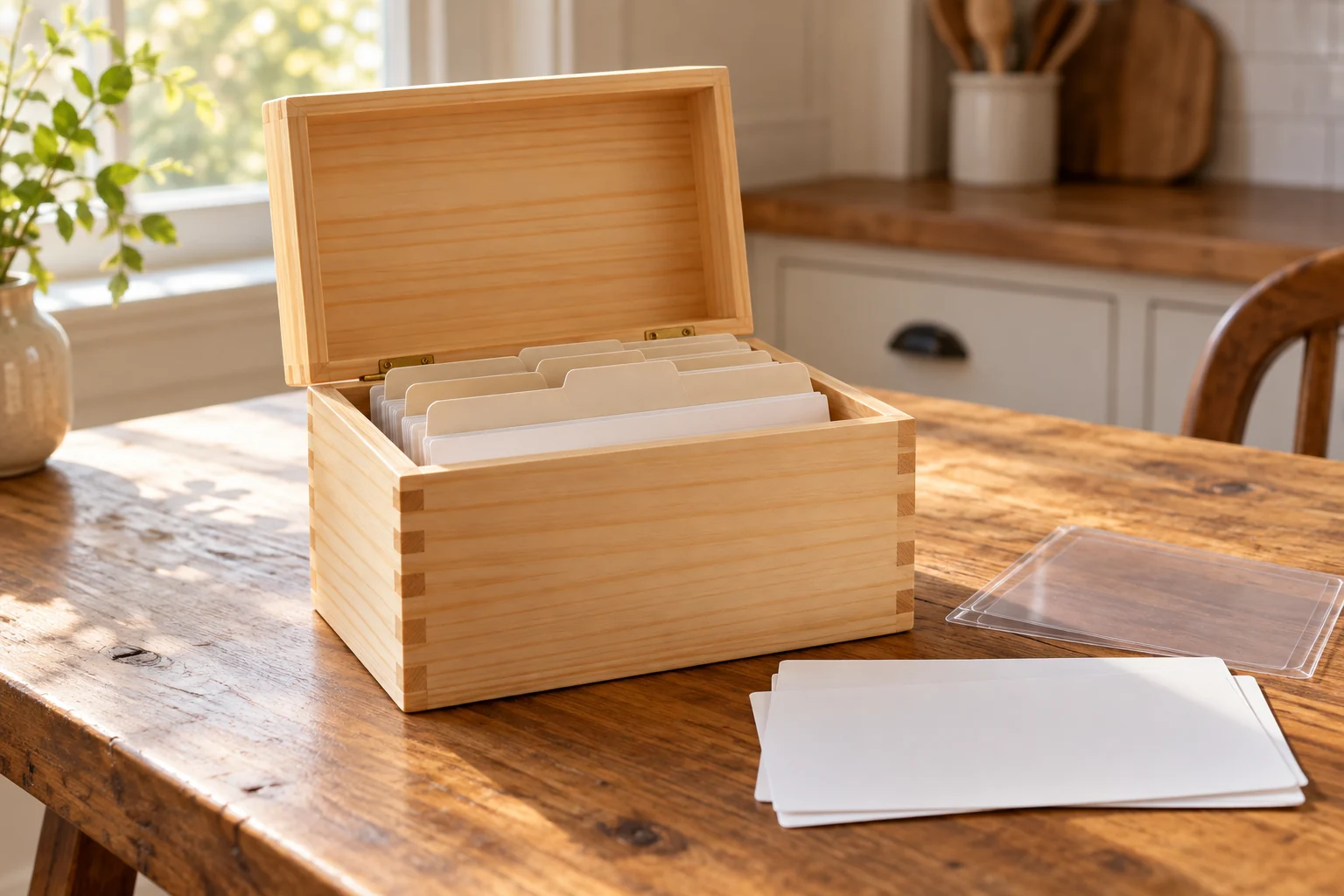
A recipe box divider system answers a simple question: where should a particular card go so that someone can find it again? Dividers create routes into a collection; cards hold the recipe; sleeves can protect individual cards. Those jobs overlap in everyday use, but they are not interchangeable. A thick stack of neatly protected cards can still be hard to search, while a beautifully labelled divider set does little for a card that gets splashed beside the stove. Start with the retrieval problem and then decide how much protection the working cards need.
The SJJ pine recipe box lists 16 paper dividers, 100 blank 4-by-6-inch cards and a removable internal divider.
The Myst Design recipe box lists 12 tabbed dividers, 50 4-by-6-inch cards and 50 clear sleeves in a galvanized-iron box with a wooden lid.
These are descriptions of the listed contents, not a promise that either kit has a particular working-card capacity or that every sleeve, tab and card will suit every cooking routine.
Understand the three layers of a recipe box
Think of the box as a small filing system. Its container gives the cards a place to live. A divider tells the reader which section to search first. A card carries one usable recipe version. If a sleeve is present, it is a cover around a card, not another index. This distinction helps when a collection becomes untidy. A cook who cannot recall whether a dish was filed under “supper” or “vegetables” has an indexing problem. A cook whose most-used card becomes stained has a handling or protection problem. Buying more dividers will not solve the second problem, and adding sleeves alone will not solve the first.
Both listings describe cards of a nominal 4-by-6-inch size. The SJJ listing supplies overall box dimensions of 13.5 by 6 by 5.5 inches.
Myst Design lists overall dimensions of 7.08 by 6 by 5.9 inches.
An overall dimension is not a measured interior fit. Once sleeves, tabs and handwriting are added, clearance changes. If an existing collection contains folded pages, unusually tall tabs or thick laminated cards, check the actual interior and sample cards before assuming that the printed card size settles the matter.
Choose divider names from the way you look things up
The common temptation is to use every supplied divider immediately. The available tabs are possibilities, not a required number of populated sections. Begin with a few labels that match a real search question. Someone planning weekday meals may look for “quick dinners,” “make ahead” and “side dishes.” Someone collecting family recipes might search by contributor or occasion. Neither scheme is inherently better. The useful scheme is the one that lets its users predict where a new card belongs and where an old one will be found.
Avoid making labels that compete for the same recipe without a tie-breaker. A lemon cake might fit “desserts,” “holidays” and “family.” If the box has one physical card, give it one primary home and put cross-references elsewhere if they genuinely help. For example, keep the full card behind “desserts” and write a short locator under “holidays” that points to it. That is clearer than moving the only card between sections whenever the occasion changes. It also prevents someone else from concluding that the card disappeared.
A small trial is more informative than a perfect-looking blank index. File ten cards, ask another household member to find three of them, and note where the search stalls. If the label “mains” has to be explained every time, use the household's ordinary term instead. If one section becomes crowded, split it only after a repeated search need appears. The number of supplied tabs does not require a complex hierarchy. Empty dividers can remain unused until the collection actually needs them.
Separate a recipe version from a recipe name
A card titled “apple pie” does not necessarily identify which apple pie a cook expects. It may be a first draft, a relative's variation or the version that worked in a different pan. Put a short distinguishing cue on the card itself: contributor, year, occasion or an explicitly recorded change. For a recipe copied from another source, record that source and what was changed rather than presenting the copy as an original family instruction. This makes the card more useful than relying on the divider label to carry version history.
The existing holiday recipe box guide deals with finding the version a cook actually wants. The lesson for an everyday box is narrow: a section name locates a group, while a card's own annotation identifies the method inside that group. If two versions of a dish matter, keep both clearly named instead of silently replacing one. If only one version remains useful, record why the other was retired before removing it from the working set.
Decide which cards need sleeves
The Myst Design listing includes 50 clear sleeves alongside 50 cards. That matching count describes included pieces, not a measured maximum number of recipes in the box.
Sleeves can make sense for cards frequently handled near mixing bowls, damp hands or a crowded counter. They may be less useful for archival cards that are rarely taken out. A protective sleeve can also make a stack thicker and may cover an edge where someone has written a useful note. Test one completed card in a sleeve and in the intended section before sleeving an entire collection.
A sleeve should not be treated as a license to leave the box in a wet or hot place. Do not assume an ordinary card sleeve is waterproof, heat resistant or suited to contact with food. Keep the box away from a direct spill, flame or burner. If a card becomes wet, remove it from its sleeve and let the materials dry appropriately rather than sealing damp paper back inside. A plain working copy can be easier to replace than a treasured original.
SJJ’s listing does not describe included clear sleeves. It does list double-sided blank cards and a unit-conversion card.
A general kitchen-measure reference is an aid, not a substitute for checking the measures and method of an individual recipe. A user who wants protected working cards can evaluate sleeves separately, but should verify fit with the actual cards and box. Do not assume that accessories sold with one box fit another box.
Use the box layout as a working constraint
SJJ describes a removable internal divider and says its top can hold two frequently used 4-by-6-inch recipes for reference.
Those are useful layout ideas, subject to the listing’s actual construction and the cook’s safe workspace. Removing an internal divider may open space for larger notes or a small book, but it also changes how the card sections sit. Judge the trade-off with a representative stack: insert the cards and tabs, open the lid and remove a card without disturbing the remaining order. Do not infer that every oversized notebook will fit from the external dimensions.
Myst Design describes a wooden lid with a slot for a recipe card and another for a smartphone.
A slot can put a working reference in sight without making the stored collection into a countertop pile. It does not establish device fit, viewing angle or protection from heat and spills. If using a phone while cooking, keep it in a suitable location and follow the device maker’s own precautions. A printed card can be a convenient alternative when a screen is awkward to read with messy hands.
Build a retrieval test before adding more sections
Imagine a box with 40 cards and labels for breakfast, weekday dinner, baking and celebrations. A new soup card could fit weekday dinner or celebrations. The owner decides that the primary home is the meal type, so the full card goes behind weekday dinner. A small locator behind celebrations points to that section if the soup is also a holiday staple. This is an illustrative filing rule, not a feature supplied by either product. It answers the practical question of where the only working copy lives.
Now ask a second person to retrieve that soup without coaching. If they start behind celebrations, the locator helps. If they look behind baking, a new tab probably will not help; the labels or title cue need clarification. If they find the card but cannot tell whether it is the current version, improve the card's annotation. Three different observations lead to three different fixes: cross-reference, clearer category name or clearer recipe identity. This short test is more useful than assuming that a larger divider count creates a better archive.
Keep the test modest. A card box is a household tool, not a formal database. One readable title, a stable home and a brief source or version note often do enough. Reserve elaborate codes for a collection whose users already understand them. If the box is shared, write the filing rule on a plain index card. A future cook should not have to reconstruct the original owner's private logic before making dinner.
Keep collection and exchange roles distinct
A recipe received at a gathering often carries more than instructions: a contributor name, an uncertain ingredient amount or a story about when it is served. The holiday recipe card exchange guide discusses collecting usable methods and memories with permission. For a working box, copy only what the contributor has agreed to share, retain uncertainty where a method has not been tested and distinguish the original card from a later household adaptation. Filing a shared card behind a divider does not by itself resolve permission or factual gaps.
A gift box is different from a box already used by the recipient. The future user's categories remain unknown. If preparing cards as a gift, a handful of broad temporary dividers and an explanation of the filing idea leave the recipient room to change it. Avoid filling every tab with a guessed scheme. The most considerate collection is one that can be reorganized without losing the provenance of individual recipes.
Pick the kit that matches the first real task
The SJJ listing emphasizes a pine box, removable internal divider, 16 paper section dividers and 100 blank cards.
The Myst Design listing combines a galvanized-iron box, wooden lid, 12 tabbed dividers, 50 cards and 50 clear sleeves.
That is a comparison of stated included parts and layout, not a durability ranking. Decide whether the immediate task is to write many blank cards, protect a smaller set of working cards or accommodate an existing collection. Then inspect current availability, the actual item and relevant dimensions before purchasing.
The durable principle is simple: sections help someone predict a card's location, the card identifies a particular recipe version, and a sleeve may protect a card that needs frequent handling. Start with a few understandable labels, test retrieval with real cards and revise the index when a search fails. That approach works whether the box arrives with twelve dividers, sixteen dividers or a different arrangement altogether.