Writing & Documents
Prepare public meeting comments for the right submission route
Choose the right route for a named council meeting.
Start with the actual meeting
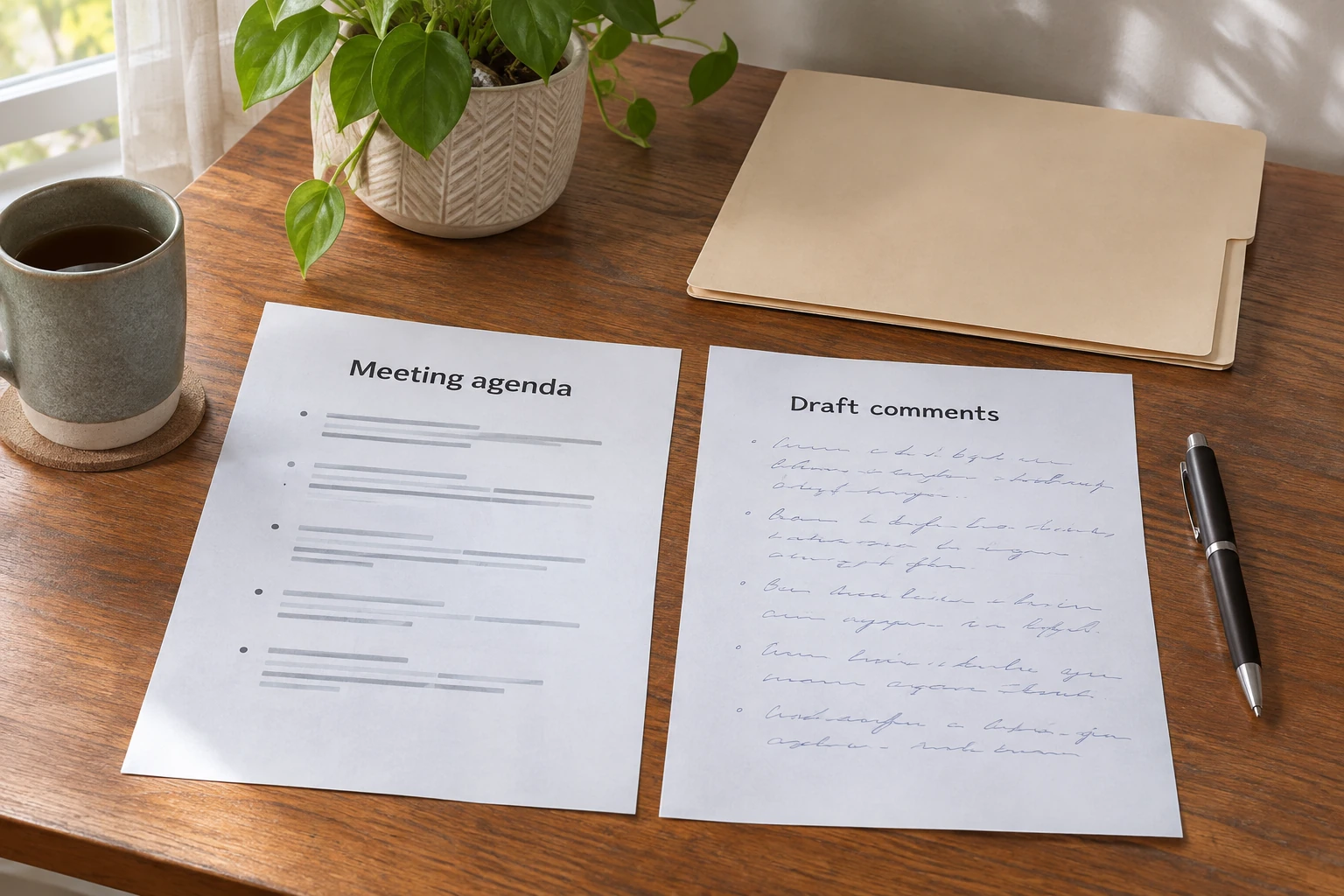
Prepare public meeting comments beside the agenda for the particular meeting you intend to address. Salt Lake City’s meeting resources distinguish work sessions, where the public listens, from formal meetings that may include a comment period. The page asks readers to check the agenda because some formal meetings have none. Its in-person instructions distinguish a card requesting a speaking turn from a card carrying comments without speaking. Use the relevant meeting and route in your notes. Record the meeting date alongside its stated type. A prepared page cannot establish that a comment period exists or that staff have received your material.
Denver’s general comment session concerns city-related topics that are not already scheduled for a specific public hearing. Its page directs readers to check the hearing list before signing up. Registration is required, and the thirty-minute session may not accommodate everyone who registers. In-person, Zoom and telephone participation are listed separately. Begin your preparation by deciding which published opportunity fits your topic, using Denver’s actual hearing information when that is your destination. Keep a place in your notes for the registration result. Keep the selected session name with its published meeting date. An available registration route does not promise that you will get a speaking turn.
Austin separates general communication about non-agenda matters from speaking on specific agenda items. The general route has its own advance registration period and a maximum of ten registered speakers. Agenda-item registration uses another schedule, with different arrangements for online registration and in-person kiosks. Special-called meetings may use a different window. Identify the route before copying a deadline into your calendar. Austin also gives a separate deadline for documents speakers want supplied to Council. Treat the comment registration and the delivery of those documents as separate preparations, following the current meeting’s instructions for each. Save the route’s stated window beside the intended meeting date.
Choose a submission channel
Portland’s item-specific form offers registration for verbal testimony or submission in writing. It says written material joins the public record if received before Council votes, unless the meeting or agenda specifies otherwise; it is not read aloud. The page gives different cutoffs for virtual and in-person testimony. It also contains unavailable-item messages and conditional form sections. Locate the actual agenda item rather than treating the general form as an open slot. Its contact information says email is for questions and does not accept written submissions. Keep the channel you intend to use attached to your draft.
Boston’s committee-hearing guidance asks an email or mailed letter to identify the committee and topic, with a docket number if available. It explains where to send material for the docket’s record. In-person and virtual participation have separate instructions, and some hearings are exclusively virtual. A prospective virtual speaker should contact the committee or hearing liaison named in the public notice for instructions. Use that notice to identify your destination. Address the committee shown on that particular hearing notice. Boston’s page also describes video submissions, whose treatment depends on timing. Choosing one of these routes does not automatically complete the requirements of another.
Philadelphia’s committee public-hearing instructions limit testimony to matters printed on that hearing’s agenda. Speakers sign up individually rather than for another person or group. The page generally directs prospective speakers to contact the committee chair’s office by three in the afternoon the day before the hearing, supplying a name, callback number and the relevant bill or resolution numbers. It gives the chair’s office as the destination for material sent in writing. Put those identifiers beside your draft so the office can recognize the matter. Use the actual committee’s instructions for any accommodation or service you need. Keep the callback number usable for that hearing.
Check the information and files
Cambridge’s form asks for the specific agenda item, such as a policy-order number, and explicitly distinguishes that from an index number. It also warns that information entered will be displayed while the person speaks. The captured form showed no meetings open for registration. The form does not currently offer a signup. Check again when the relevant registration period opens. Before entering information, read the form’s current instructions and decide what belongs in the requested fields. Keep an unresolved item number as a question for the council office rather than supplying a number that merely looks plausible.
New York City Council’s non-Land Use hearing page distinguishes remote participation, in-person attendance and written testimony. It warns that personal information supplied becomes publicly available and remains in the record. Its prose lists commonly available file formats, while the visible upload control specifically lists DOC, DOCX and PDF with a ten-megabyte limit. Keep that narrower control in view when preparing an upload, and ask the hearing contact about any unresolved format issue. The page gives a separate route for Land Use hearings. Confirm that you are using the instructions for the body actually hearing your item.
Match the deadline and participation method
San Diego separates the webform deadline for distributing comments to Council from the later cutoff for adding them to the written record. The form limits comment text to five hundred words and permits attachments. In-person speakers use a slip for the relevant item, while virtual participants use the meeting’s queue. These are different actions. Record which one you intend to complete and what its current instructions require. A webform submission cannot by itself show that an in-person slip was accepted or that a virtual hand joined the queue. Retain the result supplied by the channel you actually used.
Seattle provides an email route for comments and separate arrangements for oral participation. Remote speaker registration opens one hour before applicable meetings. The page asks people to register with the telephone number they will call from and describes an email carrying joining details. In-person speakers use the sheet inside Council Chambers. Read the route you selected before treating a sent email as a speaking registration. If you plan to call, preserve the joining information associated with that registration. The published instructions also ask speakers to mute other devices playing the meeting to avoid audio feedback.
Phoenix’s meeting page distinguishes formal, policy and special meetings. It explains how published agenda items and a citizen-comment period fit different parts of the proceedings. Its sections describe different speaking allowances, including three-minute citizen comments and approximately two-minute guidance elsewhere. Do not turn those passages into a single promised allowance for your appearance. Check the actual agenda and ask the Clerk about a remaining timing question. Keep the meeting type and item in your notes when doing so. This preparation concerns participation instructions; it supplies no legal interpretation or assurance that Council will act on a comment.
Leave any stationery purchase optional
You can keep a personal paper copy while deciding how to submit your comment. The optional single-unit electric-stapler listing concerns a separate retail enquiry. Its photograph shows Swingline and Optima 50 markings, while its catalog metadata names Haoleiruishangmao and model 1. That maker relationship remains unresolved. The title mentions supplied staples and a remover, which the single device photograph does not verify. No capacity, speed or jam-free behavior was tested. This account establishes no council requirement to bind papers or reason to purchase this device for an individual submission.
The optional double-head stapler listing depicts two heads, an angled paper bed, bench clamps and a pedal. Its catalog names Dag and model ST-100G, while the photographed heads show ST100G. The picture does not authenticate the maker or establish what will be delivered. No electrical specification, operating procedure, binding result or suitability for your papers is established here. Keep any enquiry about that equipment separate from the clerk’s submission instructions. Personal paper organization supplies no evidence that an office accepts bound material, and neither linked device is needed to prepare this draft.
Keep neighboring venue tasks distinct
The community bulletin-board notice guide addresses temporary public postings at named libraries. It distinguishes staff approval from qualified self-posting, then follows each venue’s attachment, size and removal conditions. Those decisions concern displaying a notice in a particular space. A council comment uses the relevant meeting’s participation channel instead. If you are also preparing a flyer, keep its posting request as a separate task. A venue’s permission to display that sheet cannot establish that a council office received a comment or registered its author to speak.
The step-free event route enquiry guide concerns asking an organizer about an unclear connection between an entrance and an event room. Its fictional example keeps missing route information visible until the organizer answers. You may have an arrival question alongside your planned council participation. Follow the meeting’s actual accommodation or access contact for that question. A route answer and a speaking registration confirm different things. Preserve each response in its own context, and leave any unanswered connection as a question rather than filling it from the name of a building or room.
Review any retail payment separately
Preparing a comment does not require a new stationery order. If you independently decide to buy equipment on republeq.com, begin with the exact selected offer and the questions that remain about it. A product photograph cannot establish the complete delivered package, and a council’s instructions cannot answer a retail quantity question. Resolve the information you need for the purchase through the merchant’s published support route. If you prefer cryptocurrency, including USDT, check which methods are actually offered for that particular order. This article establishes no currently supported token, network or receiving destination for either linked listing. Read the responsible checkout’s instructions before authorizing a transfer. Confirm the requested asset, network, destination and amount against the payment screen you are using. A familiar asset name from a previous purchase does not supply the rest of those details. Review the stated shipping, cancellation, return and refund terms for the same order while deciding whether to proceed. Neither a machine’s advertised capacity nor a municipal comment deadline promises a payment or delivery outcome. Keep the order reference and any payment response actually supplied by the responsible system. If a payment attempt leaves its result uncertain, establish what happened through that order process before considering another transfer. Missing confirmation does not show that nothing occurred. Keep recovery words and private credentials out of correspondence about the order. This paragraph supplies no payment address, current fee estimate or assurance that a transfer can be recovered. Record an abandoned checkout as abandoned. Record a confirmed order only when the responsible service confirms it. Separately retain the council channel’s actual submission or registration response. An equipment purchase cannot confirm that a clerk received your comment, that a speaking turn is available or that a council accepted your position. You can finish preparing the meeting document while leaving the optional purchase undecided.
Keep the meeting and submission route beside your draft.