Crypto Commerce
Premium Levella PWC337KB wine cooler — PWC337KB or a shallow 15-inch wine cellar for bottles you check regularly
Compare Premium Levella PWC337KB wine cooler by alarm behavior, cabinet fit, controls, shelving, and upkeep.
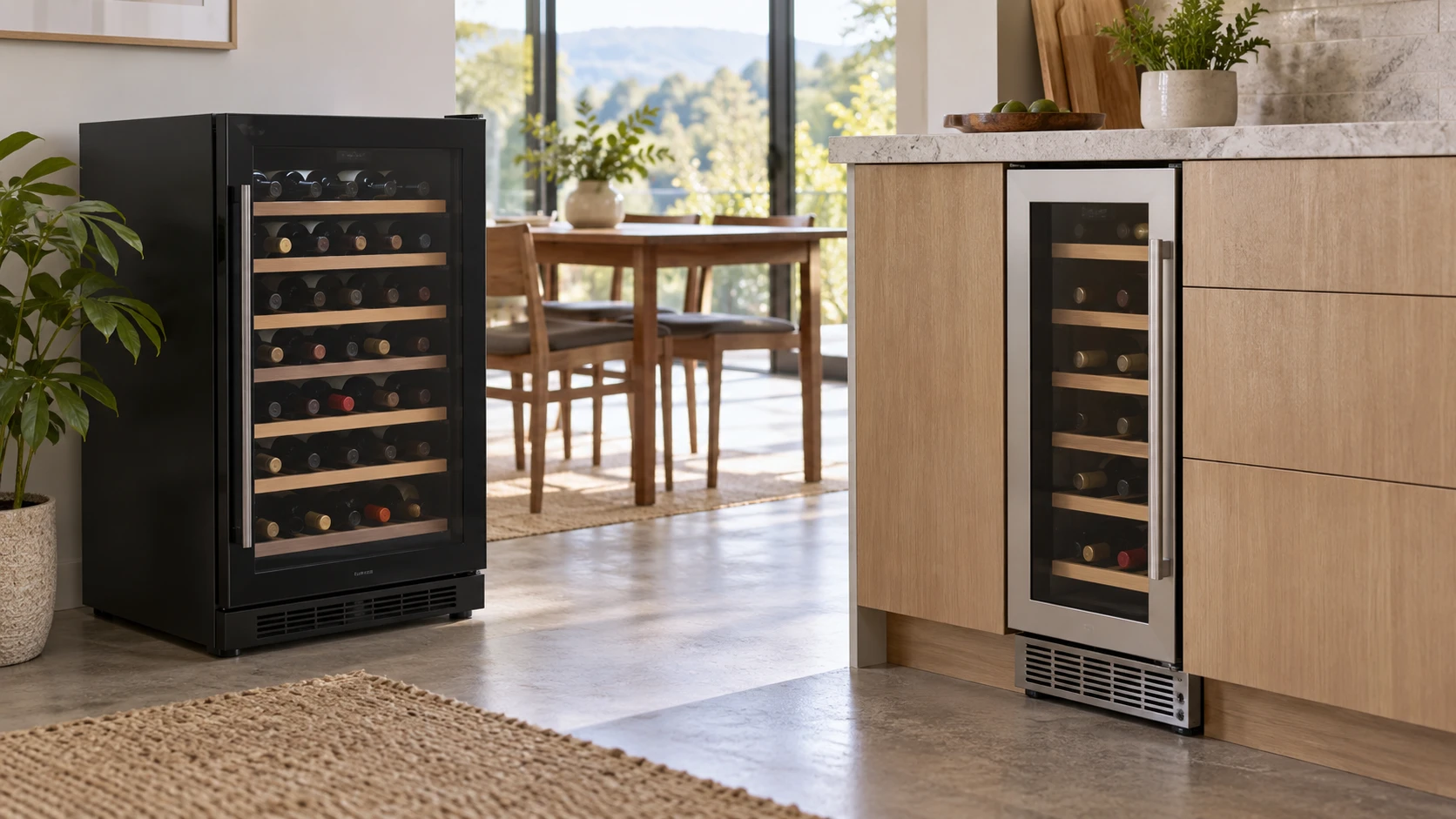
The Premium Levella PWC337KB wine cooler is a freestanding, single-zone cabinet listed for up to 33 bottles. Its saved listing names a high/low temperature alarm, but does not describe a separate open-door warning. The alternative here is a shallow, built-in-capable cellar whose listing explicitly names both an open-door alarm and a high-temperature alarm. Decide whether the cellar must fit a particular undercounter opening or can stand in a room with space around it.
A temperature alarm and a door alarm can catch different problems. A door left ajar may be noticed quickly if someone walks past the cooler, while a warm cabinet in a quiet room may go unnoticed without an audible warning. The published guide to wine refrigerator alarm checks offers a useful checklist for testing an alert rather than simply counting it as a feature on a product page. Read the alarm behavior and placement instructions for the exact unit before deciding which warning will actually be heard in its intended room.
The 15-inch ADA-height wine cellar is listed as under 18 inches deep and 32 inches high in its base configuration. Its adjustable legs and slide-out kickplate can raise the height as far as 34 inches. Those dimensions point to a different job from the freestanding PWC337KB: fitting a shallow wet bar, island, or lower counter. The saved row does not give a bottle count for this cellar, so its narrow footprint should not be treated as a known storage capacity.
Know what each alarm reports — wine refrigerator alarm checks
Premium Levella lists a high/low temperature alarm. That is a helpful distinction from a cooler with no listed alert, though the saved row does not state the temperature threshold, how long the condition must last, whether the warning is audible, or whether it continues after the door closes. It also does not promise a separate door-open alarm. If a partly closed door is a frequent concern, ask for the manual's exact description and a demonstration of that behavior. Do not assume that a high/low temperature warning reacts quickly enough to substitute for a door alarm.
The shallow cellar's saved description is more specific. Its open-door alarm sounds when the door has remained open for more than 60 seconds. An audible high-temperature alarm sounds if the interior rises out of the set range. Those statements still leave questions worth checking: where the sound comes from, whether it can be heard through a closed room door, how it is reset, and what happens if power fails. The listing says the unit restores its last settings after power returns, but does not say the alarm sends a phone notification or retains a history of events.
The cellar also has a Sabbath mode setting that can disable lighting and alarms for up to 48 hours. That may be useful for the intended observance, yet anyone relying on alarms for day-to-day checks should know when the mode is active. Ask how the control shows that status and how the mode ends. The PWC337KB row does not mention a corresponding setting. Avoid using absence from the saved excerpt as proof that one does not exist; use the current model manual for a final feature check.
Alarm usefulness depends on the room. A cabinet in a busy kitchen may be noticed immediately, while one tucked under a wet bar across the house may only be checked when guests arrive. Decide who will hear an alarm, how soon someone can respond, and whether the door can be seen from normal traffic. For valuable bottles, set up a separate temperature check with a thermometer suitable for the cabinet and compare its reading after the cooler stabilizes. The product descriptions do not provide independent alarm-response tests.
Settle the installation before counting bottles — 15-inch ADA-height wine cellar
PWC337KB is explicitly freestanding. The saved description calls it a 17-inch unit with adjustable leveling legs, but does not give the complete width, depth, height, or required ventilation clearance. Measure the intended floor space, the doorway used for delivery, and the clearances in its current installation instructions. A free-standing appliance should not be pushed into an enclosed cabinet on the assumption that a nearby built-in wine cellar looks similar. Its airflow needs must be checked from the manufacturer's directions.
The 15-inch cellar is described as front breathing and built-in capable, with a shallow 17.75-inch depth. Its right-angle plug and sealed back are listed as space-saving design details, while its integrated hinge avoids added height at the top during installation. Those features help when a bar cabinet has little depth. They do not remove the need to confirm the actual cutout, electrical outlet position, door swing, and service access on a dimensioned installation sheet. The listing also says it can be used freestanding because the cabinet is finished in black.
The cellar's 32-inch base height is described as suitable for lower ADA-compliant counters, and leveling legs plus a slide-out kickplate can raise it to 34 inches. ADA language in a product listing does not establish that every installed kitchen or commercial bar is accessible. Check the finished counter, reach to controls, door clearance, and local requirements for the actual site. A projecting handle or nearby wall may decide whether a user can open the door fully even when the appliance fits the cutout.
Both door and leg adjustments matter more after the cabinet is loaded. The shallow cellar has a user-reversible door, which may help avoid an adjacent wall or sink. Its key lock is factory installed. Check where the key goes when the door is reversed and who will keep the spare; a lock can be useful in a shared space but can also slow a routine temperature check. The PWC337KB row gives adjustable leveling legs but does not specify a reversible door or lock. Ask for those details if either is needed.
Compare usable shelf space, not a headline count — 15-inch ADA-height wine cellar
Premium Levella gives the clearer capacity figure: 3.1 cubic feet, five wire shelves, top and bottom storage areas, and room for up to 33 bottles. It is a single temperature zone with a listed range of 41 to 64 degrees Fahrenheit. A 33-bottle figure is a planning maximum from the listing, not a promise that every mix of sparkling, Burgundy, and tall bottles will fit with every shelf installed. Bring dimensions of the bottle shapes you regularly buy, then test the intended loading pattern against the shelf spacing.
The shallow cellar's saved row says it has removable black steel shelves with stainless trim, but it supplies no bottle capacity, shelf count, or temperature range. Ask for the current loading diagram and internal dimensions before using it for a collection with a fixed number of bottles. The narrow, shallow cabinet could be the right physical fit under a counter while storing fewer of the bottles you own. Conversely, a smaller collection may not need the PWC337KB's listed maximum at all. Bottle shape and access to the back row are as relevant as a count.
Both are single-zone choices. If the household wants one temperature for a mixed collection, decide which bottles will be stored for longer periods and which will be chilled for immediate serving. The PWC337KB's 41-to-64-degree range is stated; the other listing omits its numeric range. Confirm the settable range and how the display reports it on the shallow unit. Do not assume that a wide control range produces identical temperatures on every shelf. A thermometer check at more than one position can show whether the loaded cabinet behaves as expected in its actual room.
The shallow cellar's glass door gives a view of the contents and is described as double-pane tempered glass. PWC337KB lists white LED lighting and exterior electronic touch controls, while the undercounter unit lists interior LED lighting. If the cellar sits in a bright room, consider how often sunlight reaches the door and follow the maker's placement advice. Neither saved row provides a measured UV-transmission figure for comparing protection. A photograph of illuminated bottles is not a temperature or light-protection test.
Plan cleaning and recovery after a disruption — 15-inch ADA-height wine cellar
Premium Levella lists compressor and direct cooling with automatic defrost. The shallow cellar describes fan-forced cooling and frost-free operation. Those are design differences, though the source rows do not provide comparable pull-down times or temperature uniformity tests. The undercounter listing says fan-forced cooling helps it recover temperature quickly and cools from top to bottom; treat that as a claim in Republeq's catalog to test in the planned setting. Neither listing removes the need to clean shelves, check door seals, and leave the required ventilation path clear.
PWC337KB's exterior controls may let a user inspect and change the set point without opening the door. The shallow cellar's listing says it remembers the last temperature setting after power returns. For either cabinet, a power interruption calls for checking the actual interior temperature once power is restored. Setting memory tells you what the control will request; it does not tell you how warm the bottles became while the power was off. Note when the outage began if possible and decide whether the wine needs closer inspection.
The undercounter cellar's stainless steel interior and sealed back may make ordinary wipe-downs easier to plan, but its removable shelves, kickplate, lock, and front-breathing route still need access. The PWC337KB has five wire shelves and auto defrost, so ask how the shelves come out and where any condensate or defrost water is handled. Use the exact manual's cleaning directions and avoid blocking a vent with a mat, stored box, or baseboard trim. A neat installation that impedes cooling can defeat the purpose of a temperature alarm.
The PWC337KB listing names a one-year parts-and-labor warranty. The shallow cellar's saved row does not provide warranty terms. Compare current written coverage for the two exact listings, including who performs service locally and what access a technician needs. A cooler buried under a fitted counter may require more planning to remove for repair than a freestanding one, even when its front ventilation makes normal operation possible in the cabinet.
Choose for the room and the response routine — 15-inch ADA-height wine cellar
PWC337KB makes sense when there is a suitable freestanding location, a need for its stated 33-bottle capacity, and someone can check a high/low temperature warning. Verify the missing door-alarm behavior and complete dimensions before ordering. The 15-inch ADA-height cellar makes sense when shallow built-in fit, a 60-second door warning, and an audible high-temperature warning solve the actual room's problems. Its bottle count and exact settable temperature range still need confirmation.
Whichever cabinet fits, test the alarm in the intended location after installation and record the normal temperature with bottles inside. That small check establishes whether the warning can be heard, whether the door closes cleanly, and whether the shelves hold the bottles the owner plans to keep there.