Portable & Backup Power
Power station package contents and expansion batteries
Check Bluetti Apex 300 and B300K separate delivery, combined-package energy, included cables and VEVOR port labels before treating the kit as complete.
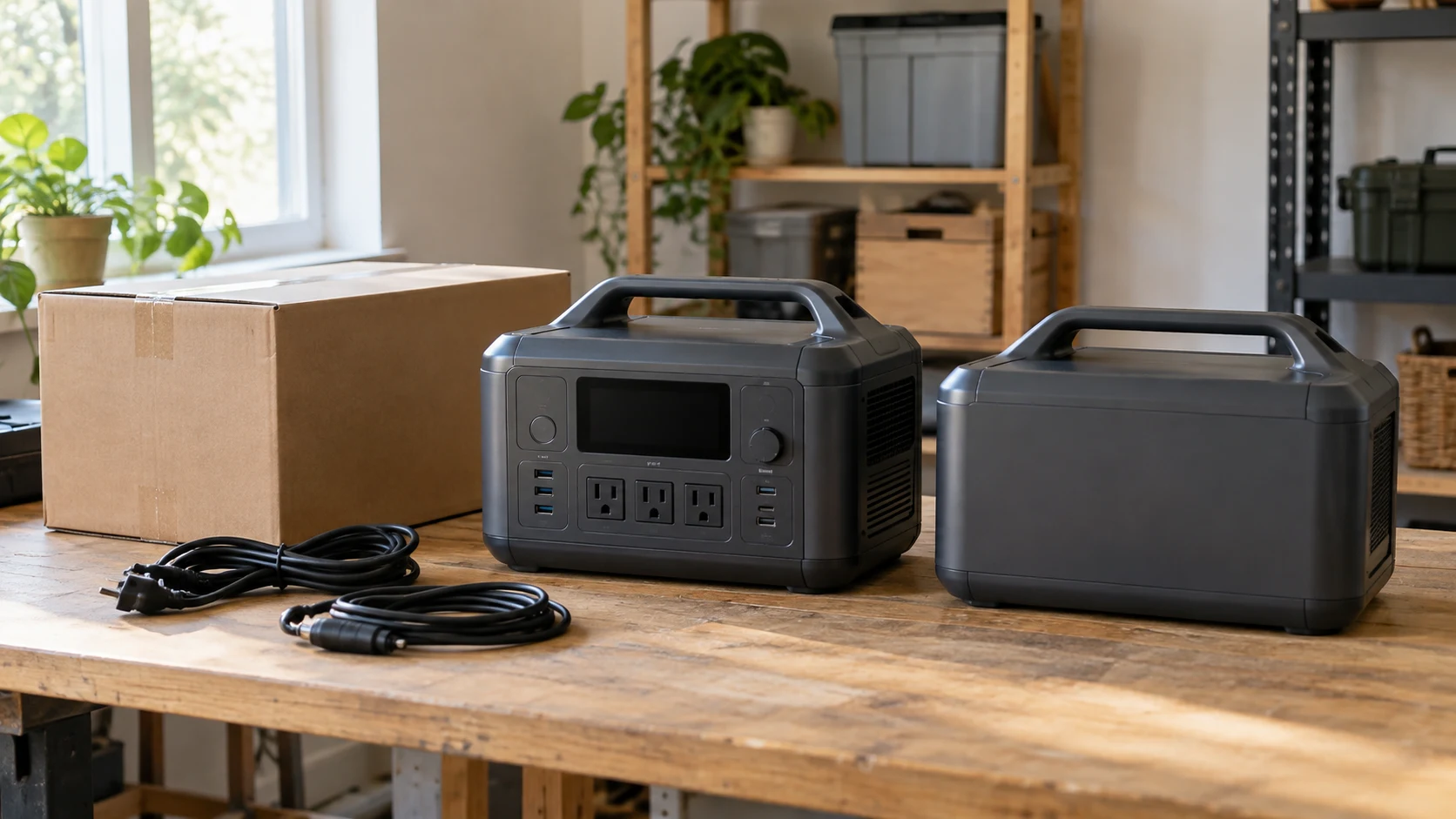
The power station package contents for this refurbished Bluetti Apex 300 offer include a B300K expansion battery that ships separately. Its stated 5,529.6 Wh of combined usable energy belongs to the described combined package. A reader receiving the main station needs to keep the separately shipped component on the order record before treating the package as complete.
The VEVOR-labelled 296 Wh offer raises a different inventory question. It lists nine output ports, but uses DC charging-port wording within that list. It also advertises solar charging while explicitly excluding a solar panel. These are concrete reasons to separate included equipment, incoming charging paths and outgoing device connections. An impressive energy figure or port count cannot answer all three questions.
The named expansion battery is part of the Apex package
The refurbished Bluetti Apex 300 and B300K package names both the main station and the expansion battery. That is more specific than an unspecified future expansion option. The contents list also names an AC charging cable, a car charging cable, a grounding screw and a user manual. It gives the buyer an actual set of items to reconcile with the selected offer.
Keep the B300K model identity with that inventory. The offer identifies this particular expansion component as included; it does not establish compatibility with every Bluetti battery or a different power station. It also does not enumerate a complete interconnection procedure. The named pairing is useful purchase information, while the instructions needed to use the actual supplied system remain a separate requirement.
If the expansion component is central to the purchase, retain the exact package description and order identity together. Someone selecting this offer for the combined system has a different delivery checklist from someone ordering only a main station. The advertised combined-energy figure makes the distinction consequential. A main unit's arrival alone is not confirmation that every listed package item has arrived.
Expansion battery delivery needs its own record
The listing says the B300K ships separately. For expansion battery delivery, record that stated arrangement alongside the included-item list. Separate shipment does not specify which item arrives first, how many tracking notices will be issued or a promised delivery date. Those details belong to the actual order. Keep any delivery notice tied to the component it identifies so that one notice does not silently stand for the whole package.
When a parcel arrives, compare its described contents with the ordered item record. Leave the B300K entry open until the actual battery delivery is accounted for. If a notice or parcel description is unclear, identify the exact package and component in the inquiry. This is an order-reconciliation task, not permission to start an undocumented operating arrangement while another part is still outstanding.
The separate-shipment statement also matters when reporting a missing item. A buyer should distinguish an explicitly separate delivery from an item omitted from a parcel expected to contain it. The listing cannot settle the status of an individual shipment, so preserve the actual notices and received contents. That evidence is more useful than assuming a delay, loss or packing error from the first arrival alone.
Keep combined energy attached to the complete system
Bluetti describes 5,529.6 Wh as combined usable energy for the Apex 300 with B300K. The wording identifies the described system behind the figure. It does not provide a measured result for the individual refurbished units delivered to a buyer or state that the main station alone has that amount. Keep the combined-package claim intact rather than moving the number onto whichever component is already on the table.
A reader considering the expansion package should establish the actual component identities and applicable system documentation before relying on that configuration. The contents list gives a starting point for that check. It does not identify every connection item or operating condition behind the combined-energy statement. This article supplies no instruction for attaching the battery and no test of the energy available from the delivered combination.
That boundary keeps power station package contents useful as a purchase decision. You can determine whether the described expansion battery is included and whether its separate delivery is accounted for. You still need the actual operating information and condition evidence for the received equipment. The order record establishes what was promised and received; it cannot turn a nominal package description into an observed runtime.
An included battery differs from an expansion option
The actual restored Jackery 1000 v2 and Bluetti AC180 guide discusses a different Bluetti offer that mentions compatible expansion batteries without naming the expansion model, connection kit or maximum combined capacity. It treats those as unresolved parts of a future purchase plan. Here, the Apex package explicitly names the included B300K and its separate shipment.
That distinction changes what the buyer needs to record. An optional expansion route requires identifying and pricing the additional compatible parts. An explicitly included component requires confirming the ordered identity and accounting for its delivery. Neither situation grants operating instructions from the other model. The AC180's cables, charging limits and accessory compatibility belong to that actual AC180 offer.
Keep an expansion feature, an included expansion item and an observed complete delivery as separate facts. The current source establishes the named inclusion and shipping arrangement. It does not establish the status of a particular order. This avoids two shopping mistakes: budgeting for an item already stated as included, or assuming an unspecified expansion option supplies the battery automatically.
Read the supplied cables as identified items
The Apex contents list identifies AC and car charging cables. Those names are useful because they establish that the offer includes charging items with stated roles. They do not provide a full connector specification, complete charging-source requirements or permission to substitute a similar-looking cable. Keep the actual supplied parts with the applicable documentation for the selected system.
The grounding screw is also an inventory item. Its inclusion does not explain when or how it should be used, and this guide provides no grounding or wiring procedure. The same applies to the listed user manual: confirm that the supplied documentation identifies the actual equipment received. A contents list can help expose a missing part or document without replacing the instructions that govern its use.
If your planned charging arrangement depends on a particular connection, identify the necessary component and specification before assigning value to the included cable. The package's cable names cannot prove that every possible source is supported. Keep that question tied to the actual Apex system and source you intend to use, while keeping the B300K delivery inquiry focused on its own included-item record.
Keep the offer identity with each delivery record
The Apex listing identifies the selected Gray offer with SKU sku-18295466312 and UPC 193022005211. Retain those identifiers with the product link and the full package description. The same description names the B300K as an included separately shipped item, but provides no separate B300K barcode or serial number. An offer identifier helps locate the order; it does not identify every physical component within the advertised system. Keep the received component's own identity with its delivery record.
When an order answer names only the Apex 300, compare it with the original package wording. Does the answer address the main station, the included B300K or the whole package? State which part has arrived and which listed item remains unaccounted for. Include any notice that identifies the separate shipment. This gives the supplier a specific fulfillment question and avoids treating a general response about the station family as confirmation that the expansion component has been delivered.
Clarify package-specific support and return arrangements when one component arrives separately. The listing does not establish a return deadline, a warranty duration or how a missing expansion item is handled for an individual order. Keep the question attached to the Apex-plus-B300K purchase and the actual delivery information. A response about a standalone station may leave the included battery unresolved. Obtain the applicable terms for that combined order without assuming that separate parcels share a particular service process or deadline.
The VEVOR offer names a different inventory
The VEVOR-labelled portable power station offer describes a 296 Wh lithium-ion battery and a nine-port output inventory. The offer's brand field says NOBRAND; VEVOR appears in the retail title. Keep both details with the exact offer instead of treating the title as a separate manufacturer verification. The description names Type-C PD100W and PD27W, two QC3.0 ports described as 24 W, AC output and a cigarette-lighter connection, alongside DC charging-port wording.
Those stated roles help a buyer organize device and charging questions, but the mixed labels leave part of the port map unresolved. The source lists a DC Charging Port 12V to 24V and another DC Charging Port among the nine output entries. Preserve the wording when seeking the actual diagram. Do not convert those labels into extra device outputs merely to make the count agree with a preferred interpretation.
A buyer who needs a particular DC connection should make that role explicit in the inquiry: does the relevant connection accept charging power, deliver power to a device, or support another documented arrangement? The listing alone does not answer that for every named entry. A nine-port headline identifies an advertised inventory count; it does not establish nine interchangeable connections.
Power station charging port labels need direction
For power station charging port labels, distinguish the station receiving energy from a device receiving energy. The VEVOR description names charging methods and device-port ratings in the same account. A rating attached to one role should not be silently assigned to the other. Obtain the actual port map and applicable instructions before counting an ambiguous DC charging label as part of the device arrangement you intend to use.
The two AC outputs are described as 300 W Max. The text does not provide a complete simultaneous-output table explaining how the limit applies across those sockets and the other connections. Likewise, the individual USB labels do not supply every voltage profile or a pooled maximum for all ports used together. Keep the requirements of your actual devices with those unresolved specification questions.
The description also says the station automatically shuts down when the load is less than 2 W. That is a specific behavior claim to investigate when an intended device has a low draw. It does not establish the timing, affected connection or a supported way to alter the behavior. Ask about that behavior for the actual port and device combination before treating an output label as continuous availability.
Solar charging does not mean a panel is included
The VEVOR description explicitly says the solar panel is not included. That gives a clear answer about one package item, even though solar charging is advertised. A buyer planning to use that input needs to account for a separate compatible panel and any required connection equipment. The listing does not identify every compatible panel or cable, so the charging-method name cannot complete the accessory list.
The actual restored Jackery Explorer 300 and Bluetti AC50B guide distinguishes charging paths from named cables and panels in two other offers. It shows why a solar-input claim and a contents list deserve separate attention. Its particular panels, cable kits and input limits remain with those earlier models. They cannot supply a missing VEVOR accessory specification.
The Apex description lists solar input up to 2,400 W through dual MPPT, while its package list names no solar panel. Keep that advertised input capability separate from confirmed panel contents and compatibility. The current source does not establish a complete ready-to-use solar kit. The VEVOR panel exclusion is explicit; the Apex buyer needs a package-specific answer about any panel arrangement beyond its listed items.
Keep headline performance claims in the background
Bluetti lists 3,840 W of continuous AC power, a 7,680 W surge and six AC outlets. It also describes simultaneous 120 V and 240 V output. These are source claims without a complete port-level compatibility record here. They do not provide permission to install building connections or establish compatibility with a particular appliance. The package-readiness task remains identifying the actual supplied system and its documentation.
The offer's 80-percent charge in 45 minutes through 1,500 W AC input and the VEVOR charging-time statements concern different advertised arrangements. They provide no shared test from which to rank charging speed. Similarly, Bluetti's cycle, lifespan and extreme-condition testing statements provide no report on the battery health of the specific refurbished package delivered. The earlier restored-station guides develop those condition questions; they should not displace this article's complete-package decision.
Make the order record reflect the intended package
The Apex package is worth investigating when the explicitly included B300K is part of the equipment you intend to receive. Keep its exact identity, separate-shipment arrangement and the combined-system energy wording together. Reconcile the main station, battery and listed charging items against the actual order. Establish any operating or compatibility detail through documentation that belongs to those supplied components.
The VEVOR-labelled offer is worth investigating when its documented individual ports and charging methods appear relevant to your devices, provided the unresolved DC roles and necessary separate solar equipment are clarified. Keep the actual port map beside the package contents answer. For either offer, record what is included and what has arrived, with unresolved connections kept as model-specific questions.
Conceptual editorial cover for power station package contents: generic switched-off battery units, a plain carton and loose cables, without depicting exact retail models, supplied inventory, capacities or shipment timing.