Crypto Commerce
restored Jackery Explorer 300 power station vs BLUETTI AC50B: lighter carry or larger reserve?
Compare restored Jackery Explorer 300 power station by load, ports, charging, carried weight, and battery-condition questions.
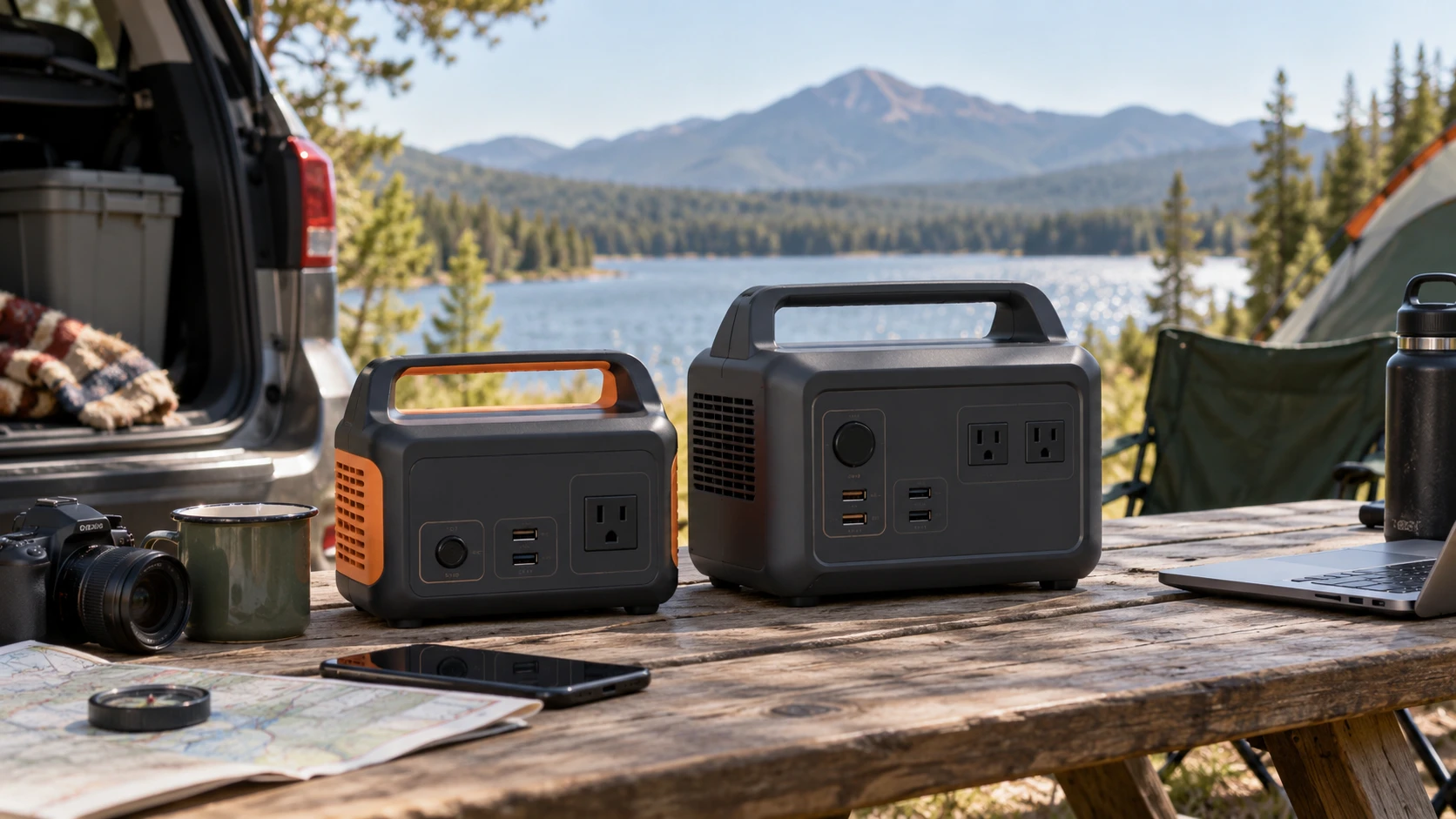
A small portable power station can run a few devices away from an outlet, but its watt-hour label does not tell you exactly how long any one device will last. The restored Jackery Explorer 300 lists a 293 Wh battery, 300 W AC output, and a 7.1-pound weight. The refurbished BLUETTI AC50B lists 448 Wh, two AC outlets described as 700 W, and a 14.8-pound weight. Their different capacities and carrying weights point to different trips. Both are refurbished offers, so verify the battery condition and the exact box contents before treating a catalog specification as the performance of the unit you will receive.
The September 30 catalog snapshot marked both products available. It gave minimum prices of $260 for Jackery and $366 for BLUETTI, a historical difference of $106. Both exact product pages and a related guide returned HTTP 200 on October 3. Those link checks do not establish today's price, refurbishment grade, warranty, or remaining battery capacity. The product descriptions make claims in Republeq's catalog about output and recharge speed; no common test in the saved source compares the two stations under the same loads.
Separate battery energy from appliance power — battery-capacity units without predicting runtime
The restored Jackery Explorer 300 power station is described with a 293 Wh lithium-ion battery and two pure-sine-wave AC outlets delivering a stated 300 W output. BLUETTI lists a 448 Wh lithium iron phosphate, or LFP, battery and two AC outlets described as 700 W. Watt-hours indicate stored energy; watts describe the power a connected device demands at a moment. A larger watt-hour figure may extend a particular job, while a higher permitted output may allow a device that the other station cannot run. Neither number alone answers both questions.
The published guide on battery-capacity units without predicting runtime is a useful way to set up the calculation. List each device's measured or labeled watts, estimate hours of use, and account for conversion losses and reserve capacity. The guide does not certify either power station's runtime. For a simple hypothetical 50 W load, dividing 293 Wh or 448 Wh by 50 W gives an ideal upper-bound calculation before losses and battery condition. A restored battery, an AC inverter, temperature, and fluctuating demand all reduce the usefulness of that neat quotient as a promise.
Check the peak and sustained requirements for the actual appliance. A lamp or laptop charger may have a fairly stable draw; a pump or refrigerator can draw much more when starting. Jackery's saved description calls its AC output 300 W. BLUETTI's listing mentions a 1000 W Power Lift mode for higher startup loads, but it does not explain how that mode affects voltage or which appliances are approved. Do not add the two 700 W outlet labels together and assume a 1400 W system limit. Use the current manuals' combined-output and surge specifications for the exact units.
Make a short list of essential devices and the time they must run. A phone, camera battery, light, and laptop may fit a different plan from a powered cooler or cooking appliance. Check whether each device needs AC, USB-C, USB-A, or 12 V power, and whether several need power at once. The usable energy also depends on how you distribute that load. If a device can charge directly over USB-C, compare that path with its wall adapter, but verify the required voltage and profile first. A port label does not prove compatibility with every laptop or camera.
Count the ports you will use together — refurbished BLUETTI AC50B power station
Jackery's excerpt names two AC outlets, one 60 W Power Delivery USB-C port, one fast-charge 3.0 port, one USB-A port, and one DC car port. It says the unit can power up to six devices simultaneously while also describing recharging and output at the same time. Treat those as configuration claims to check against the total output limits. Six tiny devices do not draw the same power as six heavy ones. Plan where each plug will go, and confirm whether bulky adapters block neighboring outlets or need an extension approved by the manufacturer.
BLUETTI names two AC outlets, two 65 W USB-C ports, a 15 W USB-A port, and a 12 V/10 A car port. The extra USB-C port may help if two people need laptop or tablet charging at once. The saved text does not document every USB-C voltage profile or the combined limit across its ports. Check whether the connected devices negotiate the expected rate and whether using AC and USB outputs together changes the available power. Avoid assuming that each printed maximum remains available while every other port is fully loaded.
The Jackery listing describes pure-sine-wave AC output, a useful specification to verify for equipment with sensitive electronics. BLUETTI's saved description does not give a directly comparable waveform statement. That silence is a reason to consult its current technical sheet, not evidence that its AC output is unsuitable. For medical or other critical devices, obtain the device manufacturer's power requirements and choose a tested backup arrangement. Neither product listing establishes suitability for an unattended safety-critical load.
Compare recharge plans at the next stop — refurbished BLUETTI AC50B power station
Jackery claims its Explorer 300 can reach up to 80% charge in about two hours from a wall outlet while the 60 W USB-C port is in use. Its source does not state a complete common test setup. BLUETTI claims the AC50B can reach 0% to 80% in about 45 minutes using 580 W Turbo AC input through its app. A faster advertised interval can help during a short stop, but the claims may use different starting charges, settings, temperatures, and battery conditions. Read the charging instructions and ask whether the refurbished unit includes all parts needed for the advertised mode.
Jackery lists home AC charging, car charging, and solar input with a Jackery SolarSaga 100 panel. Its box list names the station, AC adapter, car charger cable, and user guide; it does not name a solar panel. BLUETTI lists AC, car, generator, and up to 200 W solar input. Its box list names an AC cable, solar cable, car cable, and manual, but does not name a panel. Price the panel and any adapter separately, and verify connector compatibility. A solar-ready label tells you an input is available; it does not mean the day will supply enough sun to refill the battery.
If the station will support a weekend away from outlets, draw a day-by-day charging schedule. Mark when a vehicle is running, when an AC outlet is available, and how much daylight reaches the proposed panel. Solar output can be lower than its label because of angle, clouds, heat, and shade. A cable included in the box does not establish a complete solar kit. If car charging is part of the plan, follow the manuals for the vehicle circuit and avoid draining a starting battery while parked.
The BLUETTI source promotes LFP chemistry and claims more than 3,500 charge cycles and service life up to ten years. Those are estimates in Republeq's catalog for a new design, not a measured guarantee about a refurbished battery. The Jackery source identifies a lithium-ion pack but does not provide a directly comparable cycle-life claim. Check each Republeq catalog entry what battery-health threshold qualifies a restored unit, what testing is performed, and what warranty applies to the battery. The lower purchase price of refurbished equipment is useful only if its actual capacity and support match your intended use.
Decide what must be carried — refurbished BLUETTI AC50B power station
Jackery's listed 7.1-pound weight is much lower than BLUETTI's 14.8 pounds. If the station travels in a backpack or must be carried from a parking area to a campsite, test whether that difference changes what else you can bring. If it will ride in a vehicle and be moved only a few steps, the BLUETTI's larger listed reserve may be more useful. Weight figures do not include a solar panel, cables, or the devices you intend to charge. Pack the whole setup before deciding it is genuinely portable for your route.
Neither saved description gives exterior dimensions or a complete handling diagram. Check the official size, handle shape, ventilation clearance, and safe placement for the exact models. An inverter and battery can generate heat while charging or delivering power. Keep ports and vents clear and use equipment according to its manual. If a station will sit inside a tent, vehicle, or small room, confirm the manufacturer's operating and storage instructions. A compact appearance in a listing photo cannot establish that the intended spot is safe or convenient.
Refurbished condition deserves a physical inspection. Confirm the promised cables, check the ports for damage, and test charging and output promptly within the return period. Ask for the refurbishment process, battery-health standard, warranty issuer, and return shipping terms before purchase. A unit may turn on and still fall short under a sustained load. Perform a bounded test with a noncritical device you know well, record the starting and ending charge, and compare the result with the Republeq's catalog policy rather than treating a percentage display as a full capacity test.
Choose the reserve and connection plan — refurbished BLUETTI AC50B power station
Jackery fits the plan to investigate when the gear is relatively light, a 300 W AC limit suits every necessary appliance, and a 7.1-pound station will be carried often. Verify the exact restored battery condition, wall-charge claim, included car cable, and USB-C output profile. Its listed 293 Wh should be budgeted with a reserve and conversion losses, especially if the trip includes a night away from power.
The refurbished BLUETTI AC50B power station deserves investigation when a larger energy reserve, two USB-C ports, and the stated higher AC capability serve the devices you own. Confirm the combined AC limit, Power Lift behavior, the 45-minute charging requirements, and the health of the refurbished LFP battery. Its extra weight and historical price premium may be acceptable if they prevent a missing outlet or an early recharge stop.
Before checkout, write down every device, its watts or charging profile, how many hours it must run, and when the station can recharge. Add cables, panels, and the complete carried weight. That worksheet will expose a load that exceeds an outlet rating or a trip that asks more energy than either restored unit can reliably supply.