How-To Guides & Tutorials
Plane with the grain on a bare practice board
A bare-board practice session connects grain inspection, established workholding and a controlled stroke using general published hand-planing guidance.
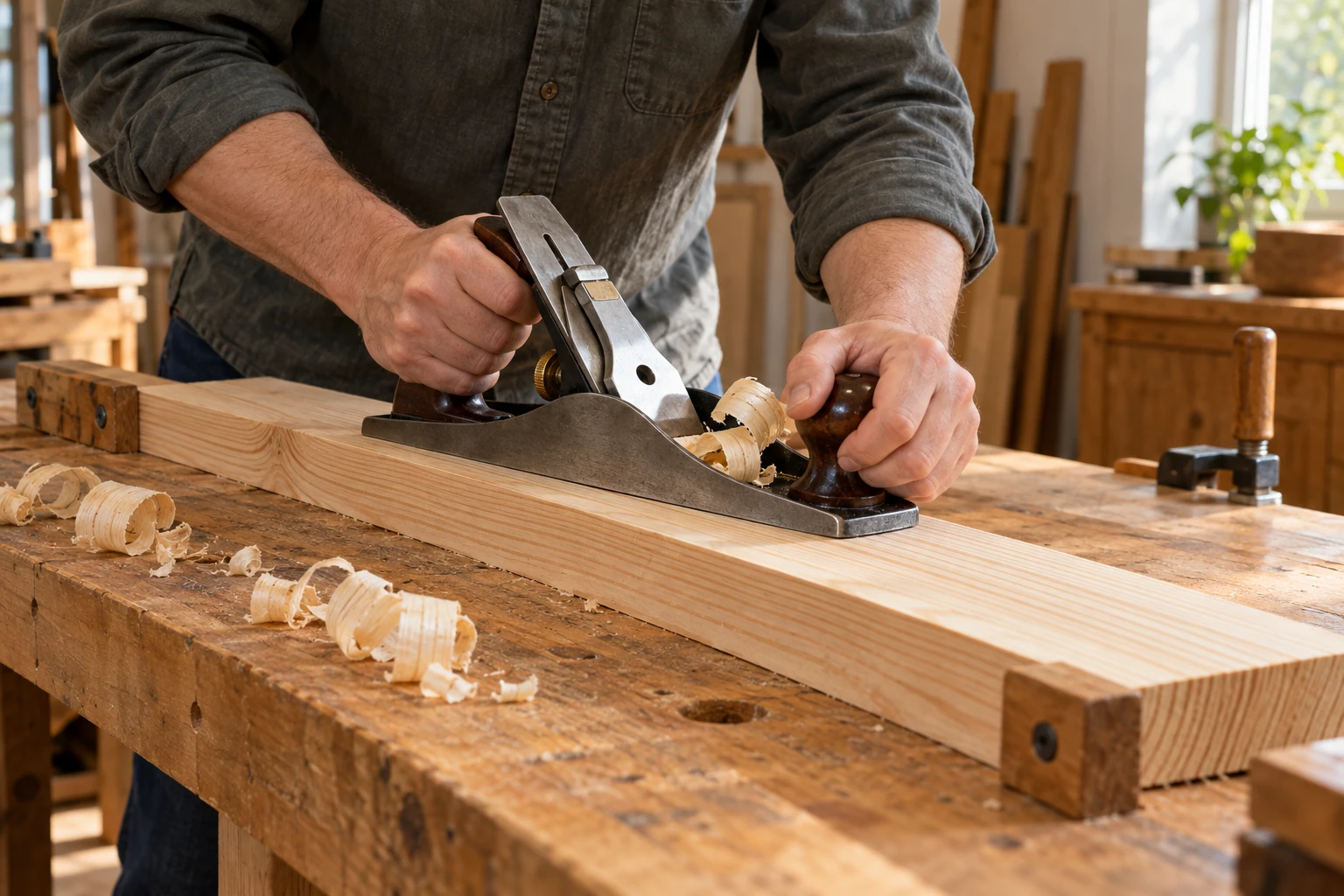
To plane with the grain, begin with a practice board you are willing to change. The point of the exercise is to recognize a supported direction of work and learn a controlled stroke. You are not trying to rescue a finished cabinet door or prove that a newly purchased plane is ready for every kind of timber. Give yourself one manageable surface and a clear stopping point.
This guide follows published general hand-planing advice. The two catalog examples are a Faithfull No.4 smoothing plane and a Silverline No.5 hand plane. Neither was operated for this article. Obtain the instructions for the actual tool before using it, and learn its setup with appropriate instruction. The catalog offers identify the products but supply no operating sequence.
Choose the task before buying another tool. If you are learning in a class or shared workshop, ask which practice stock and workholding arrangement are intended for the lesson. You may already have suitable equipment available. If the proposed work belongs to someone else, agree what you may alter. A practice exercise should not become an unplanned change to a piece that still has a job to do.
Read grain direction on the piece you will plane
To read grain direction, distinguish the arrangement of the fibers from the decorative pattern you notice first. Wood grain describes the longitudinal arrangement of wood fibers or the pattern resulting from it, while figure concerns visible effects associated with growth and other features. A striking pattern on a board's face does not by itself establish a single easy direction for the whole operation.
The general wood-grain reference distinguishes straight, spiral, interlocked, wavy and irregular grain. Straight grain follows one direction, while interlocked grain changes its spiral direction over growth periods. Knots and other growth features can create irregularity. These distinctions explain why a clear straight-grained practice piece and a highly figured piece are different learning tasks, even when both are sold under the same species name.
The same reference distinguishes working with, against and across the grain, and working end grain. Those terms describe different relationships between the cut and the fibers. This exercise concerns a pass along the side-grain surface of an ordinary practice board. It supplies no end-grain trimming, complex figure treatment or method for cutting around a knot. Leave those operations for the guidance that addresses them.
Secure the board before beginning the stroke
Fine Woodworking's hand-plane safety guidance starts with securing the workpiece using suitable workholding, such as a vise, clamps, a bench stop or a bench hook. It also calls for a sharp plane iron, so the user need not push as hard. These are preparations for the task. This article does not supply clamp forces, bench construction or a sharpening procedure for either retail offer.
The same safety account discusses working at a suitable height. It describes a common hand-tool bench reference at the user's fingertips when standing with arms hanging down. Treat that as the account's reference, not a dimension to copy onto every workstation. Set up the actual lesson with the workholding and working position appropriate to you and the work, rather than beginning with a loose board.
Fine Woodworking also describes small-piece operations in which the work moves against an inverted plane. That is a separate arrangement with its own blade-clearance concern. It is outside this practice stroke. Keep the present task as a secured board and a normally oriented hand plane. A method illustrated for a small loose piece should not quietly replace the workholding you established for this exercise.
Establish the direction on scrap before working the project
This Old House's hand-plane guide advises inspecting the grain on the board's side and planing in the direction of its upward slope. Its guidance connects that direction with avoiding tear-out when working against the grain. Inspect the particular board before choosing the direction. A photograph of a different piece does not establish which way the fibers run in the stock you have secured.
The same guide recommends trying a plane on scrap after its setup, then adjusting as needed for the desired cut. Its troubleshooting discussion identifies sharpness, depth of cut and alignment as relevant to different symptoms. A rough result therefore deserves attention to the actual setup as well as the grain. This tutorial gives no universal knob position or mouth opening for the Faithfull or Silverline tool.
This Old House also describes planing from the ends toward the middle or supporting an exit with a sacrificial block for end-grain work. Those are distinct methods for a different cutting relationship. They do not become an extra step in the present along-grain exercise. Read the operation being described before borrowing its motion or workholding from a broader woodworking guide.
Control the hand plane stroke from entry to exit
Woodcraft's Mastering the Hand Plane describes starting with the front of the plane supported on the workpiece and the blade behind its end. The account places initial downward pressure at the front knob. As the plane moves fully onto the board, pressure becomes balanced between the front knob and rear handle. The changing support position is part of its description of the stroke.
To control the hand plane stroke through the exit, Woodcraft describes easing front pressure and placing more emphasis on the rear handle as the tool approaches the far end. It also describes using the body to move the tool rather than asking the arms alone to power it. These are general technique descriptions, without a force measurement or a promise about a selected product's result.
For broader surfaces, the Woodcraft account describes consistent overlapping passes. It also raises the sole slightly on the return to avoid needless blade wear. Its separate instructions for WoodRiver frog adjustment belong to that documented design. They are not Faithfull or Silverline setup directions. Use the general stroke explanation within an actual instructed practice session, with the tool already prepared according to its own guidance.
What the two catalog offers establish
The Faithfull No.4 smoothing plane in a cardboard box is identified by that name in the product offer. Its description repeats the title. The photograph shows a whole hand plane with a front knob and rear handle. It supplies no setup measurements or preparation result, so ask for the product's applicable information before planning a lesson around its delivery.
The Silverline No.5 hand plane carries the title designation “50 x 2mm Blade.” Its catalog description says “Woodwork.” The whole product photograph shows the plane, but it is not an operating manual. Both offers sit in Hand Tools. Their names and images identify buying inquiries; they do not demonstrate that either delivered tool has been sharpened, adjusted or tried on your board.
If you are deciding between an order and equipment already available, start with the practice you can arrange. An instructor may need to assess a tool you own before the session, or you may be able to use a prepared workshop plane. Ask that question before treating a second purchase as the first step in learning. A new parcel is not the lesson itself.
Use the anatomy guide for parts, then return to the operation
The hand-plane parts guide explains the relationships between the sole, iron, mouth and adjustment mechanisms, including different blade orientations. Use it when you need to identify which part a source names. Its geometry explanation supplies no observation of your practice pass and no substitute for the actual tool's setup instructions.
The guide to wood stain that remains tacky concerns an applied coating and the product history behind it. That is a later finishing question. This practice uses bare wood; it supplies no permission to plane through an unidentified coating or to treat further cutting as a remedy for sticky stain.
Stop and describe what you actually learned
After the instructed pass, put the result into ordinary words. Were you able to identify a proposed grain direction and carry out the intended stroke? Is there a condition that needs your instructor's attention before you continue? Describe what you observed instead of declaring the whole tool correct. You can finish a useful practice session with a question that still needs an answer.
Choose the next exercise with that answer in view. If you have not established the setup or working direction, repeat neither on a valuable project just to see what happens. Bring the actual tool, practice piece and applicable guidance into the discussion. If the lesson has met its purpose, put the equipment away under the workshop's arrangements and decide when you want to continue learning.
Consider payment after deciding whether an order is needed
Someone buying a hand plane through republeq.com can leave the payment decision until the intended order is clear. Start with the work you want to learn and the equipment you can already use. If you decide to purchase, review the selected offer and quantity before considering crypto. A preference for cryptocurrency, including USDT, does not establish which choices the current checkout will provide. Inspect those choices for the basket you actually intend to authorize. If another person is arranging the purchase, agree who is placing it and give that person the exact request. This can prevent two people independently acting on the same need. Read the conditions presented for the transaction and seek clarification about anything that changes your willingness to proceed. You can leave a proposed order undecided while you obtain an answer. If USDT is offered and you choose it, follow the transaction's supplied asset and network information rather than substituting details from an unrelated payment. Keep the confirmation with the purchase information you ordinarily retain. When a transaction's status is uncertain, ask about that specific transaction before deciding on further payment action. This paragraph gives no retail price, conversion estimate, transfer-fee prediction or arrival promise. It makes no claim that the payment choices on a future order will match today's. You may decide to postpone buying while arranging a practice session or to make no new purchase at all. Those choices can remain part of your own assessment of the task. An available payment method is useful only within an order you want and are authorized to place. Once the purchasing question is settled, return to the activity with the guidance and arrangements it requires. Paying in an offered cryptocurrency, choosing another available method or leaving the basket open need not decide what you will learn next.
Take the practice result back to the next lesson
A completed exercise leaves you with a particular board, an actual tool and an account of the stroke you attempted. Use those when deciding the next step with your instructor. You do not need to turn one pass into a verdict on a brand or a guarantee about future timber. Begin the next piece by looking at its own grain and the operation you intend to carry out.