How-To Guides & Tutorials
Plan a windowsill herb space before buying pots
Observe actual windowsill light, identify the herb and check pot and tray dimensions before choosing a growing arrangement or ordering a container set.
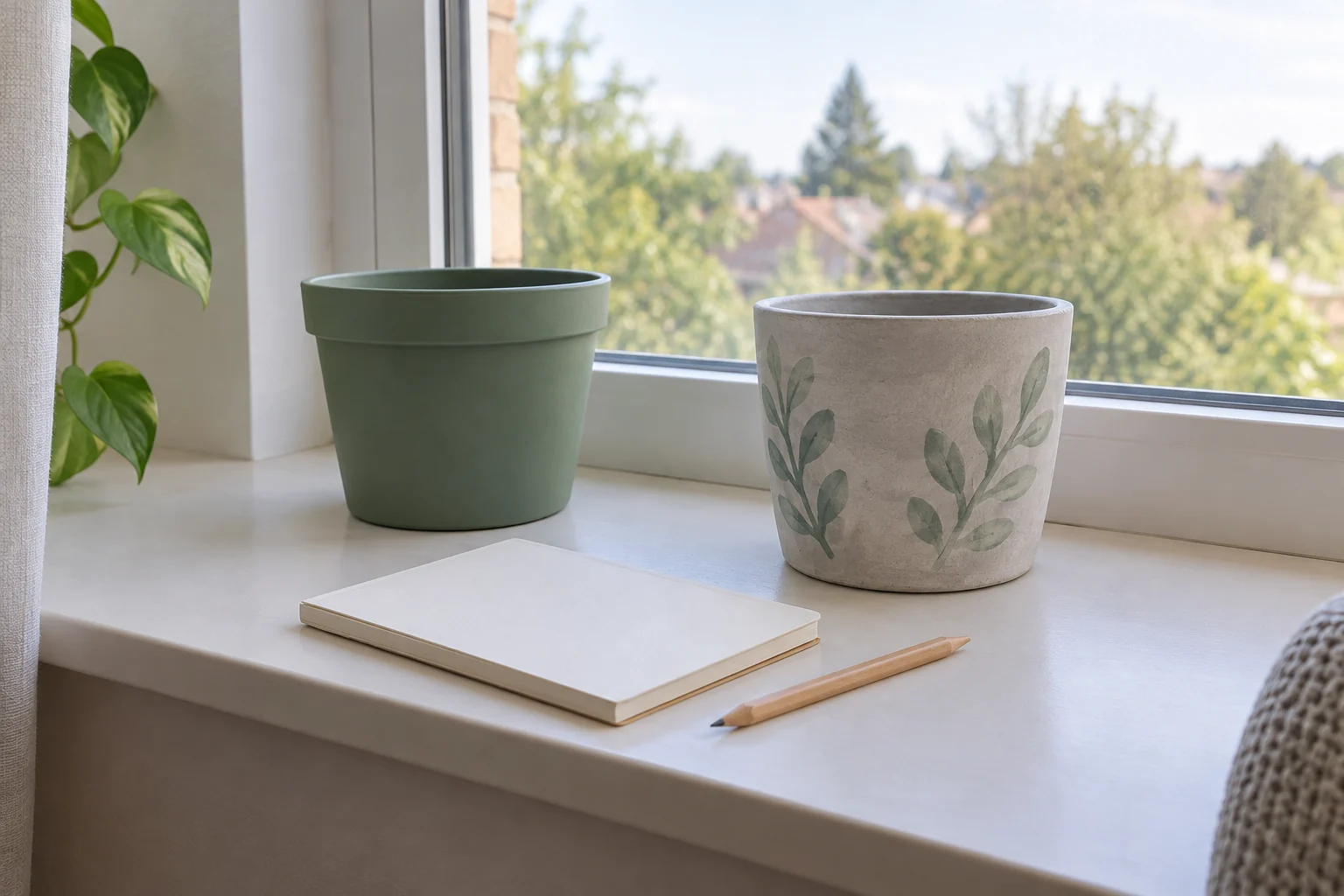
Plan a windowsill herb space by checking the light and the actual place available before choosing a set of pots. A window label in a product description does not establish suitable conditions for every herb. Begin with one possible location, observe what happens there and compare what you learn with the requirements of the particular plants you want.
This is a planning exercise before planting. It supplies no potting, drilling, plug-removal, watering or grow-light installation sequence. You can assess the location with ordinary observations and information about the containers you already own. The two offers below provide purchasing examples, without a growing trial or a confirmed arrangement on your windowsill.
First, choose the actual position you would use
Identify the part of the sill or other appropriate supporting surface where the plants would stand. A room can have more than one window, and a bright-looking corner may not describe the proposed container position. Name the particular window and the part of its sill you are considering.
Look at the way the household uses that place. Curtains may be drawn during part of the day, or the window may need to open. Describe the ordinary arrangement you intend to keep. There is little value in assessing a temporarily cleared or uncovered position if that is not how the space will normally be used.
If the location belongs to a shared room, ask whether the proposed use suits the people using it. Someone may need the sill for another purpose or prefer not to have a new display there. Establish an agreed possibility before treating the whole surface as available for a growing project.
Observing windowsill sunlight means checking that place
For observing windowsill sunlight, use the actual proposed position rather than a general impression that the room is sunny. Note when you can see direct sunlight reaching it and when it no longer does. Write down when you were unable to observe the position. A bright patch seen during one visit does not establish that the position received sun continuously while you were elsewhere.
Repeat observations when you can reasonably do so, retaining the conditions you actually saw. A day when curtains remain closed concerns that arrangement. A different day's observation can add information without replacing it. Do not turn a few convenient checks into a claim that you measured a complete day of light.
The University of Maryland Extension's indoor-herb guidance recommends a south- or west-facing window receiving at least five hours of sun a day. It also says different herbs have different light requirements and that winter light may need supplementation. Keep those qualifications with its recommendation. The page does not certify the conditions in your particular home.
Compare the observations with the plant you mean
Name the herb you want to investigate before deciding the window suits it. A broad plan for herbs could include plants with different requirements. Use the identified herb's care information to compare its needs with the light you actually observed. You may decide to begin with one plant whose requirements you can establish instead of buying an assortment around an unexamined location.
If a plant you already own is unidentified, keep that question open. The missing plant-label guide distinguishes a temporary container reference from a name supported by earlier records. Its GreenThumb and LINE42 label offers cannot identify your herb or establish its light needs. Resolve the actual identity before selecting care information for it.
A pot described as suitable for herbs does not identify which herb belongs in your proposed conditions. A small pot still needs to be matched to the identified plant's growing requirements. Ask about the particular plant rather than treating the retail category as a shared care instruction for everything that could be placed inside it.
Keep seasonal conditions in the question
An observation made now describes what you saw now. If you are planning for another season, keep that timing visible instead of presenting today's result as a year-round account. Maryland's winter-light qualification is a reason to investigate the later conditions, without supplying a lighting installation plan for this project.
The same guidance advises avoiding drafts, dry heat vents and temperature extremes. Consider the actual position alongside those cautions and the plant's applicable requirements. A window-facing label cannot answer the complete placement question. If you need an assessment of an uncertain condition, seek information for that actual location and plant.
You can leave the growing plan undecided while finding that information. Choosing another suitable location or postponing the purchase remains possible. A decorative pot does not need to be assigned a plant immediately simply because you like its colour or shape.
Herb pots and available space need labelled dimensions
For herb pots and available space, compare the actual proposed container arrangement with measurements you can establish for the supporting place. Keep a tray's stated dimensions separate from a pot's dimensions. Neither a package count nor a size word in a title identifies the complete footprint of every possible arrangement.
When a dimension matters, establish what it measures. Ask whether a quoted width describes the outside of the container or the internal planting space. A tray's overall length does not necessarily identify its usable interior. Ask about the specific boundary you need instead of assigning every number in the description to the same space.
Include the ordinary access the location needs. A proposed group that appears to fit a closed outline may still leave a question about curtains or the window's use. This article gives no universal clearance or support rating. Obtain the actual information appropriate to the surface and arrangement before relying on it.
Read the MM P set without inventing a layout
The MM P green herb-pot set describes six polypropylene pots, each four inches wide and 4.3 inches high. Its tray is stated as 11.8 inches long, 4.3 inches wide and 1.2 inches high. The account names bottom drainage holes, detachable saucers and drainage mesh nets. SKU sku-17714372056 and UPC 681882073568 identify this offer.
The current product name also includes a twenty-four-inch size label. The supplied description does not explain how that label relates to the individual-pot and tray measurements. Preserve the question when asking about the exact set. Do not replace the tray's explicit dimensions with the title's number or declare a particular complete layout established.
Six supplied pots do not prove that all six occupy one tray in the arrangement you imagined. Ask what the package contains and which measured arrangement any reply describes. The included saucers and nets also have their own applicable instructions. This planning article supplies no fitting or removal method for those components.
Keep the Unbranded cement set's actual identity
The Unbranded planter offer with PASENITY in its title describes a set of three hand-painted cement pots. The description states 3.5 inches for both diameter and height and names pre-drilled drainage holes and plugs. Plants are not included. Retain the actual Unbranded catalogue identity alongside the title wording when asking about the selected item.
The listing suggests succulents, cacti, herbs, flowers and other small plants. Those are use claims, without a demonstrated result for the herb and conditions you are considering. The 3.5-inch size account also does not provide every internal dimension or a measured growing capacity. Obtain the information your actual plant needs.
A description naming holes and plugs does not establish how the item you would receive is configured for the proposed use. Maryland's guidance calls for adequate container drainage. Check the applicable product and plant information rather than treating a component list as a confirmed drainage result. No plug manipulation or pot modification is instructed here.
Sketch one proposed arrangement before choosing a set
Make a simple sketch of the actual place, showing the window and the surface you are considering. Mark the parts whose dimensions you have established and leave the others without invented figures. An unscaled sketch can still identify which boundary you need to ask about. It does not need to look like a finished room illustration.
Show the number of containers you actually want to consider there. You do not have to assign every pot in a retail package to the same place. If another pot would be used elsewhere, give that location its own assessment. The light you observed at this window supplies no result for another room.
Keep ordinary access visible on the sketch. For example, identify the curtain or window function you already know must remain usable. Then ask for any relevant product dimension still missing. You are describing the proposed arrangement so someone can answer the actual question, without treating the sketch as a support or clearance assessment.
One fictional comparison shows what an observation can answer
Imagine two possible places for a herb. At the first, a person sees direct sun during a morning check but is away for the rest of the day. At the second, the person has observed a longer part of the day. These are fictional circumstances, without a measured duration or a plant-growth result.
The first place has an unobserved interval. Calling the whole day sunny would fill that interval with a guess. The second observation may answer more of the light question, while still leaving the actual herb's requirements to check. Neither description establishes a suitable pot, so that physical question remains alongside the light question.
If the person later chooses another location, the earlier observations remain about the original two. They can use the same planning method at the new place without claiming the earlier result moved with the pot. This is why the actual proposed position matters throughout the exercise.
Separate the light plan from the watering decision
The watering-can and plant-needs guide keeps a tool's capacity separate from the water a plant actually needs. Its Unbranded and Fiskars equipment details supply no watering quantity for these pots. A location considered for sunlight also needs its own applicable care information, without a universal routine assigned from the container's appearance.
Do not add a fixed watering amount to the windowsill plan merely to make it look complete. This exercise has not established one. Keep any actual plant-care answer with the species and arrangement it concerns, and obtain further guidance when those conditions change.
Finish with what you know and the decision still open
Bring the light observations, the identified plant and the container information together. You may have established a promising location while still needing an internal dimension, or found that the observed light leaves the plant choice unresolved. Ask for the missing internal dimension or herb-specific light guidance before choosing the set.
If the proposed arrangement changes, revisit the affected part. Moving to another window changes the location you observed. Selecting a different pot changes the container information. Keep the new choice distinct from the old assessment so an answer about one place or item does not quietly become an answer about another.
Use the resulting windowsill herb space plan to choose the next appropriate step. Confirm the conditions and item information your actual plant requires before proceeding through the applicable growing instructions. The pot offers remain optional choices, with no promise of a harvest or proof that a particular windowsill will support it.
Conceptual windowsill herb space cover with complete generic empty pots beside a window; no exact retail models, planted arrangement, measured light or growing result is shown.