Crypto Commerce
Plan interview camera framing for a seated conversation
Interview camera framing begins with a choice about the people in the picture. If you plan to record a seated conversation with an adult relative, decide whether the viewer should see the relative alone or see you listening as well. Then decide where your relative will naturally look while speaking. Those choices give you something specific to inspect in a trial frame; a camera listing cannot decide them for you. For interview camera framing , verify each step.
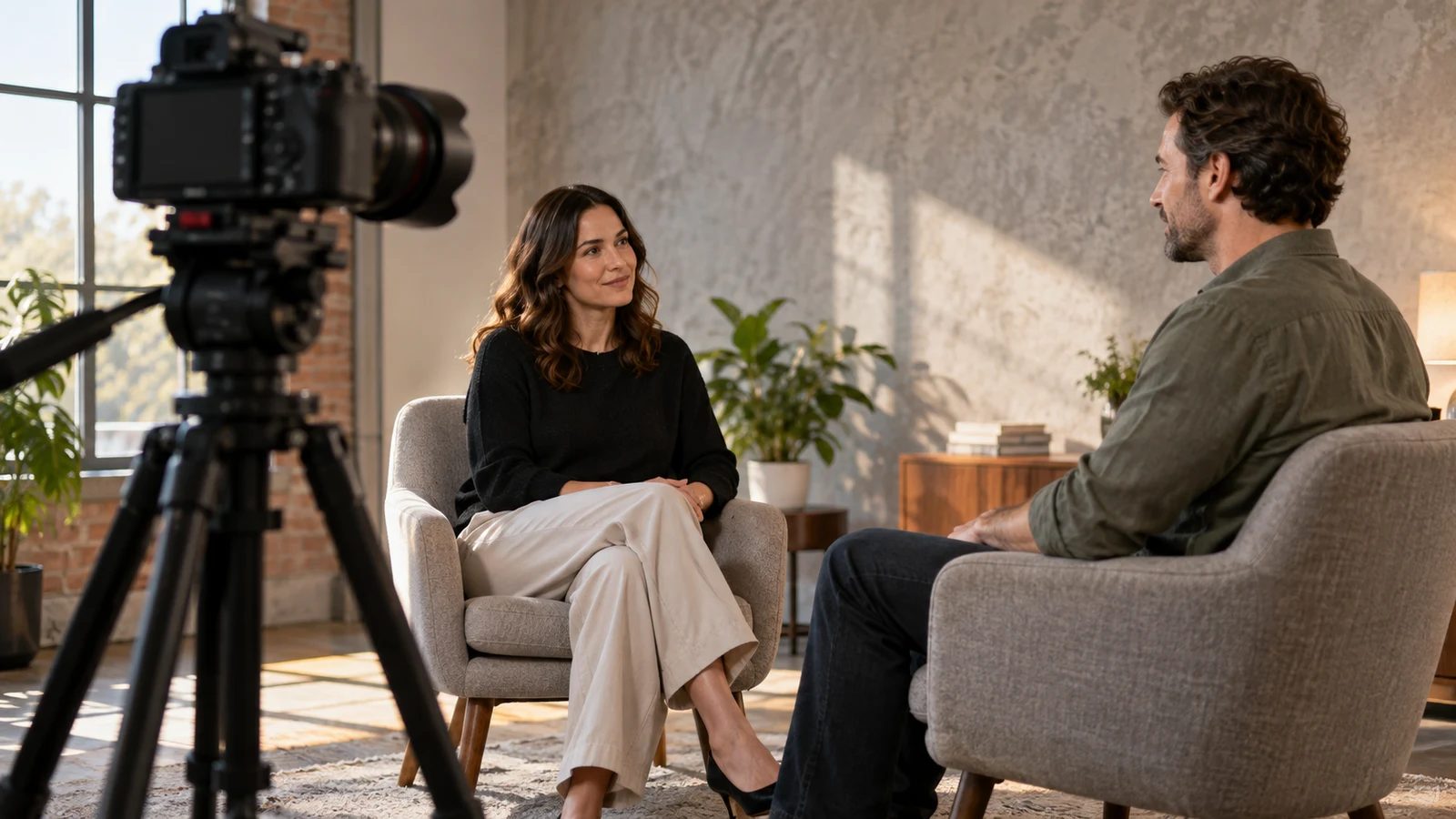
Interview camera framing begins with a choice about the people in the picture. If you plan to record a seated conversation with an adult relative, decide whether the viewer should see the relative alone or see you listening as well. Then decide where your relative will naturally look while speaking. Those choices give you something specific to inspect in a trial frame; a camera listing cannot decide them for you. For interview camera framing, verify each step.
Imagine that your aunt has agreed to talk with you at her kitchen table. She is comfortable speaking to you, but neither of you has decided whether the finished video should look like her account to a viewer or a conversation between the two of you. Both are reasonable intentions. Ask what she is happy to have visible before arranging the seats or pointing a camera at the table.
Family Interview Questions And The View Of A Conversation
A prepared question can draw out an answer, but it cannot establish what the viewer sees while that answer is given. Keep the choice of image separate from the choice of words. The guide to family interview questions addresses what to ask; this guide concerns the boundaries of the picture and the people inside them. You can plan either part first, provided the person being recorded agrees to the intended view.
Begin by naming the audience's position in the conversation. Will someone watching feel as though they are sitting opposite your relative while she talks to you, or will they see two people talking together? In the first arrangement, the interviewer may remain outside the picture. In the second, the interviewer belongs inside it. This is a decision about the visible relationship between speakers, not a rule that one kind of interview is more authentic.
Next, distinguish looking toward the interviewer from looking toward the viewer. If your aunt is answering you, it can make sense for her eyes to follow your seat, even when that means she rarely looks straight at the camera. If she wishes to address future viewers directly, that is a different intention to discuss with her. Do not ask her to hold an unfamiliar pose merely to make a planned composition work; adjust the plan if her comfortable way of speaking leads elsewhere.
A quick sketch can settle an ambiguity that spoken directions leave open. Draw the table as a simple shape, mark your aunt's ordinary seat, and draw an arrow toward the person she expects to speak to. Put a box around the people you want visible. You are recording an intention, not measuring a room. A note such as “listener just outside the right edge” describes the proposed picture more clearly than “nice interview shot.”
For a view of your aunt alone, place your own mark outside the sketched box, close enough in the drawing to explain her gaze. In a shared view, put both seat marks inside the box and allow for the space between them. The empty portion of the image can matter: it may show that she is speaking to someone just beyond the edge, or it may give both participants room to turn naturally toward each other. Check what that space communicates before treating it as an accident to eliminate.
The background also has a job, even if no one meant to give it one. A kitchen wall, a doorway, or part of a table can make the seating arrangement intelligible. A visible address, another person's photograph, or an item your relative would rather keep private calls for a different boundary. Ask her to look at the trial image with you. What seems harmless to the person setting up the picture may feel quite personal to the person in it.
Consider how much of each seated person is needed to make the conversation readable. A view cropped very tightly around one face may leave no clue that someone else is listening; a wide view may make expressions difficult to notice. Neither observation tells you to use a particular setting. It tells you to inspect the picture you actually intend to make, at the seats you actually intend to use, and to revise the boundary when it hides something important.
Family Interview Questions Do Not Determine Who Appears
Suppose your aunt plans to answer the same prepared prompts in either version. In the first fictional composition, you sit outside the right edge of the picture. She looks toward your seat, and the viewer sees her response without seeing the listener. The picture can keep attention on her expressions. It cannot show your reaction or establish from sight alone exactly where you are seated. If the edge cuts through a hand she tends to move while talking, expand the proposed view and inspect it again.
In the second version of that same fictional conversation, your chair appears beside hers. The viewer can see your listening posture and the space between you. Your presence also uses some of the picture, so your aunt may occupy less of it. The visible exchange may be the point; alternatively, she may find the shared arrangement distracting. Ask her which version represents the conversation she wants to have, and avoid assuming that inclusion of the interviewer is automatically more candid.
The two versions need not follow identical gaze instructions. When you are outside the image, her turning toward you will lead her attention beyond the edge. When you are inside it, the same turn can make the relationship legible without explanation. If you had planned for her to speak to future viewers instead, talk about that intention separately. Asking her to look at the camera while you remain beside her can create a different picture from the one the seating sketch originally described.
A trial frame makes these differences visible without asking anyone to perform a full interview. Invite your relative to sit normally and move as she would during a conversation. Look at the image together before recording. Do you both stay inside the proposed boundary when you turn toward each other? In the single-person version, does her ordinary posture still fit? A composition that works only while someone holds still is probably not the picture you sketched.
Check the edges first. A chair back or shoulder may enter the frame when the interviewer is meant to be unseen, while a shared view may clip the listener as they shift in the seat. Then look at the middle. Does the space between people clarify that they are together, or does it separate them visually more than intended? These are observations to make on the actual trial image, not predictions a product description can guarantee.
Ask what the viewer can infer without knowing the room. A face looking beyond the edge may read as a response to someone present, especially when the image leaves room in that direction. A shared view makes the listener visible but may also bring other background details into view. Neither composition carries the whole situation by itself. Choose the version whose omissions you and your relative are comfortable with, and note anything the frame cannot explain.
If your aunt prefers one view but you had drawn the other, change the sketch. Her consent to a conversation does not settle consent to every possible depiction of it. She might welcome an image of herself alone and dislike appearing beside another person, or prefer the opposite. Treat that preference as part of the composition decision rather than a late obstacle to a camera arrangement.
Canon PowerShot G7 X Mark II And The Trial Frame
After you know what the image should include, you can consider a recording device. Republeq lists a white Sony ZV-1 II compact vlog camera as one optional candidate for interview camera framing. The listing identifies a video-capable camera; it does not demonstrate how your aunt and her seat will fit in your chosen room. Keep the composition sketch beside the listing so that the product name does not replace the actual question you are trying to answer.
The Canon PowerShot G7 X Mark II international-version camera bundle is another listed video-capable option. There is no need to use the two cameras together. Nothing in either supplied description establishes whether a single-person or shared view will include the intended seats from a practical camera position. Choose a proposed setup, then inspect its view in the room rather than treating a specification as a preview of the finished picture.
For either candidate, the useful question is spatial: can you place the camera where the desired people appear, where your relative can look toward the person she means to address, and where the visible background is acceptable? A photograph of a product cannot show how a particular doorway or table will fall behind the participants. If you cannot inspect a proposed setup before choosing equipment, leave this as an unresolved check rather than promising the camera will produce the composition.
Do not let the existence of a trial frame turn into a demand for a polished performance. A quiet moment in the ordinary seats is enough to reveal whether someone disappears when leaning back or whether a private object remains visible. You can discuss the picture and try a different boundary. The purpose is to see whether the intended relationship appears in the image while both participants remain comfortable.
When a view looks crowded, ask which element belongs there before trying to squeeze everything in. Perhaps the interviewer was included only out of habit and can sit outside the picture. Perhaps seeing both people is the whole reason for recording the exchange, so a background object should be moved out of view instead, with your relative's agreement. Revising who appears is a story decision; moving an unwanted object is a privacy decision. The same crowded picture can call for different answers.
Likewise, do not assume that a tidy background is the most meaningful one. Part of the table or an ordinary household object may help the viewer understand that the conversation takes place in a familiar setting. Keep a detail when your relative is comfortable sharing it and it serves the intended view. Exclude it when it draws attention away from the conversation or exposes something she did not agree to show.
Look at the trial image from the perspective of someone who was not in the room. If your aunt looks away from the camera, does the composition leave a plausible place for the unseen interviewer? In the shared version, can the viewer tell who is listening when she speaks? Ask these questions without trying to infer personality or emotion from a still moment. The frame can show positions and gestures; it cannot certify what the eventual conversation will feel like.
Write down the result on your sketch: “aunt in frame, listener off to her left,” or “both seats visible, turn toward each other.” Mark any background detail to exclude and any part of the image still to test with the actual equipment. Those notes make it easier to explain the plan to your relative without handing her a list of camera terms. They also leave room for her to change her mind when she sees what the proposed view looks like.
Before the conversation begins, compare that annotated sketch with one ordinary trial frame and ask your relative whether she is comfortable with what appears. If the image contradicts the sketch, redraw the boundary or reconsider who belongs in it. When the people, gaze, and background match the picture you both agreed on, the framing decision is ready; the conversation itself can proceed in its own way.