Crypto Commerce
Plan family interview questions that invite specific memories
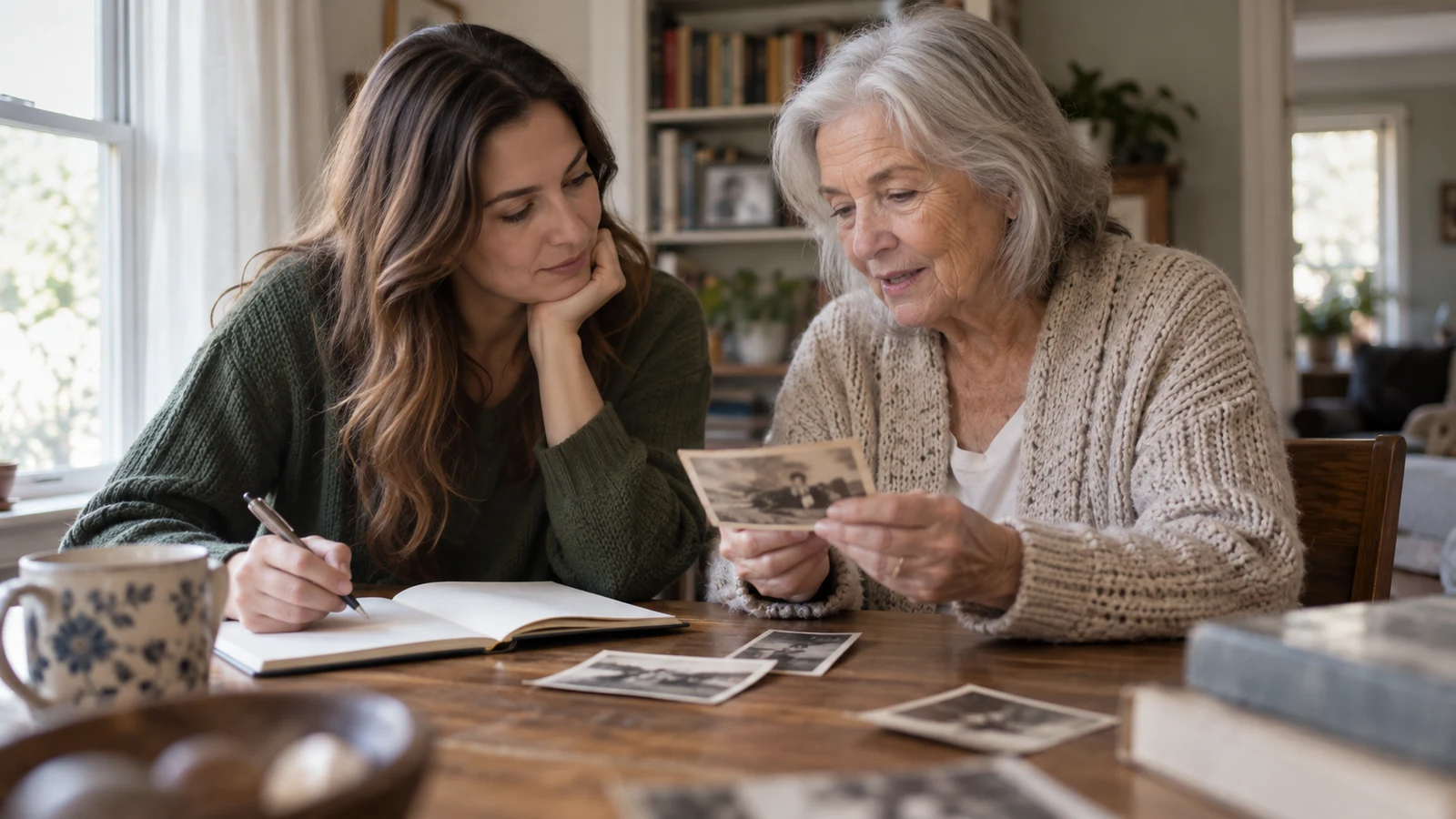
To invite a specific family memory, ask about an occasion the person can choose, then follow the details they give you. Start with something bounded: a meal they remember preparing, an afternoon after school, or a time someone showed them how to do something. Your aim is to give them a place to begin without deciding in advance what their story should mean.
To invite a specific family memory, ask about an occasion the person can choose, then follow the details they give you. Start with something bounded: a meal they remember preparing, an afternoon after school, or a time someone showed them how to do something. Your aim is to give them a place to begin without deciding in advance what their story should mean.
Useful family interview questions leave room for an ordinary answer, an unexpected answer, or no answer at all. You can prepare a short question sheet with opening prompts and possible follow-ups, but let the conversation determine which ones you use. A remembered detail deserves attention even when it takes you away from your next planned question.
The examples below are suggested wording, not accounts of actual family experiences. Adapt them to the person you are speaking with, and avoid assuming that particular relatives, homes, celebrations, or relationships were part of their life.
Shape The Conversation Before Electronics Product Checks
Decide what you want to understand about this person's experience. “Their whole life” is a difficult assignment for one conversation. “How they learned to prepare a meal they still remember” gives you a manageable starting point. Keep the scope small enough that you can listen closely instead of watching for the next milestone on a biographical list.
Invite the person to help choose the subject. You might say, “I'd like to hear about something you used to do regularly. Would you rather talk about cooking, work, or something else?” The options are invitations, not requirements. If none fits, ask what they would enjoy talking about.
Before beginning, explain whether you hope to take notes or make a recording, and ask what they are comfortable with. Agree that they can skip a question, pause, or stop. Keep permission to record separate from any later request to share the conversation. These choices belong to the person telling the story, and they may change their mind during the interview.
Neutral Openings Before Electronics Product Checks
Read each opening question for assumptions. “Why did you love visiting your grandparents?” assumes both that visits happened and that the person enjoyed them. A more open version is, “Who did you spend time with outside your household, if anyone?” You can ask about a particular visit after they introduce one.
Watch for words that assign an emotion or importance before the speaker does. “Proudest,” “happiest,” and “hardest” ask someone to rank experiences as well as remember them. Those questions may suit a later conversation, but you can begin with an event that does not require a verdict about an entire life.
- Instead of “What was your happiest childhood memory?” try “Is there an afternoon from when you were young that you remember clearly?”
- Instead of “How did your mother teach you to cook?” try “How did you first learn to make something to eat?”
- Instead of “Why was that job so important?” try “What do you remember doing during one day at that job?”
- Instead of “What traditions did everyone love?” try “Was there something your household did repeatedly that you remember?”
These alternatives still need judgment. A question about a household may not suit everyone, and an ordinary subject can carry difficult associations. If the person redirects the conversation, follow their choice rather than defending the question you prepared.
Specific Occasions Before Electronics Product Checks
When an answer describes a habit, ask whether a particular instance comes to mind. Suppose someone says, “We used to mend things.” You could ask, “Do you remember one thing you helped repair?” That moves the conversation toward an occasion while leaving the object and circumstances for them to supply.
Once they choose an occasion, ask one question at a time. “Where were you?” gives them one task. “Where were you, who was there, what could you smell, and how did you feel?” gives them several, and makes it harder to know which answer you should follow. Save the unused prompts for later.
Choose detail questions that fit what they have already said. If they mention a difficult step in a repair, ask what made that step difficult. If they mention another person laughing, ask what happened just before the laughter. You do not need to collect a sight, sound, smell, and feeling for every memory.
A small action can be enough material for a story. Ask how someone held an unfamiliar tool, what they did when an ingredient ran out, or how they knew it was time to leave, provided the speaker has introduced that situation. Avoid adding a tool, ingredient, or departure merely because it would make a vivid scene.
Answer-Led Follow-Ups Before Electronics Product Checks
Prepare follow-up forms rather than a fixed chain of questions. “You mentioned ____. What happened then?” can work across many subjects because the speaker supplies the missing detail. Use their wording when you can. Replacing “unusual” with “frightening,” for example, would add an interpretation they did not express.
If someone says, “My first day was a muddle,” you might ask, “What happened that made it feel like a muddle?” If they describe arriving at the wrong entrance, stay with that event. “How did you find the place you needed?” follows their answer more closely than jumping to a prepared question about their favorite colleague.
Leave a pause after an answer before choosing your next question. If you need to think, you can say, “I'm deciding what I'd like to ask about that.” You do not need to fill every quiet moment. When clarification is necessary, make it brief: “When you say ‘we,’ who was with you?”
Keep your own memories from taking over. If you remember the occasion differently, first let the person finish. You can then ask whether they would like to hear your version. Treat the difference as something to understand rather than a reason to reshape their account into yours.
Draft Two Question Sheets On A Dell Inspiron Touchscreen Laptop
You can prepare your prompts on paper or in a document on a computer you already use. If you are considering a Dell Inspiron touchscreen laptop, its possible role here is a workspace for drafting the questions. This example does not establish that a particular application is included or that it connects to any recording device.
Give your family interview questions a flexible layout. Put one opening near the top, leave space for the speaker's words, and place optional follow-ups below it. Keep separate sheets for different subjects so that each conversation has a clear starting point. You can stop after one remembered occasion without completing the page.
The first sample sheet concerns learning an everyday task. It invites an account of doing something, with room for the person to describe learning alone or with help. Use only the follow-ups that fit their answer.
- Opening: “What is something you remember learning to do when you were younger?”
- Occasion: “Can you remember a particular time when you were learning it?”
- Action: “What did you try first?”
- Detail: “Which part needed the most attention?”
- Optional follow-up: “You mentioned someone helping. What did they show or tell you?”
- Closing: “Is there anything about learning that task that I haven't asked about?”
If the answer is “I just picked it up over time,” accept that shape of experience. You could ask about an early attempt they remember, but do not insist on a first lesson or a teacher. The sheet should accommodate what happened, including gradual learning with no clear beginning.
The second sample sheet concerns a remembered visit. It opens with the person's choice of occasion and follows the encounter itself. It does not require a holiday, a long journey, or a close relationship.
- Opening: “Is there a visit you made or received that you feel like talking about?”
- Beginning: “What do you remember about the start of that visit?”
- People: “Who was there?”
- Moment: “Was there something someone said or did that you remember?”
- Optional follow-up: “You mentioned that the plans changed. What happened next?”
- Closing: “What would you like someone hearing this story to understand about that visit?”
Keep the conditional prompts visibly optional. The question about changed plans only belongs if the speaker mentions a change. If they remember the conversation but not the arrival, follow the conversation. You are gathering their account, not checking whether they can supply every part of a scene.
Room For Uncertainty On A Dell Inspiron Touchscreen Laptop
Leave space in your question document for uncertainty as well as answers. When someone says, “I think it was before we moved,” preserve that qualification in your notes. Do not silently turn it into a date or replace it with a confident sequence of events.
If timing matters to understanding the story, ask whether they remember a nearby event that helps place it. “Were you still at school then, or are you unsure?” offers an explicit way to leave the question open. If timing does not matter, you can continue without settling it.
Distinguish a personal recollection from a story heard from someone else. A neutral prompt is, “Is that something you remember yourself, something someone told you, or a mixture?” Their answer can help you describe the account accurately later. It does not require you to dismiss a family story because its origin is uncertain.
When an answer becomes uncomfortable, offer a choice without demanding an explanation: “Would you like to stay with this, move to something else, or stop?” Avoid treating a difficult disclosure as material you must pursue. You can have a worthwhile conversation while leaving parts of someone's experience unspoken.
Separate Recording Choices From Electronics Product Checks
Decide whether recording would serve the conversation and whether the speaker wants it. Notes may be sufficient for your purpose. If you are considering a camera for recording answers to your family interview questions, that link opens the Sony camera listing. It is a product reference, and the interview guidance is on this page.
Handle equipment questions separately through the guide to electronics product checks. Use it for the technical questions raised by your intended recording task. Neither the camera reference nor the laptop reference here establishes compatibility between the two products or promises a particular recording result.
Once you have chosen your method, give it a short rehearsal so that operating it does not become your main task during the conversation. Practice reading one prompt, listening to an answer, and making a brief note without interrupting. If using a screen makes you look away too often, a printed question sheet is another option.
Before the interview, read your opening aloud. Remove any emotion, relationship, or event you have assumed. Choose two possible follow-ups, then leave room to write down something the speaker actually says. That is enough preparation for a first conversation.
End your family interview questions with an invitation to change the emphasis: “What should I have asked you?” Then ask whether anything they said needs clarification or should be left out of the record you keep. For your next conversation, let an unfinished thread they want to revisit guide the opening.