Garden Care & Watering
perlite and vermiculite: different jobs in a potting mix
Understand how two inorganic media components differ without assuming a universal swap or a tested result for a retail bag.
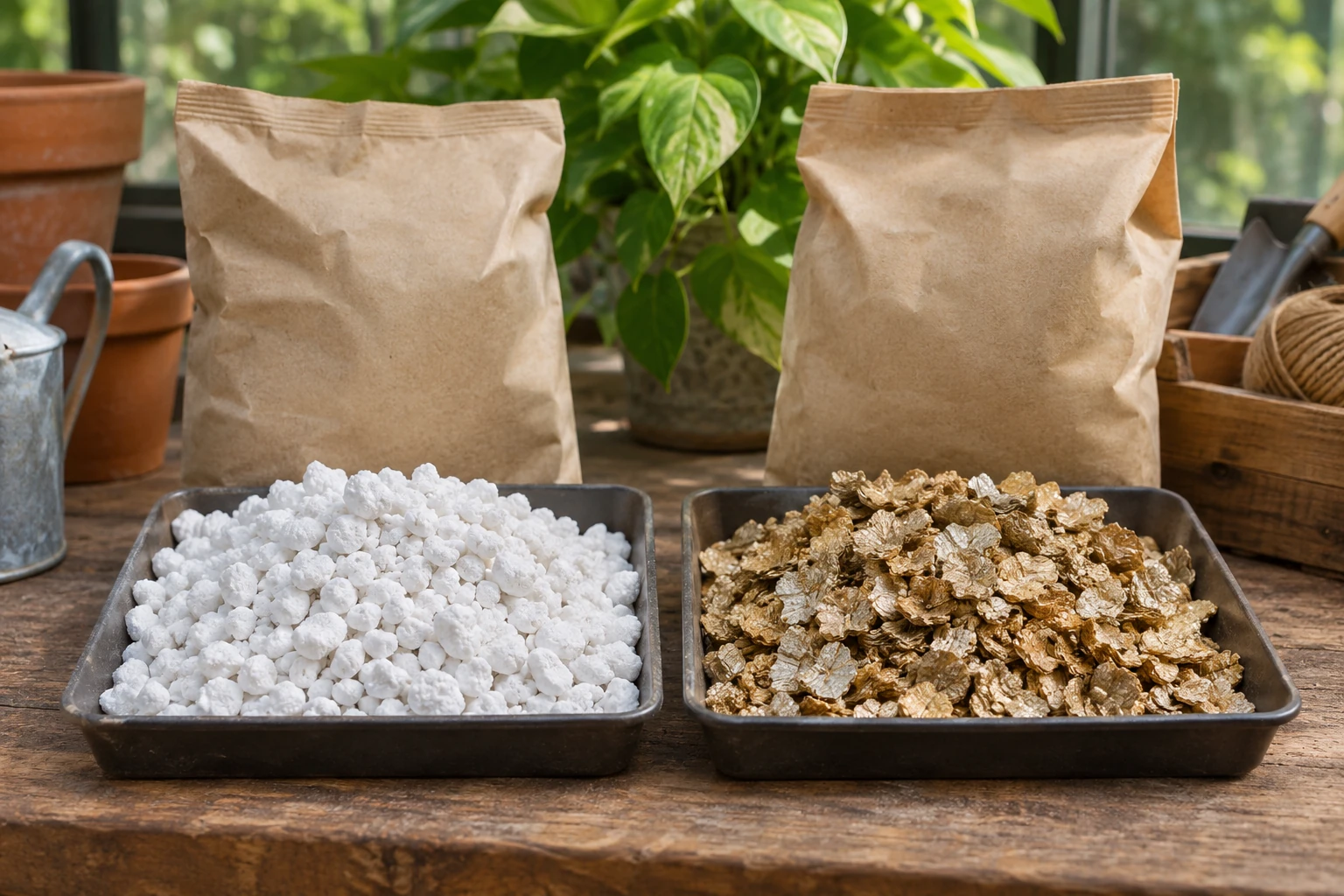
Perlite and vermiculite can appear in the same ingredient list while serving different purposes. Iowa State places both among the inorganic components of potting media, alongside organic materials such as bark and coir. The useful comparison concerns what an ingredient contributes to the mixture, rather than whether its name appears on a bag.
Begin with the ingredient question you actually have
Imagine an original fictional gardener, Ellis, reading two proposed orders with his friend Jo. Ellis has circled perlite on one page and vermiculite on another. He has not chosen a mixture, tested a sample or identified a recipe for the planting he intends. Jo asks what he wants the circled word to tell her. He initially answers that both are things people put in growing mixes. That leaves the choice between them unexplained.
They agree to read the two words as different ingredients. Ellis writes down the question he meant to ask: what role is he trying to understand before investigating a particular product? He can learn the distinction without pretending he has already selected a complete growing program. Their discussion is fictional, and it ends before any material is mixed or any plant is grown.
Growing media aeration is one role
Iowa State describes perlite as an expanded rock-like material used to maintain air-filled pores in a potting mixture. It discusses vermiculite primarily as a material that retains water and, to a degree, nutrients. Its wider account emphasizes component processing, particle size, container choice and handling. The same page warns that dry perlite can produce substantial dust. These are ingredient roles within its potting-media discussion, not a measured result for either retail example or a reason to identify an unknown pale particle by appearance.
Ellis changes his question from which name sounds more familiar to which property he wants explained. In the imagined conversation, Jo asks him to read the surrounding sentence rather than point at the ingredient word. A sentence about growing media aeration and a sentence about another property might both be relevant, but they are not automatically the same statement. Ellis leaves both sentences on the page so that his next question can refer to the particular claim he is considering.
Nutrient retention is not the same description as holding water
Texas A&M’s greenhouse-media account describes expanded vermiculite as plate-like particles with substantial water-holding ability. It also discusses exchange and buffering properties and the ability to supply potassium and magnesium. That gives nutrient retention a chemical context beyond the visible wetness of a handful. Its perlite discussion emphasizes aeration and drainage, while also noting dry dust, flotation and a potential fluorine concern. Those qualifications remain part of that source. They do not establish the composition, safety or nutrient contribution of a specific delivered retail bag.
The Texas account also describes vermiculite as less durable than perlite or sand. Read that as one characteristic to consider within the intended growing-media use, rather than a prediction of how long a particular purchase will last. This guide gives no fertilizer dose, nutrient recipe or laboratory analysis of either offer.
In their fictional conversation, Jo asks Ellis to say what he actually learned. He can repeat his question in more precise words without declaring that one bag is best. He has not measured its contents, and neither person has agreed to use it. They can understand a distinction and still need guidance about the mixture they intend to investigate. Ellis decides to keep that unresolved choice visible when he next asks for advice.
A grade label belongs with the particular material
LSU AgCenter’s account separates grades within each material. Its perlite discussion associates particle-size differences with different water-holding and aeration characteristics; its vermiculite discussion distinguishes fine and larger grades by intended uses. It also explains vermiculite’s layered particles and their capacity to retain nutrients. Thus the material name alone leaves grade and use unresolved. This guide transfers no numerical grade range or water-holding percentage to the two retail bags and supplies no universal substitution ratio.
Ellis had copied the word coarse from one proposal and fine from the other. He now keeps each word beside the material it originally described. He does not treat a similar adjective elsewhere as proof that the products match. If an answer he receives depends on a particular grade, he can ask the seller for the corresponding information rather than complete the record from another product’s photograph.
Nursery guidance keeps propagation and long-term use separate
Oklahoma State’s nursery guidance places both ingredients within a narrower production setting. It says perlite’s lightness and tendency to float can limit its usefulness in general container-nursery mixtures, while retaining a propagation role. It describes expanded vermiculite as easily compressed and unsuitable for the long-term mixture discussed there, again distinguishing propagation uses. These are nursery-specific qualifications, not a prohibition on every houseplant product containing either ingredient. Preserve the intended growing setting when comparing that account with broader potting-media guidance.
The same nursery reference considers physical, chemical and biological properties together. Its discussion does not select a mixture from a single ingredient word. A general account of a material cannot authenticate a particular bag, and a retail growth claim cannot settle the nursery question. Obtain guidance appropriate to the actual plants and growing arrangement before deciding whether a proposed ingredient belongs in the plan.
Jo asks whether the apparent disagreement means they must choose one reference and ignore the other. In this invented exchange, Ellis decides to describe the setting of each passage first. He can bring both accounts to an adviser while explaining which proposed use remains uncertain. He does not need to claim they are identical to keep reading. Nor does the existence of two accounts require him to improvise a compromise mixture.
Read the GROW!T offer as the selected catalog example
The GROW!T perlite offer identifies model JSPERL24 and UPC 638104018340. The seven-frame gallery includes a green bag marked Super Coarse and #2, close views of white particles and growing-use scenes. A coin, scoop, plants and containers in those scenes are not additional supplied stock established here. The selected offer is bagged growing material, not a complete growing installation.
Keep the fine vermiculite offer’s identity separate
The fine vermiculite offer identifies UPC 361247453760. Its catalog brand is Unbranded, while the eight gallery frames include Alliance Chemical packaging marked Fine Grade Vermiculite. Other panels depict possible applications and promotional claims. These identify the pictured account without proving purity, organic certification, safety, crop suitability or a delivered growth result. No comparative trial of the two offers is reported here.
Keep the neighboring questions with their own guides
The coir preparation-budget guide asks who intends to own the work left by an ingredient purchase versus a specified mixture. It does not provide a perlite-versus-vermiculite substitution rule. The white-crust enquiry guide distinguishes a suspected surface deposit from legitimate mixture ingredients before replacing material. An unknown pale coating still needs its own enquiry; this ingredient comparison does not diagnose it.
Ellis returns to the two proposed orders after the discussion. He has a clearer vocabulary for the question he wants answered, but he has not made a purchase. He can name the material and the grade that prompted his enquiry, explain the intended growing setting and ask what further information is needed. He can also decide to stop investigating either offer if it does not fit the question he meant to pursue.
Jo offers to make the enquiry, so Ellis sends the exact references rather than describing the products from memory. She asks him to leave his unanswered questions in ordinary words. He writes that he is investigating a possible ingredient, not reporting a successful planting. Their shared note makes no claim that the products are interchangeable. It simply tells the person answering what the two friends are actually asking about.
Suppose the reply concerns a different product. In the story, Jo can ask whether that recommendation was intended as an alternative instead of silently attaching it to Ellis’s first choice. If he wants to investigate the alternative, he starts a new product question. The original proposal stays available for comparison. Neither person needs to defend it merely because they spent time reading about it.
They finish by deciding what remains outside their conversation: no sample has been tested, no mixture has been prepared, and no growing result has been observed. Ellis can carry the question forward without converting the discussion into an instruction. The next decision belongs with the actual intended plants, the appropriate guidance and the product information still to be obtained.
Before Jo sends the message, Ellis notices that one sentence sounds as though he has already chosen an ingredient. He changes it into the question he actually wants answered. She reads the message back to him, and he confirms which proposed order it refers to. That exchange is part of the invented story, not a recommended horticultural test. It leaves room for the adviser to recommend a different approach or ask for information the friends have not supplied. They keep their original question available so they can understand which part of it a later answer resolves, rather than rewriting the question to match the reply.
Keep a possible retail payment attached to its order
If you later decide to buy growing material through republeq.com, settle the selected product and quantity before reviewing payment. Someone considering crypto, including USDT, still needs an answer to any material or supplied-version question that affects the order. A payment method cannot establish that an ingredient suits a plant or that a mixture has been prepared correctly. Read the checkout presented for the actual basket. Establish which methods are offered for that transaction and review the instructions for the method you intend to choose. Check the amount, any displayed fees, receiving details and applicable time limit. Ask through the transaction’s support route if a necessary instruction remains unclear. This article supplies no wallet address, network selection or instruction to transfer funds. You can leave an order pending while obtaining a product answer. Keep the merchant’s clarification with the precise material reference so another buyer can identify the selection. If you change the basket, check the item, quantity and current payment instructions again before proceeding. Read the applicable cancellation and refund terms and retain the terms you accept. After an authorized purchase, keep the order confirmation with its payment reference. Reconcile an uncertain payment status against the actual transaction before considering another payment. The transaction records establish what was ordered and paid, not the composition of a sample or a future growing outcome. If the delivered identity differs from the order, raise that as a product question using the correct reference. Keep any advice about the intended planting separate from the merchant’s account of the retail transaction. Those two conversations can remain connected through the actual product without asking either one to prove the other.
A comparison of perlite and vermiculite is useful when it leaves the ingredient roles understandable and the remaining choice explicit. Ellis and Jo finish with that distinction, an identified enquiry and no invented planting result.
Conceptual ingredient comparison; no tested grade, mixing ratio, chemistry or growing result is demonstrated.