Audio Production
How peak-hold response separates acquisition from retention loss
Peak-hold response depends on acquisition, retention and reset. Trace brief pulses, hold capacitor droop and readout windows under an explicit detector model.
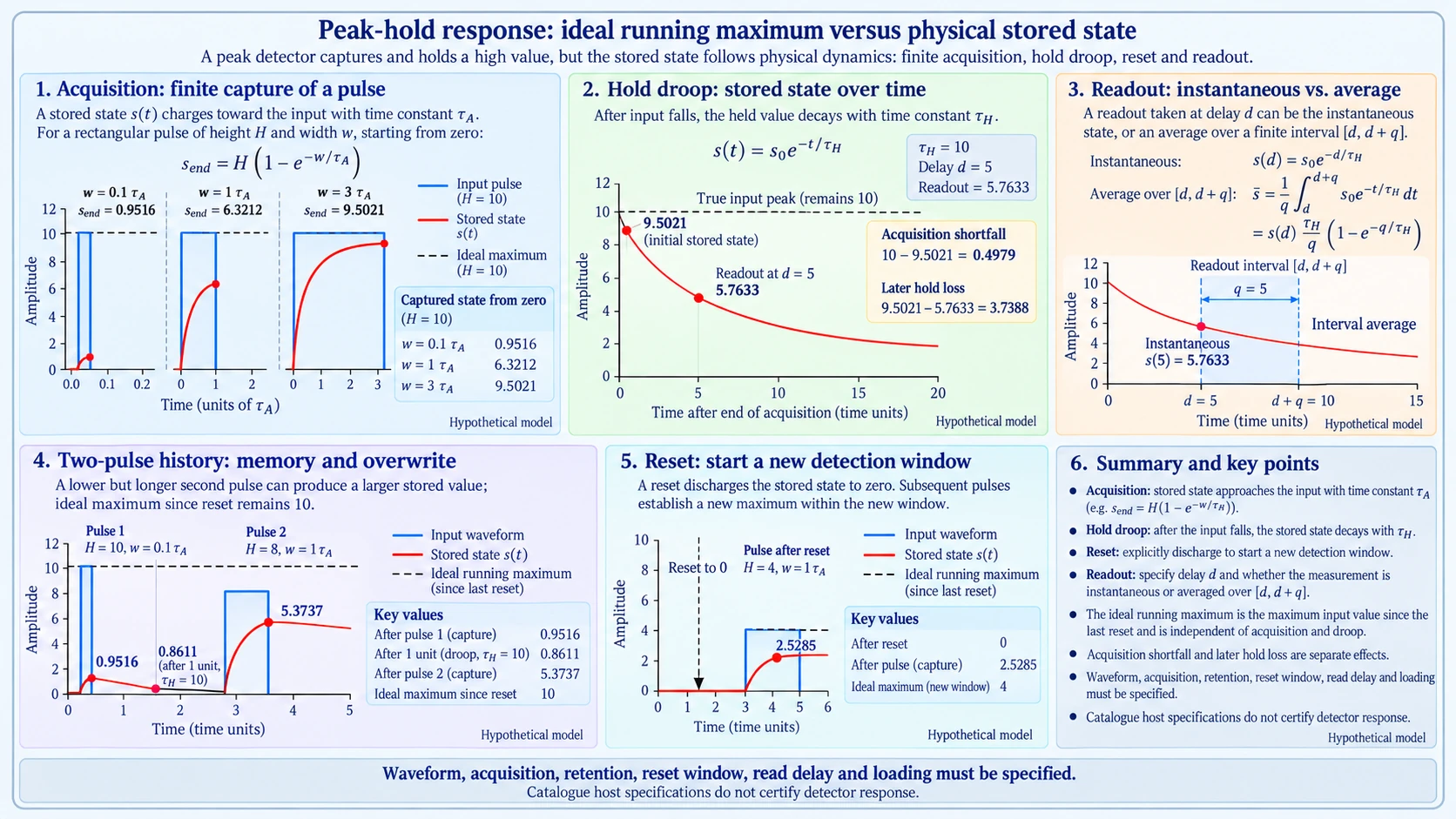
A peak detector can remember a voltage smaller than the highest input pulse even when its readout works correctly. A brief pulse may end before the stored state acquires its amplitude. After the pulse, that state can fall before it is read. Capture error and retention error have different causes and need separate accounts.
peak-hold response is therefore a stateful measurement contract. It depends on the pulse waveform, initial stored value, reset boundary, and readout delay. A number labeled maximum is defensible only when the apparatus has acquired and retained the relevant peak under those conditions.
Define the ideal maximum and a physical stored state
An ideal running-maximum operator begins at a declared reset and returns the largest input amplitude encountered since then. If a pulse reaches 10 and a later pulse reaches 8, the ideal maximum remains 10. The operator has no acquisition delay or retention loss in that definition.
A physical peak-hold detector stores a state s. The input can increase that state through a charging path, while a hold element retains it after the input falls. A readout observes s at a chosen time. A reset establishes a new initial state and a new measurement window. These transitions cannot be replaced by an assumption that s instantly equals every new input maximum.
For the bounded model here, use nonnegative rectangular pulses and an ideal charging threshold: charging occurs while the input exceeds s. During charging toward pulse height H, stipulate ds/dt = (H - s)/tauA. When the input is below the stored state, stipulate hold decay ds/dt = -s/tauH. An ideal instantaneous reset sets s to zero.
The model applies separate simplified laws in the charging and holding states. They are not a complete circuit model or a claim about a commercial instrument. Offsets, charging thresholds, loading, and reset imperfections would need their own apparatus-specific contracts. The example isolates acquisition from retention.
Trace peak detector acquisition during a brief pulse
Starting from s0 below H, a constant-height pulse of duration w leaves sEnd = H - (H - s0) exp(-w/tauA). With s0 = 0, that becomes H times (1 - exp(-w/tauA)). A finite pulse ends with a stored value below H in this model, even if a prompt read has no further hold loss.
Choose H = 10 and express pulse widths in units of tauA. A pulse lasting 0.1 tauA leaves approximately 0.9516. A pulse lasting one tauA leaves approximately 6.3212. A pulse lasting three tauA leaves approximately 9.5021. All three inputs have the same maximum amplitude, but their captured states differ.
This comparison isolates acquisition dependence. Changing the pulse width changes how long the state can approach the input level. It does not change the ideal maximum of 10. A measurement that reports 0.9516 after the shortest pulse has not observed a lower true input peak; it has observed the result of an incomplete charging interval.
The amplifier-slew-rate guide explains how signal amplitude and frequency set the required rate of voltage change. That question matters for peak detector acquisition when validating a charging path. The present model supplies its own first-order acquisition law; a general amplifier specification does not establish this detector's capture behavior.
A real pulse shape also matters. For a ramp or shaped transient, the stored state evolves against a changing input rather than one constant H. The rectangular formula cannot simply be applied to its total duration. A defensible capture claim needs the waveform and the applicable state equation or measured response.
Separate hold capacitor droop from capture error
After the pulse ends, the model enters holding. If the captured value is sEnd, a read delayed by d observes sRead = sEnd exp(-d/tauH), assuming no intervening charging pulse or reset. That loss occurs after acquisition; it cannot be diagnosed solely from the pulse width.
For the three-tauA pulse, sEnd is approximately 9.5021. Choose tauH = 10 time units and read five time units after the pulse. The retention factor is exp(-0.5), giving a readout of approximately 5.7633. A prompt read would have reported about 9.5021 under the same model. The input's true maximum remains 10 in both cases.
The capture error at pulse end is about 0.4979. The later hold loss is about 3.7388. Their combined difference from the original peak is approximately 4.2367. Those numbers identify different intervals in the measurement, so the record should retain the end-of-pulse state and the readout delay rather than present only one aggregate error.
Hold capacitor droop can have another law in a particular device. A stipulated constant leakage current, for example, would produce a linear voltage loss over its valid interval instead of the exponential retention chosen here. The apparatus model determines the correction. Naming a hold capacitor does not select one universal droop formula.
If the readout integrates the retained voltage over an interval, the sampling-aperture guide linked through hold capacitor droop supplies a relevant measurement-window distinction. It explains that reporting averages more frequently does not remove the averaging interval's effect. Here the averaged quantity would be the detector's evolving held state. The acquisition and retention laws still need their own evidence; an aperture model does not establish those laws.
Follow multiple pulses without confusing the measurement window
Start with a reset to zero. Apply a height-10 pulse for 0.1 tauA, giving s approximately 0.9516. Let the input remain low for one time unit with tauH = 10. The state decays to approximately 0.8611. Now apply a height-8 pulse for one tauA.
The second charging interval begins from that nonzero state. The formula gives sEnd = 8 - (8 - 0.8611) exp(-1), approximately 5.3737. The lower but longer pulse produces a larger stored state than the earlier higher pulse. The ideal input maximum across the whole window is still 10.
Reading 5.3737 does not identify which pulse had the highest input amplitude. It reflects the complete acquisition-and-retention history. Treating the stored state's largest observed value as proof of the largest pulse height would ignore how each pulse interacted with the state that preceded it.
A pulse below the current stored state does not begin charging under this threshold rule. The holding law can continue while the input remains below s. If droop later carries s below the pulse's input level, the state transition must be handled then. A formula that assumes one unchanged mode across an entire pulse is valid only if that mode's condition holds throughout.
Trace reset and prompt versus delayed readout
Reset defines the window whose maximum is being sought. If the detector resets after the height-8 pulse, its stored state becomes zero. A later height-4 pulse lasting one tauA then captures approximately 2.5285. The earlier height-10 pulse is outside the new window, so it is not part of the new ideal maximum.
If reset was requested but did not finish before the height-4 pulse, the zero initial-state formula would not apply. A production record needs the actual reset acceptance and completion boundary. The example assumes instantaneous reset solely to make its state sequence explicit.
For a repeatable isolated pulse, compare prompt and delayed reads under the same reset and waveform conditions. A prompt value below H points to capture limitations or other acquisition-path effects. A further decline with readout delay identifies retention loss under the chosen model. Changing both pulse width and delay at once obscures that separation.
The readout itself must fit the retention contract. If connecting a meter changes the storage-node loading, the unloaded holding law may not describe the measured interval. A claim about a stored maximum should record the readout arrangement and its effect on the state rather than assume observation is nondisturbing.
Even a nondisturbing readout can average instead of taking an instantaneous value. Stipulate a uniform measurement window of duration q beginning delay d after pulse end, with no charging or reset during that window. Under the exponential hold law, the reported mean is sEnd times tauH/q times [exp(-d/tauH) - exp(-(d + q)/tauH)]. It lies between the start and end held values for this decay. The prompt-versus-delayed comparison must therefore retain the readout window as well as its start time. Otherwise an averaged declining state can be mistaken for the instantaneous stored value.
State the conditions supporting a peak claim
A defensible measurement specifies the pulse shape and polarity, amplitude range, acquisition response, initial stored state, reset window, and delay to readout. It also specifies which uncertainty and offset terms are included. Without those conditions, two numbers called peak can describe different input windows or different retained states.
For the charging model, a desired fraction of H can be turned into a required pulse duration. Starting from zero, reaching at least 99 percent requires exp(-w/tauA) no greater than 0.01, so w must be at least tauA times ln(100). That is approximately 4.6052 tauA. The result is conditional on the constant-height pulse and stipulated model.
Retention adds another requirement: the read delay must keep its allowed loss within the measurement objective under the chosen hold law. Check acquisition duration and retained-value loss separately. A long enough pulse does not prevent a late read from drooping, and immediate readout does not repair an inadequately acquired pulse.
A bounded calculation can verify the equal-height width cases, prompt/delayed reads, two-pulse history, and reset example. Those tests check the stipulated state model. A physical validation needs independent input-waveform evidence and measured capture/retention behavior; the calculations do not certify an untested detector.
A software notebook can compare pulse widths and readout delays while retaining the initial state for each calculation. The ASUS Vivobook 14-inch FHD laptop is a catalogue example of a computer for that modelling workspace: its listed processor is a Core 5 120U, with 16GB of DDR4 memory. Those specifications describe the host, not the physical detector's charging constant or retention loss.
Keeping a pulse definition beside its calculated state helps expose a reset-window mismatch before interpreting a saved maximum. The Lenovo IdeaPad 15.6-inch FHD touch laptop describes another computer for inspecting such records, with a listed i5-1334U processor and 512GB SSD. A stored result still needs its acquisition and readout conditions to support a claim about peak-hold response.