Office Supplies & Stationery
Stop paper damage during staple removal before it spreads
A damaged edge calls for a document-handling decision before another attempt with a removal tool.
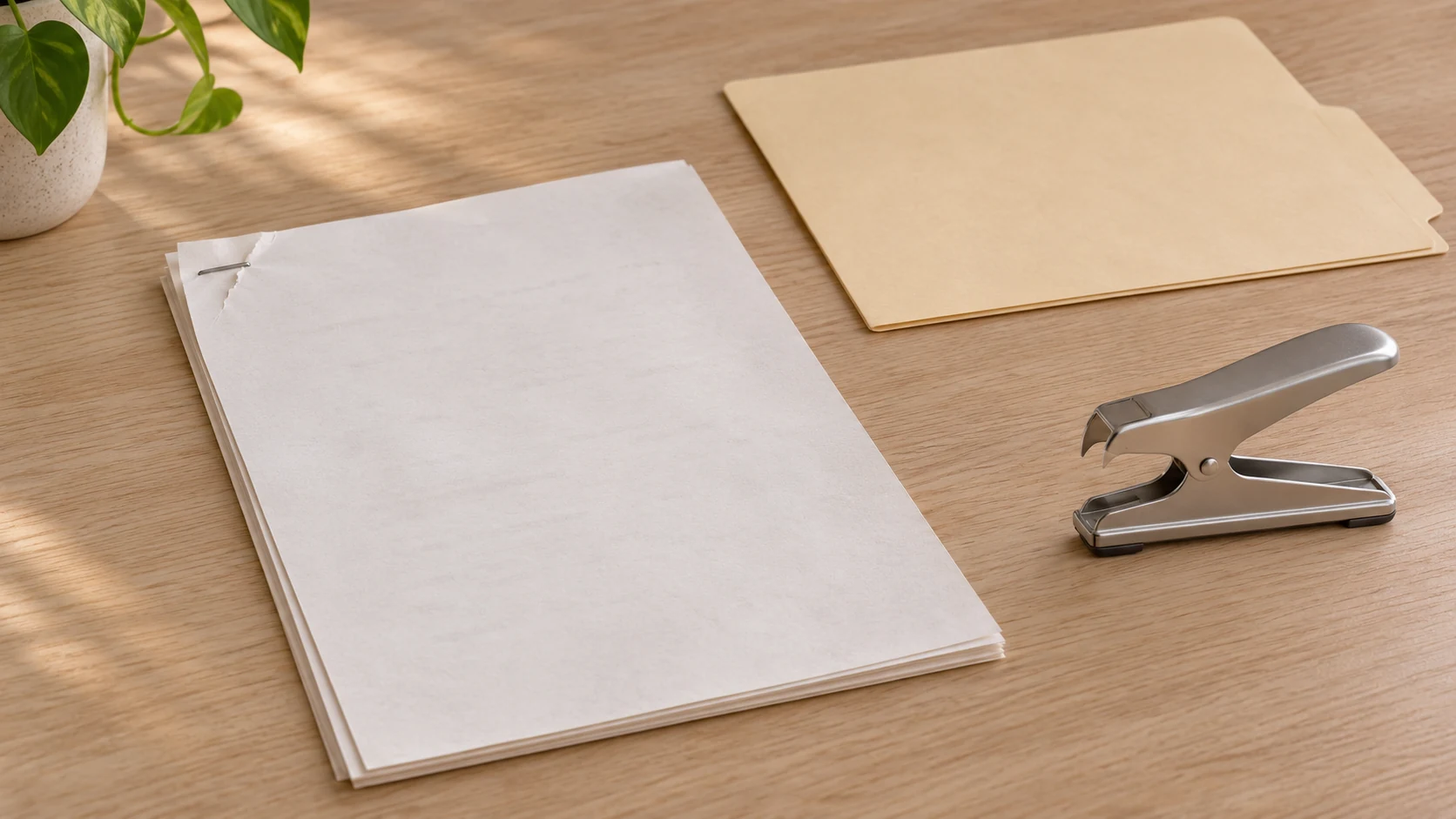
When you notice paper damage during staple removal, pause before making another attempt. NEDCC’s guidance on historic documents explains that fasteners can damage paper, but removing them can also cause damage. That makes the next decision a question about the document and its condition, rather than simply a search for a stronger tool.
Establish why the pages need separating
NARA’s holdings-maintenance guidance distinguishes fasteners that obstruct access to unique information or cause damage from those that can remain. For office fasteners, it notes that leaving them in place is often safer than removal. A fastener removal decision therefore starts with a reason: what information cannot be reached, or what damage is occurring? A wish to make every packet look uniform does not supply the same preservation need.
Keep document association visible while considering that reason. NARA explains that appropriate folders and subfolders can maintain the relationship between records when fasteners are removed. Separating the metal and preserving the grouping are different parts of the work. A loose page still needs to remain connected with its record group and original order.
This guidance concerns records maintenance, not permission to dismantle every unfamiliar item at home. Historic or official attachments may themselves carry information. NARA directs difficult separation questions toward conservation help, including heavy or tightly embedded staples. Leave that uncertainty in the description of the problem when seeking advice.
Treat fragile or historic paper as its own problem
NEDCC specifically advises against using staple removers on historic documents. Its conservation leaflet describes a different, controlled approach and recognizes that fragile paper and rusted fasteners need special care. The existence of that procedure does not establish that an ordinary household attempt is appropriate for an unknown document. This article gives no scraping, prying or extraction sequence.
An unusual historic fastener can also be worth retaining as evidence. NEDCC recommends curatorial judgment and leaving a fastener in place when uncertain. A commercial remover’s name does not answer that judgment. Before resuming work on an old letter or unique record, describe the affected edge, the attachment and the purpose of separating it to the appropriate specialist. Keep the fastener’s historical significance an open question.
A lever remover listing cannot certify a treatment
The Swingline satin-chrome staple remover account describes a heavy-duty, spring-loaded lever tool. Its title offers a bundle of ten each, and the selected count-per-pack option is ten. The catalogue’s bundle field is false. The sole photograph shows one complete silver-colored remover with its base, lever and lifting jaw; it does not independently establish the contents of a delivered order.
Those integral parts belong to one removal tool. There is no separately supplied case, staple stock or conservation accessory established in this account. A faint handle marking is not confidently readable as a factory identity here. Keep the exact listing identity when asking the seller to clarify the quantity and model rather than assigning a model from an indistinct mark.
The account provides no paper-condition assessment, archival suitability finding or demonstrated damage-free result. Heavy-duty wording is a retail description, not evidence that more leverage will solve a torn edge. If the unanswered question concerns the document’s condition, buying this tool cannot supply the missing conservation judgment.
Removing one fastener does not commit you to removing all
The National Park Service’s 2025 fastener-removal considerations describe a case-by-case decision. Processing level, anticipated use, available staff time, preservation needs and digitization plans affect the choice. Removing one attachment need not mean removing every attachment in a collection. That distinction helps keep a local problem from becoming an unnecessary project across the whole box.
Its staple discussion also identifies a difficulty when several staples are present: the prongs associated with the targeted staple must be correctly identified. A heavy staple combined with thin paper presents another damage concern. Neither observation establishes a universal consumer-tool remedy. If the attachment is unusual or tightly adhered, the guidance points to a paper conservator.
For a request for help, retain the specific question. Explain which packet is involved, why separation is being considered and what condition has made the work uncertain. Do not describe the whole collection as needing removal merely because one staple has become a problem. The treatment decision can stay limited while other records remain undisturbed.
Keep an ordinary folder’s role modest
The Staples manila end-tab folder listing describes letter-size folders sold as 250 per box. Its text names reinforced 11-point paper stock and a straight-cut tab. The gallery shows the plain folder form, staged shelf filing and a retail box marked ST56685 and 250 Folders. The box also says 1 UNIT. That shipping-unit wording does not independently verify a delivered folder count.
Keep the identifiers distinct: the listing title includes 613395, the catalogue’s model field says ST56685-CC, and the pictured box says ST56685. They have not been certified as factory aliases here. Applied shelf labels, shelving and hands in the staged image are context, not established supplied contents.
Most relevant to this article, the account provides no acid-free, lignin-free or archival-suitability certification. A folder can illustrate the separate need to keep pages grouped without becoming a recommended conservation enclosure. Ask what enclosure the actual material needs before assigning that preservation role to an ordinary office product. The reinforced-tab claim alone cannot establish it.
Do not hide a tear with an improvised repair
The Library of Congress’s paper-care guidance favors clean handling and appropriate supportive enclosures. Its paper FAQ advises considering whether minor damage can be left as it is, especially where treatment could affect an item’s value. Progressing damage, high value or complex work calls for a conservator. It also warns against self-stick tape, including products described as archival. Resist turning a pause in removal into an adhesive repair attempt. Describing the condition accurately gives a specialist more useful information than concealing the affected edge.
Recognize what professional treatment involves
NARA’s St. Louis Preservation Branch describes specialized treatment of damaged records, including records affected by the 1973 fire. Its account places careful fastener removal within a laboratory workflow. It also describes professional treatment of fragile or torn records and supportive housings. This is evidence of the setting and expertise involved, not a home repair recipe or a demonstration of a retail remover.
Keep that distinction when asking for help with a damaged packet. A professional treatment account can explain why a tool purchase leaves important questions unanswered: the record may require condition assessment, controlled handling and a suitable housing decision. The laboratory’s use of conservation materials does not authorize substituting household tape, glue or an unverified folder.
This article does not transfer cleaning, decontamination, humidification or adhesive procedures from that account into an office task. If those concerns are part of the actual record’s condition, include them in the enquiry to the responsible preservation service. They are additional reasons for a qualified assessment, rather than extra steps to attempt while removing the staple.
Keep access research separate from physical treatment
The postcard archive collection-route guide follows institutional collection descriptions, browsing routes and access information. Its reader is trying to find and understand records available through an archive. That research can help identify which collection or institution is relevant without determining how a physical item on your desk should be treated.
An online description, catalogue entry or access route is not a condition assessment of your own paper. The archive guide also keeps optional paper-storage accounts outside any claim of certified conservation suitability. Preserve that boundary when a retail folder appears beside a preservation question. A browsing project and a treatment decision can involve paper while requiring different evidence.
If your enquiry concerns an institutional collection, use the relevant collection and access route for that enquiry. If it concerns your own damaged packet, identify that different object and ask an appropriate preservation professional. Do not treat a search result as an inspection, or assume that a product mentioned during research has been approved for the physical material you hold.
Do not let a scanning plan settle the removal question
The scanner carrier-sheet compatibility guide requires the exact scanner, accessory part and capture route to be matched. It distinguishes a carrier intended for a documented scanning path from ordinary folders that serve another purpose. That is a separate equipment question from whether a particular attached page should be separated in the first place.
A scanner project can therefore have an unresolved preservation decision before any accessory decision is complete. A carrier name does not establish that a damaged original is suitable for feeding. Nor can an ordinary office folder inherit scanner compatibility because it keeps pages together on the desk. Keep the proposed capture route and the paper’s condition as different questions when requesting advice.
The peer guide’s practical result is an exact compatibility enquiry, with uncertainty retained where the model or part cannot be confirmed. Here, the corresponding limit is narrower: no scanner setup or capture accessory has been selected. Resolve the actual document-handling question with appropriate expertise before treating the equipment plan as permission to resume removal.
Keep the pages associated and the removal paused until the appropriate specialist can assess the document and its attachment.
Keep a possible purchase separate from the treatment decision
If you decide that an ordinary office purchase is still needed, keep its specification separate from the unresolved paper problem. A basket on republeq.com might include a remover or folders without providing conservation advice for a particular document. Confirm the exact offer, selected quantity and current terms before choosing a payment method. A buyer considering crypto needs the same product answers as any other buyer. The product records identify cryptocurrency as an accepted payment category; that does not establish that a particular token or network will be offered for a later order. If USDT is presented for your actual checkout, follow the transaction instructions supplied for that order and obtain clarification from the responsible service when an essential detail is missing. This article supplies no wallet address, network recommendation or transfer procedure. Keep the order reference with the payment information and retain the confirmation produced by the method you actually choose. If either the order or payment status is uncertain, reconcile that uncertainty before considering another payment. An unanswered status is not evidence that nothing happened. Review the applicable delivery, cancellation, return and refund terms for the selected basket, including any terms specific to the available payment method. The folder listing’s quantity labels and the remover’s bundle wording still need their own clarification; a payment option cannot settle them. Likewise, completing a purchase does not establish that the tool should be used on a fragile record or that the folder is an appropriate preservation enclosure. Leave the treatment question with the qualified person assessing the material. Buy only for the ordinary task whose requirements you can actually establish, and keep the supplier’s product answers beside the eventual order record.