Skills & Planning
Paired product average: keep the row pairs together
Three four-row tables keep both column means at zero, while their paired-product averages are 1, 0 and -1. An exact centered cross-term explains the difference.
Write which average the question requests
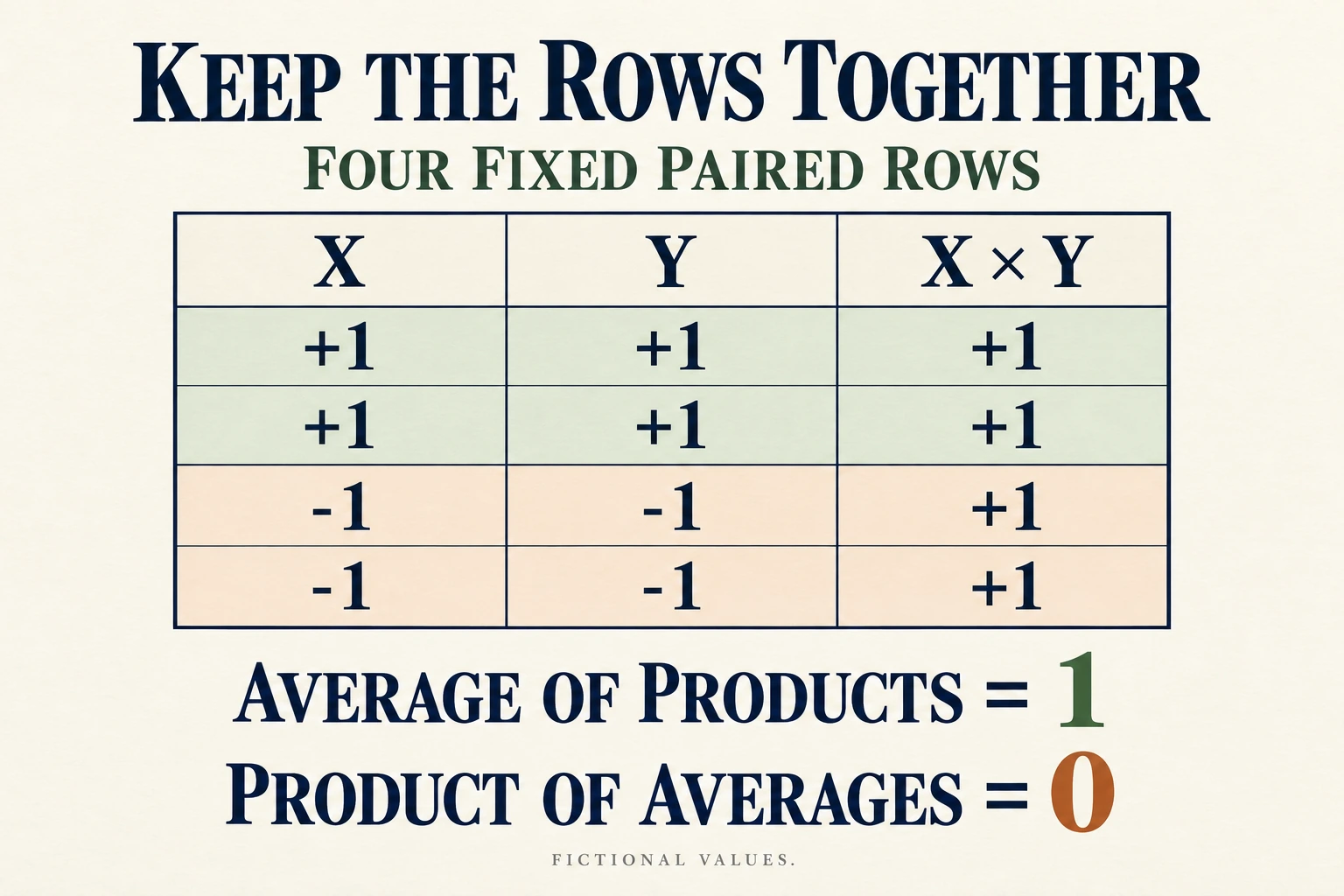
Paired product average uses the product within each recorded row before averaging those products. That is a different calculation from averaging each column first and multiplying the two column averages. In the original four-row worksheet below, both column averages are zero, while the average of the paired products is one. The disagreement is not a multiplication error. The shortcut has discarded the relationship between values occupying the same row.
Use four explicitly paired rows of exact real values, with every row receiving the same weight, one quarter. There are no missing entries, rounded observations or hidden rows. The numbers are invented signed labels, without a physical unit or measurement claim. A row identifies which X value belongs with which Y value. Row labels retain that association during copying. Keep those pairs visible while deciding which operation the question asks you to perform.
Calculate the aligned table completely
For the first table, X is 1, 1, -1, -1 from row one through row four. Y is also 1, 1, -1, -1 in that order. Thus the complete row pairs are (1,1), (1,1), (-1,-1) and (-1,-1). The two repeated pairs remain separate rows. They each carry the stipulated one-quarter weight rather than being collapsed into an unweighted list of distinct values.
Add X's four values: 1 + 1 - 1 - 1 = 0. Dividing by four gives mean X equal to zero. The same addition gives mean Y equal to zero. Their product is zero times zero, which equals zero. Now calculate within each row. Both positive pairs give product one, and both negative pairs also give product one. The four products sum to four, so their average is one.
Keep the failed shortcut attached to its inputs
The expression mean X times mean Y gives the product of two summaries. The expression mean of XY gives the average of four recorded within-row products. In the aligned table their values are zero and one respectively. Recording the two headings beside the answers makes clear which calculation actually returned zero. Calling both results simply the average would hide the operation responsible for the disagreement.
A zero column mean does not mean that every entry in that column is zero. Here two positive entries cancel two negative entries in the sum, while the same-sign pairs give positive products. No row has a zero product. The signed values and their pairing explain this particular result, without suggesting that multiplication by a genuine zero entry would behave differently from ordinary arithmetic.
Change the pairing while preserving both columns
Keep X unchanged and make a separate table with Y equal to 1, -1, 1, -1. Each column still contains two ones and two minus ones. Both column averages therefore remain zero. The new row pairs are (1,1), (1,-1), (-1,1) and (-1,-1). Their products are 1, -1, -1 and 1, whose sum is zero and whose average is zero.
For a third table, retain X again and use Y equal to -1, -1, 1, 1. Both column averages remain zero, with exactly the same values and frequencies in each column. Every row now pairs opposite signs, producing four products of minus one. Their average is minus one. The original column summaries coexist with three different paired-product averages: one, zero and minus one.
Preserve rows when changing their display order
Reordering complete rows changes their printed order while retaining each pair. The products move with those rows, so their sum and equal-weight average stay unchanged. In the crossed table, moving row three ahead of row two gives pairs (1,1), (-1,1), (1,-1), (-1,-1). The products still consist of two ones and two minus ones, giving the same average zero.
Sorting only Y into descending order is a different operation. If X stays at 1, 1, -1, -1 while Y becomes 1, 1, -1, -1, the crossed table has been replaced by the aligned table. Its paired-product average changes from zero to one. No column value was added or removed. What changed was which X and Y values were attached to one another.
Name the missing term for any complete paired table
Let a complete table contain N paired rows, where N is a positive integer and each row has equal weight. Write mX for the average of all X entries and mY for the average of all Y entries. For each row, subtract mX from its X value and subtract mY from its Y value. Multiply those two centered values within that same row, then average the resulting centered products.
Call that final quantity the centered cross-term. The exact relationship is: average of XY equals mX times mY plus the centered cross-term. This supplies a condition for the shortcut to agree: the centered cross-term must be zero. The next expansion explains the identity without assuming that the column means or the original products are zero.
Derive the identity before using it
For one row, expand (X - mX)(Y - mY). The four terms are XY, minus mX times Y, minus mY times X, plus mX times mY. Now average each term over all N rows. The quantities mX and mY are fixed numbers for the complete table, so they can remain outside their corresponding averages.
The average of Y is mY, and the average of X is mX by definition. The expansion therefore gives centered cross-term equal to average of XY minus mX times mY minus mY times mX plus mX times mY. The last three terms combine to minus mX times mY. Rearranging yields the stated identity. Every step uses the same paired rows and the same equal weights.
Apply the cross-term to the three signed tables
In all three original tables, mX and mY are zero. Centering consequently leaves every entry unchanged. Their centered cross-terms are therefore one for the aligned table, zero for the crossed table and minus one for the opposed table. Adding each of these terms to the common product of means, zero, recovers the three paired-product averages already calculated directly.
The crossed table shows that the shortcut can agree on a particular complete table. The aligned and opposed tables show that this agreement is not guaranteed by the separate column means or their value frequencies. Keep an actual equality tied to the rows for which it was checked. It establishes the numerical relationship on that record, without certifying that the two columns have no other relationship.
Check a version with positive entries and nonzero means
Make a separate shifted version of the aligned table by adding ten to every X entry and twenty to every Y entry. X becomes 11, 11, 9, 9, while Y becomes 21, 21, 19, 19. Their averages are ten and twenty. Multiplying those averages gives 200. This altered input keeps the aligned row correspondence but no longer has zero column means.
The actual products are 231, 231, 171 and 171. Their sum is 804, and dividing by four gives paired-product average 201. Centering X by ten and Y by twenty returns the original aligned signed table, whose cross-term is one. Thus 200 plus one equals 201, exactly as the identity requires. The disagreement survives this shift to positive entries.
Check the declared table rather than repairing its appearance
When a worksheet reports zero for the aligned table's paired-product average, compare its working with both requested operations. If it averaged columns first, preserve that zero as the answer to its different calculation, then calculate each paired product. Changing a column entry to force agreement would change the stipulated problem rather than correct the missing cross-term in the shortcut.
If a row was copied incorrectly, retain the original table and record the correction before recalculating. This article supplies no evidence that somebody else's real record should be sorted, re-paired or edited. Likewise, unequal row weights would require a separately stated calculation; an empty table has no ordinary average obtained by dividing by its row count. The identity here concerns a complete finite table with a positive number of equally weighted rows.
Bound the optional dispenser accounts
The OfficeMate tape-dispenser account shows a complete black two-core unit with an integral stationery compartment. Tape, pens, pencil and scissors are pictured staging, not verified supplied stock. Exact maker, model, dimensions, material and performance remain unverified.
The Better Packages dispenser account shows a pale lever-operated unit with a TapeShooter 404 mark and emerging tape. Exact maker authenticity, model, supplied tape or water-brush configuration, material and dispensing performance remain unverified. No loose brush is pictured.
Neither account supplies the paired rows, averages or identity. Their role is optional paper-workspace context, and the exercise requires no purchase.
Leave other summary and product questions distinct
The pooled median guide constructs two datasets with identical subgroup summaries but different pooled central ranks. This table instead keeps complete paired columns and computes row products. No pooled median or sorting-based central position supplies its cross-term.
The matrix shape compatibility guide checks whether complete rows and columns have matching lengths before a matrix product exists. All pairs here are already supplied. The failure is a shortcut between two defined scalar calculations, without an undefined array product.
Keep a transaction enquiry outside the table
If you separately consider a tape-dispenser order on republeq.com, assess the current offer and transaction before choosing how to pay. The signed rows and averages in this worksheet are invented mathematical inputs, not product quantities, prices or cryptocurrency instructions. Before using USDT, inspect the actual checkout and determine what that particular order presents. Check the requested amount and denomination, the receiving destination displayed, any network instruction, and the order status before sending funds. These are questions to resolve, rather than statements that an option exists for either offer. Confirm that the item and intended quantity match your proposed order. Resolve product and supplied-content questions separately from payment instructions. A photograph does not authenticate transaction terms. Keep the current instructions, their date and the result of any action you actually take, distinguishing a pending step from a completed payment. If the selection changes while you are checking, review the resulting transaction instead of carrying an earlier conclusion across automatically. Determine what the merchant currently supplies about delivery, cancellation and any refund process before relying on it. Do not assume a transfer can be reversed or a particular network will be supported. This conditional checklist makes no claim about token acceptance, transfer success or available remedies. You can complete the paper worksheet without buying either offer. A table average cannot authenticate a payment destination or show that an order has been accepted. The actual purchase needs its own clear and current order-specific evidence, and its records belong separately from this abstract exercise. Retain unanswered questions beside the proposed transaction.
Save the operation with the pairs it uses
Keep the aligned table's product average one beside its product of column averages zero. Retain the crossed and opposed tables separately, with results zero and minus one. The centered cross-term records the exact difference in each case. A complete record preserves the row pairs, equal weights and requested operation, so a later display change cannot quietly replace the calculation you meant to check.