Outdoors & Mobility
packing cube bag type compatibility: Match each item to a travel organizer
Match folded clothes, thin accessories, shoes and toiletries to the organizer type that holds them and stays accessible in your luggage.
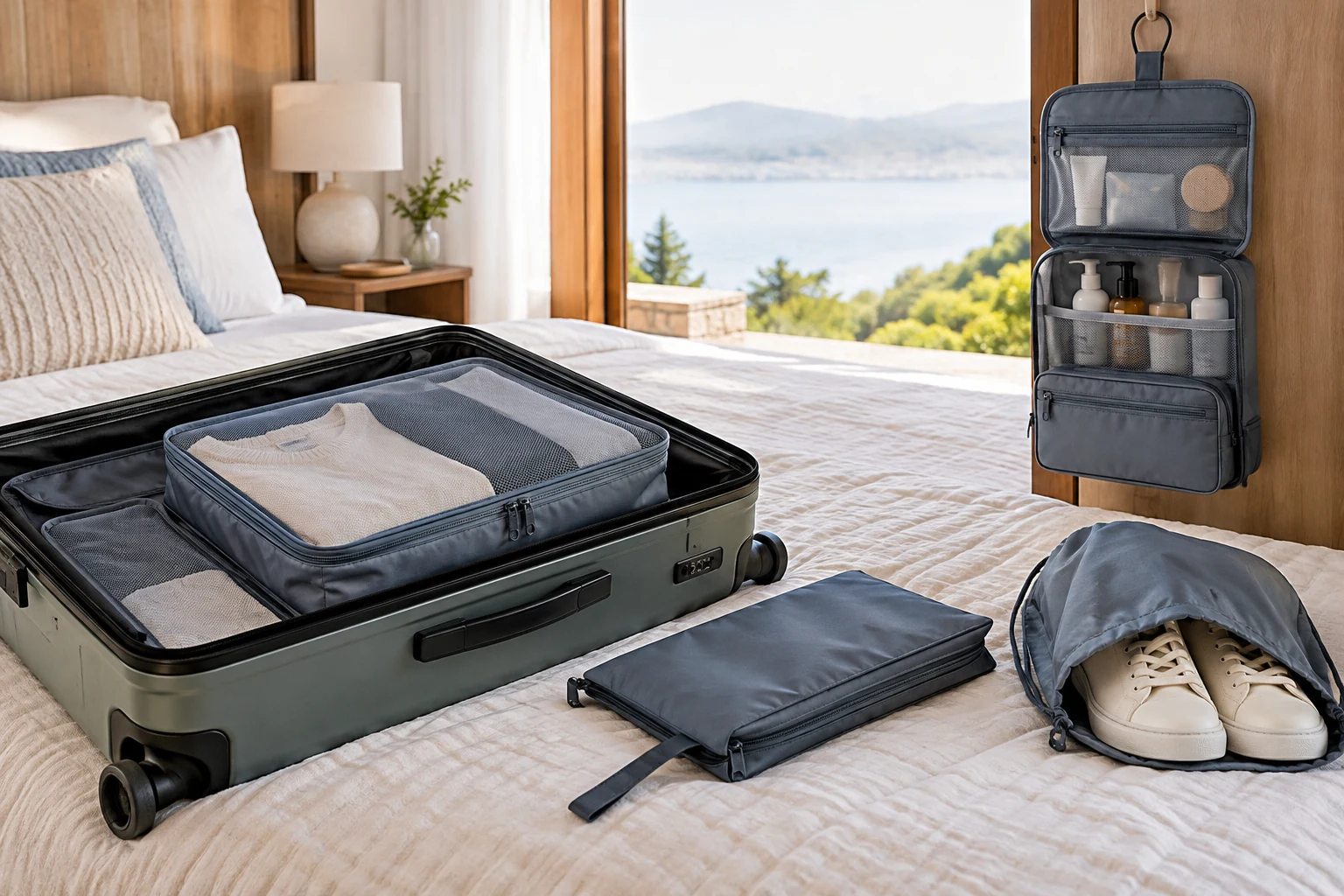
Packing cube bag type compatibility begins with the item, not the organizer. A folded stack of shirts, a pair of shoes, loose socks, and a bottle of shampoo ask for different shapes and levels of access. Putting everything into the same kind of cube can make a suitcase tidy for a photograph but frustrating during the trip. Before choosing a piece from a travel set, identify what it must hold, where it will sit in the luggage, and when you will need it. Those three questions make the accessory decision more useful than the printed piece count.
Set out the items for one real trip. Fold the clothes as you normally would, keep the shoes together, and group toiletries in the containers you plan to carry. Then try each group in a bag you already own or against the listed dimensions of a proposed piece. A bag that looks suitable when empty may be too shallow for the folded stack, too long for a suitcase corner, or inconvenient to open when you need one item. Treat a catalog description as a starting point for this fit test, not a promise that your exact load will work.
Match the bag shape to the physical load
A packing cube is a reasonable candidate for a coherent group of folded clothing. Its rectangular form can keep several garments together, and a mesh panel may let you see the top layer. It is less helpful if the group contains one rigid object that distorts the cube, or if you must repeatedly open the zipper for a tiny item. Try placing the actual folded stack inside the proposed footprint. Leave a little room to close and reopen the bag without forcing the zipper. A perfect edge-to-edge fit on paper can be awkward in fabric.
A flat zip bag serves a different shape. Thin socks, scarves, or small fabric accessories may sit well in a low-profile pouch, particularly when you can slide it into an available gap. Thick rolled clothing may make the same bag bulge, reducing the advantage of its slim outline. Do not assume a flat bag is a smaller clothing cube merely because both have zippers. Ask whether the item remains easy to remove and return after the bag is loaded. That repeated-use test matters more than the empty bag's appearance.
A shoe bag should be tested with the shoes you will pack. Bring the pair together in the orientation that actually fits: soles facing, heels offset, or side by side. Adult sneakers, children's shoes, and bulky boots have very different outlines. A product listing that includes a shoe bag does not establish that every pair will fit. If the shoes are too long or deep, use another suitable barrier or choose a different layout. Do not squeeze a pair so tightly that you cannot close the bag or retrieve it without emptying the suitcase.
A hanging toiletry organizer is useful when its compartments suit the containers and the destination setup. It is not an automatic substitute for every small pouch. Place your actual closed containers beside the listed compartments, and consider whether the organizer can fold once filled. Keep any transport or screening rules as a separate decision; the presence of a toiletry bag in a packing set does not establish that its contents meet them. The question here is whether the accessory physically organizes the items you have and remains workable where you use it.
Read mixed sets by piece type
One current BHAHB seven-piece travel set lists three packing cubes, three flat bags in different sizes, and a shoe bag. The listing describes mesh and double zippers. That combination offers several shapes, but the individual pieces are not interchangeable. A folded clothing stack should be compared with the cube footprint; a flatter collection belongs in the flat-bag comparison; shoes require their own fit test. The package count does not answer which piece fits a particular item.
A current AGUA AGANKKUA six-piece set describes compression packing cubes and also includes a shoe bag and hanging toiletry bag. The listing mentions mesh panels and two-way zippers. Compression language does not establish a fixed reduction in the size of your particular garments. Test the packed dimensions and the ease of opening after loading. A bag can technically close yet become annoying if you need to unpack several layers to reach one shirt. Treat each piece as an accessory with a specific load, rather than counting all six as equivalent cubes.
Make a short matching table on paper: item group, candidate bag type, packed outline, and access frequency. For a set containing several piece types, fill one row at a time. If a row has no useful candidate, do not force an item into the wrong bag to justify the set. If several pieces could work, try the one that keeps the item easy to retrieve and return. This table makes a shopping comparison concrete while leaving room for the actual trip to decide what belongs together.
Check closure as well as storage. A cube may fit the folded clothes but sit so full that its zipper strains. A flat bag may close around socks yet become lumpy and consume more depth than expected. A shoe bag may separate footwear but leave no convenient place in the case. These are physical fit results you can observe. They are more reliable than assuming a bag's name determines its usable load. Leave a modest margin for fabric movement and for items that will be repacked less neatly during travel.
Check the organizer against the suitcase
The accessory must fit the luggage too. The separate suitcase packing-space guide covers the difference between a size label and usable interior space. Use that measurement before deciding where the loaded organizers can go. Wheel housings, a curved shell, handles, and interior pockets can interrupt a neat rectangular layout. A cube that fits inside the case by itself may conflict with the shoe bag or toiletry organizer once all the pieces are loaded together.
Place the bulky clothing group first, then test the smaller pieces around it. Avoid treating every space as something to fill. You will need room to open the case, take out an item, and put it back. If a flat bag slides behind a cube but cannot be retrieved without removing the cube, that location is a poor match for something used daily. Reserve difficult positions for groups you will not need until arrival. Access frequency is part of compatibility, not an afterthought.
Try a full rehearsal. Pack the real items, close the luggage without force, and then retrieve one named group as if you were in a hotel room. Return it and close the case again. If the arrangement only works on the first packing attempt, change the bag type, the item grouping, or the placement. Do not solve a failed layout by buying another organizer before you understand the space problem. Another piece adds separation but cannot create more suitcase capacity.
Watch for changes after use. A clothing cube may become partly empty after the first outfit is removed and shift position. A shoe bag may become unnecessary if the footwear is being worn. A toiletry organizer may stay at the destination while the suitcase is moved. Consider where each piece lives during the trip, not only at departure. The accessory that fits a packed object at home should also fit the repeated motions of retrieving, carrying, and repacking it.
Keep transit items reachable
Some items need to be reached before you open the main suitcase. A pillow, eye mask, or other comfort item used en route may belong in a separate accessible bag. The neighboring travel rest kit packing routine handles that reachability and return-path decision. A packing cube can organize a group at the destination, but placing a transit item beneath clothing cubes defeats the access requirement. Decide when the item is used before assigning it to an organizer.
Small essentials can present the same issue. A charger or medication container may fit a flat bag physically, but its needed location may be different from that of clothing accessories. Keep any safety, storage, or transport requirements specific to the item in their own plan. Bag fit alone does not settle them. The useful test is both physical and practical: does this piece hold the item, and can you reach it at the moment you need it without undoing the rest of the packing?
Shared luggage adds another access question. If two travelers use one case, placing everyone's socks in one flat bag may save space but complicate retrieval. Separate pieces can be useful when each person needs an independent group, although the suitcase must still accommodate them. Test a complete morning routine: open the case, find the right bag, take out one item, and return the bag. A layout that works for the person who packed it may not be obvious to someone else.
Visible mesh and labels can help recognition, but they are not substitutes for a clear arrangement. If all bags look similar, assign stable positions or use a simple written list. If the bag's contents change each day, update the grouping rather than relying on a label from the first packing session. Compatibility includes being able to identify the correct piece after items move around. A small number of well-matched accessories may be easier to manage than many almost identical ones.
Use one trip to confirm the match
At the end of a trip, note which bag types actually held their intended loads. Did the cube keep folded clothing together? Did the flat pouch remain flat enough to fit its planned gap? Did the shoe bag accept the pair without a struggle? Could the toiletry organizer fold and hang where you used it? These observations identify a working combination for your own items. A bag that stayed empty is not a failure; it is evidence that its role was unnecessary on this trip.
Keep the useful pieces and adjust the awkward ones. A different garment fold may solve a marginal fit, but do not force a bag to perform a role it does poorly. The next trip may have another suitcase, footwear pair, or access pattern, so repeat the simple test when the load changes. The purpose is not to find one universal packing layout. It is to know which accessory type suits each item group and where that loaded piece works in your luggage.
Packing cube bag type compatibility is a chain of observable fits: the item fits the bag, the loaded bag fits the suitcase, and the item stays reachable when needed. The two cited sets illustrate why a cube, flat bag, shoe bag, and toiletry organizer should be assessed separately. Start with the actual load, rehearse the arrangement, and keep the pieces whose roles held up during travel. That gives you a practical match without promising a precise capacity or relying on the set's headline count.