Office Supplies & Stationery
over-door file organizer clearance: diagnose the door path before loading pockets
A door-path check for hanging file pockets: identify the contact point, test reach, and evaluate a wall location only after its mounting conditions are known.
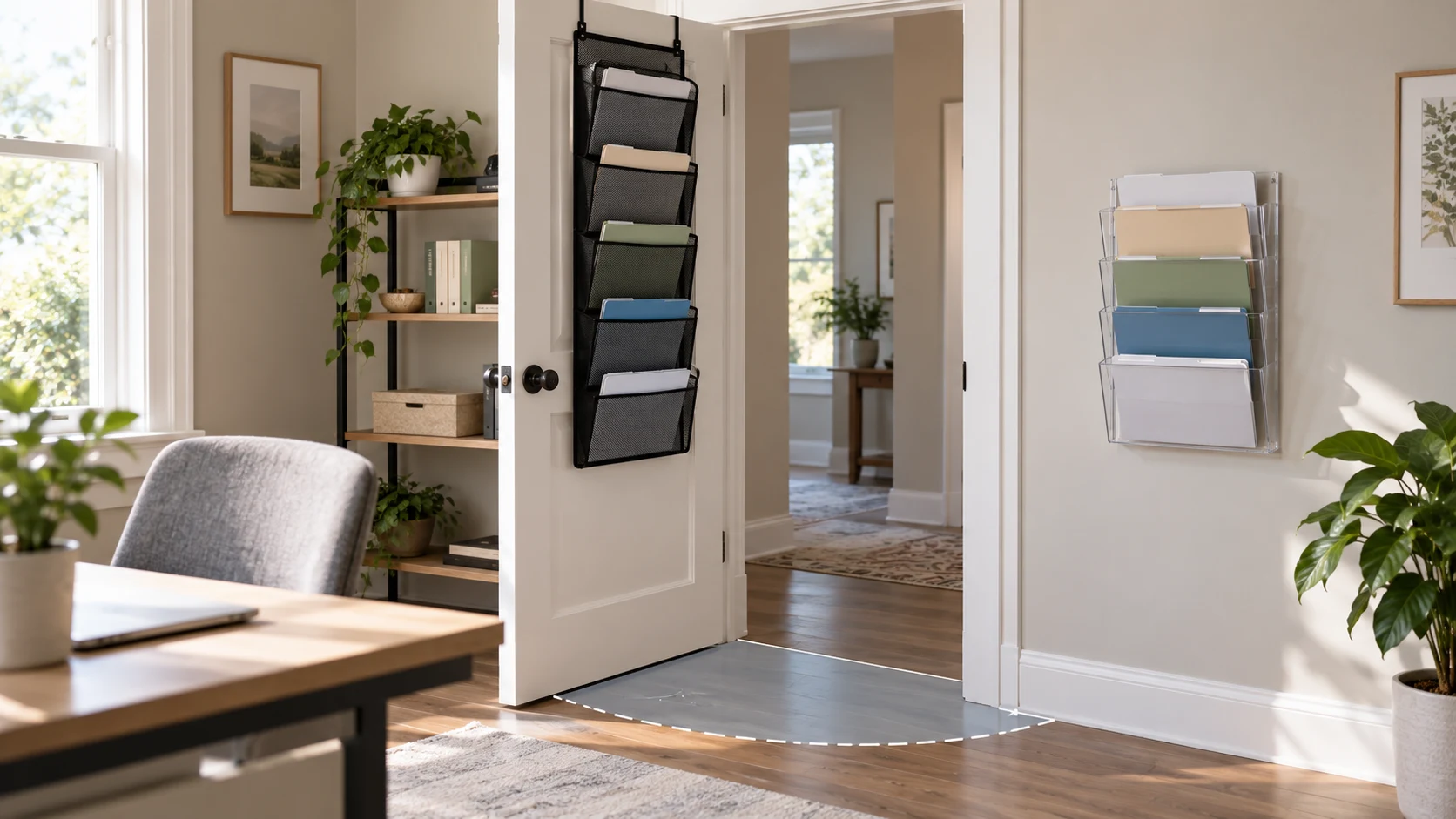
An organizer hung over a door can look fine while the door is still. The problem may appear only when someone closes it, opens it fully, or walks past with a folder in hand. For an over-door file organizer clearance check, leave the pockets empty and identify the exact point of interference before changing the papers inside. The top hooks, pocket projection, door swing and nearby trim can create different problems. A separate wall location may solve one of them, but only after that location is checked too. Do not assume a product picture proves fit on your door.
Find the point where the door path fails
Start with the door operating normally, without a holder on it. Open and close it slowly through the range people actually use. Look at the top gap between door and frame, the side near the hinges, the handle side, and the space the door occupies when fully open. A holder can collide with the frame at the top, bump an adjacent wall, brush a cabinet, or put pockets where people pass. These are separate observations. Record which one occurs rather than saying only that the organizer “does not fit.” If the door itself already catches, address that condition before testing an accessory.
Next hold a paper template or the unloaded organizer in the proposed position without fastening or loading it. Keep control of the item and do not let it fall or strike the door. Watch the whole door path from both sides. At the top, a hook that appears thin from the room may still meet the frame as the door closes. On the face of the door, the bottom pocket may reach a handle, a raised panel, or a surface people touch. Beside the door, a wall or piece of furniture may block the projected pockets when the door swings open. Mark the first contact point.
If there is no physical collision, ask whether the location remains usable. Can a person open the door without stepping around the holder? Can someone remove a folder without standing in the doorway or pulling against a moving door? A location that allows the door to close can still be awkward for ordinary retrieval. Try the movement at normal standing height with the door stationary. Keep these access questions distinct from the folder-width and pocket-depth tests in the public guide to wall file organizer folder fit. That guide owns the paper-to-pocket fit decision; this one diagnoses the path around the mounted holder.
Read the two mounting routes as possibilities
The native over-door file organizer listing describes a five-tier metal holder with detachable, stackable pockets and says the pockets may be used on a desk, wall or door. Its gallery depicts hooks over a door. Those observations show why it is reasonable to test a door route, but they do not establish the thickness of your door, the top clearance under your frame, or an installed load limit. Treat the pictured arrangement as a concept to check on site. Do not infer that every pocket must be stacked in the shown order or that the product arrives ready for every door.
A distinct clear wall-pocket listing describes six separate acrylic pockets and says mounting hardware is included. Its gallery shows separate clear holders rather than a long unit draped over a door. That makes a wall location a possible alternative when the door route fails. The listing does not verify the condition of your wall, the hardware appropriate to it, the support available behind it, or where the installed pockets would land. Its title contains malformed punctuation, so use the native description and gallery for the limited physical comparison, and verify the current offer before making a purchase decision.
Neither route is automatically better. A door hook avoids selecting a separate wall position but places the holder on a moving surface. Wall pockets avoid the door leaf if installed outside the swing, yet they require an appropriate mounting surface and a position people can reach. A separate wall holder can also obstruct a door if mounted too close to its travel. Think of the two listings as examples of different placement questions. The decision is whether the actual door path and actual wall space can accommodate the chosen arrangement, not whether one product photograph looks neater.
Check the top gap before the pockets
For an over-door arrangement, the first measurement is the usable gap where the hook would sit while the door is closed. Do not rely on a gap measured with the door open. The frame, weatherstrip, hinge alignment and any change in the door's position during closing affect the path. If you have the actual hook or a verified dimension from the current seller, compare it with that specific gap without forcing the door. A paper template can help identify likely contact, but it does not reproduce the hook's stiffness or exact shape. If the door begins to resist, stop the test rather than pressing through the obstruction.
Check whether there is a closer, seal, latch or other part near the top that the hook might touch. A top clearance that works on one side of the door may not work at another point along the edge. Try the intended hook positions, not an arbitrary spot in the middle. Avoid relying on a universal “standard door” measurement; the relevant opening is the one in front of you. If the listing does not give the hook dimensions you need, mark that fact unresolved and obtain the current specification or measure the actual item before deciding. Do not invent a clearance from the gallery image.
Sometimes the door closes but rubs at the top. That is still a failed fit. Repeated contact can make the door harder to use, and a moving door may shift a loosely placed holder. The article does not establish what contact is harmless for your door or finish. Remove the test item, record where it touched, and decide whether another approved position is available. If not, stop treating this as a pocket-capacity problem and examine the separate wall route. The important diagnosis is the physical conflict, not a promise that a thinner looking hook will cure it.
Trace the swing and the reach
Now check the door face and swing arc. When open, the door may approach a nearby wall, desk, shelving unit or other object. The pockets add projection on the face where they hang, and their contents may add still more. Use the current item's actual depth or a conservative physical mock-up rather than guessing from a front photograph. Move the door slowly through its normal path with the organizer empty, then reconsider the path with the kind of folders people would genuinely place there. A route that works unloaded but cannot accommodate ordinary use is not a workable location.
Pay attention to which face of the door carries the holder. A room-side location may affect furniture clearance, while a hall-side location may affect people moving through the opening. The latch and handle may remain free, yet lower pockets could land where someone leans or reaches. Look from the viewpoint of the next person who uses the door, not only from where the organizer will be seen. Keep the trial reversible: use a temporary outline or hold the unloaded item securely rather than drilling, loading or modifying a door before the fit decision is made.
Test access while the door is stationary in the position in which papers would be retrieved. Can a person see the pocket opening, reach the top and bottom positions, and remove a normal folder without twisting around a door edge? Do not substitute a stack of empty paper for an actual working folder if the ordinary packet is thicker. This check is about the human path to the holder. The paper workflow guide about intake, action and completed documents covers how pockets can be assigned tasks. A good workflow cannot rescue a physically inaccessible or door-blocking location.
Evaluate the separate wall position
If the door route fails, mark the door's full travel area before choosing a nearby wall. The wall pockets must sit outside the swing and away from the handle side if people need that space to pass. A wall position just beyond the door may look clear when the door is closed and be hidden behind it when open. Put a temporary outline at the proposed location and repeat the door-path and retrieval checks. This is the same method applied to a stationary mounting surface: first clearance, then reach, then the ordinary contents.
Inspect the wall itself separately. The clear-pocket listing says hardware is included, but that does not establish that the supplied pieces suit every wall. Identify the actual surface, what may be behind it, the allowed installation method and who is authorized to make changes there. A renter, classroom or shared office may have different restrictions. Do not improvise a fastener recommendation from the product image. If support or permission cannot be verified, keep the wall option pending. A different product route does not remove the need for a reliable installation decision.
The separate pockets may be arranged with space between them, but the native page does not prove a specific arrangement will fit your available wall. Lay out the actual pocket dimensions and the gaps needed for a hand to reach the contents. Also consider whether a person can see the lower pocket without bending into the door path. An organizer mounted high to clear furniture might become hard to use; one mounted low might be hit by a chair or carried bag. These are site observations to make before installation, not product performance claims.
Make one decision from the observed constraints
Write a short record for each route: where it would go, the verified product dimensions or unresolved measurements, the first point of collision if any, the position of the door when papers are taken out, and the mounting question still open. This keeps the choice tied to actual evidence. If the over-door route fails at the top gap, a wall holder outside the swing may be worth evaluating. If the wall has no approved mounting location, the door route does not become acceptable by default. Both may be unsuitable for that doorway, and another location may be needed.
Do not use the number of pockets as a shortcut. Five stacked pockets and six separate pockets create different physical layouts, but count alone does not tell you whether the door can close or someone can reach a folder. The native descriptions also do not establish a loaded projection for your particular papers. Once the placement route passes, then check the folders and packets the holder must carry. The separate folder-fit article can help with that later test. Keep the decisions in order so a paper problem does not get mistaken for a mounting problem.
If a product page changes, repeat the checks against the current item. A new hook shape, pocket depth, hardware set or quantity could change the physical decision. Preserve the measured doorway and wall observations, because those are still useful, but do not assume an old listing describes a revised offer. Check the item received before any permanent installation. If its actual mounting parts differ from what was verified, pause and reconcile the difference. The same caution applies if a gallery and text disagree: uncertainty is a reason to inspect, not a reason to pick the convenient claim.
The answer to an over-door file organizer clearance problem is a specific contact point and a verified route around it. Start with an empty door-path test, confirm the top gap and swing, then test ordinary retrieval. The over-door metal-pocket example belongs only on a door that actually accommodates it. The separate clear wall pockets belong only where the wall position, mounting method and reach are established. If either condition is unresolved, leave that option pending. This produces a placement decision that can be checked again without inventing dimensions, load capacity or universal fit.