Food & Groceries
Check orzo ingredients when rice-shaped pasta causes confusion
A practical way to clarify an orzo request, compare scoped ingredient descriptions and ask for the current package information before choosing an offer.
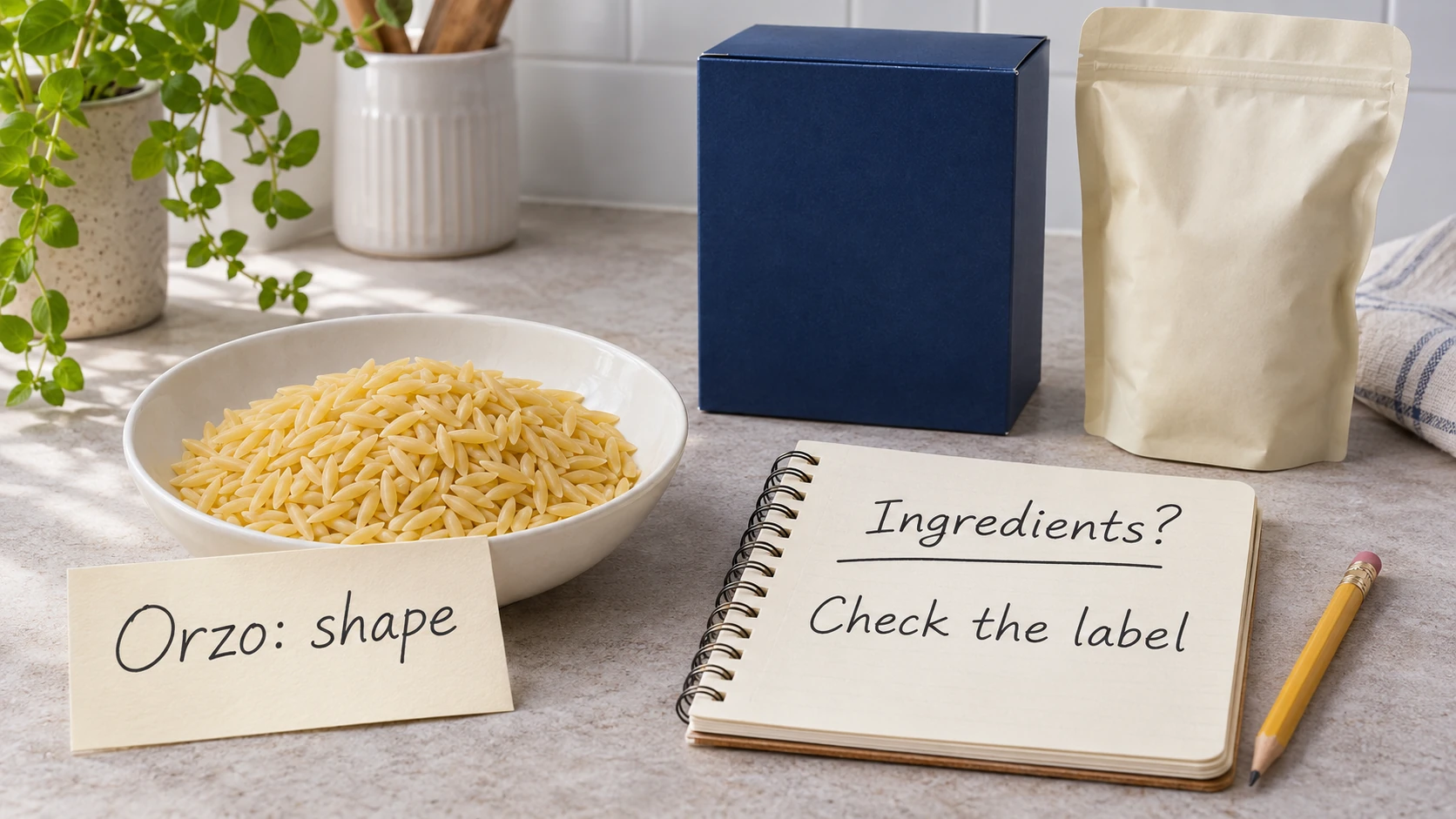
You have a shopping note that says “orzo,” but the picture makes you think of rice. Before choosing an offer, ask what the note is asking you to buy. The question about orzo ingredients may concern a shape, a particular formulation or an instruction that the requester has not yet explained. A clear follow-up can keep an uncertain shopping request from becoming an assumed ingredient decision.
Recognize rice-shaped pasta
RiceSelect’s current Tri-Color Orzo page describes its own product as a small, tomato- and spinach-flavoured pasta made with enriched durum semolina wheat. It compares the appearance with large grains of rice. That gives the phrase rice-shaped pasta a specific use: it describes what this named pasta resembles. The producer’s comparison with rice does not turn its stated wheat formulation into a rice ingredient. Keep the product account attached to that observation.
The same producer page includes a broad orzo-versus-rice explanation framed around wheat pasta. Another producer supplies a different example. That broader wording should therefore stay within the formulation being described, rather than becoming a claim that every product called orzo has identical ingredients.
A second producer describes a different formulation
DeLallo’s current Gluten Free Orzo page describes a corn-and-rice pasta. It states a blend of 70 percent corn and 30 percent rice, and calls orzo a tiny cut shaped like barley or a grain of rice. Those are the producer’s statements about its named product. They show why the shape word alone cannot supply a complete formulation. They do not establish the contents of an unidentified packet or authenticate a particular retailer’s shipment.
The DeLallo page also makes facility, certification and texture claims. This guide has not independently tested those claims or established suitability for an individual. Its current manufacturer SKU and UPC are a separate reference from the retail account discussed below; no code equivalence is assumed. Use the actual supplied package information when making the final ingredient decision.
Read the two selected retail accounts
The Barilla Orzo account describes durum wheat semolina and a case of sixteen 16-ounce packs. Its sole original image shows a Barilla ORZO box marked “enriched macaroni product” and one pound, with a pasta window and a serving suggestion. It does not show a complete ingredients panel or a readable barcode. The stated case quantity cannot be counted from that one pictured box.
The DeLallo Orzo account describes twelve 12-ounce packages. Its single original front image says “Made with Corn & Rice” and carries gluten-free and wheat-free wording. A complete back ingredient panel and readable UPC are not shown. The pictured cut number 65 is retained separately from the native catalog model 86292; their relationship has not been authenticated.
Both selected accounts concern packaged orzo, with different stated formulations. Their photographs do not verify full delivered inventories, complete ingredient panels or the condition of a shipment. A source description and a pictured package claim remain the evidence actually available here, rather than a report of food received or cooked.
Read ingredient disclosure
FDA’s Types of Food Ingredients page explains that ingredients are listed in descending order of predominance by weight. It also preserves exemptions to the listing requirement, including certain incidental additives. The page’s table distinguishes functions such as enrichment, preservation and colouring. Read ingredient disclosure through its actual wording and scope. The guidance does not inspect either offer or provide an individual dietary assessment.
FDA’s account helps explain why a list is worth obtaining rather than reconstructing from a familiar product name. Its explanation is broader than this shopping question. Here the useful task is to locate and read the information for the particular package under consideration, while keeping an absent or partial panel recorded as a limitation.
Clarify the request before choosing a package
Consider this original shopping example. Nina writes “orzo for the soup” on a shared list. Ari, who is collecting the shopping requests, adds “rice?” beside it. Neither person has named a brand or selected a package. The question mark is Ari’s uncertainty. It is not Nina’s instruction to replace the requested item or a record that she has accepted a particular formulation.
Ari can ask, “Do you mean the orzo pasta shape, or rice as an ingredient?” That question gives Nina two different things to clarify. If Nina replies only that she means the shape, Ari has learned something about the request while still lacking any separate ingredient requirement. Ari should keep the unanswered part visible rather than complete it from her own guess.
For this example, Nina’s reply is, “I meant the shape. Please ask me about the package before ordering.” Ari rewrites the note as “orzo shape; package still to be agreed.” That is the entire fictional reply. It supplies no instruction about an allergy, a medical diet or a particular grain. The shopping note is now more useful because it records what was said and leaves the remaining choice open.
A different reply would need a different note. Nina might instead say that the ingredient is the point of her request and ask Ari to send the complete package information. Ari could preserve that instruction exactly. It would be premature to write the name of an offer beside it as if a selection had already been made. The answer to one question should remain distinguishable from an order decision.
In either version, Ari can send a photograph or transcribed information for the actual package being considered. She can identify the offer alongside it and say which information is still missing. The example does not require her to predict what Nina will approve. It gives the two people a clear next conversation without reporting a purchase, a prepared meal or an outcome they have not observed.
Keep the answer attached to the exact offer
A useful question to a merchant can be brief: “Please confirm the current ingredient information for this exact offer and the package that would be supplied.” Include the offer reference through the service’s supported channel. If a photograph is provided, retain it with the answer so that later correspondence can refer to the same package. A response about a differently named item should remain a response about that item.
You can also ask whether the information describes an individual package or the selected order. That keeps a formulation question separate from a fulfillment question. Do not fill a gap in one answer with a number from another field merely because both appear on the same page. Record the uncertainty in ordinary language, such as “current ingredient panel not yet supplied,” so another person can understand what remains to be answered.
When the response arrives, read it beside the original question. Check whether it actually addresses the package you named. A useful reply may resolve one point and leave another open. You can acknowledge the part answered without treating the entire shopping decision as finished. If the requester needs to make the choice, send the information back to them rather than presenting your interpretation as their approval.
Suppose Ari receives “This is the small pasta in the blue box.” That identifies what the responder is pointing to in the fictional exchange, but it does not reproduce an ingredient statement. Ari can reply, “Thank you. Could you send the current ingredient panel for that package?” She need not treat the first answer as useless or rewrite it into a complete approval. Keeping both messages lets Nina see what was actually supplied and why a follow-up was still necessary.
If a photograph is difficult to read, say which part you cannot make out. Ask for a clearer account rather than silently completing a word or identifier. Preserve the first image alongside any clarification. That makes a later correction understandable, while the final shopping note can use the information that was actually confirmed.
Keep the recipe’s role clear as well. In the example, the shared note refers to a recipe, but its complete instructions are not reproduced or changed here. An answer about a package does not create a revised recipe. Any later decision to use a different product belongs with the actual recipe and the person making that decision, with the relevant information available to them.
Two related guides answer different questions
The baking powder ingredient guide reads a leavener’s base, acid and formulation alongside reaction timing. It keeps manufacturer descriptions and dated specifications within their scope. That chemistry question does not determine which grain formulation a request for orzo intends.
The salt-clumping guide separates the ingredient’s identity and storage history from a passive vessel’s openings. It does not diagnose pasta or supply a rice remedy here. The current problem is an unclear food selection, not joined salt grains or a shaker mechanism.
Leave a clear shopping record
Return to the note that started the question. You may now have a clearer request, an offer reference and an answer about the package. Keep those actual results together. If an essential answer has not arrived, the record should still show that gap. Someone taking over the shopping should be able to see the next question without having to reconstruct which assumption was yours.
Checking orzo ingredients means keeping a pasta’s shape separate from its stated formulation.
Review the order before payment
In Nina and Ari’s invented exchange, a reply about a pasta shape leaves the order open. Before placing a real order at republeq.com, the payer needs the actual selection and the authority to purchase it. A shopping note alone is not an instruction to send funds. If someone wants to use USDT, first establish whether the responsible service offers that option for the intended basket. An article mentioning the token cannot establish its availability. Once an actual crypto route is offered, compare the token and chain named by that service with the transaction the wallet is preparing. Obtain the requested amount, recipient details and order reference from the supported order process, and resolve a disagreement before submission. Do not substitute details from another order or from a remembered message. Include applicable transaction fees and any stated conversion terms in the review. Read how cancellation, returns and refunds would work for the chosen method, rather than assuming that changing a food selection also cancels a transfer. Retain the service’s instructions with the order acknowledgement and any transaction identifier actually produced. A wallet result and the merchant’s order status may answer different questions; keep an uncertain result open while it is checked through the verified channel. Reconcile the existing attempt before deciding whether any further payment is needed. In a shared purchase, give the person paying the agreed item reference and the unanswered package questions. Let that person make an informed decision about proceeding. A successful payment message supplies no new ingredient information and reports no inspection of delivered food. The requester and payer should be able to trace the selection they actually agreed without relying on a familiar box colour or the shape of the pasta.