Problem-Solving Articles
Salt clumping in a shaker: check the ingredient and storage history
Identify the ingredient and the question your vessel still needs answered.
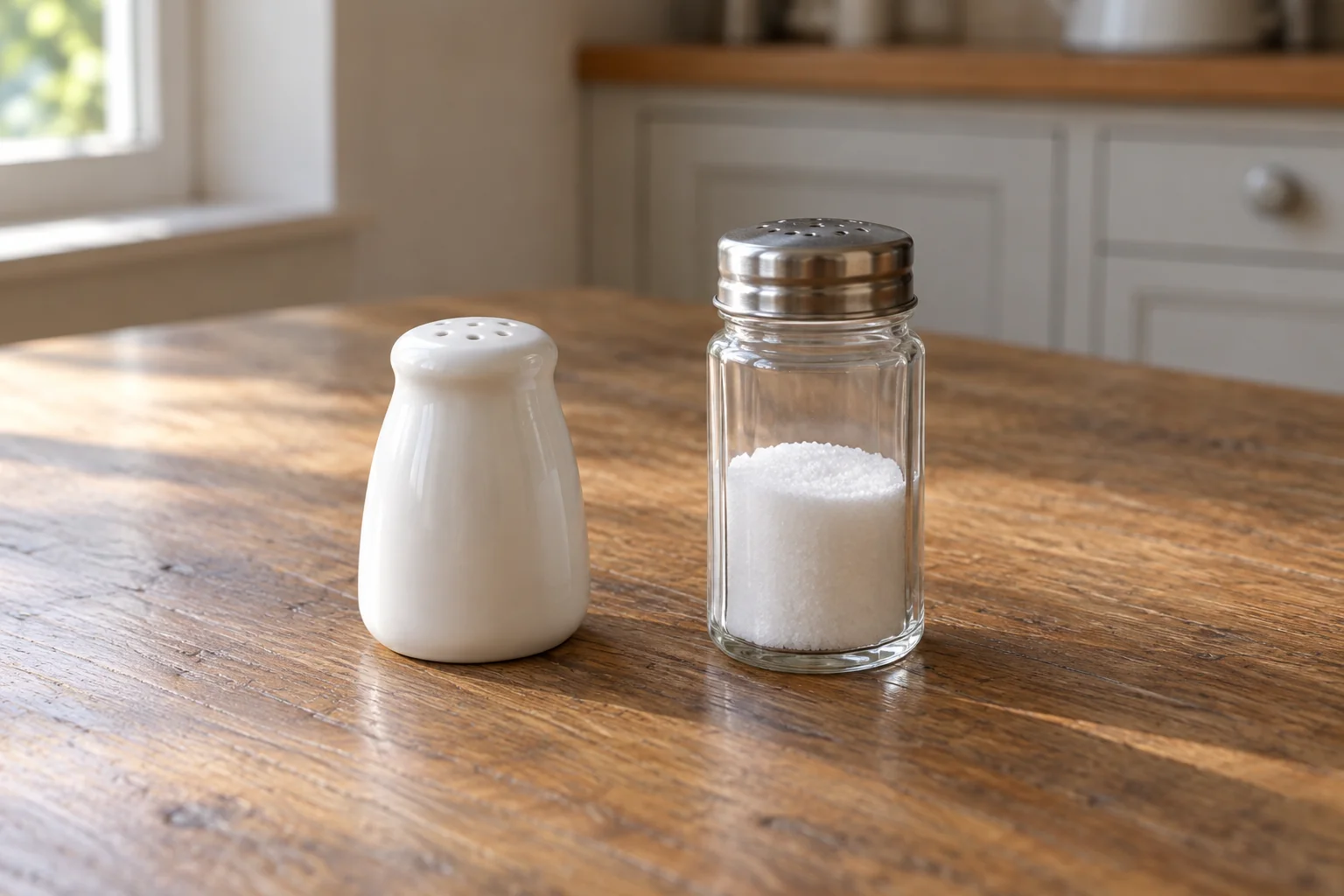
When you notice salt clumping in a shaker, begin with what you can actually see. Joined grains, a closed dispensing opening and a damaged container are different observations. Tell the person helping you which one you mean. If the only description is that nothing comes out, leave the cause open while you identify the ingredient and vessel. A replacement purchase can wait until you know what question it would answer. The aim here is to understand the reported problem without inventing a cleaning method for an unidentified shaker.
Begin with the actual salt packet
Morton's food-salt FAQ identifies calcium silicate as an anticaking ingredient in its iodized salt, alongside potassium iodide and dextrose. Its storage advice calls for a cool, dry place away from cooking, or an airtight container when that location is unavailable. Those statements concern the manufacturer's salt. They do not establish that the contents of an unmarked shaker are that product, or that every salt has the same additives. Retain the actual ingredient package if you need to clarify what was used to fill the vessel.
Morton's expiration guide also separates salt itself from salt products containing other ingredients. Its named recommendations differ according to the product and whether additives, iodine or seasonings are involved. Use the applicable package information instead of treating a clump as an age test. That guide's advice about tapping or shaking a package is not an instruction to strike a glass or stoneware shaker. Use its applicable care information.
Read salt storage conditions with their scope
Utah State University Extension identifies moisture and temperature as important food storage conditions. It explains that environmental moisture can affect stored dry foods and can also damage some packaging materials. Its examples include deterioration of paper and rusting of metal. Keep a question about the ingredient package distinguishable from a question about its contents. Its discussion concerns food storage broadly. It does not examine your filled shaker or establish why its contents have changed. Use that distinction when reviewing salt storage conditions: describe where the ingredient package was kept, then distinguish that location from the place where the filled vessel normally sits.
The same guidance discusses direct sunlight and the heat it can add to a storage location. A convenient countertop position and a cupboard may expose food to different conditions, but this article has no measurements from your kitchen. Describe the actual location without assigning it an invented humidity or temperature. The university's discussion also includes other foods and a wheat storage study. Those accounts do not provide a salt-specific shelf life, a test of either selected vessel, or a diagnosis that the contents are safe to eat.
Why joined grains can become a lump
Researchers reporting in ACS Omega studied sodium chloride through controlled wetting and drying experiments. In one part of their work, a liquid bridge between two salt crystals left a solid crystalline bridge as water evaporated. That is a direct observation of grains joining in their experimental arrangement. It gives a physical explanation for caking without establishing that a blocked opening is the only possible problem in a household shaker. Their controlled samples and equipment were different from a filled kitchen vessel. They examined crystals at different scales, using microscopy and a two-crystal arrangement to observe the contact area. They compared samples with and without the studied additive.
The study also investigated an industrial anticaking additive and how it changed crystal surfaces and bridging. That work supplies no home additive recipe here. It does not authorize treating your salt with a chemical, reproducing the laboratory procedure, or assigning a guaranteed result to a replacement container. Keep the useful distinction: the researchers observed changes in the salt itself. A claim about a dispenser's material or lid does not, on its own, describe the history of the grains inside it.
An additive-free salt has its own account
Redmond's answer about clumping describes its Real Salt as having no anticaking or flow additives. It explains moisture uptake and grains sticking together within that product account. Keep that formulation statement with the named salt; it cannot identify a refill from another package. Redmond says its clumps generally break up easily unless exposed to substantial moisture. That is its account of the salt, without a test of your filled vessel or a documented force to apply. The answer also suggests rice in a shaker, without establishing separation or suitability for either intended vessel. This guide supplies no rice remedy. Follow the actual food and vessel information without adding an unverified material to solve the reported problem.
Before seeking help, write a short description that someone else could understand without handling the vessel. For example, distinguish grains already joined in the ingredient package from grains you first noticed after a refill. If you do not know when they changed, keep that timing unknown. Someone else's recollection can be recorded as their account, without becoming your own observation. Add the ingredient name only when you have established it. This is a way to state the question accurately, not an experiment or a confirmed explanation.
Keep spice guidance with spices
McCormick's storage FAQ recommends tightly capped containers for herbs and spices, away from heat, moisture and direct sunlight. It advises using a dry measuring spoon and avoiding sprinkling seasonings straight into a steaming pot, because moisture can enter the bottle. That is useful context if the container under discussion holds one of those seasonings. It does not turn an unidentified mixture into table salt, or document the washing and drying procedure for a separate retail jar.
McCormick also distinguishes its quality dates from an automatic verdict about flavor or consistency after opening. Read the applicable package information for the actual seasoning involved. The FAQ lists different recommended ranges for ground spices, whole spices, leafy herbs and blends. Identify the relevant category before using its storage account. This article does not extend the FAQ's broad comments about older spices into a safety judgment about unknown or contaminated contents. Nor does it transfer the suggested loosening actions in that FAQ to the selected vessels. A storage recommendation and permission to put an object inside a particular container are separate matters.
Shaker pour holes are described settings, not measurements
The Unbranded six pack of glass spice jars describes a capacity of seven fluid ounces per jar, with a diameter of 2.16 inches and height of 5.37 inches. Its stainless steel and plastic rotating tops have fine, medium and coarse pour openings. The description says the tops screw off for refilling. These are the offer's stated features, without a demonstration of the jars or a verified fit between a particular salt grain and an opening.
For shaker pour holes, the listing supplies named choices, without aperture measurements or calibrated serving amounts. Seven fluid ounces is a volume capacity. Its dust and moisture language is a seller claim, without an independent seal or leak test.
Read the stoneware offer's actual identity
The second listing titled Nora Fleming Stoneware Pinstripe salt and pepper shakers records its brand as NOBRAND. Preserve that distinction when identifying the offer. Its description gives dimensions of 6.75 by 2.75 by three inches without labeling the axes or explaining what assembly those measurements cover. It states dishwasher and microwave suitability, but supplies no complete cleaning procedure, temperature setting or account of how filling access works. Those omissions remain unresolved.
The title identifies stoneware shakers; it does not establish an adjustable opening arrangement like the one described for the six glass jars. The two offers therefore do not answer the same control question. Neither listing demonstrates that changing vessels will resolve the clumping you observed. If a particular supplied feature determines a purchase, establish that feature for the actual offer. A familiar name in the title cannot authenticate the recorded NOBRAND item or supply instructions missing from its description.
If the actual device grinds pepper
A vessel that grinds whole pepper has a separate mechanism question. The guide to a Peugeot pepper mill that is not grinding addresses identified manual mills and their applicable contents, movement and dry care. It also preserves a conflict between the Paris offer's adjustment descriptions. Those model-specific accounts do not supply a brush, rotation or disassembly procedure for either passive shaker here. Identify the actual device before treating that other guide as the relevant branch. Its result cannot diagnose joined salt grains in a different container. That guide also separates manual-mill questions from its manufacturer’s electric-mill branch. A battery or motor question needs its own applicable information; it is not another step for these passive vessels.
The useful boundary is the task being reported. A question about a documented grinding mechanism belongs with that mechanism's instructions. A question about a passive vessel's openings belongs with the actual vessel, while the ingredient's storage guidance remains with the ingredient. Keep the distinction in any request for help so a reply about a pepper mill is not silently applied to the shakers.
Keep a recipe quantity separate from pouring
If the concern is how much salt a changed recipe calls for, the guide to scaling recipe quantities on paper treats the original amounts, units and proposed arithmetic as a separate worksheet. A shaker's opening label cannot perform that calculation or establish a teaspoon-to-weight conversion. Retain the actual recipe and its ingredient identity when asking the quantity question. This article supplies no substitution, revised salt amount or cooking instruction. A calculation also cannot establish whether the contents of an unidentified container match the recipe.
The worksheet guide keeps the original line visible for comparison and leaves practical cooking decisions unresolved. Changes to portion count do not establish corresponding changes to cooking time or equipment. The guide leaves those practical questions with their own applicable information. Follow that separation if both questions arise during the same meal preparation. Resolve the recipe wording and arithmetic through their own applicable information. Then keep the vessel's dispensing question distinct, without treating a displayed calculator result or a larger pour opening as permission to change an ingredient amount.
Finish with what you learned
Keep the description of the problem beside the information you actually located. You may now know the ingredient's identity and its storage guidance while still lacking the vessel's applicable care instructions. That is a useful, limited result. If the original symptom has not been checked again, leave the outcome unreported; if it remains, say so plainly. Decide whether a purchase would address a particular documented need before choosing an offer. Keep the unanswered question specific enough for someone to answer without guessing what you filled, moved or cleaned.