Office Supplies & Stationery
Read an original list poem through a rehearsal room
An original poem makes a scarf, cup, chair, folded programme and strip of light part of one imagined room.
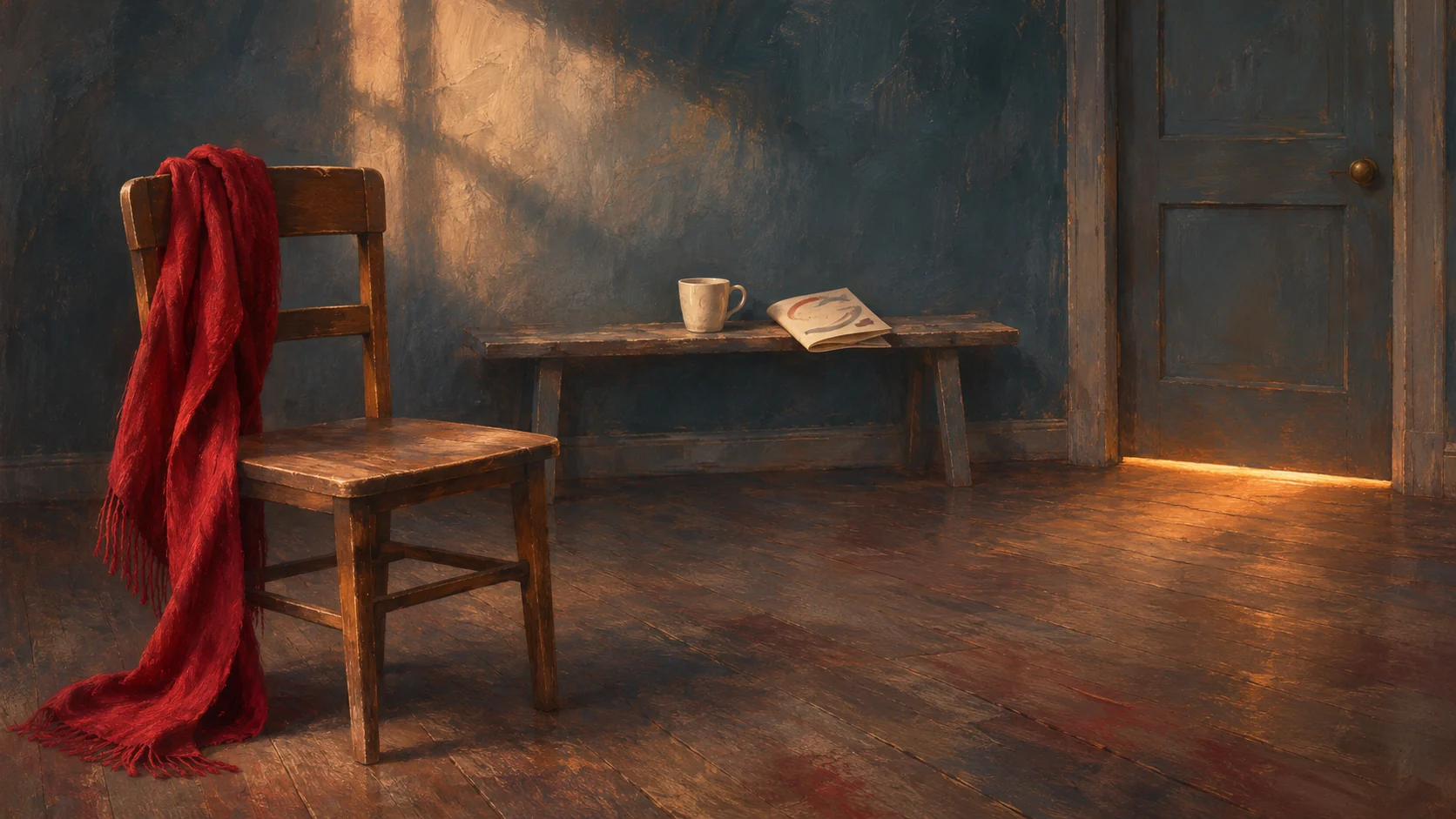
This list poem gathers a rehearsal room’s chosen objects after an invented evening. What Stayed After Rehearsal contains a red scarf, a cup, an empty chair, a folded programme and light beneath a door. I wrote the complete piece below, then considered what each selected thing contributes to this particular room. The speaker, rehearsal and objects are fictional. No property inventory, musical performance or actual gathering is being reported.
Here I use the name list poem for this authored piece built around selected things. I am explaining the work actually on this page, without giving a definition that every poem must satisfy. Its stanzas have no spelling handoff, hidden letters or counting condition. The objects are not a shopping list or a set that a reader needs to collect before writing.
Read the complete original poem
The red scarf keeps the curve of a shoulder
along the chair’s hard back.
I remember a hand lifting it
while another hand held open the door.
Now one end reaches toward the seat,
and the other has nothing left to follow.
The cup is waiting beside the folded paper.
No name leans across its rim.
I bring my own cup close, then take it away;
I would know mine by the small turn of its handle.
This one remains where somebody set it,
with the last warm-looking colour of the room inside.
The chair has been pulled out from the wall.
Its seat is empty beneath the scarf.
I leave the space in front of it clear,
as if someone might still need to stand there
and finish the sentence
that the open door carried into the hall.
The programme has closed around the evening.
Its middle crease holds a white ridge of light.
I do not open it to find the names.
I remember a thumb resting on the corner,
keeping a place for someone
who had already begun to listen.
Beneath the door, a narrow light remains.
No one is holding it out to me.
It lies across the floor without a hand,
without a folded corner to turn back.
I leave it at the end of what I noticed,
then put my own cup down outside the room.
The rehearsal room is made from selections
The rehearsal room has no complete floor plan in this poem. The wall, door, chair and place beside the paper give the speaker somewhere to look, but I have not described every surface. I selected a few things that could belong to the same invented evening. Their presence makes this particular page, rather than proving that these are the objects every rehearsal leaves behind.
The poem also does not identify everybody who attended. A shoulder, hands and a thumb enter through the speaker’s invented recollections. I kept those small parts beside the objects instead of supplying a cast list. The programme could have given me a way to name people, but I wrote the speaker leaving it closed. That decision belongs to this version, where the room’s remaining things receive more space than an explanation of the event.
A list of all the room’s contents would be another piece. It might include a clock, stacked chairs, a cupboard or a broom. I have not established those objects in this poem, and I do not need to add them merely because a rehearsal room might contain them. The authored scene is limited to what these stanzas actually put on the page. Its omissions are creative choices, without a claim that an inspection found nothing else.
chosen objects
The scarf comes first because I wanted its shape to carry a trace of someone before the poem names an empty seat. Its two ends do different things in the stanza: one reaches toward the chair, while the other has nothing to follow. I chose that last phrase for the departure it leaves unfinished. It is figurative language within an invented poem, not an observation that fabric knows where a person has gone.
The cup introduces the speaker’s own object alongside something unclaimed. Bringing one cup close to the other gives the speaker a small action, rather than leaving the whole piece as a view from the doorway. The line about a handle belongs to this fictional speaker’s way of recognising their own cup. It offers no marking or identification procedure for real property, and the warm-looking colour reports no measured temperature.
The chair stanza makes an empty place around the scarf. I did not add a second person sitting down. The speaker leaves room for a sentence that has already gone into the hall, an image I chose for the unfinished conversation. Nothing in the poem establishes who spoke it or what its words were. Those details remain unwritten; there is no correct missing reply for someone to recover.
The folded programme introduces a different kind of remaining thing. It contains names in the fiction, but the speaker does not open it. I preferred the remembered thumb holding a place to a summary of who performed. That small gesture lets the stanza stay with the object’s use during the invented evening. I have written no actual programme, repertoire, performer history or claim about how a rehearsal ought to proceed.
The strip of light is my last selection. It differs from the things a person could pick up and carry away, and I wanted that difference in this piece. Its stanza names no hand holding it. The speaker then takes their own cup outside, leaving the remaining light where the poem has placed it. This ending does not require the room to become completely dark or the abandoned things to receive owners before the page can stop.
A separate stanza I did not choose
I also wrote this possible clock stanza: The clock above the cupboard / keeps its hands apart. / I look up for a reason to leave, / then look down before I have read it. / The room has no appointment with me; / my coat is already outside.
That is actual new material, kept apart from the selected poem. It would introduce a cupboard and a reason to look for a time. I preferred the cup’s small movement outside the room as the ending I wanted here. The unused stanza is not a mistake that the selected version repairs. It is another authored direction whose new objects and action I can name, rather than a vague instruction to make the poem more urgent.
If I placed that stanza before the light, the speaker would look upward before returning to the floor. I could write that enlarged version in full later. For this article, I keep the complete selection already printed above. I am not asking a reader to imagine an unwritten better arrangement or accept an asserted effect on every audience. The selected ending is a particular choice I can show in the words themselves.
Read the sequence that is actually written
The chosen objects move from the scarf’s remembered shoulder to the speaker’s cup, then to a seat, a closed programme and light. I keep that sequence because it gives this speaker several different ways of being near what remains. They remember, compare, leave a space, decline to open something and finally go out with an object of their own. These actions belong to the poem I wrote.
I did not arrange the stanzas alphabetically or make the last word of one dictate the first word of the next. Nor did I hold one prose sentence unchanged while trying different printed breaks. Such conditions would create other composition tasks. Here the stanzas were written freely around their selected things. The author’s choice concerns this actual group of images and the small ending they lead toward.
The word remains appears early in the cup stanza and again near the end. Those local repetitions can stay without becoming a required line carried through every stanza. I am not calling the poem a completed rule check. The whole piece is available to read beside these comments, including the lines that do not receive an explanation. A selected object does not need a single fixed symbolic meaning to have a place in this particular poem.
Optional Fredrix canvas accounts
The Fredrix TF1072 Style 580 account describes an acrylic-primed cotton canvas roll. Its description says sixty-one inches by six yards, while its listed size says fifty-nine inches by six yards. That width discrepancy remains unresolved. The only image is a white woven texture crop, without a whole roll, identifying label, measured dimensions or inspected contents.
The Fredrix Dixie account titles a seventy-two-inch by three-yard acrylic-primed canvas roll. Its short description gives Brand New, a UPC and FREDRIX FX10171. Its only image is also a woven white texture crop. Those native declarations and surface appearance do not authenticate a whole roll, factory model, fibre, primer, dimensions, condition or delivered quantity.
Neither account supplied the poem’s room or objects. No selected retail canvas was painted, cut or used for writing this work. The accounts remain optional buying context, with texture-only photographs kept distinct from whole-product authentication. The poem provides no rehearsal, painting, storage or media-compatibility procedure.
Two different poetry tasks
The same-words line-break guide holds one complete stone-and-ribbon sentence and its punctuation fixed while comparing printed line groups. This list poem instead supplies newly written object-centred stanzas. It does not claim that only the breaks changed, and its selection is not a comparison of two arrangements of one unchanged sentence.
The wind-chime word-chain poem carries each line’s final word into the next line’s opening. Its actual example checks that particular spelling condition. These rehearsal-room stanzas use no such handoff or matching task. Their sequence comes from the author’s selected objects and actions, without a hidden answer to reconstruct.
Purchasing independently of the poem
You can read or write this poem without buying a painting surface. If you separately consider a Fredrix order from republeq.com, keep the exact offer and unresolved questions together. For TF1072, ask about the sixty-one versus fifty-nine width descriptions and the actual selected roll. For Dixie, ask for any essential model, dimensions or contents clarification that the texture-only photograph cannot establish. A response about one item does not authenticate the other item or replace checking the selected order. Retain the actual question and response so their scope stays visible. If you prefer crypto such as USDT, check which cryptocurrency options the merchant actually presents for that transaction before deciding whether to proceed. This article establishes no available asset or network and supplies no transfer instructions, wallet address, exchange rate or fee estimate. Read the current amount, asset, network, receiving information and order reference provided by the responsible service. Ask the merchant or payment provider to clarify an essential instruction that remains uncertain. Review applicable delivery, cancellation, return and refund terms, including any cryptocurrency conditions shown for the order. Keep any acknowledgement and distinguish an order’s status from a payment’s status. If another person places the order, share those exact references so both of you are discussing the same proposed purchase. If an earlier attempt remains unresolved, reconcile it before beginning another payment. No payment response settles an unverified roll dimension, material or supplied quantity. Nor does a completed transaction verify the events of this fictional room, the value of an artistic choice or a reader’s response to the poem. The creative work remains complete while an optional purchase stays undecided.
Keep the selected poem beside its alternatives
What Stayed After Rehearsal ends with the speaker’s cup outside and the light still across the floor. The scarf, chair and folded programme remain in the complete piece as written. I would save that selection beside the separate clock stanza, keeping each identifiable. This list poem has its own chosen objects and ending; another room can begin another work without supplying a verdict that this imagined evening has not made.