Musical Instruments & Listening
Shorten an original melody ending for Small Return
A complete original written melody keeps its opening, answer and return while its author compares a busy final phrase with a shorter closing choice.
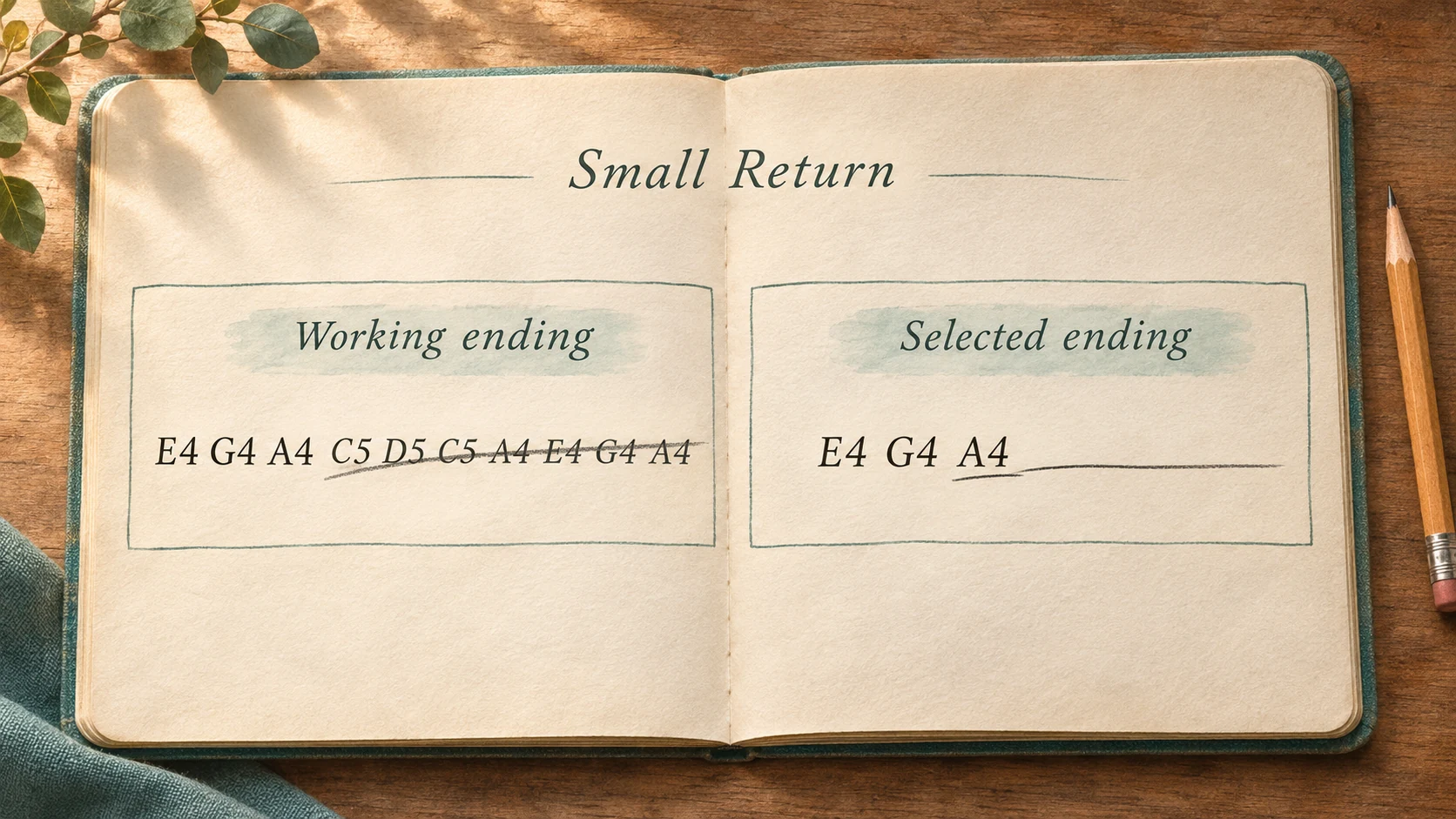
The working melody ending of my original piece Small Return reaches A4, then wanders upward before arriving there again. I want the close to stay at that first arrival. Here is the complete written piece, including the longer ending I am replacing, so the change can be considered beside the music that leads into it.
Small Return is newly authored for this example. Its pitch names define a written composition, with no claim that a retail harmonica has played it or can produce its complete range. The revision expresses my preference for this particular piece. Another author could keep the longer close and write a different account of what they enjoy about it.
Read the complete working piece
Use an even, unhurried pulse throughout this written version. Each note lasts one pulse except the last note of each phrase, which lasts two. Move into the next phrase after that longer note, without adding a separate rest. These durations belong to the composition as written here; they are enough to distinguish its ordinary movement from each phrase’s held finish.
Opening: A4 C5 E5 D5 C5 A4 G4 A4. Answer: C5 D5 E5 G5 E5 D5 C5 A4. Return: A4 C5 D5 E5 D5 C5 A4 G4. Working ending: E4 G4 A4 C5 D5 C5 A4 E4 G4 A4. Apply the same final-note duration to each of these four phrases. This is the complete working version, not a fragment with a missing note to guess.
I hear the opening as a small departure and return because it begins and ends on the same written A4. The G4 immediately before its last A4 gives me a detail I want to remember later. That description is my response to the piece I have written. It does not assign a fixed emotional meaning to either pitch.
The answer begins at C5 and reaches G5 before coming back to A4. I want that higher visit to remain the broadest upward gesture in this version. The return phrase then begins like the opening but changes its middle and stops at G4. It leaves the final movement into A4 available for the ending. Those are the particular relationships I am preserving while revising the close.
Find the exact point where the ending continues
The working ending starts E4 G4 A4. At that A4 I already have the arrival I want after the return phrase’s G4. The next C5 starts another rise, and D5 extends it before the line comes back through C5 to A4. The remaining E4 G4 A4 repeats the ending’s opening movement. I find myself waiting through that tail for an arrival the phrase has already offered.
My complaint concerns that written tail, rather than the entire piece. I still want the opening’s turn through E5, the answer’s G5, and the return’s ending at G4. Changing those earlier phrases at the same time would give me a different comparison. For this revision I leave their pitch order and durations intact and replace only the closing phrase.
Selected ending: E4 G4 A4. The E4 and G4 keep their ordinary single-pulse duration. The A4 becomes the phrase’s last note and receives the same two-pulse duration used at the ends of the other phrases. I have removed the following C5 D5 C5 A4 E4 G4 A4 tail. The first A4 now carries the close that the working version delayed until its last A4.
final phrase
The final phrase now has a different scale beside the earlier phrases. It arrives after three longer statements and answers the last G4 with a brief E4 G4 A4 movement. I like the smaller amount of material at that point. The ending can acknowledge what came before without supplying another long rise to compete with the answer phrase’s earlier visit to G5.
There is also a loss I accept. The working ending has a second departure after its first A4, followed by a return through the lower E4. Someone who likes that extra motion could reasonably prefer it. I am choosing to give up that excursion because I want the piece to stop sooner. Calling the tail unnecessary would hide the actual choice between two complete versions.
The cut changes which A4 is sustained. In the working ending the first A4 passes onward at the ordinary duration, while its last A4 is held. In the selected ending that first arrival becomes the held finish. The written result therefore changes duration at the cut as well as removing pitches. Keeping that detail explicit makes the shorter version reproducible from this account.
Compare the unused turn before choosing
I also wrote another possible ending: E4 G4 E4 A4. Its final A4 again lasts two pulses and its earlier notes each last one. This alternative turns back to E4 before rising to A4. I like the small hesitation it creates, but I prefer the direct E4 G4 A4 movement after the return phrase. The unused turn remains a real alternative, rather than an intentionally broken version invented to make the selected one win.
A longer alternative would repeat the complete opening as the ending: A4 C5 E5 D5 C5 A4 G4 A4, with the last A4 held. That would make the ending recognizably echo the beginning. I have left it unused because I want the final movement to be smaller than a full restatement. The comparison concerns the amount and shape of the material I want at the close, with no requirement that every melody end this way.
Keeping these alternatives written down also preserves the reasons for the choice. If I later decide the shorter version stops too abruptly for my taste, the E4 G4 E4 A4 turn is still available. If I want an unmistakable opening reprise, that complete phrase is available too. I can reconsider the preference without pretending that the rejected versions were transcription errors.
held note
The held note at the selected close is A4. In this score it lasts two pulses, just like the last pitch of the opening, answer and return. I keep that duration while comparing the endings. A much longer final duration could introduce another expressive choice, but it would no longer be this exact comparison of the written versions.
The return phrase finishes on G4 and the selected ending begins at E4. I keep that lower beginning because I enjoy the modest approach back through G4 to A4. Beginning the ending straight on A4 would give me a more immediate arrival. That is another possible composition, though it would remove the small approach I have chosen to retain.
I would describe the result as a shorter close with an earlier sustained arrival. I would not describe it as a proven cure for a weak melody or as the required resolution of these pitch names. The words earlier and shorter refer to changes visible in the actual score. Whether the new version feels complete remains a listener’s or author’s response to this piece.
Read the complete selected version
Opening: A4 C5 E5 D5 C5 A4 G4 A4. Answer: C5 D5 E5 G5 E5 D5 C5 A4. Return: A4 C5 D5 E5 D5 C5 A4 G4. Selected ending: E4 G4 A4. Every ordinary note lasts one even pulse; the last note of each phrase lasts two. No other note order, phrase ending or duration has been revised between the complete working version and this selected version.
Read the two full versions from the beginning when comparing them. The answer’s higher movement and the return’s G4 belong to the context in which I chose the short close. Looking only at E4 G4 A4 would lose those relationships. My decision is to keep this ending after these three phrases, rather than to nominate a small pitch sequence that should close unrelated music.
Keep the native instrument references bounded
The Milisten 6245169 harmonica account identifies a silver harmonica and uses C-key, sixteen-hole and sixty-four-sound catalogue wording. Its photographs show a slide-button instrument marked PROFESSIONAL1664. Those disclosures do not establish a playable note inventory for Small Return, identify a factory alias, or document a performance of this score. The offer is a contextual musical-instrument reference.
The Hohner 2509-C Echo Celeste account names a C-key harmonica and describes its construction. One photograph also shows a reusable branded zipped carrying case; the description does not confirm that case is supplied. Neither the model name nor the pictures establish that this complete score fits the offered instrument. Confirm the actual instrument and applicable instructions separately before planning a performance.
Two nearby music projects make different choices
The harmonica call-and-response session shares a learned song opening between people using applicable instruction. Small Return is an original complete written piece whose author changes its closing phrase. Its pitch names are not replacement harmonica hole instructions for that session.
The glockenspiel sound journal connects a remembered scene with a personal sound sketch that can remain unfinished. Here the actual four-phrase score and alternative endings are supplied. There is no remembered scene to translate, and the selected change can be located directly in the written music.
Ordering supplies through Republeq
This written composition can be considered without buying an instrument. If you choose to order through Republeq.com and cryptocurrency such as USDT is offered for that actual order, review the current checkout information before agreeing to payment. Confirm the selected item, quantity, delivery destination and complete amount in the order you intend to place. Treat the Milisten catalogue wording as an offer description, not a verified pitch list for this score. For the Echo Celeste, obtain clarification if receiving the pictured carrying case matters to your decision; its inclusion remains unconfirmed here. Keep any answer with the order details you review. Check the payment asset and network stated by the actual checkout, and use only the destination and instructions presented for that transaction. Do not derive an address, conversion amount, payment deadline or confirmation requirement from this article. If the order or instructions change while you are reviewing them, return to the current order details and establish what you are being asked to authorize before proceeding. Any wallet or exchange charge should be considered through the service actually being used, alongside the merchant’s displayed total. Keep your own record of the order reference and the payment information the involved services provide. A sent transaction and a merchant’s confirmed order describe different events; establish the actual order status through the responsible service if the result is unclear. Do not send another payment merely because a page has not yet supplied a clear result. Questions about delivery, returns or a payment problem belong with the applicable order terms and support channel. None of those ordering choices verifies an instrument’s range or changes the authored notes of Small Return.
Keep the chosen score with its earlier version
I would save the working and selected scores under the same piece title with their endings identified. The longer tail records an idea I actually wrote; the shorter ending records the choice I currently prefer. Small Return now closes E4 G4 A4 after the unchanged opening, answer and return. That is the version I would take forward when deciding how to realize this written piece on an appropriate instrument or sound source.