Office Supplies & Stationery
Ordered polygon area calculation: keep the sign and boundary
A boundary-ordered coordinate ledger gives one L polygon area six, with independent area checks, sign reversal, translation cancellation and a self-crossing control.
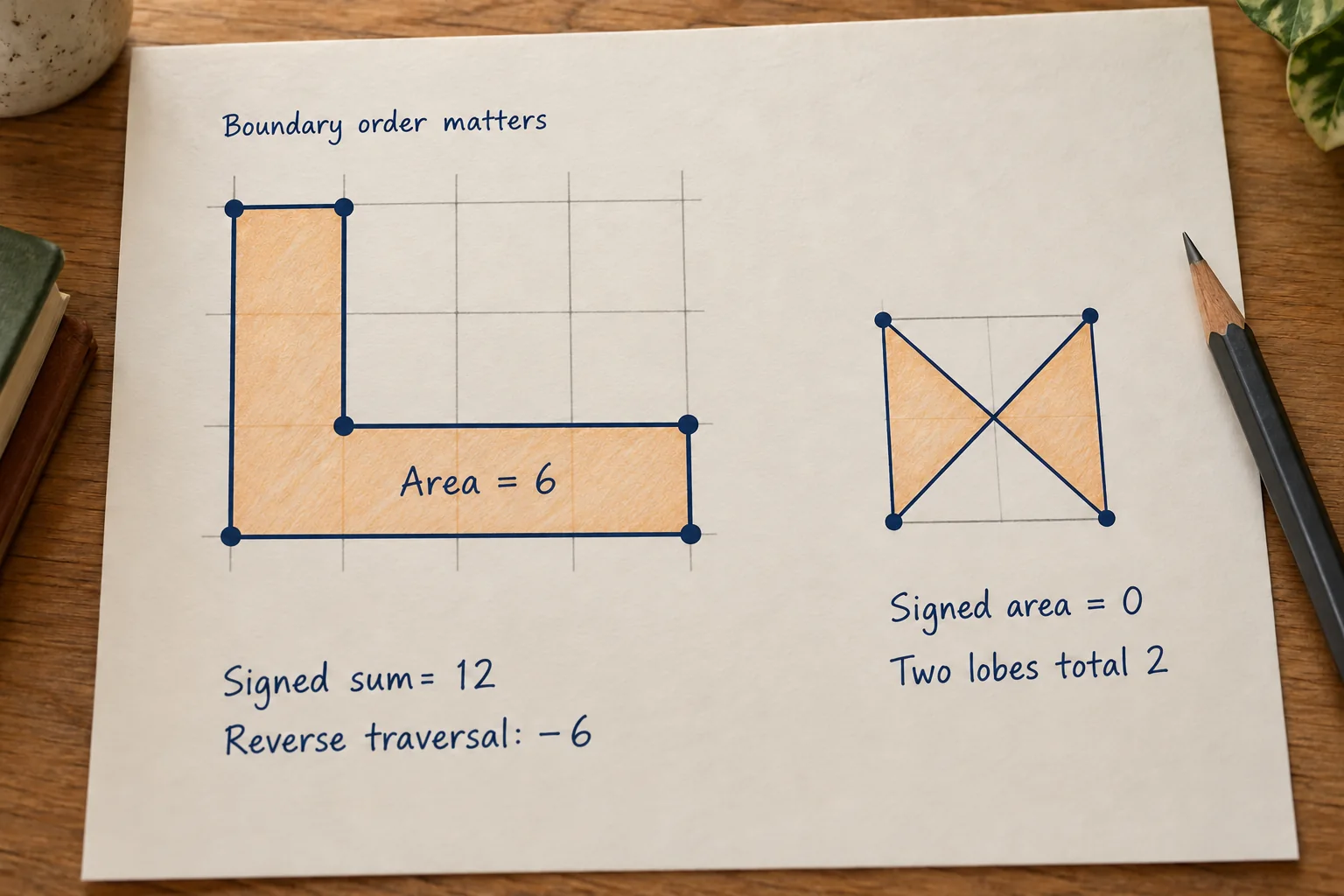
An ordered polygon area calculation starts with the route around the boundary. A list of coordinate pairs alone does not tell you which segments join them. In this invented worksheet, six vertices form a simple concave L shape. A signed cross-product ledger gives area six, and a separate rectangle count checks that result. Reversing the route changes the sign of the ledger, while moving the entire shape changes neither its area nor its signed total.
The coordinates use dimensionless invented units. They are not measurements of paper, cutting instructions or a supply estimate. Keep the coordinate list and its order beside the drawing throughout the exercise. A later four-corner example will show why this matters: reordering the corners into a crossing path produces a zero signed sum even though its two triangular lobes occupy positive area. Taking an absolute value cannot repair a changed boundary definition.
Write the complete boundary route
Name the six vertices A = (0, 0), B = (4, 0), C = (4, 1), D = (1, 1), E = (1, 3) and F = (0, 3). Join them in that order, then join F back to A. Starting at the bottom-left corner, the route goes right four units, up one, left three, up two, left one and down three. Those six segments define the polygon.
The outline is simple: its nonadjacent boundary segments do not cross. The corner at D makes it concave, with an upper-right rectangular region missing from the surrounding four-by-three rectangle. That missing region is three units wide and two units high. You can recognize the L from these declared coordinates without assuming a printed grid has any particular physical spacing. The drawing helps track the route; the numbers define the model.
Close the route explicitly in the record. Omitting the final edge can alter a signed sum, especially after coordinates have been translated. Its contribution happens to be zero in this first placement, which could conceal the omission. A correct worksheet includes every directed edge, including one whose arithmetic contribution is zero. This makes the method transferable to a different placement of the same polygon without changing its input contract.
Build the signed ledger one edge at a time
For each directed edge from (xᵢ, yᵢ) to the next vertex (xⱼ, yⱼ), record xᵢyⱼ − yᵢxⱼ. Add all six contributions, then divide by two to obtain the signed area. For the declared simple polygon, the magnitude gives its ordinary area, while the sign records the direction of traversal. Keep the subtraction order consistent across rows. Swapping the products in only one row would combine two different conventions in the same calculation.
AB contributes 0 × 0 − 0 × 4 = 0. BC contributes 4 × 1 − 0 × 4 = 4. CD contributes 4 × 1 − 1 × 1 = 3. DE contributes 1 × 3 − 1 × 1 = 2. EF contributes 1 × 3 − 3 × 0 = 3. Finally, FA contributes 0 × 0 − 3 × 0 = 0. The sum is 0 + 4 + 3 + 2 + 3 + 0 = 12.
Halving twelve gives signed area 6. With the stated coordinate orientation and subtraction convention, the A-B-C-D-E-F route is positive. Record six square units for the ordinary area. A second arithmetic organization provides a useful copying check: the forward products total fourteen and the backward products total two, so their difference is twelve. Keep those totals separate from the final halving step; twelve is not the polygon's ordinary area.
Check the result without the ledger
Split the L into two rectangles with nonoverlapping interiors. The bottom rectangle occupies 0 through 4 horizontally and 0 through 1 vertically, so its area is four. The upper part of the left arm occupies 0 through 1 horizontally and 1 through 3 vertically, giving area two. Their shared boundary adds no interior area. Four plus two gives six, independently matching the signed-ledger magnitude.
There is also a triangle check for this particular shape. From A at the origin, join the other boundary vertices to make triangles ABC, ACD, ADE and AEF. Their areas are 2, 3/2, 1 and 3/2. For example, ABC has vertical base BC of length one at horizontal distance four from A, giving half of four times one. ACD has horizontal base of length three at height one, giving 3/2.
The remaining two triangles contribute one and 3/2, so the total is six again. Their interiors fit together inside this particular L without overlap. This also explains the ledger's four nonzero contributions: each is twice the corresponding triangle area in this placement. Do not assume every fan from a chosen corner of every concave polygon stays inside it. The present triangle check is tied to the explicitly drawn L and its origin corner.
Reverse the traversal, then change the start
Walk the same boundary in reverse, using F, E, D, C, B, A and closing back to F. Every directed edge now appears with its endpoints exchanged. Its contribution becomes xⱼyᵢ − yⱼxᵢ, the negative of the earlier contribution. The total is therefore −12 and the signed area −6. The occupied region is unchanged, and its ordinary area remains six. Preserve the minus sign until the interpretation step.
Changing only the starting vertex has a different effect. Starting at C and continuing C-D-E-F-A-B-C retains the same directed edges in a cyclically shifted order. Addition gives the same total twelve. This is a useful distinction: reversing the route changes its orientation, while shifting its starting point does not. Neither action authorizes sorting the vertices by a coordinate value, because sorting can create a different set of consecutive segments.
Translate every vertex together
Add ten to every x coordinate and twenty to every y coordinate. The new list is (10, 20), (14, 20), (14, 21), (11, 21), (11, 23) and (10, 23). Keep the same order and close the final edge. The individual ledger rows change: they are −80, 14, 63, 22, 23 and −30. Adding all six still gives twelve, and halving gives signed area six.
The cancellation has an exact reason. Under a general translation by (a, b), one edge contribution changes by a(yⱼ − yᵢ) + b(xᵢ − xⱼ). Around the complete closed route, every vertex coordinate appears once with each sign in those differences. Both sums telescope to zero. The total is unchanged even though individual rows may become negative or much larger than before. Leaving out the closing row would destroy that cancellation.
A negative row after translation is consequently not evidence that a piece of the polygon has negative ordinary area. The rows are signed accounting terms relative to the coordinate origin. Their complete closed sum has the translation property just proved. Compare the complete result with the unchanged rectangle geometry rather than interpreting each isolated row as an independent physical patch. Keep the translated worksheet as a second placement of the same ordered model.
Test a crossing route separately
Now use a new four-vertex list: (0, 0), (2, 2), (0, 2), (2, 0), then close. These segments cross at (1, 1), making a bowtie path. Its ledger contributions are 0, 4, −4 and 0. The signed sum and signed area are both zero. Taking the absolute value still gives zero. This calculation is correct for the signed accounting; its interpretation as ordinary enclosed area needs attention.
The upper lobe is a triangle with horizontal base two at height two and its third corner at the crossing, one unit below. Its area is one. The lower lobe has the same area one. Their interiors do not overlap, so their combined ordinary area is two. The signed calculation cancels the two oppositely oriented lobes. It does not establish that neither lobe occupies space or that a zero total is an ordinary-area measurement.
The same four corner coordinates in the order (0, 0), (2, 0), (2, 2), (0, 2) would instead trace a simple square of area four. Thus a bag of points cannot replace a boundary-ordered list. For this worksheet, check simplicity before interpreting the magnitude of the signed formula as ordinary polygon area. A general software fill rule or a broader theory of crossing regions is outside the exercise; the explicit bowtie is enough to expose the boundary-order error.
Keep the supporting references separate
The Sakamoto Ryouma letter opener account shows a complete sheathed miniature opener with a red textured sheath, black cord and dedicated vertical stand. The account’s name does not authenticate its maker. Separately offered scissors are not supplied. No origin, artisan work, material, size, weight, edge treatment, safety or opening performance is verified here.
The Hijikata Toshizou letter opener account shows a miniature opener, red patterned sheath and broad horizontal display stand. Its whole assembly differs from the other selected account. Native descriptions supply sheath and stand. No maker, history, material, dimension or performance claim is authenticated, and neither tool provides the area proof.
The equal area and different perimeter guide compares two twelve-cell rectangles with different boundary lengths. Here the question is a signed coordinate sum and its boundary-order contract. The independent L-rectangle check uses ordinary area, without deriving a perimeter or a physical material requirement.
The graph coloring on paper guide assigns labels to vertices under declared adjacency constraints. This worksheet instead preserves an ordered sequence of polygon edges. Moving a starting point, reversing orientation and introducing a crossing affect a signed ledger; they do not answer a vertex-label constraint.
Keep any desk purchase independent
If a reader considers an optional desk-tool order, keep the item evidence separate from the polygon calculation. A signed area proves no supplied material, maker identity, package dimension or opening performance. Before ordering through republeq.com, identify the exact listing, quantity and condition, and resolve any product question that affects the intended purchase. A display stand pictured with one miniature opener does not establish that another item fits it. If cryptocurrency is being considered, inspect the payment choices actually presented for that particular transaction before deciding how to proceed. Mentioning USDT in a guide does not establish that the token, a particular network or a particular wallet is supported for an order. Where a suitable cryptocurrency option is actually offered, verify the requested asset, network, destination, amount and order reference against the current instructions before authorizing a transfer. Include shipping, taxes and any transaction charges when checking the complete amount. Keep the item reference and applicable delivery, cancellation and return terms with any written clarification that influenced the purchase. If an item or a payment instruction changes, check the new information rather than carrying an earlier conclusion forward automatically. Save the order confirmation and payment record together so that a later inquiry can identify the exact transaction. If payment or order status is uncertain, reconcile the existing evidence before considering another payment. Neither a completed order nor a preferred payment method changes the declared vertices or their boundary order. The mathematical worksheet can be completed without buying either optional tool, while a later purchase depends on its own current product and transaction information.