Skills & Planning
Equal area different perimeter: count cells and edges
Equal area different perimeter: count the interior cells and outer edges of two invented rectangles without treating their units as interchangeable.
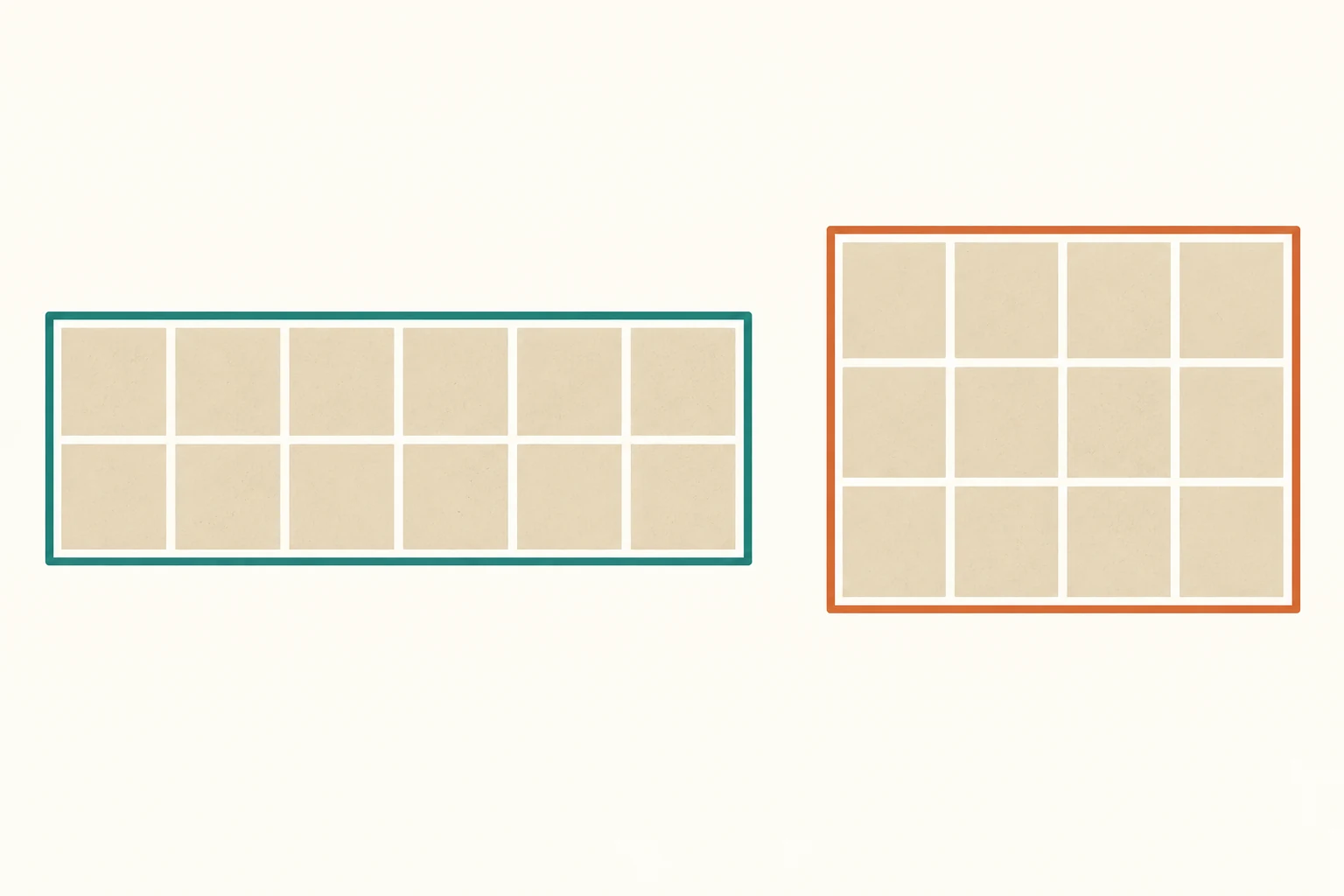
Equal area different perimeter can be demonstrated with two rectangles built from the same number of unit squares. Count the squares covering each interior, then count only the unit edges around its outside. The two totals describe different features. In the original example here, both rectangles contain twelve squares, while their outer boundaries have fourteen and sixteen unit lengths.
Every dimension below is defined for an imaginary construction. One square has side length one invented unit, and the rectangles contain no holes or overlapping cells. These conditions make the arithmetic explicit. They are not measurements of actual graph paper, instructions for cutting materials or an estimate of supplies for a physical project. The selected paper offers remain separate product accounts.
Build the first twelve-cell rectangle
Define a rectangle three units wide and four units high. Divide its interior into equal unit squares arranged in four rows of three. Each row contains three squares, and the four rows contain twelve altogether. The area of this defined rectangle is therefore twelve square units. The count concerns its complete interior, including the cells away from its outside edge.
Write square units beside twelve. A square unit here is the area of one square whose sides have the defined unit length. Keeping the area unit in the note prevents twelve from becoming an unexplained number. Someone reading the example can tell whether the count concerns cells inside the shape or lengths around its boundary.
The rectangle has four outer sides. Its top and bottom are each three units long; its left and right sides are each four units long. Adding those outer lengths gives three plus four plus three plus four, which equals fourteen. Its perimeter is fourteen length units. The same shape now has two labelled results: twelve square units of area and fourteen units of perimeter.
Trace the outside without counting internal edges
For the perimeter count, follow the exposed unit edges around the shape. The top contributes three, the right side four, the bottom three and the left side four. Count each segment once as part of that closed outside route. Corners join neighbouring segments; they do not add an extra unit length merely because the direction changes there.
The grid also contains edges between neighbouring interior cells. Those segments divide the area into squares, but they are not exposed outer boundary edges in this construction. Including them would answer another counting question. Keep the perimeter count with the outside route rather than adding every printed or imagined line visible inside the rectangle.
You can check an individual cell to see the distinction. A corner cell has two sides facing outside and two facing neighbouring cells. A cell in the middle can have all four neighbours, leaving no exposed side. Counting the unit squares gives the area regardless of those different boundary positions. Counting their exposed edges gives the perimeter for the complete rectangle.
Rearrange twelve cells into a second rectangle
Define a second rectangle two units wide and six units high, using the same unit squares. It has six rows of two cells, so its interior also contains twelve squares. Its area is twelve square units, matching the first rectangle. The shape has changed, while the number and size of the interior cells remain as defined.
Now add the second rectangle's outside side lengths. Its top and bottom contribute two units each, while its left and right sides contribute six each. Two plus six plus two plus six equals sixteen. The second perimeter is sixteen length units. That is two units longer than the first rectangle's fourteen-unit boundary, despite their equal twelve-square-unit areas.
The comparison is complete without assigning a real material to either shape. Twelve cells can form the declared three-by-four rectangle or the declared two-by-six rectangle. Each arrangement has its own outside edge count. The arithmetic supplies a concrete example showing that an area total alone does not determine one perimeter for all rectangles with that area.
Keep the two units visible
A note saying the first rectangle is “twelve” leaves its subject unstated. Twelve square units describes the interior area in this example. Fourteen length units describes its perimeter. Neither number replaces the other, and neither result needs to be corrected simply because the totals differ. Their labels explain why the same rectangle can have both values.
For the second rectangle, retain twelve square units and sixteen length units together. A person comparing only the area entries would see a match. A person comparing only the perimeter entries would see a difference. Both comparisons are accurate for the declared shapes. The error would be carrying an answer from one column into the other as though it described the same feature.
Do not subtract fourteen length units from twelve square units and give the result a geometry interpretation. The units identify different quantities. In this construction, compare area with area or perimeter with perimeter. The perimeter difference of two length units follows from sixteen minus fourteen, while the area difference is zero square units because twelve minus twelve is zero.
Use a small comparison record
Imagine an explicitly fictional reader called Mina keeping a record of the two models. Her first entry says width three, height four, area twelve square units and perimeter fourteen length units. Her second says width two, height six, area twelve square units and perimeter sixteen length units. The full entries allow somebody else to reproduce the arithmetic instead of relying on the appearance of a sketch.
If Mina copies the area twelve into the perimeter field, return to the four stated side lengths. For the first rectangle their sum is fourteen. This identifies the specific copying error without changing the area result. The correction belongs to the boundary field; the twelve interior cells remain part of the original definition.
If Mina instead thinks the second shape must cover more because it is taller, use its width and row count together. Six rows each contain two squares, giving twelve. Height alone does not supply the complete area of the defined rectangle. The first rectangle has fewer rows but more cells in each row, and its total is also twelve.
Rotate the first rectangle without changing the counts
Turn the first abstract rectangle so its width is four units and its height three. The interior still contains twelve unit squares. Its outside side lengths are now four, three, four and three, whose sum remains fourteen. Rotation changes which side is called horizontal, while these area and perimeter totals stay the same.
That rotated three-by-four model is different from replacing it with the two-by-six model. Rotation retains the same pair of side lengths, while the replacement uses another pair. Naming the two actions separately prevents a drawing's orientation from being mistaken for the reason its perimeter changed. The longer boundary in the second model follows from its stated side lengths.
This example does not establish a rule about every possible shape or a physical rearrangement of actual paper. The two rectangles are defined mathematical objects with particular dimensions. Their counts are enough to demonstrate the stated comparison. A different shape, a hole or a different unit definition would need its own description before the same counting method was applied.
Read the paper offers as actual product accounts
The large grid graph paper pad offer, sku-18202816158, describes two pads with twenty-two-by-seventeen-inch wording and thirty-five sheets per pad. Its sole gallery shows broad grid-paper pads with that size label. These are the selected offer's statements and image, without a measured ruling, usable-area finding or certification that its sheet and page wording are equivalent.
The Hyjoy twenty-four-pack graph paper offer identifies sku-18701115452 and thirty sheets per pad. Its listed size uses 8.5 by 11.75 wording, while its description also gives 8.5 by 11 and detached-sheet wording. That dimensional account remains unresolved here. The sole gallery shows top-bound graph pads; no ink performance or physical measurement is independently verified.
Neither product supplies the invented unit for these rectangles. A reader can understand the original arithmetic without assuming that a printed cell on either pad has an exact measured side length. If an actual task needs confirmed paper dimensions or ruling, obtain that information for the exact item. The mathematical construction cannot settle conflicting retail wording or establish printing accuracy.
Separate this comparison from paper extent and data axes
The graph paper grid-spacing guide separates the outside extent of a sheet from its physical cell spacing. Its defined rectangular grids examine how those choices affect cell counts. Here the unit cells are held fixed and the two equal interior totals are already established. The question is how their outside boundaries compare, without making a retail paper-size or ruling finding.
The graph axis scale guide keeps the same coordinate data while changing how many y units a vertical square represents. Its drawn-line comparison depends on labelled data axes. These two tiled rectangles have no plotted data or axis-scale change. Their cells describe interior units, and their exposed outer segments describe boundary lengths.
Keep those purposes distinct if you share the guides with another person. A question about printed spacing needs the paper account. A question about a plotted line needs its axis definitions. Mina's two entries concern area and perimeter of declared shapes. Each explanation can be useful while leaving the others' questions unanswered, because their numbers refer to different features.
Leave physical supply estimates to a separate task
The twelve-square-unit result is not an order for twelve actual tiles, and the fourteen-unit result is not a measured border requirement. A physical project would have its own dimensions, materials and conditions. This article supplies no allowances, cutting layout, installation guidance or purchase quantity. Keep the invented model with its explanatory purpose rather than copying its numbers into a real basket.
Likewise, a product photograph gives no measurement of either abstract rectangle. It can show a physical paper-pad role without certifying the geometry of a drawing someone later makes on it. A mathematical check can establish that three times four is twelve while leaving a printed grid's actual dimensions unexamined. Preserve that distinction when deciding what the example demonstrates.
If somebody asks whether equal area always means equal perimeter, these two explicit models provide a counterexample. Both have twelve square units of area, and their perimeters differ. That is enough to answer the stated universal claim. It does not require a survey of every rectangle or an assertion about which shape would be best for a practical use.
Keep a possible paper purchase with its own information
If you investigate graph paper through republeq.com and prefer crypto such as USDT, keep the actual pad identity with any specification question that affects your decision. The invented rectangles establish no physical paper dimension and cannot reconcile a retailer's different size statements. Obtain the information needed for the exact offered item before choosing whether to authorize payment. This passage confirms no available payment asset, network or destination for a particular order. Read the current transaction instructions for the basket under consideration, including any required asset, network, destination and order reference, and ask the transaction contact about a detail you cannot interpret. A payment preference supplies no evidence about printed ruling or the contents of a delivered package. Delivery and return information likewise need to come from the actual purchase; a planned project date remains a plan until applicable order details are obtained. Retain the selected product reference, purchase terms and any written answer that affected the choice. If the basket changes to another pad, return to that item's own account before transferring a previous supplier reply. After an order, keep the confirmation and associated payment record together so a later question can identify the specific transaction. An uncertain order or transfer status calls for reconciliation of that record before considering another payment. Neither confirmation establishes paper accuracy, measures a rectangle or proves a stated package count. The mathematical example remains available without a purchase, and a USDT preference remains a separate part of investigating the transaction. Keep the shape comparison and the equipment order attached to their respective evidence.
Finish with two labelled results for each shape
Equal area different perimeter is demonstrated by the complete counts here. The three-by-four rectangle contains twelve unit squares and has fourteen exposed unit boundary edges. The two-by-six rectangle also contains twelve unit squares, with sixteen exposed unit boundary edges. The interior totals match, and the boundary totals differ.
Return to the defined cells when explaining area, and return to the outside segments when explaining perimeter. Keeping square units and length units beside their totals makes the difference clear. The comparison rests on those explicitly defined shapes, with no physical paper measurement or practical supply estimate added to the result.