Audio Production
Optical phase retrieval and known diversity
Optical phase retrieval can fit indistinguishable wavefronts. Learn how phase diversity adds observations and which wavefront ambiguity remains unresolved.
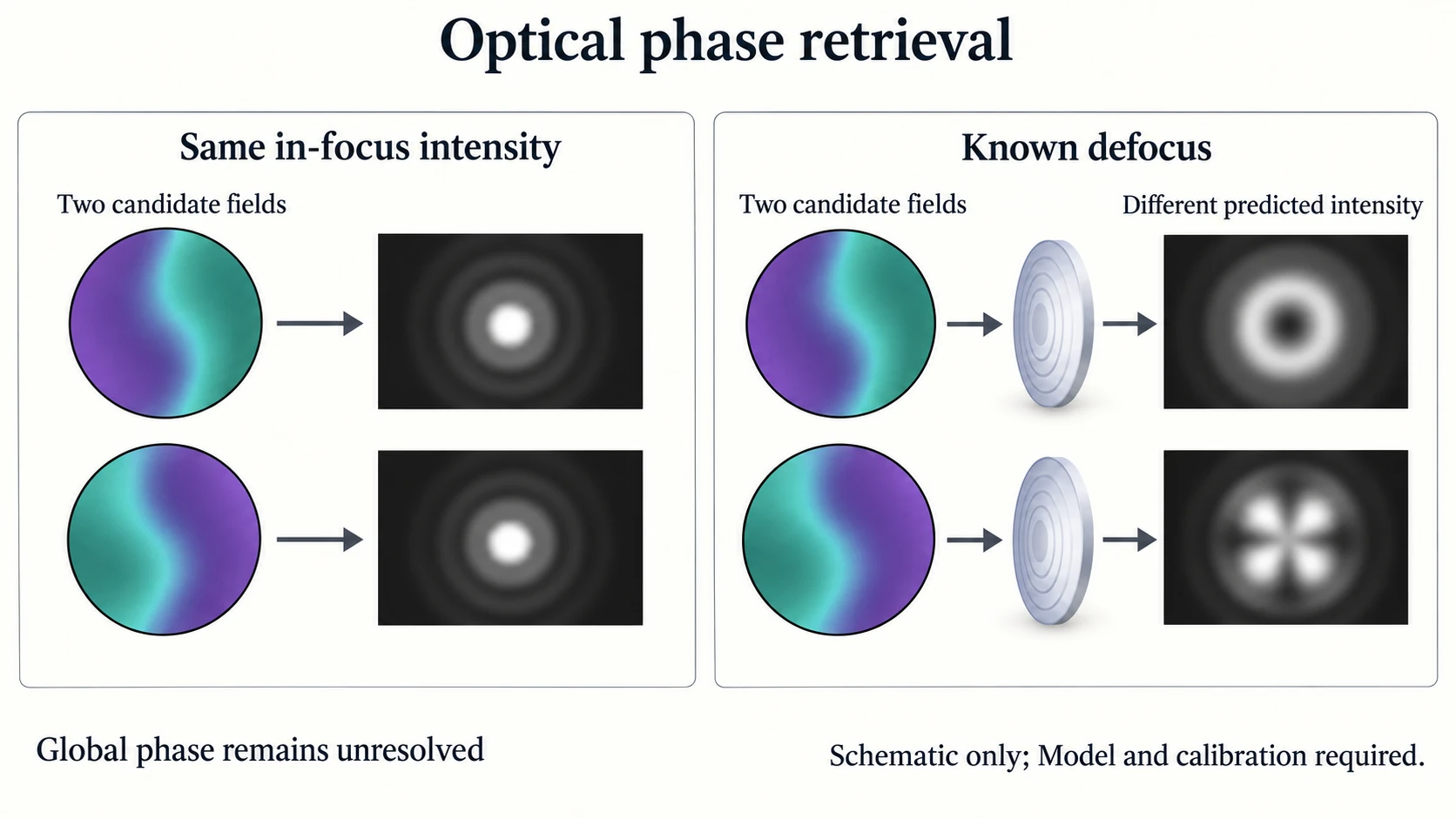
An intensity image measures the squared magnitude of a propagated field. It does not record that field's phase directly. optical phase retrieval infers an unknown wavefront through a model and additional information, so reproducing one image does not necessarily identify the intended pupil phase.
The example below uses a coherent point-source imaging model with known pupil support and a chosen Fourier propagation operator. It exhibits exact alternatives for one intensity observation, then adds a known quadratic phase change. The extra image distinguishes those particular alternatives while leaving global phase unresolved.
Define the pupil field and observation separately
Write the unknown pupil field as g(x)=a(x)exp(iφ(x)) within a known support. The amplitude a and phase φ are separate quantities. A propagation operator P maps that field to an image-plane complex field, and the recorded ideal intensity is |Pg| squared.
For the present in-focus coherent model, choose P as a Fourier transform. This specifies how pupil position contributes phase at each image coordinate. An extended incoherent object would require a different image formation account, which is not assumed here.
The support restricts where the field can be nonzero. Independently known amplitude restricts its magnitude at each allowed position. Neither restriction automatically identifies the remaining phase, particularly when the observation operator retains a symmetry.
NASA's NTRS record Broadband Phase Retrieval for Image-Based Wavefront Sensing describes adding a known aberration or diversity function to aid inference of unknown aberrations. The finite calculation below specifies its own candidates and observation operators, without claiming the performance of a particular reconstruction algorithm.
Wavefront ambiguity survives an exact intensity fit
Multiply g by a constant phase factor exp(ic). Because P is linear, the image field acquires the same factor, and its squared magnitude stays unchanged. Every intensity observation through a known linear propagator retains this global-phase ambiguity.
A reported pupil phase can therefore use a convention such as subtracting its mean or fixing one reference sample. That selects a representative of the indistinguishable family. It is not an intensity-based measurement of the absolute global phase.
A second ambiguity exists in the chosen Fourier geometry. Define h(x) as the complex conjugate of g(-x). Its Fourier transform at the same image coordinate is the conjugate of g's Fourier transform. Thus g and h produce identical intensity images.
The pupil constraints must permit h for this alternative to matter. A support symmetric under inversion allows its location. An independently known symmetric amplitude allows its magnitude. An asymmetric known amplitude can exclude this specific alternative, so the statement must retain the symmetry qualification.
The FFT-zero-padding guide provides a sampling comparison for wavefront ambiguity. It explains how more transform points evaluate the same finite-record spectrum without adding observed samples. In the Fourier pupil model here, conjugate inversion preserves intensity at every Fourier coordinate. A denser computed view of that unchanged intensity therefore cannot select between this particular pair. Known diversity changes the observation operator, which supplies a different constraint rather than simply more plotted points.
Construct two indistinguishable finite pupil candidates
Use five pupil positions x=[0,1,2,-2,-1] in normalized units. Set known amplitudes [1,0.8,0.6,0.6,0.8] and one candidate's phases [0,0.3,-0.2,0.5,-0.1] radians. The support and amplitudes satisfy the stated inversion symmetry.
The conjugate-inverted candidate has phases [0,0.1,-0.5,0.2,-0.3] on those same positions. This phase vector is not obtained by merely adding one global constant to the first. It is a distinct admissible candidate in the toy problem.
Apply the unitary five-sample Fourier operator using factors exp(-i2πkx/5) and normalization one divided by the square root of five. The two resulting intensity vectors agree to floating-point tolerance. Their zero-index intensity is approximately 2.7220.
The sum of each intensity vector is three, matching the sum of squared pupil amplitudes. This normalization check preserves total assigned power in the finite transform. It also confirms that a matching intensity vector has not resolved the pupil phase distinction.
An intensity residual can be zero for either candidate. Choosing one because its optimization residual is smaller at numerical precision would therefore confuse an algorithmic tie with new optical information. The ambiguity arises from the operator, not from failure to search hard enough.
Phase diversity changes the constraints on the candidates
Now apply a known pupil multiplier exp(i d x squared) before the same Fourier transform. This is a finite quadratic-phase model of a defocus diversity. The coefficient and sign are specified, and the same multiplier is applied to every candidate.
Choose d=0.2. The original candidate's zero-index intensity becomes approximately 2.3703, while the conjugate-inverted candidate gives approximately 2.5318. Their largest component difference is approximately 0.1615 in the chosen normalization.
The conjugate-inversion identity no longer makes these two diverse observations identical because the known phase multiplier does not undergo the conjugation needed to preserve the original symmetry. The new data can therefore reject one of this pair when the diversity and forward model are correct.
This calculation does not prove that every possible pupil candidate has been distinguished. A second observation adds constraints, and its identifiability must be assessed for the intended unknowns and geometry. Global phase still leaves both intensity images unchanged.
The I/Q guide supplies a measurement comparison for phase diversity. It shows that properly related cosine and sine components form an ordered complex pair and retain rotation direction that a real cosine alone cannot distinguish. That electrical sampling model records two related components; it is not an optical phase-retrieval procedure. Here the detector records scalar squared magnitudes, and calibrated diversity adds another intensity constraint. In both comparisons, the available observations determine which alternatives can remain indistinguishable.
A candidate record can keep the original and conjugate-inverted pupil phases beside their predicted intensities. Both zero-index values are approximately 2.7220 in focus; the stated diversity gives 2.3703 and 2.5318. The Lenovo IdeaPad touch laptop is described with 16GB DDR4 memory and a 15.6-inch FHD Touch display. When viewing such a record in that computing workspace, keep the pupil constraints and known phase operator beside the modeled values.
Known amplitude and jointly estimated amplitude are different problems
If a is independently known, the estimate varies only φ under the support and chosen phase convention. If amplitude is estimated jointly, the unknown pupil field has additional freedom. An image change can then be explained partly through amplitude and partly through phase, depending on the observation constraints.
A recovered amplitude should not be called independently measured merely because the optimizer produced it. Its evidential status remains an inference from the same data unless a separate measurement or justified physical constraint establishes it.
Likewise, imposing uniform amplitude is a substantive optical assumption. Obscurations, nonuniform illumination, or transmission variation can violate it. Fitting phase under an incorrect amplitude constraint can produce an aberration estimate that compensates for the missing amplitude model.
The finite example's symmetric known amplitude was deliberately selected to permit the conjugate alternative. A different independently justified amplitude map can change which alternatives remain admissible. The constraint's origin and uncertainty should accompany the inferred phase.
Residual agreement, held-out prediction, and identification are separate checks
Residual agreement tests whether a candidate reproduces the observations used to fit it. Held-out prediction tests a new observation not used in fitting, such as another known diversity. Physical identification asks whether the accepted observations and constraints distinguish the claimed wavefront from other admissible fields.
For the saved candidates, a held-out multiplier with d=-0.1 gives zero-index intensities approximately 2.6951 and 2.6093. Their largest component difference is approximately 0.0859. This is another finite prediction comparison, not an independent experimental receipt.
A candidate that predicts held-out data has survived a stronger check than fitting one image. It can still share those predictions with an unresolved family, including global phase. Report the remaining equivalence rather than converting agreement into unrestricted uniqueness.
Measurement noise and finite detector coverage also affect the comparison. A predicted difference smaller than the accepted uncertainty may not distinguish candidates in practice, even when the ideal vectors differ mathematically.
Unknown diversity and registration can imitate aberration
If the applied defocus is unknown, the model can trade a quadratic component of estimated pupil phase against the diversity coefficient. Calling the extra image known diversity requires calibration of the relevant optical change and its sign, not only a different actuator command.
Background intensity changes the observed data without following the same coherent pupil propagation. If it is omitted, a reconstruction can attempt to absorb the discrepancy into an apparently plausible field. A low residual under flexible unknowns does not establish that the physical attribution is right.
Pupil misregistration changes which amplitudes and phases occupy which coordinates. A shifted support, an incorrect pupil scale, or a wrong diversity center can alter the inferred phase map. Those nuisance parameters require their own evidence or a joint identifiability account.
A 14-inch FHD screen is described on the ASUS Vivobook 14 product page. A candidate table viewed on that laptop can separate independently calibrated pupil information from the parameters fitted to intensity images. The equipment listing supplies no optical calibration. Keep the applied diversity and its evidence distinct from an aberration inferred from those same observations.
The recovered phase also needs a wavelength and a phase-wrapping convention before it is interpreted as optical path difference. A phase sample is unchanged by adding an integer multiple of two π at that sample, while a continuous path-error map requires additional continuity or range assumptions to choose among such representations. Multiple wavelengths can add constraints under a specified physical path model, but that is additional data and an additional relationship to test. The finite single-wavelength example recovers candidate complex fields rather than certifying an unwrapped surface-height map. Its remaining global-phase convention should likewise remain separate from a measured absolute path origin.
Retain the unresolved family in the reported result
A phase-retrieval record should retain the propagation model, pupil constraints, diversity calibration and uncertainty with its held-out predictions. For the saved pair, the in-focus observations agree while the specified diverse observations differ. Report those exclusions alongside the unresolved global phase and other admissible equivalences before interpreting the result as an identified wavefront.