How-To Guides & Tutorials
Open an envelope with a letter opener: preserve the contents
A practical sequence for ordinary current mail: inspect the enclosure, establish the applicable tool method, and keep the received contents together.
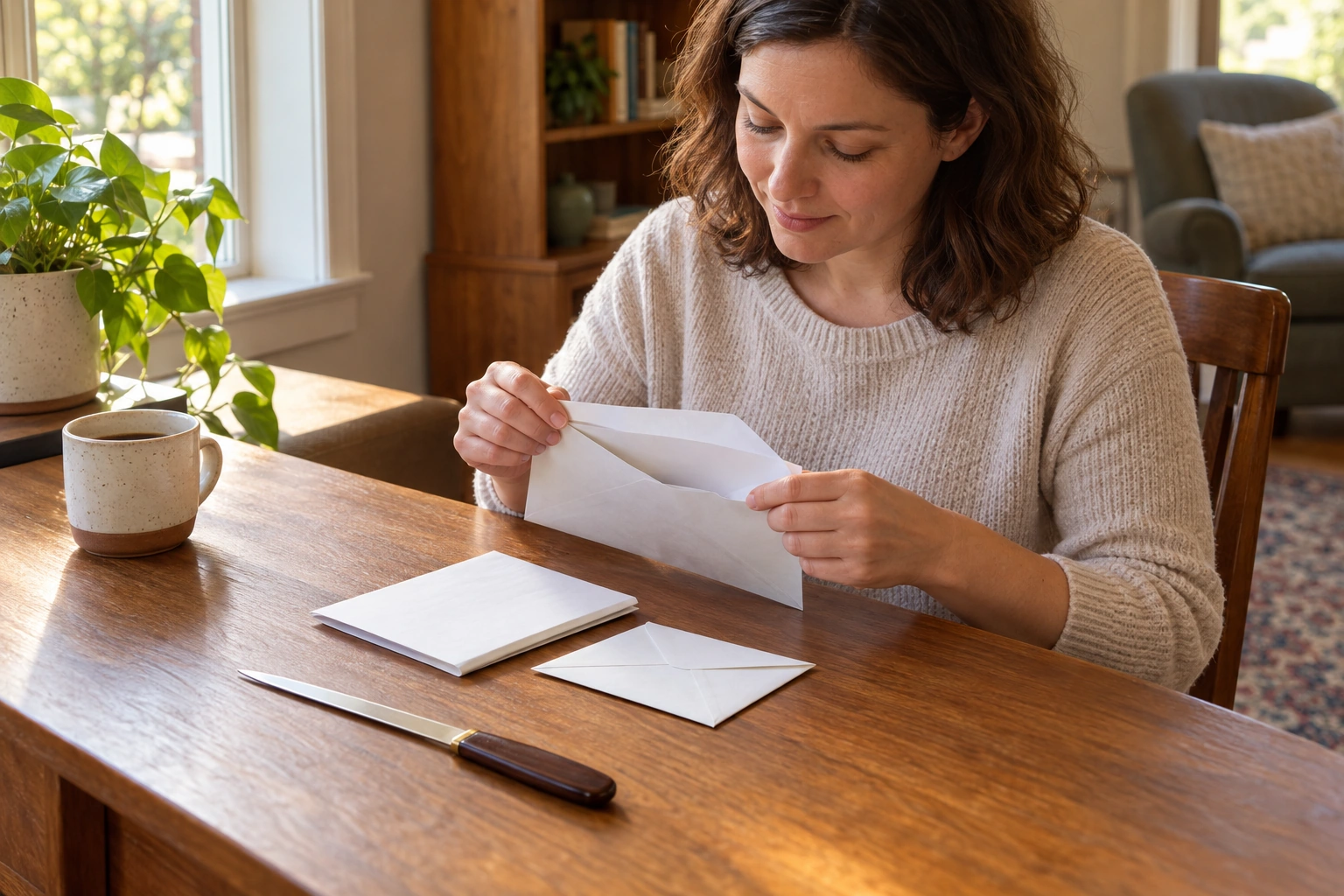
Before you open an envelope with a letter opener, decide what you need to preserve. Today's ordinary household mail can contain a return envelope, a small insert or another folded sheet behind the first page. The aim is to reach those contents without making an unnecessary cut through them. Start with mail you are entitled to open, a clear place to work and the instructions for the particular tool you intend to use.
This tutorial concerns ordinary current mail whose envelope you may open. It does not cover historic correspondence, collectible covers, sealed evidence or documents whose condition must be preserved under someone else's requirements. If the intact enclosure matters, settle how it should be handled before making a cut. A desk tool's product name supplies no authority to alter a document or open another person's correspondence.
Identify the enclosure before choosing an opening
A conventional paper envelope forms an enclosure from a flat sheet folded around a central area. Its overlapping flaps are on the reverse. A window envelope has an opening through which information on the enclosed document can be seen, commonly with a transparent covering. That visible address is part of the contents' position, not an empty space that establishes a suitable cutting route.
Other enclosures differ. A mailer can use paperboard, plastic or nonwoven material, and its closure may include adhesive, tape or an opening strip. An inter-office envelope may have a reusable string closure. A smaller return envelope can be enclosed inside the first. Look at the actual item instead of treating every rectangular package as the same arrangement of paper and flaps.
Read any opening direction printed on the enclosure before choosing a tool. If it provides an opening feature, establish how that feature is intended to work. Do not insert a blade simply because one is on the desk. If you cannot identify what the enclosure is or where its contents sit, keep it closed until you have a suitable method. Nothing in this tutorial requires you to cut an uncertain package.
Keep the envelope contents clear of the intended opening
Keep the envelope contents clear of the intended opening. Begin with what you can actually establish. Ask whether the intended edge is free of the enclosed material. A visible window, a thin-looking corner or a familiar sender cannot answer for the whole enclosure. This is an inspection question, not a claim that touching the outside reveals every item inside. Leave the opening undecided when you cannot establish the separation you need.
Choose a place where you can set down the enclosure and the papers you remove. Keep other mail out of that immediate place so an insert does not get mixed into a different letter. If another person is helping, agree which envelope is being handled. You need no elaborate sorting system for this small task; you need to recognize which contents belong to the enclosure in front of you.
Decide whether there is a reason to retain the envelope after reading the letter. It may carry information you want to keep with the document, or you may need its return arrangement. Make that decision yourself for the mail you control. This tutorial supplies no retention period, legal rule or permission to discard paperwork. Keep those requirements separate from the physical act of gaining access.
Match the method to the actual letter opener
Paper knives and letter openers share a history, but the terms have covered different tasks. Paper knives were used to separate closed edges in folded, printed book sheets. Letter openers developed for envelopes. Some modern tools house a blade within a plastic body, and powered openers also exist. A shared label does not establish that every design should be held, fed or moved in the same way.
The Pen Company's general account of a conventional letter opener describes feeding it through a gap at either side of the envelope's top, then gently raising the handle to separate the top. That is a published description of the conventional form. It is not an instruction supplied by either selected product's manufacturer, and it does not establish a feeding direction for a recessed-blade slitter.
Use the actual tool's directions to settle its handling. If you do not have them, ask for an account that identifies the model you own or intend to order. Describe the enclosure you want to open when asking. A seller's answer about an open blade cannot establish how a different tool's slot works. Keep an unresolved method unresolved rather than borrowing a motion from a photograph.
Two letter-opener offers with different information
The L'Objet DAC31 Bambou letter opener is described as 8.5 inches long, with a gold finish and 24K gold plating. Its photograph shows a long exposed blade form and a bamboo-styled handle. The offer supplies care directions but no envelope-opening sequence. Those details identify the object and its stated finish; they do not establish a cutting result on your mail.
The Quality Park Survivor handheld letter opener is described for Tyvek and other envelopes. Its photograph shows a compact black body with a recessed blade opening. The offer is a bundle of ten units, with one opener per unit. The description does not supply the tool's feeding instructions or demonstrate that your particular enclosure can be opened without affecting its contents.
Both offers appear in All Moving Supplies. Ask for the selected model’s instructions before choosing how to use it. Check whether the order quantity meets your actual need.
Make only the opening you have established
Once you have an applicable method and an appropriate enclosure, follow those instructions for that tool. Keep your attention on the enclosure being opened. If something does not match the expected handling, stop and reconsider the method with the instructions available. This tutorial provides no force limit, cutting depth or workaround for resistance. A new guess would create a different operation from the one you established.
Do not widen the job halfway through. Opening the envelope does not require trimming its contents, separating a bound insert or changing the document's format. Set the opener aside when the opening you need is complete. If another operation is necessary, choose its method separately. Keeping that boundary clear avoids treating a tool already in your hand as the answer to every paper task that follows.
Check the removed contents before clearing the enclosure
Remove the contents using the opening established for that enclosure and place them together. Check what you have actually removed before moving to the next envelope. If the letter refers to an enclosure that you cannot find, keep that question with the letter. Do not make another cut simply to make the missing item seem accounted for. The sender or the relevant recipient may need to clarify what was included.
A return envelope has a different job from the enclosure you just opened. Keep it with the request it belongs to until you decide what action is needed. A small separate insert may also deserve its own reading before you put the papers away. These are suggestions for handling your current mail, not a claim that every sender includes the same pieces or that a particular tool makes them easier to recognize.
For papers that now need a destination, the desk organizer paper plan begins with each paper group's next action before assigning a proposed place. Its organizer layout questions come after that decision. Use it when opened mail needs an answer or another defined task; it does not supply an opening method or a rule for retaining the envelope.
The guide to saving paper on working copies concerns replacing an amended page in ordinary project notes while keeping accurate pages. That is a later document decision. It gives no reason to alter an original letter or substitute a page in a formal document. Keep the received item intact when that is what its purpose and requirements call for.
Keep letter opener care specific to the object
For letter opener care, the Bambou offer says to dust with a soft cloth and, if needed, handwash with mild, non-citrus dish soap and dry with a soft cloth. L'Objet's separate Library + Decorative care guidance gives the same general approach for its library and desk collections. The other sections of that page cover different collections, including dinnerware. Their dishwasher statements do not become instructions for this desk object.
The Quality Park offer supplies no cleaning or maintenance procedure. Ask for applicable model guidance rather than transferring care or sharpening suggestions from a different object.
Keep a necessary purchase separate from the payment method
A household shopping decision can begin with the thing you need to do today. If that decision leads to a letter-opener order on republeq.com, name the object you want and review the current offer before considering cryptocurrency. You may prefer crypto or USDT, but that preference is a question for the payment choices actually displayed for your basket. This guide does not establish that any particular option will appear. Leave yourself time to understand the transaction before authorizing it. If someone else is buying the object for you, explain which offer you intended and ask them to resolve any purchasing question they cannot answer from the information supplied. Avoid having two people place independent orders for the same request. Review the intended quantity, the item condition and the terms you consider relevant to your decision. You can postpone an order while a question is being answered; an open basket does not commit you to completing it. When you decide to proceed, follow the instructions given for the selected transaction, including the stated asset and network if USDT is offered. Ask the merchant about an unclear instruction rather than substituting a remembered detail from an earlier purchase. Keep the confirmation you receive with your ordinary purchase records. If a payment's status is uncertain, establish that status before deciding whether another transaction is appropriate. Nothing here quotes a product price, token conversion, fee or delivery promise. This discussion also makes no claim about the outcome of a later transaction. Buying an item, receiving a confirmation and deciding how to carry out your own household task are separate decisions. Finish the purchasing question on the information available for the actual order, then return to the work you intended to do with the appropriate guidance. Your choice to pay with an available cryptocurrency, another offered method or to delay buying can remain your own.
Finish one envelope before beginning the next
At the end of the task, the letter and its associated pieces should still be identifiable as one received set. Put the tool away according to its applicable guidance, decide what the papers need next and retain the enclosure when your own requirements call for it. Return to the next envelope as a new item to inspect. Its contents and closure need their own decision, even when the sender or outer size looks familiar.