Heating, Cooling & Air Quality
How to open and close a folding fan slowly
A slow opening-and-closing sequence for a ribbed folding fan, with attributed maker guidance and clear limits for third-party catalog examples.
Choose a deliberate movement before a flourish
How to open and close a folding fan begins with the kind of object and movement you mean. This tutorial concerns a ribbed, manually operated folding fan and a slow, supported sequence described by fan makers. It does not teach a dance snap or a one-handed trick. Read the instructions supplied for your actual fan before trying a method from another maker, and leave an unclear construction or an unexpected resistance unresolved rather than forcing a movement.
A tutorial can explain a reference method without claiming to have tested the retail examples below. The two offers are catalog examples of paper folding fans. Their construction descriptions and photographs do not make them products of the makers whose handling guidance is discussed here. Keep that distinction through the sequence. If the actual fan's instructions differ, this general account does not override them or establish that a particular unit is ready to use.
Know which object the instructions describe
This is a useful point to separate a purchased ribbed fan from a paper craft or a powered appliance. The guide to folding a paper fan makes an object from a sheet with alternating folds and a gathered base. Its construction steps do not describe operating a retail fan's pivot and ribs. Choose the reference for the object in front of you rather than combining two methods because they share a name.
Nor does “foldable” by itself identify the task. An electrically powered fan with an adjustable body raises different questions about controls, charging and positioning. No such procedure appears here. The immediate aim is to understand the movement in the cited manual-fan references. It is a small handling task with a clear boundary, not a performance routine, a cooling comparison, or a reason to take a mechanism apart.
Read the two catalog examples without adding a trial
The Myst Design paper folding-fan offer describes paper faces with bamboo ribs. Its sole image arranges opened fans in several colors. The Fuliko paper folding-fan offer likewise describes paper and bamboo and shows overlapping white opened fans. These accounts identify catalog examples; neither photograph demonstrates the opening or closing method described in this article.
Keep the remaining catalog limits visible. The stated pack quantities are not authenticated delivered inventories. The Fuliko headline says white, while generic metadata and part of its copy use Multicolor wording. Neither image has a readable maker or model label that independently resolves identity. The pictured ribs, leaf and pivot belong to the fan form; decorating references establish no included paint, stamp or other separate tool. No actual material test, individual condition inspection or handling result is reported here.
Opening: support the fan and move slowly
Ibasen's handling guidance starts by holding the fan gently in both hands with the main rib facing upward. It describes using the thumb to slide that rib toward the right, opening the fan a little, then continuing to unfold it gently with both hands. The important contrast in that reference is with opening quickly and forcefully in one movement. This is Ibasen's described method, not an instruction to push through resistance on an unidentified or damaged unit.
Read the short sequence through before beginning. Identify which supplied instructions you are following and which fan they concern. A demonstration watched elsewhere may have a different purpose from the ordinary movement you want to learn. You do not need to reproduce its speed to understand a written reference. If a term or orientation remains unclear, keep the movement undecided while seeking applicable clarification; guessing a direction is not a required step in this tutorial.
folding fan ribs
Ohnishi Tsune's opening description also distinguishes support from movement: the right hand is on the main outer rib, the left supports the opposite side, and the right thumb gently slides the ribs open from the pivot. For folding fan ribs, that is a specific account to read alongside the reference's own illustration and your item's instructions. It does not authorize a larger opening, a forced endpoint, or a different grip invented to make a resistant fan move.
The references give you language for the task without creating an inspection result. “I understand which side supports the fan” and “this particular fan moves as expected” are different statements. Only the first can follow from reading a paragraph alone. Keep the second tied to an actual observation made under applicable instructions, if you make one. An illustration of an open fan cannot fill in an unobserved movement between its closed and open states.
closing a hand fan
For closing a hand fan, Ohnishi Tsune describes placing both hands near the middle of the outer ribs on either side, then using the right hand to slide the ribs closed smoothly along the fan's arc. Ibasen likewise describes holding the open fan with both hands and slowly following the crease while closing it from one end. Both are descriptions of controlled handling. Neither supplies a remedy for a unit that catches, twists or will not follow its own instructions.
Finish reading the closing instructions before treating an opening as the whole task. In a learning plan, “I can explain how I intend to close it” is a useful requirement to settle first. This does not mean rehearsing an improvised motion on a tool whose instructions you lack. It means keeping the return movement in the same plan, instead of reaching an open state and only then deciding what you think should happen next.
Nico replaces a performance goal with a handling plan
Nico is a fictional adult learner, not a person who tested either offer. He begins with a note to imitate a quick opening he saw in a performance. His intended everyday task is much smaller: understand an ordinary opening and closing. Once he notices that difference, he removes the speed requirement from his note. A performance effect had become his goal without him deciding that he actually wanted to learn that effect.
He reads the maker references and writes a new goal: explain the support and the opening movement, then explain the closing movement. He has not performed them in this example. The written plan lets him identify a gap before he treats it as a physical difficulty. If he cannot connect a description to the instructions for his actual item, that is the question to resolve. It is not evidence that he needs a stronger motion or another accessory.
Nico also removes an imagined success from his notes. “The fan opened smoothly” would describe a trial, and none has happened. His actual outcome in this fictional scene is a clearer learning plan. If he later tries an applicable method, he would have a separate observation to make. The distinction keeps a useful tutorial from turning into a testimonial for an offer, a personal ability claim, or a diagnosis of a particular pivot.
Separate remembering the sequence from demonstrating it
Nico can now describe the order of the reference without saying he has learned a physical skill. Remembering words is the outcome he can account for in this scene. A future demonstration would be a different activity with an actual item and its applicable instructions. He leaves that distinction in his learning goal so that neither a fluent explanation nor an attractive picture becomes a substitute for something he has not done. There is no requirement to claim progress beyond the activity he actually completed.
Keep an unclear movement separate from repair
If a movement is unclear or an actual unit resists, this article offers no repair procedure. Do not infer a cause from the words “paper,” “bamboo” or “folding.” The catalog examples do not establish whether a particular difficulty comes from condition, construction, direction or something else. A request for help should identify the item and the actual difficulty without borrowing a diagnosis from a photograph of another fan.
Leave rivet adjustment, lubrication, heating, wetting and other treatments outside this lesson. None is needed to explain the references discussed here, and no such treatment is specified for the linked offers. You can stop with an unanswered handling question. Reaching a preferred open shape is not a reason to invent an extra step, and choosing not to continue does not require calling the item defective when its condition has not been established.
A handling lesson has a different purpose from a portrait
The folding-fan portrait-prop guide follows a fictional subject deciding what an accessory means in a picture. Its open, closed and absent-prop choices concern the portrait's intention. Here the practical task is reading a handling sequence. You can prefer an open fan in an imagined portrait without knowing how a particular fan should move; a picture preference supplies no operating instruction.
Keep checkout separate from learning the movement
If you consider buying a fan through republeq.com and prefer USDT, first check whether that payment choice is actually presented for the selected order. This tutorial establishes no particular checkout method for either linked offer. A product link is not confirmation of stock, a completed order, or an available crypto transaction. Keep the exact offer and option attached to any purchasing question so that a similar-looking fan does not silently replace the one you meant to investigate. If USDT is offered and you choose it, follow the instructions presented for that actual transaction. This article supplies no receiving address, network selection, amount, fee estimate or transfer procedure. An instruction from an earlier purchase cannot answer what a different order requires. Leave unclear payment information unresolved until it is clarified through the applicable merchant channel. You can defer a purchase while a product or handling question remains open. Paying for an item would not establish that its actual instructions match a reference from another maker, and a confirmation would not prove the condition of a future delivery. Review the actual order terms, including delivery and return information that matters to you, before deciding whether to proceed. No arrival date, refund outcome, material certification or handling result is promised here. If someone else will place the order, give them the exact offer reference and any unresolved option question. Retain real order and payment confirmations separately from product instructions, each as evidence only of what it actually records. The fictional learner has not bought a fan, received a unit, completed a transfer or demonstrated a successful movement. His clearer learning plan should not be mistaken for a commercial outcome. Choose a purchase only after assessing the actual item and checkout conditions presented at that time.
Know the sequence and its limits
How to open and close a folding fan is a handling question before it is a performance goal. The cited references describe slow support and sliding movements; an actual item still needs its applicable instructions. Nico finishes with a modest plan he can explain and a clear place for an unresolved question. Keep the same distinction for your own task: understand the reference, identify the item, and avoid turning an unknown movement into a forced result.
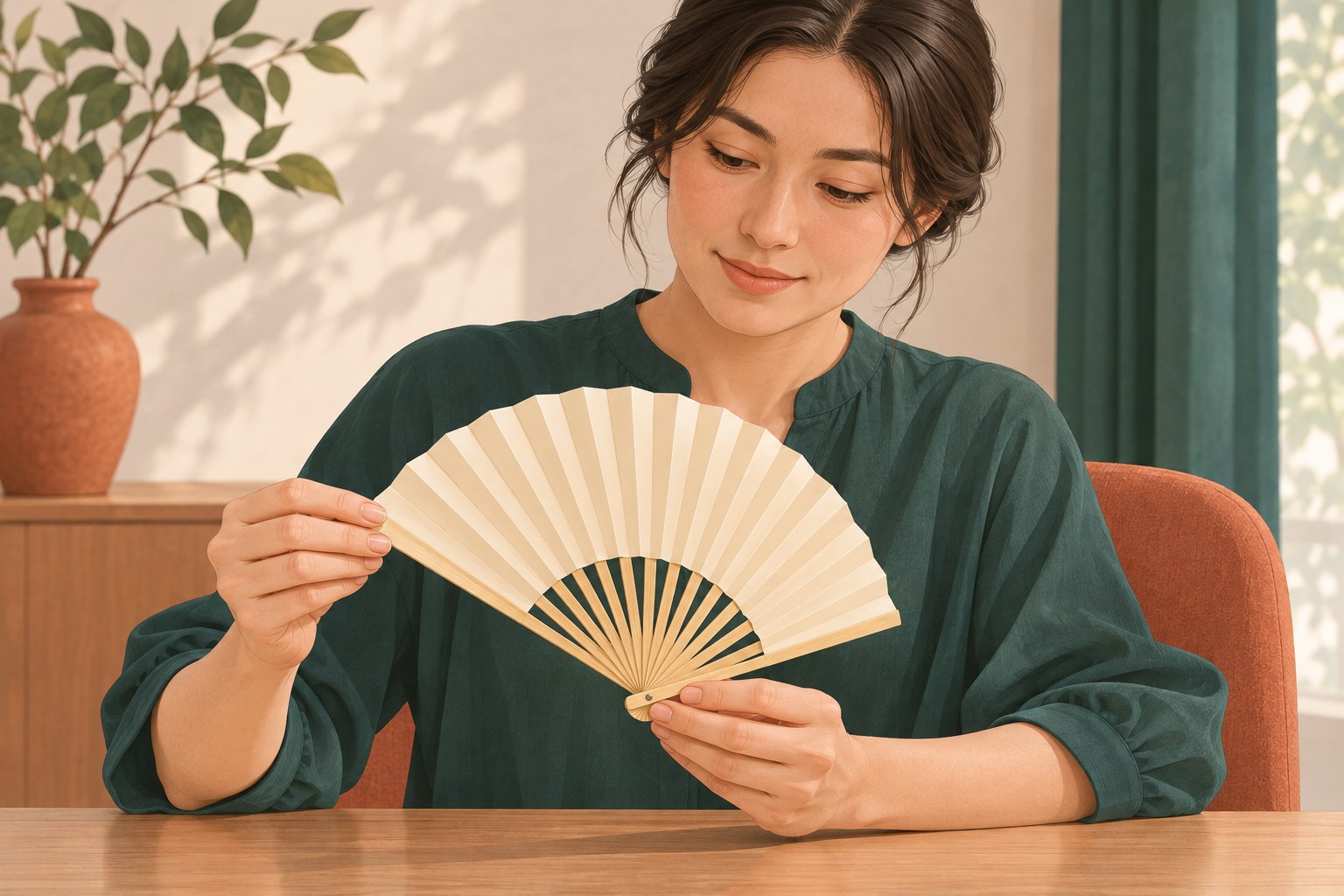
Conceptual illustration of slow two-handed folding-fan handling; no exact retail model, trial result or condition certification is shown.