Crypto Commerce
NuWave Bravo 21-Qt countertop oven vs ROABM R-BOX 23-Qt for countertop cooking
Compare NuWave Bravo 21-Qt countertop oven by pan fit, cooking controls, steam functions, electrical requirements, cleaning, and the limits of their listed…
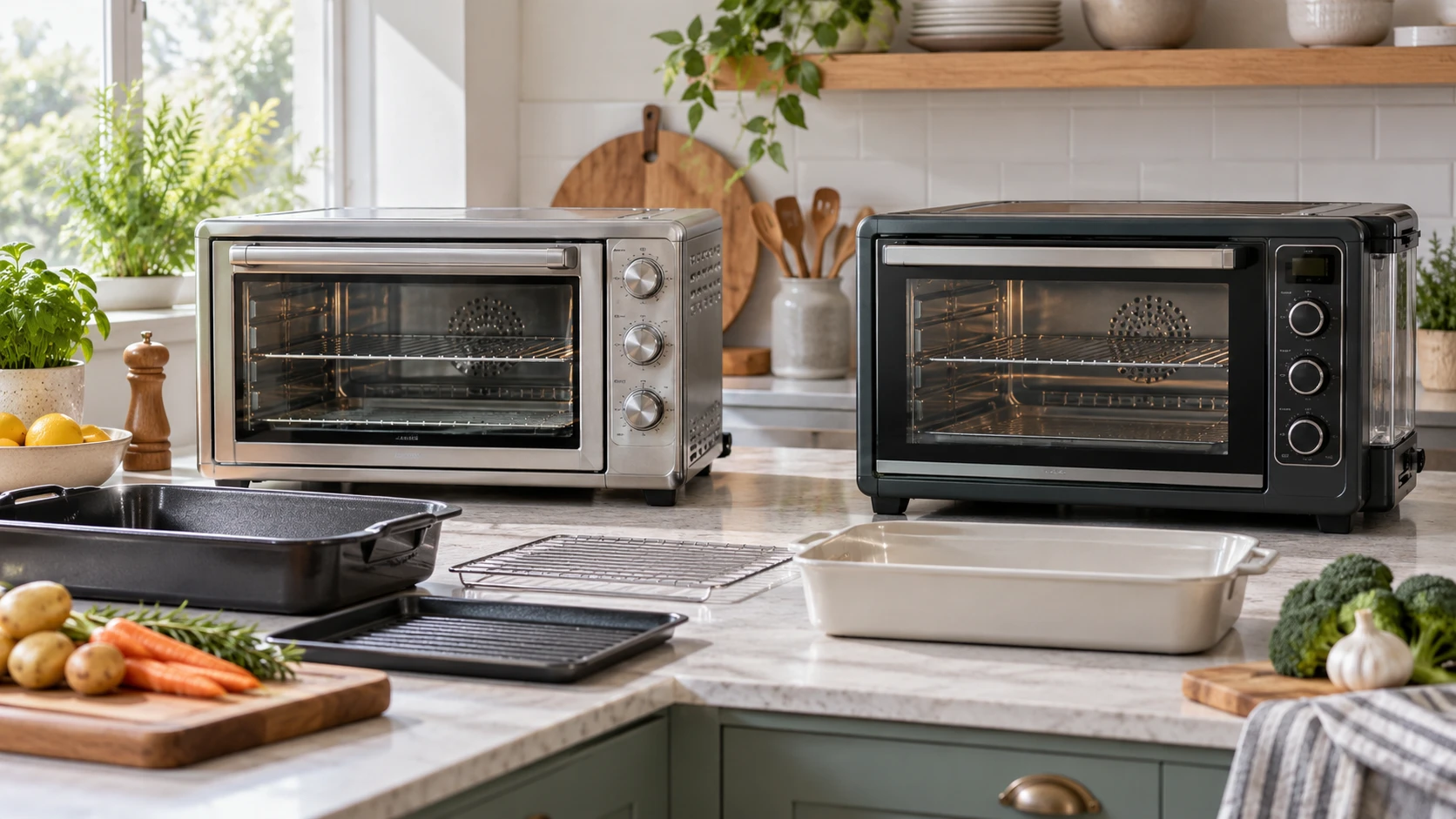
The NuWave Bravo 21-Qt countertop oven and the ROABM R-BOX both combine oven functions on a kitchen counter. NuWave lists 1800W, two rack positions, temperature control from 50°F to 450°F, and independent top and bottom heater settings. The guide to checking oven pan fit before choosing matters even for compact ovens: neither advertised quart capacity tells you whether a favorite roasting pan or baking sheet clears the door and heating elements. The ROABM R-BOX 23-Qt steam oven adds three listed steam modes, an external water tank, and a 2900W claimed heating system. Those differences are useful only after checking counter space, the electrical connection, and the cooking routine that the appliance will serve.
Fit the pan, the cabinet, and the outlet — checking oven pan fit before choosing
Twenty-one and twenty-three quarts describe nominal interior volume. They do not reveal the width between rack supports, the distance from a pan to the upper heater, or the room needed to lift a hot dish through the doorway. Make a short list of the cookware that matters: a weekday casserole dish, a sheet pan, a loaf tin, and perhaps the basket or tray used for frozen food. Measure each at its widest point, including handles. Ask for usable rack dimensions and a model-specific diagram before choosing on a two-quart difference. A pan that technically enters at an angle may still be awkward or unsafe to remove when filled with hot food.
NuWave's saved listing says it has two rack positions and heavy-duty racks rated for loads over 30 pounds. That is a rack claim, not a reason to stack heavy dishes without following the manual's placement guidance. The ROABM excerpt names a 23-quart cavity but does not specify rack positions, usable tray dimensions, or a weight rating. Ask what trays are included and where each can sit. A second rack is most useful when two items can cook at compatible temperatures and airflow remains adequate around both. Crowding a compact cavity can undermine the very browning or crisping that motivates a countertop oven.
Measure the intended counter from the wall to the front edge, and include door-swing room. The abbreviated listings do not provide full exterior dimensions or clearance requirements. Check the manufacturers' manuals for space around the sides, top, and rear, especially beneath an upper cabinet. Consider where a hot door opens, where steam will leave the ROABM, and whether a person can reach the controls without leaning over hot exhaust. A counter location that fits an unpowered box may be inconvenient once pans, water, and cleaning access are included.
The two pages state substantially different power figures: 1800W for NuWave and a 2900W dual heating system for ROABM. The ROABM excerpt does not state plug type, voltage, or current requirement. Verify the appliance label and manual for the exact unit and confirm that the intended outlet and circuit are suitable before ordering. Do not assume it can share a typical kitchen outlet with another high-draw appliance merely because it is sold as a countertop model. If the kitchen's electrical capacity is uncertain, have a qualified professional evaluate it. Avoid adapting an incompatible plug or relying on an extension cord as a workaround.
Choose the heat controls that match the food — ROABM R-BOX 23-Qt steam oven
NuWave describes 12 cooking functions, including air frying, grilling, baking, broiling, roasting, dehydrating, reheating, and toasting. It says temperatures can be selected from 50°F to 450°F in 5°F increments. The listing also describes independent adjustment of the top and bottom heaters from 0% to 100%, with separate convection-fan control. That level of control could help when a dish needs stronger top color or gentler heat underneath. It still takes experimentation: a percentage setting in a small oven is not a measured food temperature, and a recipe written for a full-size oven may need changes in pan position and timing.
ROABM lists 11 functions, among them baking, broiling, roasting, air frying, fermenting, and defrosting. Its stated general cooking range is 90°F to 445°F. The 2900W system and 2000 RPM air-circulation figure are Republeq's product specifications; they do not establish that the R-BOX will finish a particular dinner faster or more evenly than the Bravo. The page claims 45% crisper air-fried results but gives no comparison method in the saved description. Try the food you actually cook and inspect its center and surface. A potato wedge, reheated pastry, and whole roast test different parts of an oven's performance.
The low end of the stated ranges deserves attention if the oven will be used for slow drying, dough preparation, or another temperature-sensitive task. NuWave's listed 50°F minimum differs from ROABM's listed 90°F minimum, while ROABM explicitly includes a ferment function. A control's setpoint does not tell you how steadily the cavity holds that temperature or what the food itself reaches. Look up the model-specific instructions for the intended mode and test with an appropriate thermometer. For food safety, use established handling and temperature guidance for the ingredient and recipe; a multifunction preset cannot replace those checks. If these low-temperature jobs are rare, they may be a poor reason to choose a large oven over a simpler tool already in the kitchen.
Preset count is a weak substitute for control clarity. Make sure the controls allow the timing, temperature, and heat arrangement that your regular dishes require. NuWave emphasizes manual adjustment of two heater zones and the fan. ROABM emphasizes presets and a touchscreen, along with a multi-stage cooking claim. Someone who frequently changes a recipe halfway through may prefer the control scheme they can operate confidently with oven mitts nearby. Ask for the exact control manual or an in-person demonstration. The saved descriptions do not establish how easily either interface can be cleaned after a spill.
Decide whether steam will be used every week — ROABM R-BOX 23-Qt steam oven
The ROABM page names low, regular, and high steam settings at 185°F, 210°F, and 300°F, plus a mode that combines steam and roast steps. It claims an external tank can support 70 minutes of continuous steaming. Those details matter if the household regularly cooks vegetables, fish, dumplings, bread, or reheated food that benefits from moisture. Check the manual for fill level, water quality, tank removal, condensation management, and the safe way to open the door after a steam cycle. A stated 70-minute run is a product claim under unspecified conditions, so plan a real trial before relying on it for an event menu.
NuWave's saved page does not mention a steam function or a water tank. It is the simpler comparison if steaming is not part of the cooking plan. ROABM's steam options can be valuable, but they also add a tank, water path, and cleaning routine. Decide whether those tasks fit the household. An appliance that can steam, air fry, and roast will still need different accessories and cleanup for those jobs. Ask which racks, trays, or baskets arrive with the exact package and whether replacements are available.
The ROABM listing includes a self-clean and sterilize claim. It does not document the cycle, the surfaces it covers, or how it handles grease after air frying. Treat self-clean as a feature to verify in the manual rather than a promise of no hand cleaning. Inspect the crumb area, water tank, seals, and any removable parts after a representative meal. NuWave's excerpt offers no comparable cleaning procedure, so request one there as well. Ease of wiping the door and reaching the bottom may matter more to a busy cook than another preset name.
Test a meal plan, not a marketing comparison — ROABM R-BOX 23-Qt steam oven
Choose two dishes that represent how the oven will be used. One might be a sheet-pan dinner whose pan fit and browning are important; another might be a small bake or reheat where temperature control matters. For ROABM, add a steam dish if steam is the reason to buy it. Start with the manual's instructions, use a food thermometer where appropriate, and record the settings and times that work in the actual kitchen. Neither source gives independent energy-use, noise, or measured cooking results under the same conditions. A direct ranking of those outcomes would be speculation.
If several foods need different temperatures, a 21- or 23-quart cavity can still be a constraint. Two rack positions on the Bravo do not guarantee that bread, vegetables, and meat can all cook together at their ideal conditions. ROABM's multi-stage claim describes a sequence of modes, which may help one dish but cannot create extra pan clearance. Plan the meal order and where finished food will wait. A countertop oven may take work off the main oven, yet it also occupies counter area that was used for chopping or plating.
Consider the budget beyond the oven. Confirm the included trays, rack, water tank, warranty, and return terms for the exact listing. The saved excerpts do not give prices or comprehensive service terms. Check replacement-part availability if the oven will be used daily, particularly for trays, controls, and the ROABM water system. Save the model and Republeq's catalog written specifications with the purchase receipt. That makes it easier to resolve a mismatch between a short product description and the appliance that arrives.
NuWave is the stronger starting choice when adjustable top and bottom heat, a broad stated temperature range, and two rack positions match familiar baking or roasting habits. ROABM merits a closer look when steam cooking is a regular need and its electrical and water requirements fit the kitchen. Before either purchase, verify pan clearance and installation details for the precise model, then test one representative meal while return options are still available.