Crypto Commerce
Check oven pan fit beyond the advertised appliance width
A pan's label and an oven's advertised size are not enough to establish whether they belong together. To assess oven pan fit , compare the cookware's outer dimensions with an explicit accommodation statement, then check the exact model's placement requirements. Appliance width, oven volume and maximum pizza size describe different things. None should stand in for missing information about the space your particular pan would occupy. For oven pan fit , verify each step.
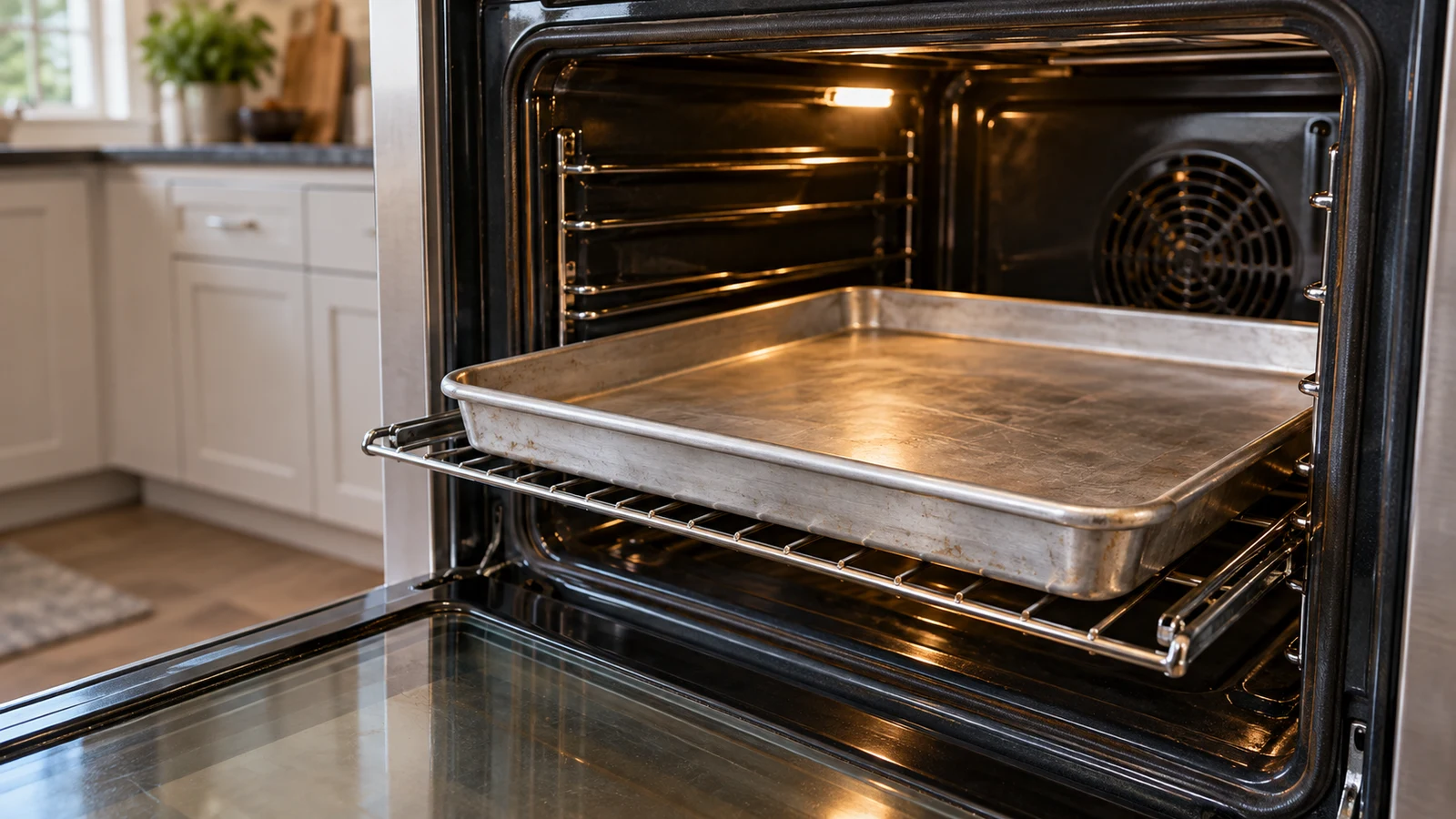
A pan's label and an oven's advertised size are not enough to establish whether they belong together. To assess oven pan fit, compare the cookware's outer dimensions with an explicit accommodation statement, then check the exact model's placement requirements. Appliance width, oven volume and maximum pizza size describe different things. None should stand in for missing information about the space your particular pan would occupy. For oven pan fit, verify each step.
The useful result is a specific assessment: supported, unresolved or contradicted. A listing might support a pan's width and depth while leaving its height or intended rack position unresolved. Keeping those conclusions separate lets you decide what information you still need before choosing an oven, including before a possible cryptocurrency purchase where that payment option is offered.
Measure The Pan Before Comparing A Countertop Pizza Oven
Start with the cookware you want to keep using. Place the empty, cool pan on a stable surface and record its widest outer extent, front-to-back depth and overall height. Include projecting rims and handles. If you intend to use a lid, record the dimensions of that complete arrangement, including any raised handle, rather than treating the uncovered pan as an equivalent shape.
Keep the dimensions printed on the pan's label in a separate note. Check whether those figures describe the cooking area, the base or the outside edges. When the label does not explain its measurement convention, do not assume it matches the measurement convention in an oven description. You need comparable dimensions before a numerical match can support a fit assessment.
Record the intended orientation as well. State which edge would run across the oven and which would extend toward the back. A simple sketch with handles marked is useful when asking about accommodation. It prevents a reply about the pan's shorter edge from being mistaken for confirmation of the wider arrangement you actually intend to use.
Consider a hypothetical rectangular pan whose cooking area matches dimensions named in a listing, but whose handles extend beyond that area. The matching label alone does not establish that the complete pan is accommodated. The next question concerns the outer handle-to-handle measurement. It does not require guessing how much extra space the oven probably has.
Height deserves its own entry even when width and depth receive most of your attention. Note the tallest part of the intended cookware arrangement. Whether that arrangement is permitted at a particular rack position remains a question for the oven's documentation. A flat outline cannot answer a vertical-space question, and a photograph without measurements should not settle it either.
Read Each Size Claim On A Countertop Pizza Oven Separately
Give each advertised figure a clear subject before comparing it with your notes. Does it describe the appliance, the oven cavity, a baking pan or the food? That distinction matters more than whether several figures happen to use inches. Two measurements can share a unit while referring to objects with different boundaries.
An appliance width designation is not a statement of usable rack width. A cavity volume does not supply its individual width, depth or height. A maximum pizza-size claim concerns the advertised food size, while an explicit pan-accommodation statement names cookware. Read each claim for what it establishes without turning it into another kind of measurement.
For each useful specification, keep the wording beside the number. Write that a description names a pan of a particular width and depth, rather than relabeling those figures as interior cavity dimensions. Likewise, preserve a pizza-size claim as a pizza-size claim. This small distinction keeps later comparisons tied to what the product description actually says.
Compare The Forno Pan Claim With The Countertop Pizza Oven Claim
The Forno Leonardo Espresso listing gives unusually direct information for assessing oven pan fit. It identifies a 30-inch white gas range with a 5 cu.ft oven and describes two electroplated oven racks designed to accommodate a baking pan measuring 24 inches wide by 16 inches deep. The pan statement is the relevant starting point for a cookware comparison.
Read that statement narrowly. It supports the listing's stated accommodation for a pan with those width and depth measurements. It does not provide a pan-height limit, identify how projecting handles were measured or give the dimensions of the usable opening. Nor does it supply every placement requirement needed to assess your particular cookware arrangement.
If your pan's measured outer width and depth match the stated dimensions, record that agreement. Keep any unanswered questions beside it, especially if the cookware has a lid, prominent handles or another feature not addressed by the description. Agreement on two measurements is useful evidence without being a complete approval of the intended use.
If your pan exceeds one of the stated dimensions, the listing does not support that larger size. However, the accommodation statement is not expressly a maximum cavity measurement. Exceeding it therefore calls for clarification; it does not, by itself, prove that the pan cannot fit. A definite contradiction would require an applicable limit or restriction that the proposed arrangement violates.
The rack count also needs careful reading. Two supplied racks do not establish that two pans of the stated size may be used simultaneously. That would introduce a separate question about the permitted configuration and space between positions. Keep this assessment focused on the particular pan and placement you need, rather than extending the description into a multiple-pan promise.
What The Countertop Pizza Oven Description Leaves Unanswered
The supplied 1100W countertop pizza oven description advertises pizzas up to 12 inches. Unlike the Forno description, it does not give pan width and depth. That difference changes the next question: you need information about permitted cookware and usable space, rather than treating the advertised pizza size as a tray specification.
A round pizza and the pan carrying it are not interchangeable measurement subjects. For a proposed round pan, check the outer rim and any handles rather than relying on its named cooking diameter. For a rectangular tray, retain both outer dimensions. Neither shape receives confirmation merely because its label contains the same number as the advertised pizza size.
Do not infer rectangular tray accommodation from an imagined square around the advertised pizza. The supplied description does not establish such a usable area or explain the opening through which cookware would pass. A drawing based on assumptions would make the comparison look more precise without supplying the missing model information.
The listed power rating does not fill that gap. Keep it out of the dimensional assessment, just as you would keep cooking-performance language separate from cookware accommodation. These examples are useful because they offer different kinds of size evidence. They do not establish that one oven is a better performer or a better purchase for every reader.
For someone choosing around an existing tray, the countertop model's pan compatibility remains unresolved from the supplied description alone. That is a limited conclusion about the available information, not a finding that the tray is unsuitable. The next step is to request the measurements and restrictions that apply to the exact model and proposed cookware.
Resolve Cookware Questions Before Appliance Installation Readiness
Use your pan record to make the remaining inquiry concrete. Ask whether the complete cookware, in the stated orientation, is accommodated at the intended rack position. Include its outer width, depth and height, and explain whether those measurements include handles and a lid. A question about a named pan arrangement is more useful than asking whether the oven is spacious.
Seek exact-model documentation that addresses the usable opening, the space at the intended position and any required separation from surrounding surfaces or components. These are distinct questions. Information about the opening alone does not establish permitted placement after insertion, while dimensions for an internal space do not necessarily answer the opening question.
Ask what any dimensional diagram measures. A drawing may identify a cavity boundary without specifying the space available to cookware at your intended position. If the labels leave that relationship unclear, keep the fit assessment unresolved. Do not supply your own clearance allowance or treat a close numerical match as permission for a tight fit.
A useful inquiry could read: "My pan's outer measurements include its fixed handles, and I intend to place its longer edge across the oven. Does this exact model accommodate that arrangement at the specified rack position? Please identify the applicable cookware dimensions, opening dimensions and placement instructions." Add your actual measurements before using the question.
Read the answer for its scope. A reply that repeats the appliance width does not answer the pan question. A reply that confirms width and depth but omits height leaves part of the assessment open. If a listing and exact-model instructions appear to conflict, record the disagreement and seek clarification rather than selecting whichever statement makes the purchase easier.
Keep Appliance Installation Readiness Separate From The Pan Decision
Mark the result as supported when the available model information addresses the complete pan arrangement and its applicable placement requirements without a known conflict. Keep the supporting wording with your measurements. This is a documented accommodation assessment, not a prediction of cooking results or permission to disregard the manufacturer's operating instructions.
Mark it unresolved when a necessary dimension, measurement convention or placement rule is missing. State the missing item precisely, such as whether the described pan width includes handles or which rack position the accommodation statement covers. An unresolved entry should tell you what answer would change the decision, rather than simply saying that more research is needed.
Mark it contradicted when an explicit applicable limit or instruction conflicts with the proposed cookware arrangement. Identify that conflict in the note. Do not try to resolve it by assuming diagonal placement, altering the cookware or inventing an exception. If you choose another pan or configuration, assess that new arrangement on its own documented terms.
Keep this result separate from appliance installation readiness. Whether cookware is accommodated inside an oven does not settle the separate questions involved in receiving and installing the appliance. The related guide addresses that broader purchase preparation; neither decision should be used as evidence that the other has been completed.
Before choosing around a pan you want to keep, finish one short statement: "This arrangement is supported, unresolved or contradicted because..." Name the pan, its orientation and the exact model, then cite the relevant wording in your own notes. If the result is unresolved, make the missing cookware detail your next inquiry before deciding whether that oven meets your needs.