Crypto Commerce
Noorio B200 wireless security camera system vs Xega LTE cameras: where will the signal and power come from?
Compare Noorio B200 wireless security camera system by coverage, charging, storage, data plans and placement.
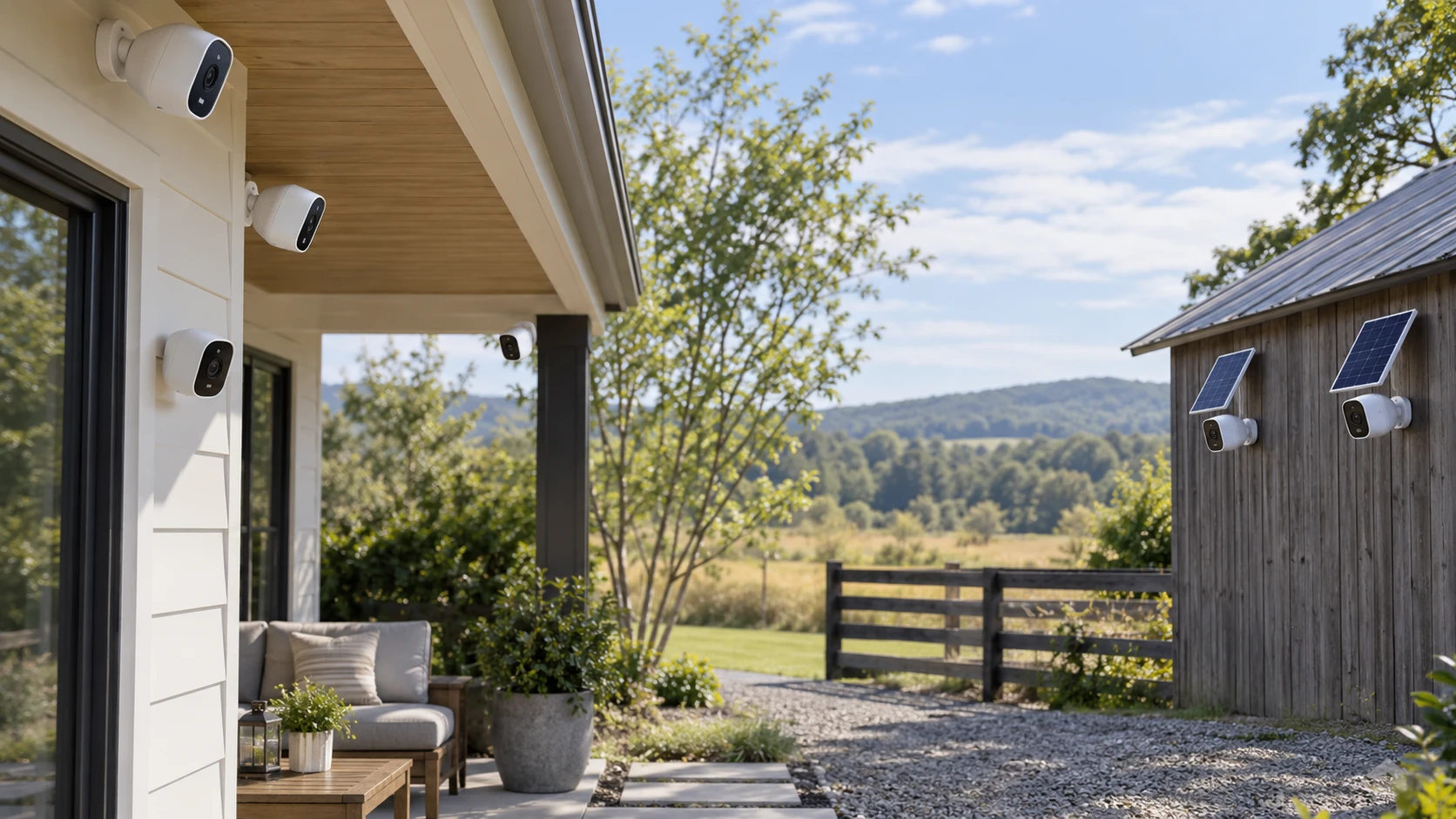
The Noorio B200 wireless security camera system is listed as four rechargeable cameras connected through a Noorio Smart HUB and app. Xega's listing is a two-camera outdoor kit that uses 4G LTE service and a solar panel for each camera. The decision begins with the property: is there reliable Wi-Fi where the cameras need to see, or do those spots need a cellular connection? After that, plan how each camera will stay charged and where recordings will live.
These descriptions are claims in Republeq's catalog, not a site survey or a test of motion detection. Camera counts, included mounts, and storage details should be checked against the exact offer at checkout. One Noorio storage passage is internally inconsistent, so its usable local capacity needs direct confirmation. Xega's initial SIM data is only for testing; the listing says continued service requires a monthly plan. Make those unresolved and recurring costs part of the purchase comparison rather than assuming either kit is ready to operate indefinitely out of the box.
Place cameras where a real signal reaches — Xega solar LTE security camera two-pack
Noorio says its Smart HUB connects B200 cameras and other Noorio devices, and that it can expand Wi-Fi coverage to stabilize connections. That does not establish coverage at the end of a long driveway or through a metal outbuilding. Mark the four proposed camera positions on a property sketch, then check the hub's allowed location, power requirement, and signal path. Ask whether the camera communicates with the hub directly or through the home's router and what happens to recording if internet service drops. The saved listing does not answer every network question.
Xega positions its pair for outdoor locations without Wi-Fi or mains power. Its cameras use prepaid SIM cards with 300 MB of initial data for testing. The listing says continued 4G service requires a monthly plan using Verizon, AT&T, or T-Mobile. Verify the supported bands, actual carrier availability at the mounting spot, activation steps, and current plan price for the exact kit. A phone showing a few bars nearby is a starting clue, but a live camera may be mounted higher, behind a wall, or pointed from a different side of a building.
The LTE approach can serve a remote gate or shed where extending Wi-Fi would be difficult. Its ongoing data charge and signal quality are part of the product, not optional accessories. A four-camera Wi-Fi hub can serve several areas around a building when the network reaches them; it may be a poor match for a remote location outside that range. If the site has both conditions, sketch which location actually needs cellular access before comparing the number of cameras per box. Two well-placed views can be more useful than four cameras installed where they cannot send an alert.
Check how each system handles a weak connection. Does it buffer video locally and sync later, send a delayed alert, or miss events? What quality and length of clip can be viewed remotely at the chosen connection speed? Neither saved product description provides a dependable answer. Ask for current technical documentation and, if possible, test one camera at the intended mounting point within the return period. Include nighttime signal conditions if the property network becomes busy after dark.
Make a charging calendar before mounting — camera battery planning away from charging
Noorio describes rechargeable batteries supporting motion-activated operation for up to 180 days. That is an upper-bound claim in Republeq's catalog, not a promise for a busy entrance where the camera wakes repeatedly. The listing includes four charging cables and a charging plug, along with magnetic and screw mounts. Plan how you will safely reach every camera to recharge it, how long charging takes, and whether a temporary replacement camera is needed during the gap. The saved description does not list a solar panel for this Noorio package.
Xega lists a 9,000 mAh battery and a 5-watt solar panel for each of its two cameras. A panel can reduce manual charging when the site gets suitable light, but the listing does not provide a tested winter charging balance or a runtime at a specified alert rate. Look at seasonal shade, the direction and tilt available for the panel, and whether nearby trees will grow into its sun path. Ask whether the panel is built in or separate and what cable and mounting hardware come with the exact offer. If a camera watches a shaded porch, the word solar by itself tells little about the charging routine.
The published guide on camera battery planning away from charging offers a way to estimate how often a camera will wake and whether you can reach it to recharge. Use that method for both products. It does not certify 180 days for Noorio or self-sustaining power for Xega at your site. Count expected motion events during a busy day and a quiet day, then check how clip length, live viewing, spotlight use, and cold weather affect the manufacturer's stated battery assumptions.
Mounting method changes upkeep. Noorio lists magnetic mounts for quick attachment and screw mounts for a more permanent fit. A quick-release camera may be easier to charge, but make sure its chosen position and attachment method are secure and appropriate for the site. Xega's solar panels need a stable exposure, so a camera angle chosen for the best image might not be the best panel angle. Confirm whether the kit permits separate panel placement. Do not assume an outdoor camera can be mounted anywhere merely because it has an IP66 rating or a battery.
Which events do you need to see? — Xega solar LTE security camera two-pack
Noorio describes motion-activated spotlights, color night vision, two-way audio, and AI human detection intended to filter animals, branches, vehicles, and other non-human movement. Treat the filtering as a feature to test, not a guarantee that it will capture every person or suppress every false alert. A porch with pets, passing headlights, or swaying plants may need sensitivity adjustment. Ask how to review missed events and whether settings can differ by camera. The description does not provide a common detection-distance test against Xega.
Xega lists 2K HD video at 3 MP, color night vision, two-way audio, motion alerts in the UBox app, and pan-and-tilt movement of 355 degrees horizontally and 90 degrees vertically. A movable view may help survey a wider area after an alert, but it does not mean every direction is recorded continuously. Find out whether the camera tracks motion automatically, whether it returns to a preset view, and what happens while it is pointed away from the entrance. The saved listing does not establish those behaviors.
Noorio's saved description does not provide a resolution figure for a direct image-quality comparison. Ask for sample footage from the exact model in daylight and in a lighting condition like your property. For Xega, a 2K label is not proof you can identify a face or license plate at a particular distance. Lens angle, compression, lighting, motion, and mounting height all change what the recorded clip shows. Sketch the area of interest and test with a person walking through it at the distance that matters.
If you use two-way audio, ask who will receive the notification and whether the app can share access safely with another household member. A feature that requires someone to watch a live feed is different from reliable event recording. Both listings describe app functions but do not specify every sharing, offline, or account-recovery behavior. The current app documentation and privacy settings should be part of the setup plan, particularly for cameras covering shared or public-facing areas.
Storage and the continuing bill — Xega solar LTE security camera two-pack
Noorio's description first says 8 GB of local storage holds up to 3,000 pieces of footage without a subscription. Later it says the system also includes built-in 32 GB storage for additional footage. The saved record does not explain whether those capacities belong to different devices, are additive, or reflect conflicting versions of the kit. Check Republeq's product page for the hub model, actual usable capacity, overwrite behavior, and export method before relying on either number. It says cloud backup is optional and advertises no hidden monthly fee, but confirm which alerts, history, and exports work without paying.
Xega says video can be stored on a microSD card or in the cloud. It does not state a card capacity, whether a card is included, or the retention time for either option. Ask for supported card specifications and cloud terms. More importantly, the listing says ongoing LTE service needs a monthly plan after the 300 MB test allocation. Estimate the plan cost over a year and how much data your expected event rate will use. Frequent live viewing can change data use considerably; the catalog does not quantify it.
Include repair and replacement costs in the same worksheet. Noorio's four rechargeable cameras may need battery or mount service over time; Xega's two solar cameras may need panel cleaning, a new card, or a changed data plan. Neither listing provides failure rates or battery replacement terms. Check warranty coverage, spare-part availability, and what happens if a camera is stolen or damaged while the other cameras continue working.
Choose the operating model — Xega solar LTE security camera two-pack
Noorio deserves closer investigation if you need four viewpoints around a building with suitable Wi-Fi coverage and can manage periodic manual charging. Verify the hub's real coverage, the exact local storage capacity, and the current app functions. Its up-to-180-day claim should be treated as a planning estimate until the cameras have run through your site's normal traffic and weather.
The Xega solar LTE security camera two-pack deserves closer investigation if the key viewpoints lack Wi-Fi and can receive both cellular service and usable sunlight. Confirm the current carrier plan, panel placement, storage option, and what the pan-and-tilt camera records when nobody is watching live. Include the monthly data charge in the price comparison from the start.
Walk the property with a phone, a tape measure, and a map of the proposed views. Mark signal quality, charging access, seasonal shade, and the distance to the event you need to recognize. Those observations turn camera-count and battery claims into a workable installation plan before holes are drilled or a subscription begins.