Tools & DIY
Negative base two notation: write integers with zero and one
A paper notation worksheet uses alternating place weights and parity remainders to represent integers without a leading minus symbol.
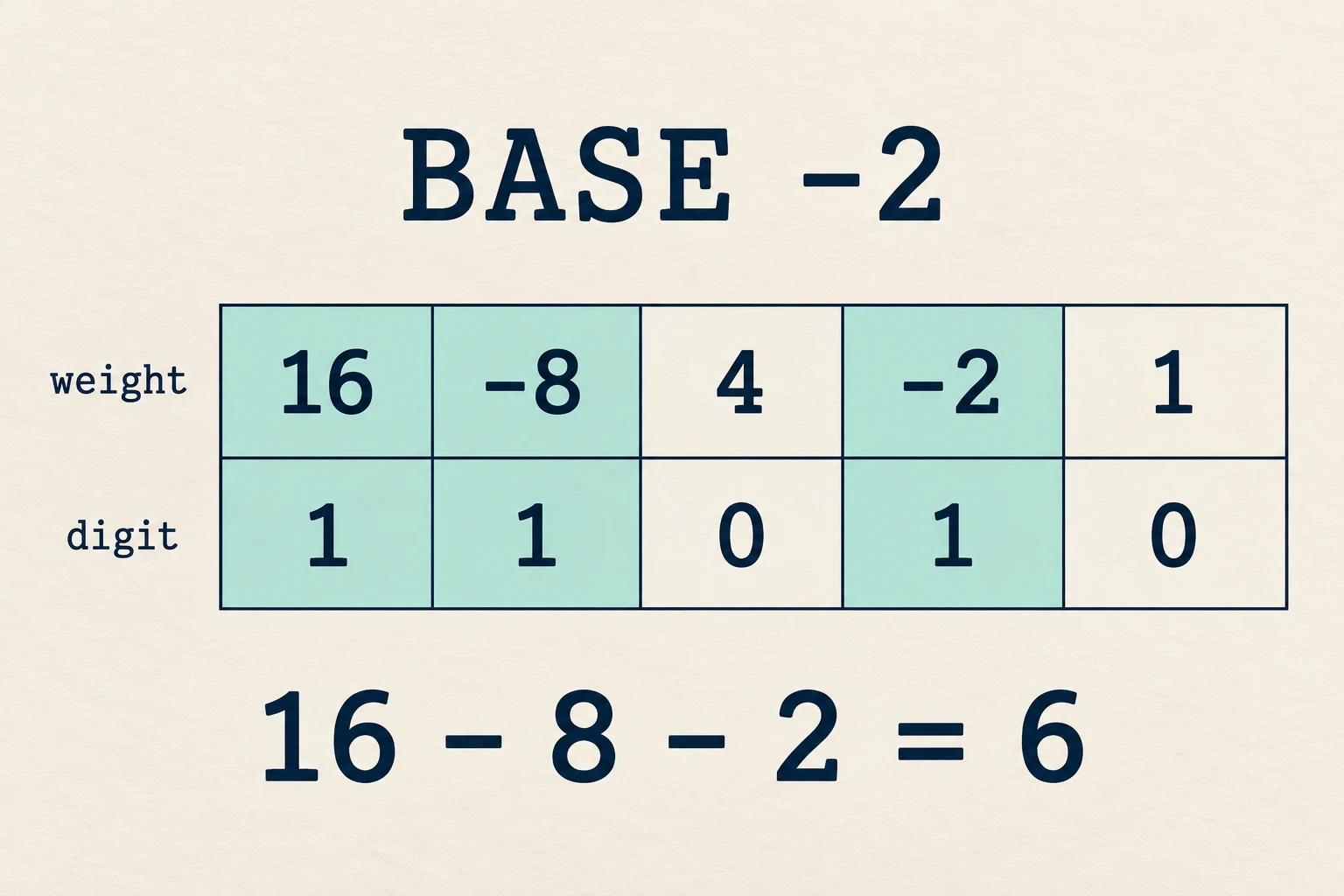
Negative base two notation assigns alternating positive and negative weights to positions. With that convention, the string 11010 represents six, while 1101 represents minus three. Both use only zero and one as digits. The minus sign belongs to the base definition, rather than appearing before the written negative value. This paper worksheet explains how to read those strings, construct them from integers, and check why the construction stops with one canonical answer.
Define the rightmost position to have weight one. Each position to its left has the previous weight multiplied by minus two. The weights, read from right to left, are therefore one, minus two, four, minus eight, sixteen and minus thirty-two. A digit of one contributes its position's weight; a digit of zero contributes zero. Add the contributions to obtain the represented integer. These definitions supply the whole notation rule used here.
Read the weights before reading the digits
Write 11010 over the five weights sixteen, minus eight, four, minus two and one, in that left-to-right order. The first one contributes sixteen. The next contributes minus eight. The middle zero contributes nothing, the fourth digit contributes minus two, and the final zero contributes nothing. Sixteen minus eight minus two equals six. The zeros preserve positions even though their own contributions are zero.
The same characters would have a different value under ordinary positive base two weights. With sixteen, eight, four, two and one, the string 11010 would give sixteen plus eight plus two, or twenty-six. Thus the string alone does not settle its value without the base convention. Preserve the base label beside the exercise. Nothing here establishes that an actual product display, calculator setting or data format uses this negative-base rule.
For 1101, the four weights are minus eight, four, minus two and one. Its ones contribute minus eight, four and one; its zero contributes nothing. The sum is minus three. A leading minus symbol is unnecessary within this defined system because the negative place weight already contributes to the value. This example does not say that an unsigned-looking string in an unfamiliar real record should be interpreted this way.
Give the written form a canonical rule
For a nonzero integer, require the leftmost digit to be one. Extra zeros may not be added before it in the canonical form. Adding such a zero would preserve every existing contribution but make another spelling of the same value. For example, 011010 would also have value six, yet our canonical rule retains 11010. The represented integer and the choice of an approved written form are separate parts of the definition.
Use the single digit zero for the integer zero. The strings 00 and 000 would also sum to zero if allowed, but they are excluded from the canonical form. No decimal point, fractional positions or digits other than zero and one are part of this worksheet. We will construct representations for positive and negative integers under these explicit rules, rather than infer a convention from a familiar-looking string.
Choose the last digit using parity
Every position above the units position has an even weight, including the negative weights. Their total contribution is therefore even. The last digit must be zero when the intended integer is even and one when it is odd. This applies to negative odd integers too: minus three needs a last digit of one. A digit of minus one is not permitted by the stated digit set.
Call the current integer n and the chosen last digit r. After removing that digit's contribution, n minus r is even. Divide the difference n minus r by minus two to obtain the next quotient q. Equivalently, n equals minus two times q, plus r. The quotient is an integer, and its representation will occupy the remaining positions after one multiplication by minus two. Record the remainder first, then continue with q.
This rule chooses r from the pair zero and one by parity, rather than accepting any signed remainder produced by an unspecified division procedure. For n equal to minus three, choose r equal to one. Then q is minus four divided by minus two, or two. The identity checks: minus two times two, plus one, equals minus three. Retaining a remainder of minus one instead would violate this worksheet's allowed digits.
Construct six and reverse the remainder record
Begin with n equal to six. It is even, so r is zero and q is minus three. Continue with minus three: r is one and q is two. With two, r is zero and q is minus one. With minus one, r is one and q is one. Finally, with one, r is one and q is zero, so the process stops. Each row uses the quotient from the previous row as its new n.
The remainders were recorded in the order zero, one, zero, one, one. The first chosen remainder is the rightmost digit because it had weight one in the original integer. Read the collected list backward to obtain 11010. Reading it forward as 01011 would put those remainders under the wrong weights. Keep the quotient and remainder columns visible until the final order has been checked.
Decode the completed result independently: 11010 gives sixteen minus eight minus two, or six. This readback verifies the example without assuming that a correctly shaped five-digit string must be correct. For the initial integer minus three, the trace begins at the second row above and records one, zero, one, one. Reversing those remainders gives 1101, whose readback is minus eight plus four plus one, or minus three.
Check why the procedure always stops
To establish termination for every integer, bound the quotient magnitude at each step. For an integer n whose absolute value exceeds one, the chosen r is either zero or one. The absolute value of q is at most half the sum of the absolute value of n and one. That bound is strictly less than the absolute value of n when the latter exceeds one. Thus each such step strictly reduces a nonnegative integer magnitude.
Eventually the remaining magnitude must be at most one. Zero is already stopped. One produces remainder one and quotient zero. Minus one produces remainder one and quotient one, which then reaches zero on the next step. The minus-one case needs its own statement: its first quotient has the same magnitude, so a claim that magnitude strictly decreases on every single step would be false. With these small cases included, the procedure terminates for every integer.
Every recorded row preserves n equal to minus two times q plus r. Substituting the next row's identity into the previous one attaches the next remainder to the next power of minus two. Continuing to the zero quotient therefore gives the original integer as the weighted sum of all recorded digits. Termination supplies a finite string; the row identities establish that the finite string has the intended value.
Explain why the canonical answer is unique
Any permitted representation of a given integer must have its last digit equal to that integer's parity. There is no choice between two possible last digits once zero and one are the only options. Remove that forced digit and divide by minus two. The value of the remaining prefix is then fixed as q. Applying the same parity argument forces its last digit as well.
Repeating the argument determines every digit from right to left. The finite construction reaches zero, where the remaining prefix ends. The no-leading-zero rule and the single-zero convention remove redundant spellings. This gives one canonical representation, rather than merely an example that happens to decode correctly. The reasoning covers arbitrarily large integers; checking a finite collection of conversions would provide useful tests but would not replace the termination and uniqueness arguments.
Use the highest place as a sign check
There is an additional check on a nonzero canonical string. Suppose its highest position has index k, with the units position called zero. Its leading one contributes (-2)^k, whose magnitude is 2^k. For k above zero, the absolute values of all possible lower contributions sum to at most 1 + 2 + ... + 2^(k - 1), which equals 2^k - 1. For k equal to zero there are no lower positions, so their sum is zero. In either case, the lower total is smaller than the highest weight's magnitude.
The lower positions therefore cannot overturn the leading term's sign. An even highest index gives a positive value and an odd highest index a negative one. Since the number of digits is k plus one, a nonzero canonical string of odd length is positive and one of even length is negative. The five-digit 11010 and four-digit 1101 satisfy that check. Zero remains the separately defined single-zero case.
The sign check does not compute the magnitude or replace a weighted readback. Other five-digit strings can represent different positive integers. Likewise, two digits can already represent a negative value: 11 has minus two plus one, or minus one. Always keep the actual digits and weights with the result. This is a finite integer notation exercise, with no claim about a physical instrument's range, resolution or internal representation.
Keep nearby explanations and tool accounts separate
The mechanical counter guide, read digit positions before counting categories, defines ordinary base-ten positions within one number and contrasts them with separately labeled category records. This worksheet instead uses alternating negative-base weights and a parity-quotient construction. It supplies no counter input, reset or operating instruction.
The digit swap check guide, keep changed order beside a passing check, examines decimal transpositions and remainder-nine and remainder-eleven checks. Here the alternating powers define the integer's actual value. They are not a shortened checksum or evidence that a copied record stayed unchanged.
The General Tools account, square-head adjustable protractor bundle, declares five each. Its sole image shows one complete GENERAL-marked square head, attached arm and fastener; it does not verify five delivered. No material, stated length, angle accuracy, graduation precision or locking performance is authenticated here.
The native Unbranded account, 2372-360 bevel protractor, shows an assembly marked INSIZE, with the upper arm tip at the photo boundary. Catalog and pictured labels remain distinct, without maker equivalence or model authentication. Its optional clamp is not confirmed supplied stock. No graduation accuracy, parallax-free performance, material or full length is established.
Keep payment details with an actual order
If you separately consider purchasing an educational or measuring item, inspect the actual offer and current order terms before selecting a payment method. The integers and binary strings in this worksheet are defined mathematical examples, not prices, product identifiers or instructions for sending funds. Do not reinterpret a real order reference, amount or receiving address using the negative-base rule. Such a change would have no authority from this paper exercise. For a purchase on republeq.com, review the methods presented for your specific transaction. If cryptocurrency is offered and you consider USDT, confirm the exact asset, network, requested amount, receiving details, fees and any time limit through the current checkout. A token name alone does not settle its network or the total that must be sent. Do not reuse details from an earlier basket or infer them from a product image or notation diagram. Check the selected item, variant, intended quantity, shipping destination, delivery estimate and final total. Resolve material questions about actual supplied contents before authorizing payment. Ask how cancellation, returns and any approved refund would be handled, including the refund asset or currency, any relevant network, calculation basis and possible deductions. Keep those answers with the order they concern; a changed selection may require a fresh review. If another person is helping, clarify whether you are requesting information or authorizing a purchase, and discuss proposed substitutions. Retain the product reference, order confirmation and any transaction record together. If an essential instruction remains unclear or conflicts with another current instruction, pause and obtain clarification through the responsible service. This is conditional purchasing guidance, not a completed transaction, a promise of any payment option or advice to choose a particular asset. The complete notation exercise requires no purchase and provides no evidence that an actual transfer succeeded.
For six, retain the quotient rows and reversed remainders giving 11010, then check sixteen minus eight minus two. For minus three, retain 1101 and its sum minus eight plus four plus one. The canonical rule, alternating weights and parity-selected digits explain both results. Their termination and uniqueness proofs belong to those stated integer rules, while any actual tool or purchase needs its own evidence.