Office Supplies & Stationery
Digit swap check: why the sum still agrees
Diagnose a digit-sum check that passes after a decimal transposition. Compare a second defined check and its position-based limits.
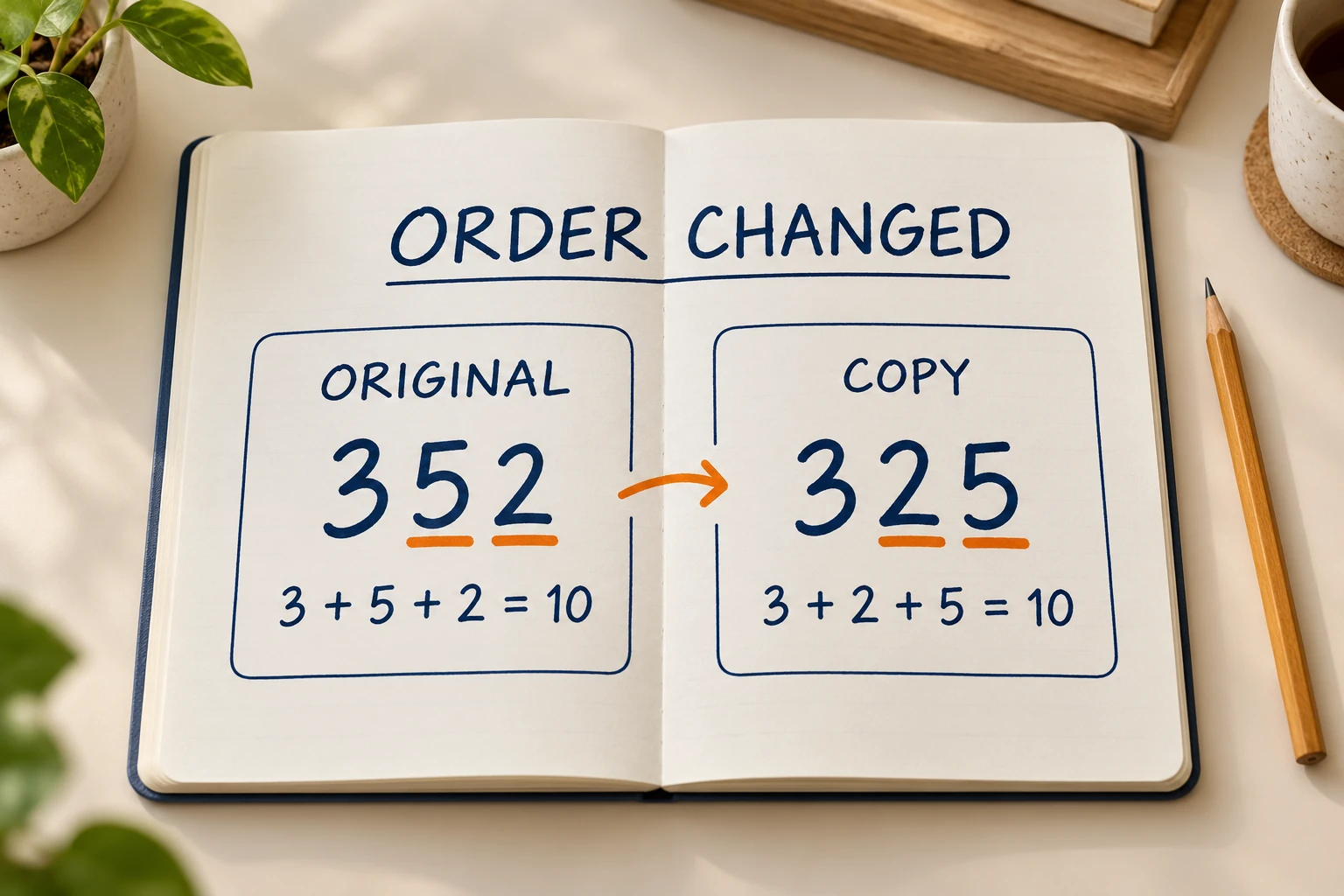
Digit swap check results can agree even when a copied number has changed. In this fictional paper example, the reference is 352 and the copy is 325. Both digit sums are ten. The agreement follows from adding the same three digits; it does not establish that their order was preserved.
The reference and copy are stipulated inputs, without an actual transcription trial or claim about a notebook's performance. We use ordinary three-digit decimal numbers and explicitly defined arithmetic checks. No wallet address, account number, identifier standard, file checksum or security system is being tested.
Keep the reference beside the copy
Write 352 in a field marked reference and 325 in a separate field marked copy. The first digit remains three. The tens and units digits have exchanged places: five and two become two and five. Thus the two written records differ, even though each still contains a three, a five and a two.
Keep the reference unchanged while investigating the check. Replacing it with the copied value would remove the independent comparison. In this exercise the reference is supplied as trusted; an actual uncertain record would need its own evidence before either version could be called correct.
The diagnostic question is why one stated check fails to notice the given change. We already know which two records we are comparing. We are not asking a short arithmetic summary to reconstruct an unknown original or to identify which character someone should alter in real data.
Calculate what the digit sum actually preserves
The reference gives three plus five plus two, equal to ten. The copy gives three plus two plus five, also ten. Addition does not depend on the order of these three addends. Exchanging the two digits changes their positions in the decimal number without changing the collection of digits being added.
Any rearrangement of the same digits would preserve this ordinary digit sum. That statement concerns this check's arithmetic, rather than a probability of an error occurring. The supplied 352-to-325 swap demonstrates that limit directly.
The numerical values do differ. Three hundred twenty-five minus three hundred fifty-two equals minus twenty-seven. The unchanged sum of ten did not imply an unchanged number. Retain both the character comparison and the arithmetic result so the check's narrow meaning remains visible.
Define a remainder-nine check separately
For another explicit check, divide each number by nine and retain its remainder. The reference 352 equals nine times 39 plus one. The copy 325 equals nine times 36 plus one. Both leave remainder one, so this check also passes despite the stated transposition.
The digit sum ten has the same remainder one when divided by nine. The relationship can be explained from decimal place value. Ten differs from one by nine; one hundred differs from one by 99. Replacing a hundreds contribution by its digit, or a tens contribution by its digit, changes a number by a multiple of nine.
For 352, the difference between its value and its digit sum is 342, which is 38 times nine. For 325, that difference is 315, which is 35 times nine. The digit sums agree, so the two numbers' remainders agree. This is an exact calculation for the printed inputs, without relying on an observed device result.
Track the place-value change
Suppose a digit a occupies position m and a different digit b occupies position n, counting the units position as zero. Their contributions are a times ten to the power m and b times ten to the power n. Swapping them reverses the two digits while leaving all other positions unchanged.
The change, new number minus old number, is b minus a multiplied by the difference between ten to the power m and ten to the power n. Each power of ten has remainder one upon division by nine. Their difference is therefore divisible by nine, as is the full swap difference.
This explains the remainder-nine blind spot for a digit transposition. A check that retains only that remainder discards the positional distinction involved in the swap. Adding a second copy of the same check would not restore the information it has discarded.
Define an alternating-position check
Now introduce a separate check for these three-digit records. Starting with the units digit, add it, subtract the tens digit, and add the hundreds digit. Then retain the remainder of that alternating sum upon division by eleven. If the sum is negative, use its equivalent nonnegative remainder from zero through ten.
For 352, the alternating sum is two minus five plus three, or zero. For 325, it is five minus two plus three, or six. Their remainders are therefore zero and six. This defined check notices a difference that the ordinary digit sum and remainder-nine comparison did not notice.
Direct division verifies the same remainders for the numbers themselves. The reference 352 is exactly eleven times 32. The copy 325 is eleven times 29 plus six. Keep the particular check definition with the calculation rather than assuming every named checking scheme uses these weights.
Explain why the positions matter
Ten differs from minus one by eleven, so it has the same remainder as minus one when working modulo eleven. Its powers therefore alternate between the residues of one and minus one. Units and hundreds have the same positive sign; tens have the negative sign in our three-position alternating sum.
Exchanging digits between positions with opposite signs changes the weighted total by plus or minus twice their difference. Distinct decimal digits differ by at least one and at most nine in absolute value. The resulting nonzero change is even and has absolute value at most eighteen.
No such change is a multiple of eleven: the only nonzero multiples within that range are minus eleven and eleven, both odd. Thus a swap of distinct digits between opposite-sign positions changes this remainder. In a decimal record, positions separated by an odd number of places have these opposite signs.
The tens-and-units swap in 352 and 325 fits that condition. This result does not mean the check detects every possible edit. It establishes a stated boundary for one transposition of distinct decimal digits under the explicitly defined weighting.
Test the same-position-parity blind spot
Make a separate example with reference 135 and copy 531. The hundreds and units digits exchange places while the tens digit remains three. Those exchanged positions both receive a positive sign in the alternating check. Their ordinary digit sums are both nine.
The reference's alternating sum is five minus three plus one, or three. The copy's is one minus three plus five, also three. Direct division gives 135 equal to eleven times twelve plus three, and 531 equal to eleven times 48 plus three. Both the remainder-nine and remainder-eleven checks agree.
Yet the numbers differ by 396. That is 44 times nine, 36 times eleven, and four times 99. Agreement on both checks therefore fails to establish an unchanged record. This explicit counterexample is enough to disprove an unconditional claim that the pair of checks detects every digit swap.
More generally, positions separated by an even number of places receive the same alternating sign. Swapping their digits preserves this weighted sum. Exchanging identical digits also leaves the written record unchanged; it is not a changed-text example. Several simultaneous edits would require their own analysis.
Keep the actual notebook accounts separate
The SP Richards Sparco notebook account retains those catalog fields. Its sole image shows assorted side-wire notebook covers marked Sparco, seventy sheets and one subject. The native bundle-of-ten-bundles wording is not multiplied by the pictured covers into a delivered count. Maker relationships and paper performance are not established.
The Business Source green-tint steno account retains catalog brand Vasttron. Its sole image shows Business Source steno covers and an open green-tint ruled page, with sixty-sheet wording. These labels do not establish a maker alias, delivered quantity, tested safety, paper weight or performance.
Neither selected account supplies the fictional records. Catalog fields and pictured labels remain separate observations without an asserted maker relationship. The notebook references provide optional writing context; no purchase or particular paper product is required for the arithmetic.
Use the result for the question it answers
The row and column control-total guide uses trusted table controls and a stipulated single-entry change, then shows balanced changes that pass totals. Here the records are decimal digit strings. Position-dependent place values explain which supplied transpositions these two checks miss.
The last digit power-sum guide checks an exponent's position in a repeating last-digit cycle. Our given numbers are reference and copy records, not powers indexed by an exponent. That cycle does not certify an unchanged order here.
A failed comparison shows the checked summaries differ, while a passing one shows only that they agree. For an exact-record question, compare the actual reference and copy character by character under the intended formatting rules. An arithmetic match supplies no missing evidence about whether the reference itself is trustworthy.
Keep an actual purchase outside the check
If you separately consider a notebook order on republeq.com and want to ask about USDT, begin with the exact offer and intended quantity. The fictional records, digit sums and remainders in this worksheet are not prices, cryptocurrency amounts or payment instructions. Correct arithmetic establishes no checkout method or actual order status. Read the payment options and conditions presented for the intended transaction, and ask the responsible support contact to clarify essential missing information before deciding whether to proceed. If a cryptocurrency option is offered, establish the specified asset and network, requested amount, any stated validity period and the reference associating payment with the order. Do not infer a transfer destination from a product image, worksheet heading or notebook label. Resolve material product questions separately, including actual supplied contents and any intended use you need the item to support. Ask about applicable delivery, cancellation, return and refund conditions, including the denomination of any approved refund and relevant deductions. Keep each answer with the offer it concerns. Information about one account does not automatically describe another quantity or purchase, and a changed order may require reviewing the resulting terms again. This article promises no present USDT availability, fee level, conversion result, confirmation time, refund amount or delivery outcome. You can inspect every fictional digit record without purchasing anything. Preserve any eventual order acknowledgement and transaction record separately from the worksheet. Those records concern an actual transaction under its documented conditions; the calculations examine explicitly defined arithmetic checks. A preferred payment asset or a plausible remainder cannot fill a gap in actual order information.
Retain the changed order beside the passing check
Digit swap check results for 352 and 325 agree on the sum of ten but differ under the defined alternating-position check. The separate 135-to-531 example passes both remainder comparisons. Save the reference, copy, check definition and position assumptions together so an unchanged summary is never mistaken for proof of an unchanged number.