Data & Spreadsheets
Row and column total mismatch: find one changed entry
An original three-by-three count table uses independently trusted row and column controls to locate one stipulated changed entry, with counterexamples limiting the diagnosis.
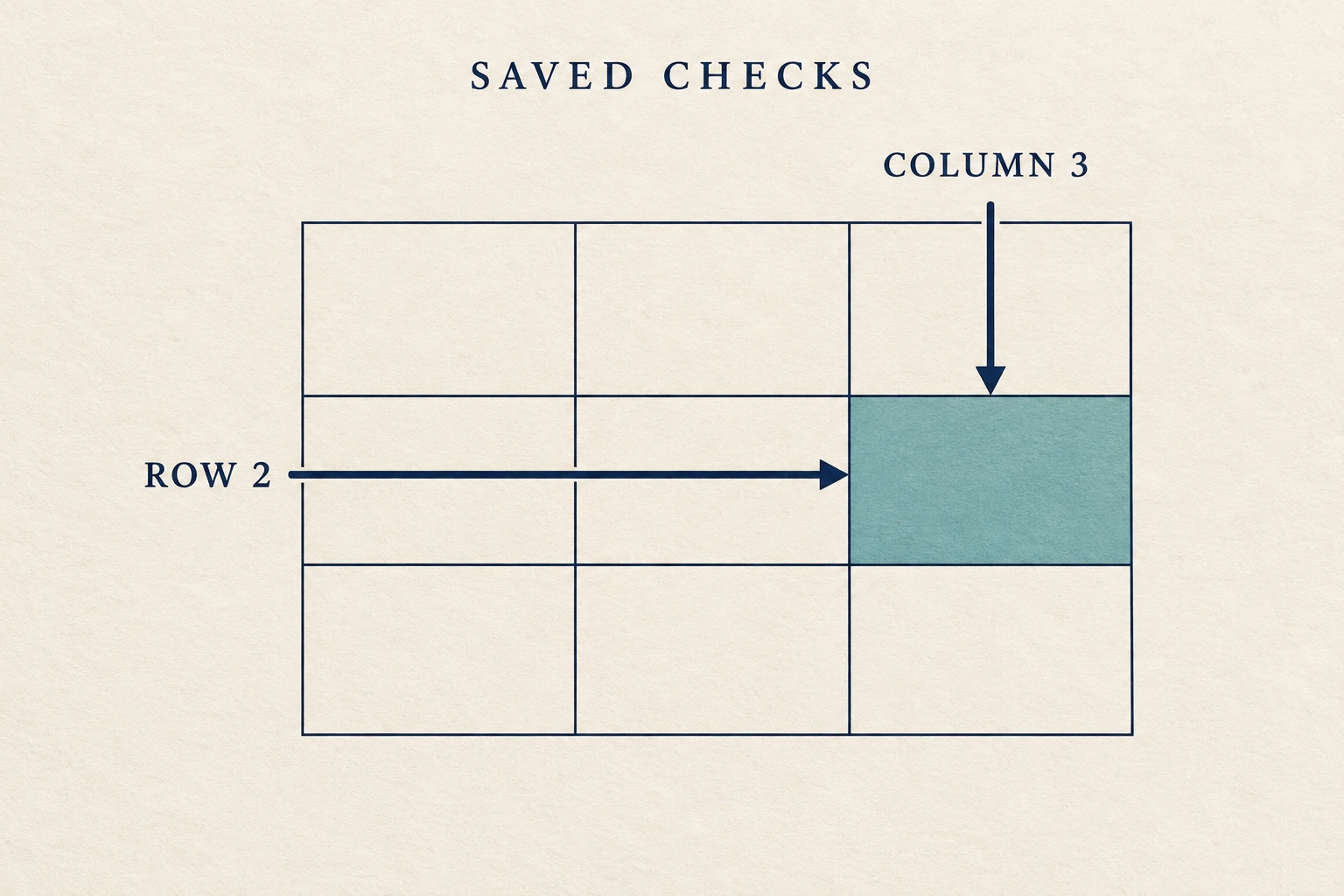
Keep the saved checks separate from the current table
Row and column total mismatch can locate one changed entry when the original controls are independently trusted and exactly one entry is known to have changed. Those conditions matter as much as the arithmetic. In this original paper exercise, the second row and third column each exceed their saved totals by ten. Their intersection identifies the stipulated changed entry, which must decrease by ten.
This is a fictional count table, not a report of actual stock, a financial reconciliation or a working spreadsheet. All nine entries use the same invented counting unit. There is no rounding, formula-copy behaviour, missing row, inserted column or changed classification. The saved controls refer to this exact table and remain unchanged while its current entries are checked.
The guarantee of exactly one changed entry is an explicit input to the first example. It is not something we will infer merely because the discrepancy pattern looks convenient. Later examples deliberately remove that guarantee. They show why a matching grand total, or even matching row and column controls, cannot certify that every entry is correct.
Limit the native sleeve references to their evidence
The native Vinyl Styl 1000-count outer-sleeve account describes sleeves for 12-inch records. Its sole image shows a carton labelled Record Outer Sleeve and 1000 Count Bulk, with model VS-P-015. The package label does not independently verify the delivered count or material. No quantity in the fictional table is taken from this offer.
The native Vinyl Styl resealable outer-sleeve account describes a 500-pack. Its sole image shows a hand lifting an integrated closure on a transparent sleeve over a wood surface. Neither the package count nor the image's dust and snag claims were independently tested. The hand and surface illustrate use; they are not verified supplied inventory.
Write the original reference before inspecting the change
The original three-by-three table has first row 12, 7 and 5; second row 4, 9 and 8; and third row 6, 3 and 11. Call positions R1C1 through R3C3, with R identifying the row and C the column. These labels name positions, without implying a particular application's address syntax.
The saved row totals are 24, 21 and 20. Check them against the reference: 12 plus 7 plus 5 equals 24; 4 plus 9 plus 8 equals 21; and 6 plus 3 plus 11 equals 20. The saved column totals are 22, 19 and 24. The first combines 12, 4 and 6; the second combines 7, 9 and 3; the third combines 5, 8 and 11.
The saved grand total is 65. Adding the three row controls gives 24 plus 21 plus 20, which is 65. Adding the three column controls gives 22 plus 19 plus 24, also 65. In this exercise those figures belong to the trusted reference. Recalculating them from the changed table and replacing the saved values would destroy the comparison.
Preserve the table that produced the mismatch
Now inspect a current version whose first row remains 12, 7 and 5; second row reads 4, 9 and 18; and third row remains 6, 3 and 11. The exercise stipulates that exactly one entry changed from the trusted reference. Keep this current version visible while calculating its checks, rather than silently substituting a more plausible number.
Its row totals are 24, 31 and 20. The second row's 4 plus 9 plus 18 equals 31. Its column totals are 22, 19 and 34. The third column's 5 plus 18 plus 11 equals 34. The current grand total is 75, whether calculated from the rows, columns or all nine entries.
A total of 75 does not tell you which entry changed. Many different ten-unit increases could produce the same grand discrepancy. The saved row and column controls provide additional positional information. Retain their labels instead of keeping only the grand total and a note that something is ten too high.
Use one sign convention for every difference
Define each discrepancy as current total minus saved total. The row differences are zero, ten and zero: 24 minus 24, 31 minus 21, and 20 minus 20. The column differences are zero, zero and ten: 22 minus 22, 19 minus 19, and 34 minus 24. The grand discrepancy is 75 minus 65, or ten.
A positive ten means the current figure exceeds the saved control by ten. It is not yet an instruction to add ten to the table. Write the subtraction convention above the results. Using current-minus-saved for rows but saved-minus-current for columns would reverse one sign and make matching evidence look inconsistent.
Under the stipulated single-entry condition, a nonzero change affects exactly its own row and its own column by the same signed amount. It also changes the grand total by that amount. Here only row two and column three have nonzero differences, both positive ten. Their intersection is R2C3, the position currently containing 18.
Reconstruct the entry before recording a correction
The trusted second-row control is 21. Its other two current entries are 4 and 9. Under the single-entry condition, those other entries are unchanged, so the value needed at R2C3 is 21 minus 4 minus 9, giving eight. The recorded 18 exceeds that reconstructed eight by ten.
Check the same position using its column. The trusted third-column control is 24, and its other entries are 5 and 11. Twenty-four minus five minus eleven also gives eight. The two reconstructions agree under the declared assumptions. They do not independently establish that those assumptions hold for a real unexplained table.
The correction in this paper example is therefore minus ten at R2C3: replace 18 with eight. Preserve the previous entry and the reason for changing it in a separate version note. Adding ten because the discrepancy was positive would move the entry to 28 and increase the mismatch rather than remove it.
After the stated correction, the row totals return to 24, 21 and 20; the column totals return to 22, 19 and 24; and the grand total returns to 65. Save this recheck with the corrected version. It confirms the proposed change satisfies the original controls in this exercise, while the earlier single-entry guarantee supplies the basis for identifying that change.
Do not turn the pattern into proof of one error
The diagnosis began with independently trusted controls and a guarantee of exactly one changed entry. An unfamiliar table does not acquire that guarantee merely because one row and one column show equal differences. Several changes can combine or cancel. Obtain the relevant records and explanation before treating a plausible intersection as authority to alter actual data.
Likewise, saved figures that were recalculated from the current entries would not be independent controls. Matching those newly calculated figures would establish only that the arithmetic was repeated consistently. A meaningful record identifies where the reference came from, which version it describes and what remains uncertain about the current table.
Two changes can leave every row total unchanged
Return to the original reference and make a separate example. Increase R1C1 from 12 to 14 and decrease R1C2 from 7 to five. All other entries remain original. The first row still totals 24 because the increase of two and decrease of two cancel. The other row totals remain 21 and 20.
The first column now totals 24 instead of 22, giving a discrepancy of positive two. The second totals 17 instead of 19, giving negative two. The third remains 24. The grand total is still 65. Thus the row and grand checks agree while two column checks differ.
This pattern does not fit the first example's single changed-entry assumption: a nonzero change to one entry could not leave its own row total unchanged. Do not select one column and force a correction at an arbitrary intersection. The separate example contains two explicit changes, so the earlier guarantee no longer applies.
Four balanced changes can pass every total check
For another separate example, begin again from the original table. Change the upper-left two-by-two block from 12, 7 on its first row and 4, 9 on its second to 14, 5 and 2, 11 respectively. Leave the third column and third row unchanged. Four entries now differ from the trusted reference.
The changes are positive two and negative two in the first row, then negative two and positive two in the second. Each affected row still has the same total. Each affected column also has one increase and one decrease of two. Consequently all three row controls, all three column controls and the grand total remain unchanged.
The full table is now 14, 5, 5; 2, 11, 8; and 6, 3, 11. Its rows total 24, 21 and 20, and its columns total 22, 19 and 24. All controls pass, but four entries are wrong relative to the original. This explicit counterexample limits what agreeing totals can establish.
Keep adjacent checking tasks separate
The spreadsheet subtotal checks guide asks whether selected rows cover the intended items once, without adding details alongside their own subtotals. This example has no nested aggregation levels. Each row and column control summarizes the same fixed nine positions for a different checking direction.
The spreadsheet formula references guide checks whether copied calculations retain their intended input dependencies. Here all numbers and sums are stipulated on paper. No formula copying, application behaviour or reference-locking instruction explains the mismatch or supplies the single-entry guarantee.
Ask about payment using the actual order
If you independently consider ordering record sleeves on republeq.com and want to ask about USDT, identify the exact offer and intended quantity before discussing payment. The counts and discrepancies in this exercise are invented paper inputs, not product prices, cryptocurrency amounts or evidence that an actual order contains the right quantity. A reconciled table cannot establish a checkout method, authenticate payment instructions or verify supplied stock. Read the options and conditions actually presented for the intended transaction, and ask the responsible support contact to clarify essential missing information before deciding whether to proceed. If a cryptocurrency option is offered, establish the specified asset and network, requested amount, any stated validity period and the reference associating payment with the order. Do not infer a transfer destination from a carton label, a closure photograph or a positive discrepancy in the worksheet. Resolve material product and package questions separately from the payment discussion. Ask about applicable delivery, cancellation, return and refund conditions, including the denomination of any approved refund and relevant deductions. Keep each answer with the offer it concerns. Information about one package does not automatically describe another quantity or account, and a changed order may require reviewing the resulting terms again. This article promises no present USDT availability, fee level, conversion result, confirmation time, refund amount or delivery outcome. You can complete every arithmetic check without buying either sleeve offer. Preserve any eventual order acknowledgement and transaction record separately from the fictional table. Those records concern an actual transaction under its documented conditions; the table demonstrates a conditional diagnosis and its limits. Matching totals do not fill gaps in the actual order information.
Keep the assumptions beside the diagnosed entry
With trusted saved controls and exactly one changed entry, the matching positive-ten discrepancies identify R2C3 and reconstruct eight in place of 18. The two-change and four-change examples show why those conditions cannot be dropped. Preserve the reference, current version, signed differences, stated assumptions and correction record together so the conclusion remains reproducible and properly limited.