Home & Living
natural stone bookend shelf palette with light and dark accents
Choose a natural stone bookend pair as a room-aware accent while keeping books usable and the support arrangement sound.
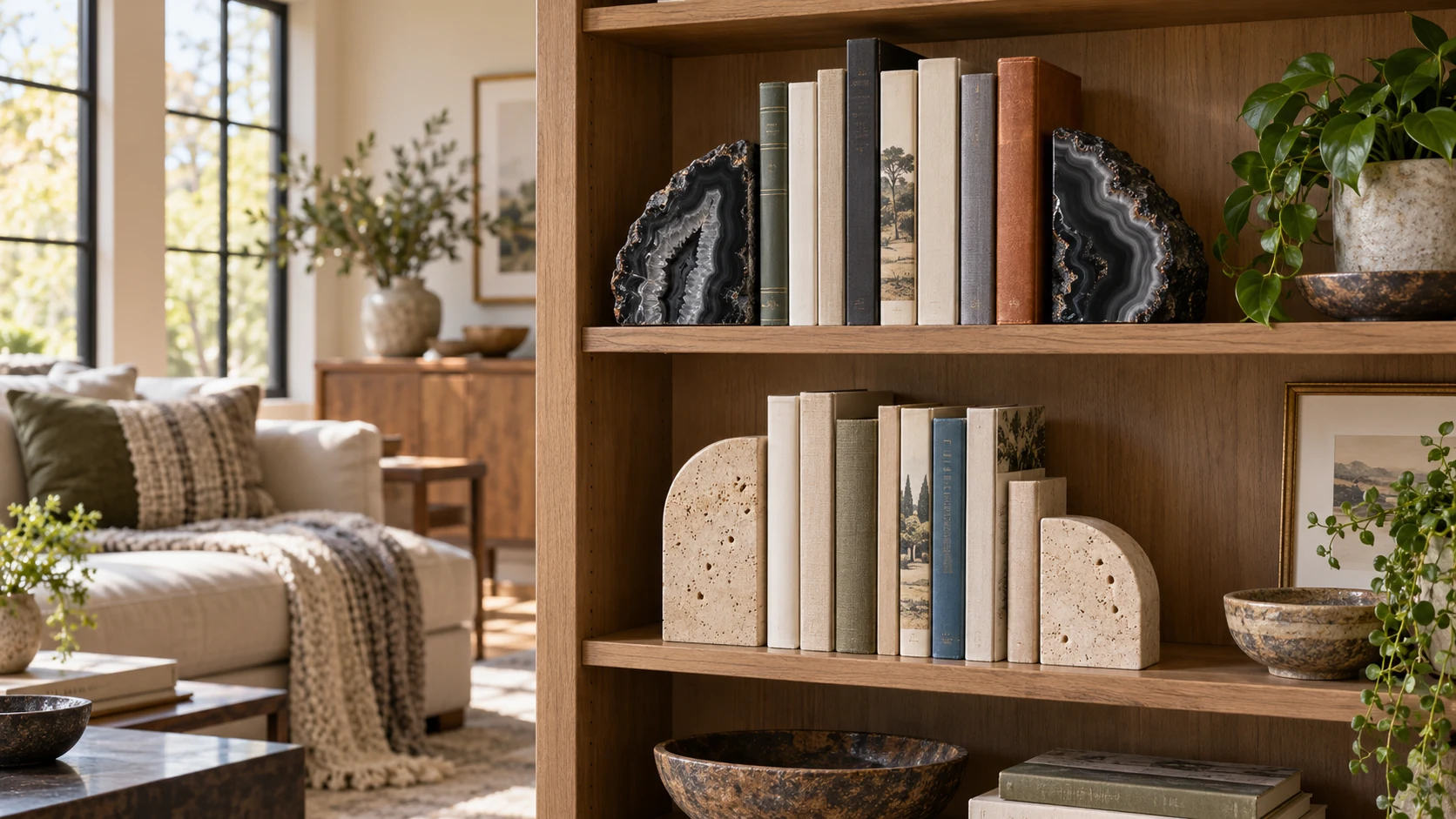
Natural stone bookends can give a shelf a visual starting point: a dark banded face at one end of a row, or a pale arch shape that echoes a light wall. The useful decision is how those colors and forms sit with books already in the room. A natural stone bookend shelf palette begins with the existing spines and nearby surfaces, then chooses one pair as a repeatable accent. It does not require reorganizing every book by color or assuming stone will stay put on every shelf without checking the actual setup.
Read the room before choosing a stone color
Stand where you normally see the shelf. Note the broad colors already present: the shelf finish, wall, nearby furniture and the book spines you use most. You do not need a formal design scheme. A short note such as “warm wood, white wall, mostly dark spines” gives you enough to compare a pale stone form with a dark one. The bookends should have a role in that view rather than being chosen from a close-up product photo alone.
Look at the shelf in daylight and again under its usual evening light. Dark stone can read as a strong edge when the room is bright and nearly blend into a dark shelf at night. Pale stone can stand out against dark books while receding against a white wall. These are visual possibilities to test in your room, not promises about the exact color of a natural material. Product images are made under their own lighting.
Choose one color relationship to try: contrast with the shelf, echo a nearby surface, or pick up a recurring color in the book covers. You need only one. If you use dark agate as a contrast, leave enough of its face visible to be seen. If you use pale travertine as a quiet echo, let its arch shape provide the detail. The aim is a shelf that still feels like a place for books, with a clear material accent.
Make a temporary test with paper or objects in roughly the proposed colors. Place a dark card at each end of a book row, then try a pale card. Take a step back. Which gives the books a clearer edge without making the shelf feel crowded? This exercise cannot predict the finish or size of delivered bookends, but it can keep you from choosing a color solely because it looked appealing on a white product page.
Use shape and texture as part of the composition
A straight line of book spines has a strong rhythm. An arch can soften that line; a geode face can introduce irregular bands. Neither shape is inherently better. Ask whether the end of the row needs a quiet outline or a visible focal point. If several objects on the shelf already have detailed patterns, a simpler pale form may let them remain legible. If the shelf is plain, a dark banded stone can supply the main accent.
Natural stone pieces are not identical printed objects. Veins, holes and edges may differ from the listing photograph. Decide whether that variation is welcome in the room before ordering. If you need two ends to match exactly, inspect the delivered pair rather than assuming a gallery image can guarantee symmetry. A bookend pair can still feel balanced when its two pieces differ slightly, especially if the books between them vary too.
Keep the intended viewing angle in mind. A pair can have a decorative face and a rougher side. Decide which face you want visible from the doorway or chair. Do not turn a bookend so its decorative face looks ideal while its support position becomes awkward. First place both pieces in a stable, ordinary book-supporting orientation; then decide whether the visible surfaces suit the room.
Read the two exact stone bookend offers
The JIC Gem black agate bookend pair is presented as a pair of natural agate geode bookends. Its native description distinguishes a polished face from a rougher natural back and says individual pieces vary. The single native gallery image shows two black-and-gray banded halves forming a rounded geode silhouette. It supports the physical bookend identity and visible banding, not a guarantee that a delivered pair will have the exact pictured pattern.
The beige travertine arch bookend pair is described on its exact native page as two natural travertine pieces with rounded arch shapes and irregular holes. Its gallery shows a taller and a shorter pale arch around a short stack of books. The URL and title use the word “marble,” while the product description specifies travertine. Treat the exact material label as something to confirm with the seller; the visual planning here rests on the pale arch form shown, not an unsupported marble claim.
Both native pages state new condition and depict pairs intended to stand by books. Their physical forms support different visual directions: dark, banded geode faces or pale, porous-looking arches. The images cannot verify weight, grip on a particular shelf, furniture compatibility or the exact natural pattern that will arrive. Keep those questions open until you have the actual pair and the shelf in front of you.
The JIC Gem text includes claims about agate and personal energy. Those claims do not belong in a practical bookend decision. Choose the pair for its visible form and your room, and follow the maker's actual handling information. Do not infer that natural stone is automatically gentle on a shelf finish, or that a heavy-looking photograph proves a specific support capacity.
Build a palette across more than one shelf
On a bookcase with several open shelves, repeat one visual cue rather than identical decorations everywhere. A pale arch pair on one shelf can echo a light ceramic object elsewhere. A dark agate pair can relate to a black frame or dark lamp base. The connection can be loose. Repeating every shape exactly often makes a useful bookcase feel staged and leaves little room for the books that belong there.
Choose one shelf as the focal shelf. Put the bookend pair there and keep the neighboring shelf quieter. View the bookcase from the room entrance, then from the chair where you spend time. A feature that is visible only from close range may be less important than the broad balance of light and dark. If the stone disappears among book covers, move a nearby decorative object rather than automatically adding more bookends.
Use book groupings that have a real purpose. Current reading, reference books and favorite volumes can each make a row. Within a row, you may vary spine heights or place one horizontal stack nearby if the shelf allows it. Keep the books accessible. This article's palette question is separate from the decorative bookends on a small shelf guide, which works through the usable width and book access of a compact shelf. Solve those fit decisions there before using color as the final styling layer.
Do not force the pair to serve as a room-wide theme. If only one shelf needs a visible stone accent, one pair can be enough. Other shelves can use ordinary supports or no bookend when books are otherwise safely arranged. More natural stone is not automatically a more coherent palette. Let the books, shelf and surrounding objects decide how much visual weight the stone should have.
Keep physical support separate from the visual decision
A stone bookend that looks right still has to sit correctly on the surface. Check the shelf maker's load guidance and the actual base contact after delivery. Do not balance a heavy piece on a narrow or unstable ledge for a photograph. If the book row leans or an end moves during ordinary use, stop and adjust the physical setup before treating it as finished decor.
The sliding bookend contact guide addresses how to observe movement and check a base against the shelf. That is the right place for a shift or grip problem. Here the decision is which natural-stone color and silhouette belongs in the room after the shelf and book row are suitable. A pleasing palette does not substitute for a stable arrangement.
Take one book out and return it as you normally would. Watch the two ends without tugging or testing aggressively. If a piece moves, the setup needs a physical review. If the row stays put, step back and judge the visual effect again. A bookend can appear balanced when nobody touches the books yet feel intrusive during normal use; both observations matter to a lived-in shelf.
Consider the underside and surrounding furniture before placing a stone object. Look at the actual base and check that it sits flat where you intend to use it. Keep loose paper, a soft mat or a raised trim piece from changing the contact. Use the instructions supplied with the delivered pair and the furniture maker’s advice where relevant. A stone label alone does not establish how every shelf finish will respond to contact or movement.
Confirm the delivered pair and refine the arrangement
When the order arrives, compare the package and pieces with the saved exact listing. Check that there are two bookends, that the visible form matches the selected offer, and that any included parts are present. A single gallery image is a preview, not a delivery receipt. If the travertine listing's marble wording matters to your purchase, resolve that material discrepancy with the seller before relying on it.
Place the pair on the intended shelf without books first, following safe handling for a stone object. Look at the color under your actual light and the finish beside your shelf. Then add a modest row of books and view it from your usual position. You may find that the dark geode face wants more clear space beside it, or that the pale arches work best against darker spines. Those are room-specific judgments, not universal placement rules.
Move only one thing at a time: the book grouping, a nearby object or the location of the pair. If you change everything at once, it is hard to tell what improved the view. Take a simple photograph from the doorway and compare it with how the shelf feels when you remove a book. A visual arrangement should still serve the books you actually use.
The finished shelf should have a readable line of books, a stable support arrangement and one stone accent that makes sense with the room. Whether you choose dark banded agate or pale travertine arches, keep the claim narrow: the native pages and galleries show two different bookend forms. The rest of the result comes from the actual delivered pieces, your shelf and how you use the books.