Outdoor Recreation & Camping
mini electric bike pump accessories: check the supplied valve fittings
Compare the disclosed included fittings for two compact rechargeable bike pumps before choosing a carrying kit.
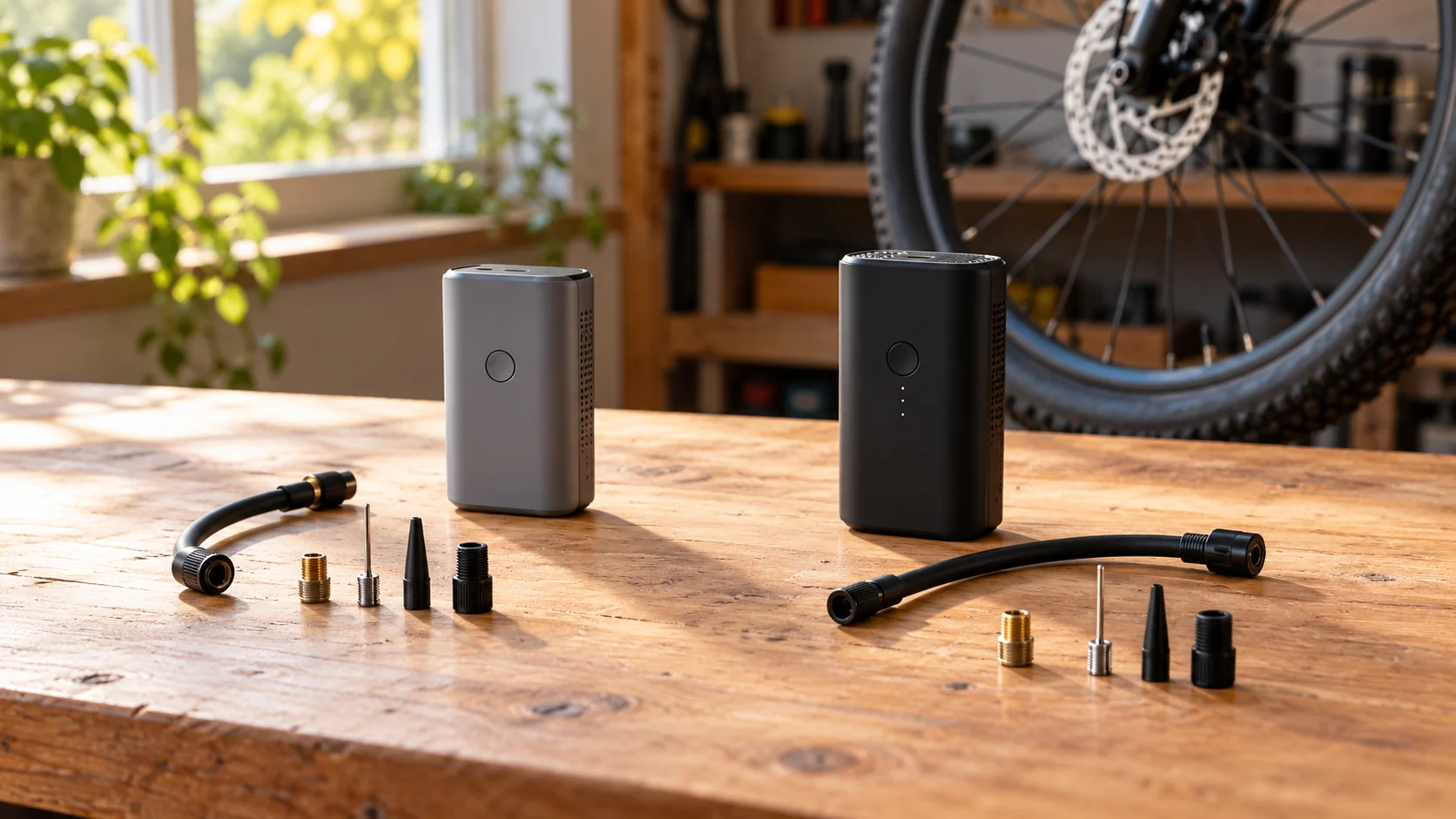
Mini electric bike pump accessories should be checked across the listing’s written description and labeled contents panels. A statement that an interface is supported answers a different question from an itemized box declaration. An unlabeled display photograph supplies less precise information about what is included. Before choosing a compact pump to carry, separate those kinds of disclosure and keep each one tied to the selected offer. This comparison concerns the declared kit contents; it does not certify a connection to a particular wheel.
The Woowind grey mini electric pump listing names Presta and Schrader support. Its gallery also contains a labeled box-contents panel naming an inflator, extended hose, carrying pouch, two valve adapters (one labeled “Shrader” in the panel and one labeled “Presta”), a ball needle adapter, USB charging cable and lanyard. These are declared contents in the captured gallery, rather than a list inferred from an unlabeled scene. The listing prose uses the spelling Schrader for its supported valve; the panel’s “Shrader” label is recorded as printed, not treated as proof of a different valve type. Confirm that the selected order uses that configuration; the panel does not independently verify the delivered shipment or a fit on your particular wheel.
The NEOVANEX mini electric bike pump listing names Schrader, Presta, a ball needle and an extra nozzle adapter in its description. Its labeled contents image shows a pump, pouch, tube, lanyard, charging cable, Presta and Schrader fittings, and ball needle. The broad “extra nozzle adapter” wording does not identify a separate third bicycle interface. Record the written and pictured declarations together, then ask about any required part that remains ambiguous for the exact order variant.
Make a simple contents sheet for each offer. Give each row one item: pump, hose or connector, Presta fitting, Schrader fitting, ball needle, extra adapter, and charging lead. Record whether it is expressly declared in prose or a labeled contents panel, merely pictured without a contents claim, or not established. A mark for “works with” belongs beside a compatibility statement, not automatically beside an included loose fitting. A panel headed “what is in the box” is an explicit seller declaration and should be recorded as such. Keep the page date and exact offer URL with the sheet so an answer about one version is not silently applied to another.
Make the valve question specific
Start with the wheel you intend to inflate. Identify whether its valve is Presta or Schrader from the bicycle or wheel documentation, the valve itself, or a qualified bike shop if the identification is uncertain. Keep that observation separate from a broad “works with bike tires” label. A valve name on a pump page is a useful first screen, but access around the rim, the length of the exposed valve, and the actual supplied connection still matter. Do not infer fit from a photograph of a pump beside a different wheel.
The existing bicycle pump valve compatibility guide covers the broader task of matching a named head or reversible hose to an identified valve. This guide stays with a narrower purchase question: which accessories are expressly named for these two compact rechargeable offers, and what must still be confirmed before treating the kit as complete for your use.
If the pump page offers color, bundle or quantity choices, resolve the actual selection before treating the general description as its packing list. A picture shared across choices may display more than one configuration. The question to the seller is concrete: “For this selected variant, which connector or adapter for my named valve is included, and is the ball needle included?” Ask for the part names or a box-contents image tied to that variant. A reply that repeats only “Presta and Schrader compatible” leaves the supplied-parts question open. Record the answer and the variant beside each other.
Do not treat the two bicycle valve names as two identical loose pieces. A pump might have one convertible head, separate fittings, or another arrangement. The selected listings state support differently, and these descriptions do not provide a complete connection diagram for every wheel. If a fitting is small enough to be lost in a saddlebag, ask whether an identical replacement can be bought for the exact pump model and how it is identified. That question concerns ownership of the kit over time, not a promise that a generic adapter will fit. Avoid ordering a part merely because its retail title repeats the valve name.
Read the included-parts wording literally
An entry such as “extra nozzle adapter” needs a precise part identity when it affects your selection. Record the wording without deciding that “extra” means a specific third bicycle valve. A ball needle serves a different interface and cannot simply fill a missing bicycle-fitting row. Ask which component the seller means and whether it is distinct from the pieces already listed. If a labeled diagram identifies that item more clearly, keep the diagram with the written answer. You are resolving a particular item, not requesting a general assurance that the pump works with bicycles.
Use a labeled contents panel as evidence of what the seller declares, while keeping the order variant attached. Transcribe the item names and any quantities actually stated. Do not downgrade an explicit declaration to a decorative photo merely because it appears inside the gallery. Conversely, a nearby lifestyle picture should not add undeclared equipment to that inventory. If the page provides two different accounts, retain both and ask about the difference. A seller’s answer can then address the precise missing or conflicting row rather than repeat a broad compatibility phrase.
For either offer, distinguish a built-in connector, a separately supplied fitting, and a part shown only to demonstrate possible use. Those arrangements can change what a rider needs to carry and keep track of. The source pages support the named valve and accessory disclosures above. They do not supply a complete, wheel-specific fitting check, so leave any unresolved part as a question for the seller or manufacturer before purchase.
A photograph can answer a limited set of questions. It may show the shape of a loose fitting or the arrangement illustrated by the seller. An unlabeled scene does not by itself establish the supplied configuration. The Ventus Race name shown on the grey pump belongs to Woowind’s product range, as its own store confirms. That resolves the brand-model association; it does not establish every term of this retailer’s package. Keep a labeled contents panel with the exact offer rather than substituting a different store’s bundle or specifications.
Check the carrying kit you would actually take
A compact pump is often chosen because it can travel with the bicycle, but the unit alone is not the whole carrying kit. Make a written list of the pump, the connection piece needed for your valve, and any separately useful item such as a ball needle. Compare that list with the seller’s declared package contents. Keep a pouch or charging lead on its own row if it matters to your plan. Then check your actual bag with the components together rather than relying on a picture of a pump beside somebody else’s equipment.
The same discipline applies when someone else will use the kit. Give them the wheel's valve type, the precise offer or variant, and the missing accessory question rather than saying “it takes both valves.” A support answer for one model, bundle or marketplace variant does not automatically apply to a visually similar pump. Retain the seller's answer with the selected offer so the remaining uncertainty is visible before checkout.
Make room for the pieces that will travel together. Put a paper outline of the pump, hose and necessary fitting beside the intended bag or saddlebag rather than assuming the pump alone represents the whole kit. If you plan to share the pump between two bicycles, list the valve on each wheel separately. A kit suitable for one rider's documented valve may still leave a second rider with an unanswered connection question. The product descriptions do not give measurements of your storage space or a wheel-specific clearance test. A quick physical check after delivery can settle those points before the equipment is needed away from home.
Rechargeable operation and the supply of charging equipment are separate disclosure questions. A contents panel may name a cable without establishing that a separate power adapter is supplied or identifying every permitted charging arrangement. Keep those questions apart from valve compatibility and consult the exact pump’s instructions. Do not infer endurance from a photograph or another owner’s experience. If the intended trip depends on a particular amount of use between charges, obtain evidence for that requirement before treating an accessory inventory as a complete travel plan.
Keep performance claims out of the fitting decision
Pressure and operating claims do not identify which fitting arrives in the package. Keep them out of an accessory comparison unless they answer a separate question you actually need to resolve. A displayed reading in a marketing image does not verify accuracy, an operating limit for your wheel, or an inflation outcome. Use the tire, wheel and exact pump instructions for procedures and limits. If those accounts disagree, seek model-specific clarification. This article gives no pressure setting, connection procedure, charge duration or number of tires per charge.
A surprising pressure reading calls for an exact-model check of units and range. If a pump fails to move air, the bike pump not inflating guide addresses the separate troubleshooting task. A buying comparison of included accessories cannot diagnose either situation.
For a shared household kit, a short label on the storage pouch can prevent the smallest pieces from being mixed with other accessories. Use the exact product name and a plain list of the fittings that were actually received, after checking the delivered box. Keep the purchase record in the same place. This does not certify compatibility: it makes the contents available to inspect again when a different wheel or user is involved. If the seller sends a revised package, update the list from that package rather than carrying forward the earlier offer description.
Before checkout, ask which uncertainty would change the decision. A missing ball needle matters if that is the extra task for which the pump is being bought. An unclear Presta or Schrader connection matters if the pump is needed for a wheel with that valve. A charging lead may be a separate concern if no suitable one is already available under the pump's instructions. Keep these as distinct questions so a reassuring answer about pressure or portability does not conceal an unanswered accessory issue. If the page offers no way to confirm a required piece, leave that purchase undecided or choose a kit whose exact contents are documented.
Leave the purchase with an exact answer
Write the chosen offer name beside three short entries: the valve on your wheel, the connection you need, and the relevant components declared for the selected package. Retain a separate line for anything still awaiting confirmation. Include the labeled box-content panel as well as the prose when recording those declarations. Once the inventory and any seller answer concern the same exact package, you can compare the kits without treating a compatibility name as a universal fitting guarantee. Check the delivered contents against that record before relying on the kit away from home.