Cooking & Food Prep
milk frothing and heating: separate functions
A practical way to read frother function charts: distinguish a whisk function from heating, then keep each named mode tied to its own instructions.
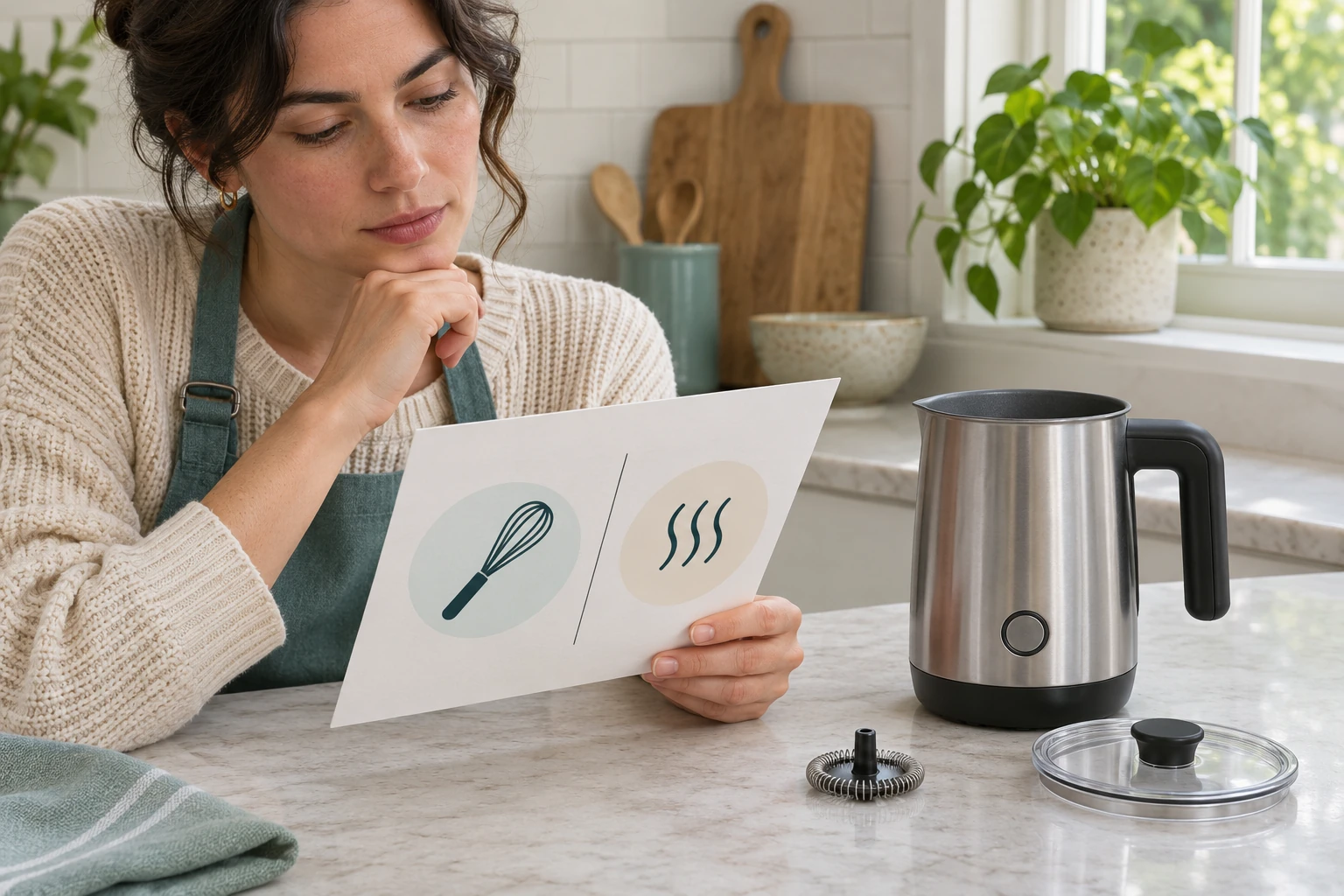
Milk frothing and heating are separate functions in the Aeroccino XL instructions. Its function chart names hot milk froth as frothing and heating together, cold milk froth as frothing only, and hot milk as heating only. The chart also distinguishes using the whisk with its spring from using it without the spring. Those are instructions for that named appliance, not a setting guide for every jug sold as a milk frother.
Read cold milk froth as a named function
The cold milk froth entry matters because it separates the frothing function from the heating function within one manufacturer’s chart. Read the complete instructions for the actual model before selecting a mode or changing an insert. An illustration of a similar jug does not establish that its controls or supplied parts follow the Aeroccino XL arrangement.
Consider an original reading exercise. Put two questions at the top of a blank page: does this named mode froth, and does this named mode heat? Add a third space for the exact model and document reference. You are making an explanation of the instructions you have, rather than a replacement operating card. Leave room for unanswered questions. A blank answer is more useful than an assumption disguised as a tick.
For the exercise, imagine Jo has written “milk frother” beside a photograph in a household notebook. That entry is too broad to answer either question. She has recorded an object category, not a named function. She starts a fresh page and writes what she wants to understand: whether the particular mode she is reading includes heating. Her first task is finding the relevant instructions, rather than deciding what the photograph ought to mean.
Separate the frothing whisk function from preheating
The original aerolatte steam-free frother instructions describe a powered whisk with a motor and batteries in its handle. They separately describe heating milk before using the frother for a warm drink, and using cold milk for a cold preparation. The frothing whisk function therefore sits within a preparation that can contain a separate heating step. This is a named example, not permission to heat milk in an unspecified container or follow a universal temperature or timing.
That document also distinguishes the handle containing the motor and batteries from the whisk end. Keep its complete care instructions attached to that appliance. Nothing in this explanation transfers its handling or cleaning permissions to a jug, a detachable disc or a different powered handle. A component name helps locate the relevant instruction; it does not establish that another component can be treated the same way.
In Jo’s invented exercise, her first draft says “froth means hot.” She crosses out the equation because it collapses the two questions she is trying to answer. Her revised note has separate spaces for the named action and any named heating step. The correction does not tell her how to operate an appliance. It tells her which part of the document still needs to answer her question. She can explain the distinction without pretending she has tested a drink.
Jo next finds a sentence copied from a different booklet without its heading. She cannot tell which mode it describes. Rather than placing it under whichever heading seems plausible, she marks it as an incomplete extract and returns to the document. This preserves the difference between a quoted fragment and a complete instruction. Her notes should let another reader find the same context, including a limitation she might otherwise have left behind.
Look for a separately described heating system
Breville’s Milk Café page names induction heating, a selected temperature and dedicated frothing discs. It describes different Latte and Cappuccino discs as parts of that particular appliance. Those components describe heating and frothing separately. They do not establish the heating method, interchangeable parts or measured foam result of either retail offer below.
The same page describes a stainless steel jug and measuring cap. These are details of the Milk Café account, not evidence that every visually similar jug has the same materials or care permissions. Read each model’s own instructions as a whole. This article supplies no temperature target, button sequence, ingredient ratio or promise that a chosen mode will produce a particular drink.
A useful explanation can be brief without erasing its boundaries. Jo writes one sentence about what the named documentation says, then one sentence identifying what it leaves unanswered for her object. She does not add a performance verdict. If the model reference is missing, she says so. If a chart belongs to another model, she keeps it as a comparison of terminology rather than attaching it to her own controls.
Suppose another person asks Jo whether the words “hot milk” and “hot milk froth” are interchangeable. She can point to the different entries in the actual chart she is discussing and identify that chart by name. She should not answer on behalf of every manufacturer. The question becomes manageable when the explanation stays with its source. It becomes uncertain again if the model name disappears from the conversation.
Read the two retail offers without filling their gaps
The LINFANG offer shows a complete black-base appliance with a handled silver jug, clear lid and two dedicated mixing inserts. All ten gallery frames belong to that offer. The supplied appliance and its fitted parts are distinct from the food, tableware and people used to stage the images. Its pictures are not an operating test.
The silver 4-in-1 offer shows a complete jug appliance, lid, base and two dedicated spring inserts across six gallery frames. Its catalog brand is Unbranded, while the pictured jug carries BIZEWO printing. That conflict remains unresolved. A handheld frother in a comparison graphic is not treated as supplied stock. No exact factory identity or heating method is authenticated here.
For Jo’s exercise, either retail account would require its own applicable documentation before she could turn a general question into an operating decision. She would not import the Aeroccino chart into a different offer because both have a jug. Nor would she assign the Milk Café heating system to a photograph of a silver vessel. The question she takes to the seller names the exact offer and asks for the documentation that resolves the mode she wants to understand.
Keep the explanation distinct from a buying comparison
The standalone milk-preparation comparison discusses two appliances through capacity and drink routines. The Ninja and Keurig guide compares coffee formats and the place of milk preparation within different brewer arrangements. Those are different decisions from reading a named function chart to distinguish frothing from heating.
Jo can finish her reading note without choosing a product. Her note identifies the document, the mode being discussed, what that document says about each function and what remains unknown. A shopping recommendation would answer another question. Keeping the explanation focused gives her a useful stopping point: she understands the distinction she came to examine, even if the eventual purchase or operating decision still needs model-specific information.
Before sharing the note, she reads it as somebody who has not seen her research. Does each example still name the appliance it describes? Does an unanswered question look unanswered? Has a comparison turned into a claim that parts can be exchanged? She removes a line saying “works the same way” because she has not established that. Her revised account is narrower and easier to use: it explains how she read the named functions, with no invented trial behind it.
The finished exercise contains no taste score, foam photograph or claimed result from an actual kitchen session. If Jo later uses an appliance, that will be a separate event governed by its complete instructions. The reading exercise has already done its job by separating the question about frothing from the question about heating. She can ask for clarification in those terms instead of treating the product category as the answer.
One final check concerns the words Jo herself has added. She has drawn two columns, but the chart in the manufacturer’s document may use different headings. Her columns are a reading aid that she invented for this exercise. She labels them as her own questions and keeps the actual mode wording beside them. That makes it possible to correct her interpretation without altering the source or attributing her layout to its author.
Jo also separates a request for explanation from a request for an instruction. “What does this entry mean?” identifies a passage she wants help reading. “Which setting should I use?” asks for an action on an actual appliance. If she contacts support, she says which question she is asking and supplies the model information she has confirmed. She does not ask a reader to infer the missing identity from her notes. If the reply concerns another model, she can recognize the mismatch before treating it as an answer. This is the endpoint of the example: a precise question, a traceable document and an honest account of what remains unresolved. No drink has to be made to demonstrate that the two questions can be asked separately.
Keep an optional order tied to the exact offer
If a later purchase through republeq.com suits your needs, identify the exact milk appliance and supplied parts before choosing payment. A shopper interested in crypto such as USDT needs the methods and instructions actually presented for the current basket. This paragraph confirms no supported token, network, receiving address, exchange rate or fee. Ask the responsible merchant to clarify a conflicting brand or model while the item is still under consideration. Keep the answer attached to the offer it identifies. A similar jug in another listing cannot supply the missing confirmation. Review the applicable delivery, cancellation and return terms for the order you intend to place. This article promises no arrival date, warranty decision or beverage result. If another person buys on your behalf, give them the confirmed selection and ask them to bring any changed offer back for consideration. Read the transaction details again if the basket changes. Use the current transaction’s own information for any permitted payment; no transfer sequence is supplied here. Retain the order reference and payment response for an authorized purchase. If the outcome becomes uncertain, reconcile that specific attempt before considering another payment. The absence of a confirmation does not establish that nothing occurred. After delivery, compare the received identity and stated contents with the confirmed order and obtain the complete applicable instructions. A transaction record identifies a purchase. It does not establish that a mode heats, that an insert fits another appliance or that a particular foam result will follow. You can leave the purchase unmade while the supplied identity or relevant function remains unclear.
Conceptual function-chart reading; no exact retail appliance, operating test or measured foam outcome is depicted.