Audio Production
Microphone low-cut and attenuation: AT2035 and AKG C214
Understand microphone low-cut and attenuation on AT2035 and AKG C214: filters, pad labels, input-limit conditions and the actual retail packages.
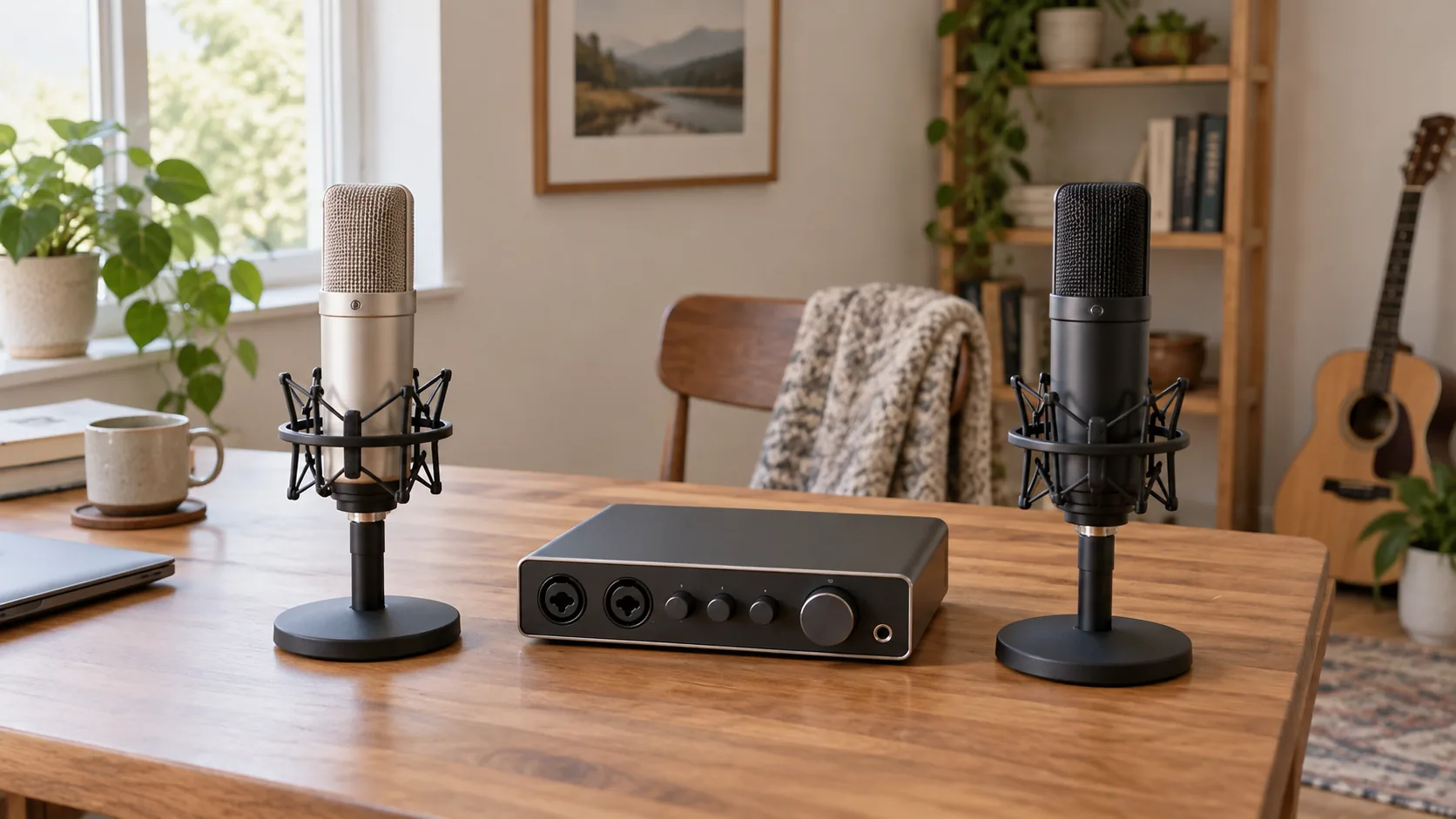
A microphone's bass-cut switch and attenuation switch address different parts of the signal. For microphone low-cut and attenuation, begin with the labels attached to the actual model. Audio-Technica's AT2035 specification identifies an 80 Hz high-pass filter and a nominal 10 dB pad. AKG's C214 manual identifies a bass-cut filter at 160 Hz and a switchable 0/−20 dB preattenuation pad. Reduced low-frequency content and reduced signal level describe different changes.
The Audio-Technica AT2035 recording bundle names an AT2035 microphone, Focusrite Scarlett 2i2 USB interface, boom arm, pop filter and cables. Its title gives a 20 Hz to 20 kHz microphone frequency response. The microphone's documented high-pass and pad functions are reasons to investigate this offer when those controls matter to the recording chain. The retailer's claims about exceptional clarity, low noise and durability are descriptions of the offer, without a matched recording against the AKG package.
The AKG C214+ROGAN STAND offer identifies a black large-diaphragm studio condenser microphone with a pro boom arm. Its short retail description does not enumerate microphone controls. The C214 manufacturer's manual supplies the model-specific bass-cut and preattenuation account. These functions can matter to someone distinguishing low-frequency response from microphone output level. The manual's standard factory accessory list does not establish everything included in this separately described retailer combination.
Concept scene for microphone low-cut and attenuation: a pair of unpowered generic studio microphones beside an unlabelled interface, with every unit shown whole. The scene supplies no measured frequency response or retail packing list.
Read microphone bass-cut frequency and slope together
The AT2035 specification lists an 80 Hz low-frequency roll-off with a 12 dB-per-octave slope. The C214 manual lists 160 Hz and 6 dB per octave. Keep both numbers when interpreting microphone bass-cut frequency. Hertz identifies the frequency part of the account, while dB per octave describes the stated roll-off slope. The numbers should not be collapsed into a single stronger-filter ranking. They describe different combinations of frequency location and response shape.
An octave is a doubling or halving of frequency. The interval from 80 Hz to 160 Hz is one octave, which helps explain why frequency and slope need separate entries. It does not mean the C214 removes twice as much unwanted sound as the AT2035. Nor does a 12 dB-per-octave label supply an exact attenuation value at every frequency. The manufacturer response curves describe the transition; the label is not a promise that everything below its stated frequency disappears.
A high-pass label concerns frequency response
Audio-Technica describes the AT2035 control as a choice between flat response and low-frequency roll-off. Its specification table identifies those switch functions separately from the pad. AKG calls the C214's corresponding control a bass-cut filter and explains that it reduces low-frequency effects associated with rumbling or wind noise. These are model-specific descriptions of a frequency-selective function. The filter account does not identify an overall recording level or tell what another connected device can accept.
High-pass means the low-frequency portion is rolled off relative to the higher-frequency portion; bass-cut names that same kind of response change from the low-frequency side. Neither is a low-pass label. Read the actual 80 Hz or 160 Hz specification alongside the stated slope instead of choosing from the name alone. This comparison identifies the documented function; it does not prescribe a filter position for a voice, instrument or room.
Microphone pad labels concern attenuation
The AT2035 sheet identifies a switchable nominal 10 dB pad. The C214 manual shows 0 dB and −20 dB labels for its preattenuation switch. These microphone pad labels describe the attenuation account rather than a selected bass-cut frequency. The C214's zero label belongs to its pad state, not to an instruction that every frequency response is perfectly flat. Its bass-cut selector is a separate control with a separate purpose.
A decibel value on a pad and a dB-per-octave value on a filter are different specifications. The pad's nominal level change should not be read as a roll-off slope. Likewise, the filter's frequency label should not be read as a broadband attenuation amount. For these models, retain Audio-Technica's nominal 10 dB wording and AKG's 0/−20 dB wording. Neither value establishes the level eventually heard through the headphones or the gain applied by an interface.
Separate a bass problem from a level problem
Imagine a recording chain where low-frequency rumble is prominent and another where a strong microphone signal challenges the receiving input. AKG's C214 description gives those concerns different controls: its bass-cut account addresses low-frequency effects, while its preattenuation account addresses headroom and the microphone signal reaching a mixer input. The distinction is useful before comparing advertised numbers. A general level reduction and a frequency-selective response change address different aspects of what the chain receives.
A microphone pad does not identify whether an unwanted sound originated in the room, a support or another electrical component. A bass-cut label does not identify which stage of a recording chain is overloading. Keep the specific symptom and the location of the relevant control separate. The manufacturer descriptions here establish control functions, without proving that either microphone will eliminate a particular noise or produce a desired voice tone in an untested room.
The source's model name limits the claim
The Audio-Technica document is headed AT2035, and its Features, Description, engineering specification and second-page table explicitly identify that model. Those regions support the 80 Hz filter, nominal 10 dB pad and other AT2035 facts used here. Its Operation and Maintenance section contains an AT2020 model reference. That naming discrepancy is preserved in the source; the AT2020-named paragraph is not used to supply AT2035 operating instructions or wiring claims in this comparison.
The AKG source is the C214 manual. Its control photographs distinguish the preattenuation selector from the bass-cut selector, and its technical table repeats their values. Its references to other AKG microphones do not supply those other models' properties to this offer. The exact C214 account is the relevant evidence. The manufacturer documents are used for model-level control information, while the actual retail descriptions identify the two differently packaged offers.
Keep rated input limits with their conditions
Audio-Technica's AT2035 table states a maximum input sound level of 148 dB SPL at 1 kHz and 1% total harmonic distortion, with 158 dB SPL when using the nominal 10 dB pad. The two numbers belong to the stated AT2035 specification. They give the pad's input-headroom account a concrete condition. They are not an interface input rating, a recording-software meter reading or a prediction for every sound source and complete bundle.
AKG lists 136/156 dB SPL at 0/−20 dB preattenuation, using a 0.5% total-harmonic-distortion condition. The paired limits correspond to the two C214 pad states. Their numerical separation is 20 dB, matching the stated attenuation account. The AT2035 and C214 distortion conditions differ, so placing 158 and 156 beside each other does not establish a matched loud-source performance winner.
Read dynamic range with the pad condition
The C214 manual's brief description advertises a 143 dB A-weighted dynamic range. Its technical table gives a more specific pair: 123/143 dB at 0/−20 dB preattenuation. Preserve those states with the figures. A headline that repeats only the larger value leaves out the table's control condition. This is another reason to read the pad account with the numerical specification, rather than interpreting the microphone's largest published number as the result of every configuration.
The AT2035 table supplies a single typical dynamic-range figure of 136 dB at 1 kHz and maximum SPL. It does not enumerate a matching two-state dynamic-range pair here. Keep that difference in disclosure visible. Neither table measures the complete retail microphone-and-interface package as one system. The C214 pair also does not supply a new noise value for every pad state. Its separate equivalent-noise entry explicitly names zero preattenuation, so a claim that the pad automatically improves self-noise would exceed these figures.
A microphone pad is separate from an interface pad
The actual MOTU M2 and Rockville R-TRACK bundle guide identifies a 25 dB pad at the Rockville interface's mic or line inputs. It also distinguishes input gain, signal and peak indicators, and main or headphone volume controls. That actual interface example gives the word pad a location in the recording chain. Its 25 dB figure belongs to R-TRACK input attenuation, rather than to the AT2035 or C214 microphone controls.
Do not pool the Rockville figure with either microphone's nominal pad value as a promise about a complete system. The R-TRACK pad belongs to the receiving interface input; the documented AT2035 and C214 pads belong to their microphones. The native AT2035 offer names a Scarlett 2i2, without specifying its generation here. The R-TRACK guide supplies no 2i2 control inventory, configuration or compatibility approval. It helps distinguish the component being described, while the actual selected interface needs its own applicable account.
Listening volume does not define microphone attenuation
In the same R-TRACK account, headphone volume is a separate control from the input pad and gain. Turning a listening level into the definition of a microphone pad would confuse the recorded signal path with the monitoring path. A low headphone level alone does not establish that the microphone output is low or that an upstream input remains within its limits. Retain the location of the stated control when interpreting a report that the sound is quieter.
The MOTU example names input and output meters on its LCD, while the R-TRACK example names signal and peak indicators. Those are specific interface features. Neither display is part of the two microphones' pad labels, and their presence does not guarantee that every other stage is free of overload. Attach the LCD meter or peak-indicator entry to the identified interface. Keep the microphone's own pad and filter entries with its model specification.
A physical pop filter is another component
The actual AudioBox 96 and Scarlett Solo interview-bundle guide identifies stands, pop filters and a shockmount among its physical accessories. It discusses desk-borne vibration and breath-related interruptions separately from interface specifications. That concrete accessory account is relevant because the current AT2035 offer names a boom arm and pop filter. A supplied physical accessory is distinct from a microphone's electrical low-frequency roll-off or pad selector.
A pop filter in the AT2035 retail list is an included item; an 80 Hz roll-off in its model specification is a control function. A boom arm is support equipment; a nominal 10 dB pad describes attenuation. The old AudioBox and Solo accessories do not become items in this offer, and the Solo 3rd Gen description does not establish the generation of its named 2i2. This prevents a familiar bundle description from silently changing the actual order.
Noise figures describe another measurement
Audio-Technica's AT2035 table lists 12 dB SPL noise, with its footnote identifying a typical A-weighted measurement using an Audio Precision System One. AKG lists 13 dB(A) equivalent noise under IEC 60268-4 at zero preattenuation. Each noise entry has a stated measurement reference. The C214 entry retains its zero-preattenuation condition; neither noise entry defines a bass-cut frequency. An advertised attenuation control should not be interpreted as an automatic improvement of every noise figure or as proof of a quieter room recording.
The two noise entries do not supply a shared test of these complete retail bundles. Microphone model specifications also do not measure the included interface, cable, support or recording environment as one system. Preserve the references if noise is part of the purchase criteria. For the present control-reading task, the key distinction is between a specified noise measurement, frequency-selective roll-off and nominal attenuation. Each describes a different property, even when decibels appear in more than one account.
Retain the microphone's connection requirements
The AT2035's model-specific Description and table identify a three-pin XLRM output and 11–52 V DC phantom-power requirements. The C214 table identifies a three-pin XLR connector and 12–52 V phantom power to IEC 61938. These are microphone requirements from the cited model regions. A USB interface included in the AT2035 retail bundle does not turn the microphone itself into a USB microphone. Its output and the interface's computer connection remain different parts of the chain.
These electrical requirements also answer a different question from low-cut and pad functions. They do not define a bass response, a headphone level or a permitted input setting for the unspecified interface generation. This comparison gives no connection sequence, wiring method or power-setting instruction. Keep the actual microphone requirements with the exact interface documentation when assessing the complete order, rather than assuming a control label makes every component mutually compatible.
Choose by the documented control function
Investigate the AT2035 offer when its model-specific 80 Hz, 12 dB-per-octave roll-off and nominal 10 dB pad address the controls you need to understand, alongside its named interface and physical accessory package. Investigate the C214 offer when its documented 160 Hz, 6 dB-per-octave bass cut and 0/−20 dB preattenuation account address that inquiry. Their paired input-limit conditions help explain each pad, without converting unlike distortion conditions into a performance ranking.
Read microphone low-cut and attenuation as two functions with their own units and locations. Keep the frequency and slope together, keep the microphone pad with its model, and distinguish both from interface gain, an interface pad and monitoring volume. The actual offer's contents complete a separate package record. Retain the model and test conditions beside each numerical specification.