Skills & Planning
Measure a jigsaw puzzle work surface before opening the box
A stepwise measurement method compares two seller-listed finished puzzle sizes with a hypothetical clear surface while keeping border and sorting room separate.
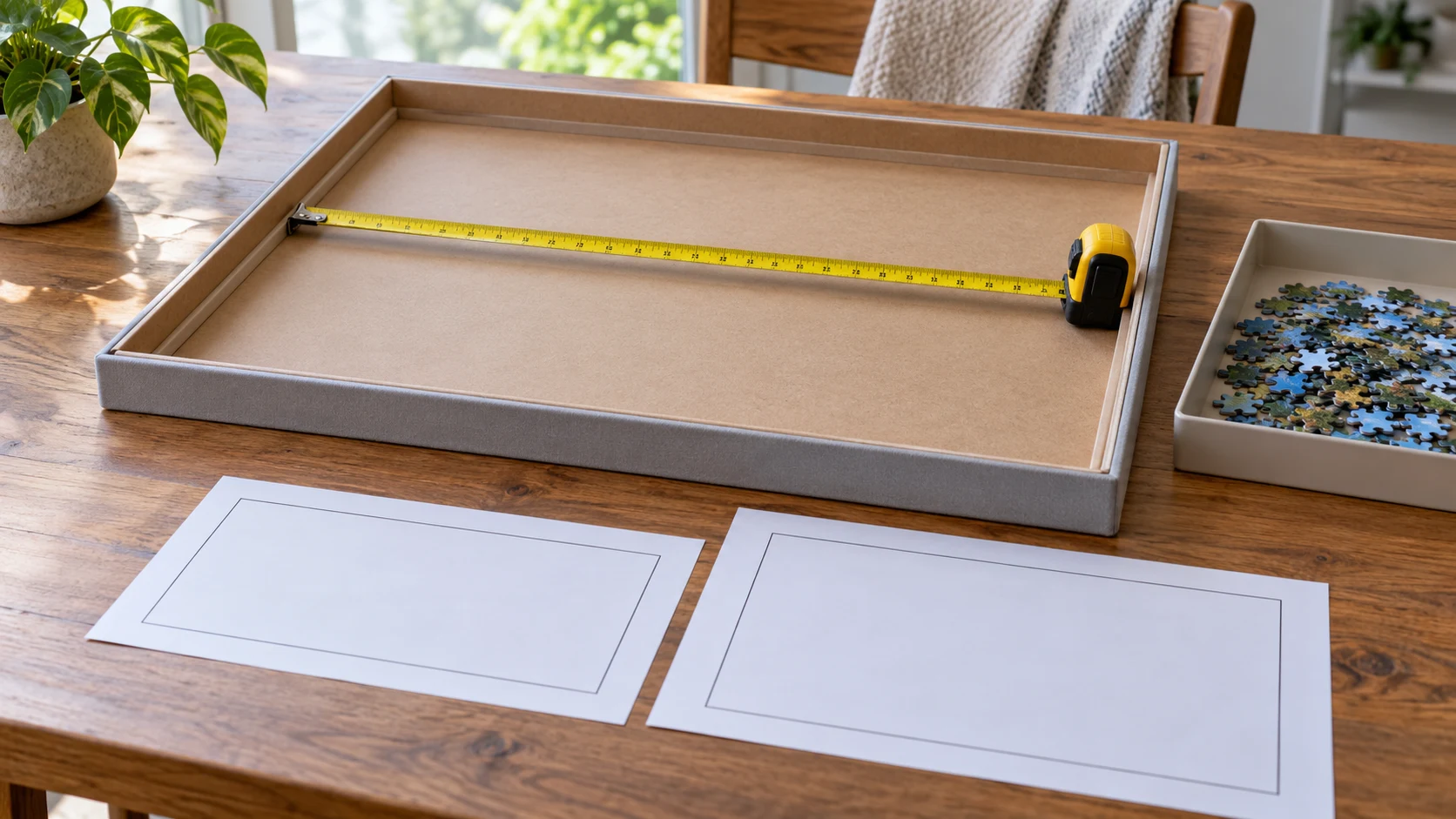
A puzzle can fit inside the outside edge of a board and still hang over the part you can actually use. Measure a jigsaw puzzle work surface at its clear inner rectangle before you open the box. Then compare that usable width and depth with the seller's stated finished size for the particular puzzle. A raised lip, a handle cutout or the space reserved for sorting can change the answer.
This is a measuring procedure, not a claim that either puzzle below fits a particular board. No board has been measured for this guide. Keep your own measurement, the puzzle listing and any orientation choice together; a board's advertised outer size alone cannot settle clearance.
Find the rectangle you can work on
Clear the intended work area. If it has a raised rim, put the tape's zero mark against the inside face of one rim and read to the inside face of the opposite rim. Repeat across the other direction. Write both readings with their units. A label on the outer carton may describe the board's entire footprint, including its frame. Your pieces will occupy the inner area.
On a table without a rim, first decide what must stay free. A lamp base, a table edge you do not want pieces to reach and the place where you keep loose pieces all reduce the area you can assign to the assembled picture. Mark the intended boundaries lightly with removable paper markers, then measure between them. The resulting rectangle is a plan for your workspace, not a manufacturer's board specification.
Take the width across one direction and the depth at a right angle. Do not add the two numbers or multiply them to decide fit. Area in square inches can match while one side is too short. The fit test asks whether each finished side has at least that much clear length along the direction in which you will place it.
Check the corners as well as the middle. A tray that narrows near a handle or clips at the edge may have a smaller uninterrupted rectangle than its widest middle span. If the surface is irregular, measure the largest rectangle you can actually reserve for the picture. Avoid treating a diagonal measurement as the width: diagonal length does not give the straight side clearance the assembled puzzle needs.
Copy the puzzle's finished size from the right source
Look for a finished or assembled dimension in the exact product account. Box dimensions describe packaging; a piece count describes quantity. Neither is a substitute for the completed picture's two side lengths. If a listing does not provide finished dimensions, ask for them or leave the fit question open until the physical puzzle can be measured. Do not infer a side length from a thumbnail.
The selected Parrot Island Jigsaw Puzzle description states 750 pieces and 27 by 20 inches, with a 69 by 51 centimetre parenthetical. The native image shows its parrot-and-flower artwork. It does not show a scale ruler or demonstrate the puzzle assembled on a board. Use 27 by 20 inches here as the seller-listed finished dimension, not a measurement made by this guide.
The Tiger Paradise Jigsaw Puzzle description states 1,000 pieces and 27 by 19 inches, with a 69 by 48 centimetre parenthetical. Its gallery shows tiger-and-jungle artwork. The artwork identifies the selected offer visually, while the dimension remains a listing claim. The one-inch difference in listed short sides matters only when the usable surface is close to that threshold.
Keep each pair of numbers attached to its product name. Two scenes from the same puzzle maker can have different finished sizes. A search result, a nearby variant or the piece count from another box could send the wrong dimensions into your worksheet. Check the exact listing and condition again when you are ready to purchase or open the puzzle.
Try both orientations on paper
Write your clear width and depth in one row and the finished puzzle width and depth in a second row. In the first orientation, compare first side with first side and second with second. Then rotate the proposed picture a quarter turn on paper and compare the swapped pair. For either orientation to pass the simple rectangle test, both puzzle sides must be no longer than their corresponding clear sides.
Suppose an invented board has a measured clear rectangle of 28 by 20 inches. That measurement belongs only to this example. The Parrot Island listing's 27 by 20 inches meets those two numerical limits when the 27-inch side runs along the 28-inch span. It leaves one inch in that direction and none in the 20-inch direction. The Tiger Paradise listing's 27 by 19 inches would leave one inch along each direction in the same orientation. Neither calculation says the real board has those dimensions.
Now imagine that the actual clear depth is 18 inches instead. Both listed short sides exceed it: 20 for Parrot Island and 19 for Tiger Paradise. Rotating either picture does not solve a depth limit if the other clear side is 28 inches and the 27-inch side already uses that long span. Changing the imagined depth by two inches changes the result; this is why the inner measurement deserves attention.
A numerical equality such as 20 inches against 20 inches is a zero-clearance plan. It may leave no room for a border, a hand or a piece that has not been seated. Decide how much working margin you personally need, and subtract it from your measured rectangle before making a purchase decision. This guide cannot set a universal margin for every board, puzzle or way of working.
Reserve sorting space separately
The assembled picture is only one use of a puzzle workspace. During assembly, loose pieces need a place where they can be seen and reached. If those pieces will share the same board, reserve a strip or use a separate tray and measure the picture rectangle again. Do not count the same inches once for the finished picture and again for a spread of loose pieces.
A hypothetical 28 by 20 inch clear area may pass the bare rectangle calculation for a 27 by 20 inch listing. It gives no spare depth for sorting within that same rectangle. A person using another table for loose pieces might accept that constraint; someone who needs everything on one board might choose a larger usable area. The decision rests on the working arrangement, not on a claimed difference in puzzle quality.
Measure storage or movement constraints too, if they matter to you. A board that stays on a desk has a different route than one that must pass through a doorway or slide onto a shelf between sessions. Those are measurements of your space and equipment. They do not change the seller-listed finished size of either puzzle, and a puzzle's fit on a work area does not prove the board itself fits its storage place.
Use a small written check before choosing
Write four things on one note: the exact puzzle name, the seller-listed finished dimensions, the clear usable rectangle you measured, and where loose pieces will go. Add the orientation that passed both side comparisons. If one of those entries is unknown, mark it unknown. A confident-looking product photograph cannot supply the missing measurement.
If you are choosing between the two selected puzzles, do not turn this clearance check into a ranking. Both share a listed 27-inch side, and their listed other sides differ. Picture preference, a verified current offer and your available working space are separate inputs. This article has no physical board test or completed-puzzle measurement that would justify an exact compatibility guarantee.
A stubborn gap inside an already assembled puzzle is a different question. The jigsaw gap placement guide asks whether surrounding pieces may have been placed incorrectly before treating an opening as proof of a missing piece. Measuring the board before starting does not answer that local assembly question. Keep the two checks at their appropriate stages.
If your decision instead turns on quoted price and nominal piece count, the jigsaw cost-per-piece guide separates cost for one complete puzzle from average amount per piece. This tutorial performs no price division. A 750-piece label and a 1,000-piece label do not measure the clear work area, and neither count alone tells you how long assembly will take.
Keep checkout separate from the fit worksheet
Once you have a puzzle and a measured workspace in mind, use the current listing and checkout for present availability, charges and payment options. An old screen capture is not a current quote. The product accounts used here state finished dimensions and piece counts; they do not establish that a particular board has enough usable room. Preserve your note until you have checked the exact item and actual workspace.
A payment choice has its own verification steps. On republeq.com, a checkout may present card payment or a cryptocurrency option, but the appearance of a method on a product listing is not proof that it is available for the exact basket and moment you reach payment. If you choose a crypto route such as USDT, read the current checkout instructions and the receiving network before sending anything. The asset name alone is not a destination address or network instruction. A transfer to an incompatible address or network may not be recoverable. Keep the order identifier, amount, asset, network and any transaction reference together, and reconcile an uncertain submission before attempting another payment. If the page or wallet gives an ambiguous result, check the merchant's order state and your wallet's recorded transaction rather than sending again to see whether the first try worked. The sale terms, tax, shipping, returns and any conversion or network fee need their own current review; this guide does not calculate a crypto price, promise a conversion rate or infer that a payment was accepted. A payment receipt also says nothing about the physical dimensions of a puzzle, the clear rectangle on your board or whether the puzzle will fit there. Do the fit worksheet before ordering, then verify the live basket and payment details when actually paying. Retain a record of what you measured and which exact puzzle offer you selected so that a later question about the order can be traced to the right item. This paragraph describes a cautious process; it is not financial advice or a report of a completed transaction.
The useful output is a comparison you can check again: two measured clear sides beside two seller-listed finished sides, with the intended orientation and sorting space written down. If either measurement changes, rerun those side comparisons. There is no need to guess from the box size or the artwork.