Skills & Planning
Jigsaw gap will not fill: question the surrounding placement
An original fictional path-and-fence example separates a stubborn gap from proof of piece loss, using the picture around the opening to question a possible earlier placement.
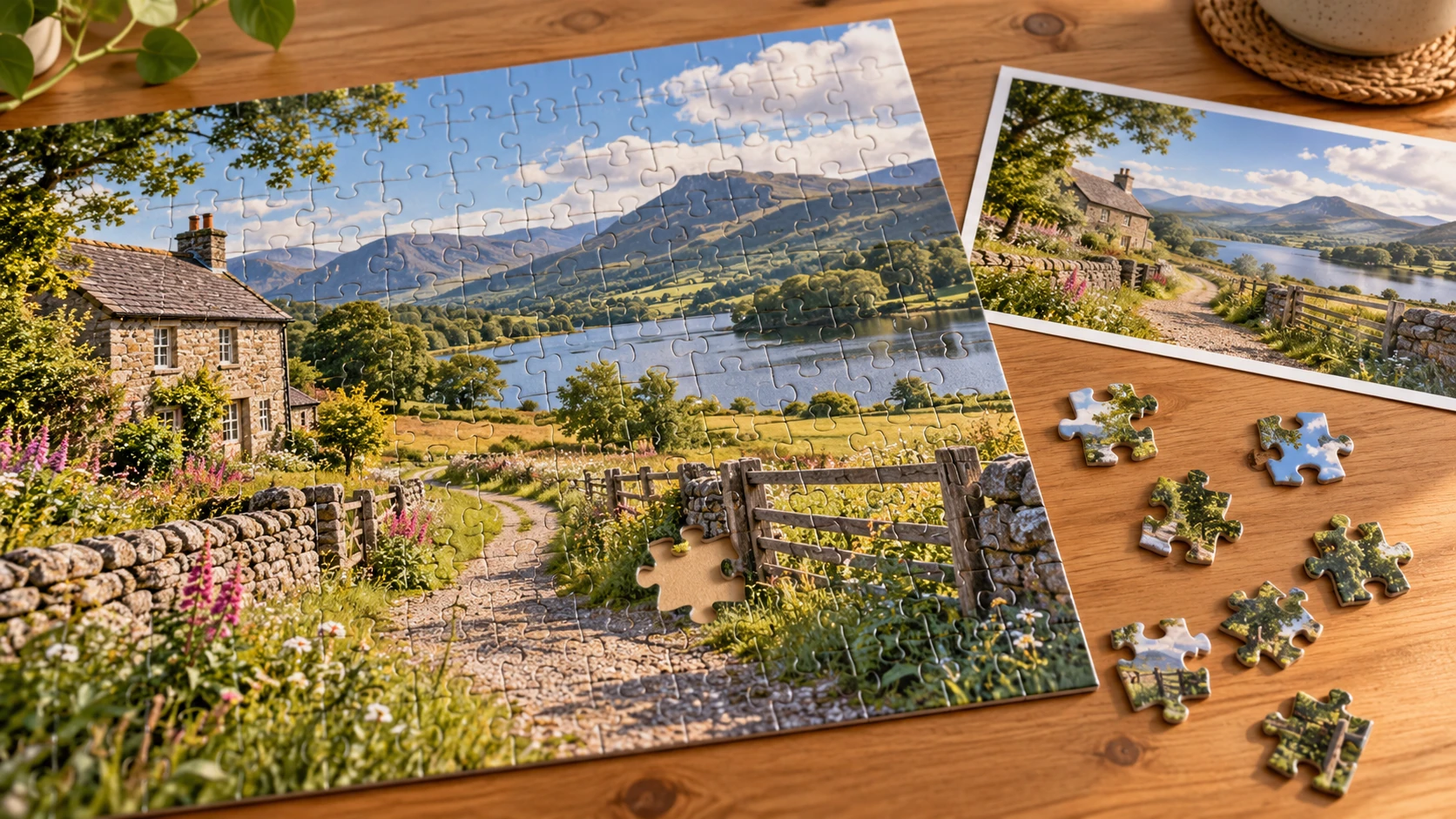
When a jigsaw gap will not fill, the empty space is easy to blame. Yet its present outline comes from the pieces surrounding it, and those placements may still be uncertain. Before describing a piece as missing or defective, ask whether the picture around the opening supports the arrangement already made. This is a local troubleshooting question about a partly assembled puzzle. It is not a promise that every stubborn opening can be resolved by changing a neighbouring piece.
Keep the opening separate from the diagnosis
Describe what you can see: an opening remains, and none of the loose candidates you have considered has been placed there. That statement leaves several possibilities open. It does not establish that you have considered every remaining piece, that the surrounding arrangement is correct or that the original parcel lacked something. Keep the current difficulty at that scope while you decide what evidence could distinguish the possibilities.
The surrounding picture matters because an opening is not an independent template supplied by the box. It is a space left by your present assembly. If one part of that assembly is misplaced, the space may ask the remaining pieces to satisfy an arrangement the original design never required. This is a hypothesis to investigate, not a diagnosis made from frustration or the number of minutes spent looking.
Keep the puzzle and its own reference together. A remembered landscape from another box cannot settle where a line crosses this picture. Nor can a picture of a similar scene establish the exact cut of the set in front of you. If the reference itself is uncertain, resolve that first rather than interpreting every disagreement as evidence against the physical pieces.
Use the selected pictures within their limits
The Ravensburger Nature Garden Jigsaw Puzzle is described as a wooden puzzle with themed shaped pieces. Its gallery shows the illustrated garden, Ravensburger wooden-puzzle packaging marked 500 and separate examples of the shaped pieces. Those images identify the selected design and its stated form. They do not locate an actual missing piece in your household or establish that a particular connection you made is correct.
The Ravensburger Welcome Banff Jigsaw Puzzle is described as a 1000-piece puzzle. Its gallery presents the illustrated mountain-and-town picture and matching Ravensburger packaging. The native account's claims about fit, quality and benefits are not results from a test conducted here. In particular, a product's fit wording does not identify the cause of a stubborn opening in an actual assembly.
Keep the two designs separate. Nature Garden's wooden description and shaped-piece examples do not become features of the Banff offer. A nominal count also gives no map of the outline of the space you are examining. Use the exact selected reference for its picture, while leaving unsupported assumptions about individual pieces, material properties or a universal cutting pattern out of the enquiry.
Look beyond the apparent hole
Choose a distinctive feature crossing the area around the opening, if the actual picture provides one. A drawn line, boundary or recognisable object can offer a more specific comparison than a broad colour group. Ask where that feature is meant to continue in the reference and whether the surrounding assembled fragments actually support that relationship. A blue patch alone may occur in more than one place.
Look at the relationship across a proposed join, rather than treating one attractive colour match as a completed explanation. A line reaching one edge and reappearing at another position is something to examine. It does not automatically prove that either piece is wrong: the reference may show an interruption, a crossing or a change in the object itself. Keep the whole relevant image available while interpreting the local detail.
The visual question also does not replace the physical one. A plausible picture fragment cannot justify forcing a piece into a space. This article gives no pressure test, trimming method or way to modify tabs and openings. If a connection is uncertain, retain that uncertainty and follow the actual puzzle's applicable guidance before handling or changing its arrangement.
An invented path-and-fence example
Imagine a wholly fictional puzzle showing a pale path passing a dark fence, with a red gate near the centre. These details are invented for the example; they describe neither selected retail artwork. Mara has an unresolved opening beside what she believes is the gate. She has been looking only for a loose piece containing more red, because she already regards the surrounding red fragment as correctly placed.
Mara returns to the fictional reference. The gate has a diagonal brace, and a thin pale path continues behind it. In her current arrangement, the visible brace appears to stop against a neighbouring fragment, while the pale line beside it does not continue where she expected. These are two observations about the picture. They give her a reason to question the local arrangement before treating the remaining opening as a missing gate piece.
Suppose Mara then notices another red feature elsewhere in the reference: a small roof. The fragment she assigned to the gate may belong there instead. Its colour did not distinguish those two possibilities. She has identified an alternative visual interpretation, not proved a physical placement or found a replacement. The roof possibility should remain a candidate until the actual picture and appropriate assembly establish it.
The useful change in her question is specific. She first asked which remaining piece could fill the space around a supposedly established gate. She now asks whether the red fragment helped create a misleading local outline. That shift lets her reconsider an earlier assumption without inventing a production fault. It also leaves room for her original arrangement to turn out correct after further examination.
Do not make every clue agree by explanation
A tempting response to an awkward detail is to invent a story that preserves the arrangement: perhaps the painted line simply disappears, or perhaps the reference has been printed differently. Those possibilities need evidence of their own. Keep a visible discrepancy as a question instead of supplying an unseen explanation merely because changing your interpretation feels inconvenient after a long session.
Likewise, a friend saying that a piece looks right can be a useful invitation to examine it, but does not settle every join around it. Ask which visible relationship supports the suggestion. Someone may have noticed a distinctive corner of the picture you overlooked. Their observation can improve the enquiry without becoming a general assurance that the entire local section is correct.
There may be no distinctive line available in the immediate area. A broad plain region can leave the visual evidence weak. Record that limitation rather than drawing an imaginary boundary into the artwork. You can pause with an unresolved opening. An honest lack of a discriminating clue is more useful than declaring that every remaining piece has been excluded when the comparison was inconclusive.
Keep a changed arrangement distinct from a repair claim
If an earlier interpretation is later revised, describe the actual result. A different opening, a newly continuous image or a piece finally placed answers a narrower question than the claim that every part was originally supplied correctly. Conversely, an opening that remains unresolved does not prove an absent piece. Keep the outcome attached to the actual assembly and the evidence you examined.
The Christmas jigsaw assembly guide addresses initial sorting, the actual outline and recognisable sections. Its warning to reconsider an uncertain edge does not provide an exact map for this opening. Here the concern is the assumption already embedded in the local arrangement, especially when repeated searching around one apparently settled feature has stopped producing useful new information.
The domino set inventory guide separates a supplied-count question from a suspected missing marking. Its whole-set inventory is a different enquiry from the picture relationship around a jigsaw gap. Do not convert an advertised jigsaw count into a drawing of the absent shape, or copy a domino contents rule into a puzzle whose actual picture and cut need their own evidence.
Leave an unresolved opening recognisable
If you seek help, identify the exact puzzle and show the relevant reference together with the local area in its present state. Explain which picture relationship seems inconsistent and which placements remain uncertain. A request saying only that the last piece does not fit omits the surrounding assumption you are questioning. Keep any earlier photograph if the arrangement changes, so the enquiry does not silently acquire a different starting point.
Ask for the guidance applicable to the actual product. This article establishes no manufacturer's individual-piece replacement policy and promises no replacement, refund or successful completion. If a piece is damaged or a connection cannot be handled under the applicable instructions, leave that physical issue for appropriate product guidance. A visual hypothesis does not supply a method for restoring a bent, broken or altered component.
You can end the session with a narrower useful finding: a local placement deserves reconsideration, the reference is still unresolved or the current evidence does not distinguish the possibilities. Jigsaw gap will not fill is then a description of a real remaining question. It need not become an unsupported missing-piece diagnosis merely because you would prefer the picture to be finished.
Keep a later purchase tied to its own selection
Both captured product offers list cryptocurrency among accepted payment methods in structured data. If you later consider an order and prefer USDT, check what the selected checkout actually offers for that transaction. The general payment category does not identify every available currency or establish the conditions of a later order. Keep the exact puzzle reference beside any question about its selected variant and contents. Nature Garden's wooden description does not transfer to the Banff puzzle because the same payment preference is used for both. Nor does an order settle the local placement in a puzzle already on your table. Read the current delivery and return information for the actual selection before deciding whether to proceed. This article promises no arrival date, replacement-piece service, refund outcome or completed picture through a payment method. If another person orders on your behalf, give them the product reference you actually selected rather than a remembered piece count or a photograph from another design. Retain the order confirmation if a purchase is made, while keeping any unresolved contents question separate. A transaction record identifies the purchase; it is not an inspection of the parcel or a verification of the finished assembly. This discussion supplies no transfer instructions, wallet setup, network choice, exchange calculation or fee estimate. Consider an available option only under the conditions actually presented for the order. You can continue examining the existing picture without making another purchase, and you can leave an order pending while an important product detail remains unanswered. Neither choice requires turning an uncertain gap into a confirmed defect or claiming that a new puzzle will resolve it.