Seasonal & Holiday Content
Christmas jigsaw assembly: sort, frame and build winter details
Begin Christmas jigsaw assembly with visible pieces, an actual border and recognizable sections, keeping Winter Garden and Springbok product details separate.
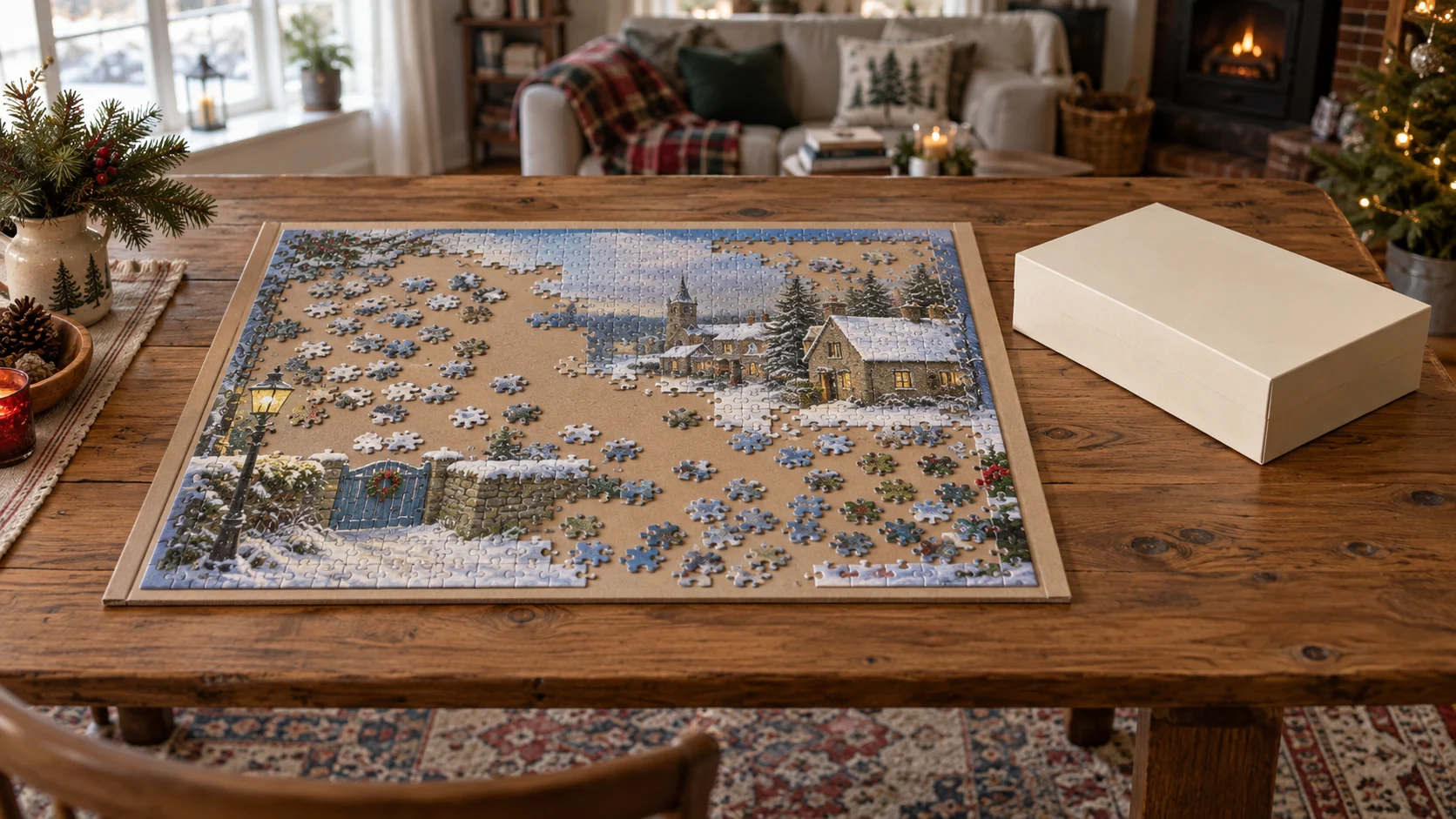
Christmas jigsaw assembly can give a winter visit a practical shared activity: put a picture together, starting with visible pieces and a workable frame. Begin with the actual puzzle, its own picture and any supplied information. A seasonal title and a piece count do not tell you every feature of the set inside the box.
The method here draws on Bits and Pieces' How to Do a Jigsaw Puzzle Like an Expert and Springbok's Strategic Guide to Tackling a Difficult Jigsaw Puzzle. Their general guidance covers sorting, borders and recognizable image areas. It supplies no timed result, tested difficulty rating or exact assembly map for either selected retail offer.
Choose the actual winter or Christmas picture
The Bits And Pieces Winter Garden 500 Piece Puzzle has a short product description: a piece count of 500 and finished-size labels of 18 inches and 24 inches. Preserve those stated dimensions without assigning an orientation or assuming that the finished image occupies all the working space the activity will need.
The Springbok Santa Christmas 500-piece puzzle offer names Everything's Up To Date At The North Pole in its title. Its product description repeats the title. It supplies no finished dimensions, material specification or actual contents beyond that short account. Obtain those missing details for the Springbok offer.
Both offers name 500 pieces. That shared number does not establish matching outlines, identical piece shapes, equal difficulty or the same completion time. Look at the actual puzzle and its available information before planning the work. A group can choose a winter garden or a Christmas subject without assigning an invented performance advantage to either.
Agree which surface can remain available
Bits and Pieces recommends a large flat working surface, useful lighting and a place away from passing traffic. Resolve that ordinary arrangement before opening the puzzle. For a winter gathering, ask when the household needs the proposed table for another purpose, including a meal or an activity already planned for the visit.
The finished picture's stated dimensions are one part of that question. Loose pieces and the arrangement you choose for them need their own space. An 18-by-24-inch finished-size account does not prove that an equally sized surface accommodates the whole activity. This guide supplies no universal allowance to add around a puzzle.
If the picture may remain unfinished, decide how the room will work afterward before making the session depend on that spot. Obtain an applicable storage or transfer arrangement if one is needed. No lifting, rolling, gluing or framing method is supplied here, and the completed image should not be assumed movable as one unsupported object.
Sorting winter jigsaw pieces begins with the visible faces
For sorting winter jigsaw pieces, Bits and Pieces begins by turning pieces picture-side up, separating likely edges and corners, and grouping the rest by colour or pattern. Those are different sorting questions. A colour group does not identify an outer edge, and an apparent edge still needs its place in the actual outline established.
Keep one puzzle's pieces with that puzzle. If another box is also open, resolve which set you are working on rather than treating two seasonal pictures as one supply. The offers here describe separate products. Their appearance together in this guide provides no shared piece inventory or evidence that their pieces are interchangeable.
Use the picture belonging to the actual set as your reference. A remembered Christmas image or a similar winter scene from another box is a different design. If the reference is missing or does not appear to match the pieces, resolve that identity question before deciding that a particular colour must belong to an imagined part of the picture.
Building a jigsaw border needs the actual outline
For building a jigsaw border, assemble the actual outer-edge pieces using their colours and patterns, as the manufacturer guidance describes. If the puzzle has a rectangular outline, its actual corners belong to that frame. Do not assign every puzzle four corners simply because a previous puzzle had that form.
Springbok explicitly warns that its cut shapes can include apparent edges that are not true outer edges. Treat a likely edge as a candidate until the actual assembly supports it. The general warning is useful without certifying that a particular piece in the selected Santa puzzle is a false edge or identifying where it should go.
A gap in the partly built frame does not, by itself, demonstrate a missing piece. The piece may still be among the unsorted candidates, or an assumed placement may need reconsidering. This article supplies no missing-piece diagnosis. Keep an unresolved gap separate from a completed inventory claim about the set you received.
Let the picture suggest a first interior section
After the border, the guides direct attention to distinctive parts of the picture and to manageable sections. Springbok recommends consulting the actual box image while working. Choose a recognizable feature in your own puzzle rather than assuming that either sparse retail account supplies the scenery, figures or lettering you expect to see.
Consider a wholly fictional winter picture with a blue gate, a pale roof and a narrow line of red decoration. These details are invented for the example and are not a description of Winter Garden or the selected Springbok artwork. Suppose the blue gate is clearly recognizable in the actual reference for this imaginary puzzle.
In that example, the pieces that seem to belong to the gate form a proposed section. Their colour is a reason to examine them together, rather than proof that all blue pieces belong there. The same fictional picture might contain another blue object. Consult the whole reference while deciding what each candidate actually contributes.
Distinguish a colour group from a completed connection
A group of similarly coloured pieces is still a group of loose pieces. It has not become an assembled part merely because you found a plausible place for its subject in the picture. The manufacturer's matching guidance considers both the picture and the pieces' shapes. Check both the image and shape for a proposed placement.
Springbok's guide advises trying a different location when a piece does not fit a proposed spot. Keep that as a reason to reconsider the placement. This article offers no way to force, trim, alter or repair a piece to make an interpretation work. Return an unplaced piece to the remaining candidates.
In the fictional blue-gate example, a piece that appeared promising might belong to another blue area. That change does not require inventing a manufacturing fault. The example describes an uncertain visual assignment being revised. No actual piece from either selected offer has been handled or tested for this article.
Keep separate sections attached to the same reference
One person may work on a recognizable feature while another examines the frame or a different area. If people choose that arrangement, keep the actual reference available to everyone who needs it. The assembly can involve several sections without assigning fixed jobs or requiring every visitor to work at the same pace.
When two people want the same loose piece, settle which proposed section needs it before either person treats the claim as established. A piece cannot become part of two actual connections at once. Return to the picture and the proposed fit rather than deciding by who first named its colour.
The fictional roof and gate can remain distinct working areas while their relationship is still unresolved. A small connected area is progress within that example, without establishing where it joins the frame. Let the actual puzzle supply the connections; a description of the scene cannot replace them.
Revisit quiet areas after recognizable ones
The manufacturers distinguish recognizable image features from subtler colours and patterns. Once an actual section is established, return to the remaining candidates with that additional context. A broad area of pale winter colour may need more careful attention than a distinctive detail, without this article declaring either selected design easy or difficult.
Use the actual picture and piece shapes for those remaining questions. A pale piece does not become sky simply because the puzzle has a seasonal title. Snow, a wall or another light area may be present in the actual artwork. Those possibilities belong to the chosen design rather than a universal winter-picture rule.
If the group stops while such an area remains open, describe the state plainly: the picture is unfinished. There is no need to call a session unsuccessful because the final piece was not placed during the visit. Nor does a completed frame establish a promised finishing time for everything inside it.
Keep assembly separate from a clue-sharing conversation
The jigsaw evening with friends guide invites adults to exchange observations about an actual picture. Its selected Unbranded Snow Globe Winter Scene and CANfacai cat-shaped wooden puzzle provide different visual contexts. The guide concentrates on conversation and participation, rather than supplying this article's assembly sequence.
You can enjoy that conversation while working, but an interesting interpretation remains separate from an established connection between pieces. The other guide's materials, age wording and cat-shaped form do not complete the missing specifications for Winter Garden or the Springbok offer. Keep the actual set beside every physical claim you make about it.
The two purposes can also be kept apart during the visit. Someone may enjoy quietly assembling a section without discussing every possibility. Another visitor may prefer to watch and talk about the image. The present method concerns the physical assembly; it does not require everyone to narrate their actions or complete an equal share.
Return the room to its agreed holiday use
The coffee-table layout and drawer-access guide distinguishes actual Safavieh Flora and Mozart body dimensions from usable moving or lower-storage access. That is relevant when choosing an existing room surface. A headline table measurement does not establish the available puzzle area or keep every drawer accessible during the activity.
Neither table example provides a certified placement for these puzzles. Check the actual household arrangement and the work the room must still support. If another activity needs the table, follow the previously resolved arrangement rather than improvising a transfer from a product title or assuming the connected pieces will remain together when lifted.
Before the visit ends, ask whether anyone wants to continue at a later agreed time. Agree on the next visit without promising to finish the puzzle by then. The actual state of the assembly is enough to describe where the next session would begin, without a score, completion forecast or written progress report.
Christmas jigsaw assembly can move from picture-side-up pieces through an actual border and recognizable sections. Use the chosen set's image, reconsider uncertain edges and let the pieces establish their own connections. If the picture is unfinished when the visit ends, use the room arrangement the household agreed.
Christmas jigsaw assembly uses the actual picture and piece shapes; this conceptual cover shows a generic winter puzzle workspace without an exact retail artwork, piece count or verified assembly result.