Garden Care & Watering
manual hose reel hard to crank: isolate winding resistance before force
A symptom-first observation guide for a stiff hand-crank garden hose reel, with safe stop points and exact-model support questions.
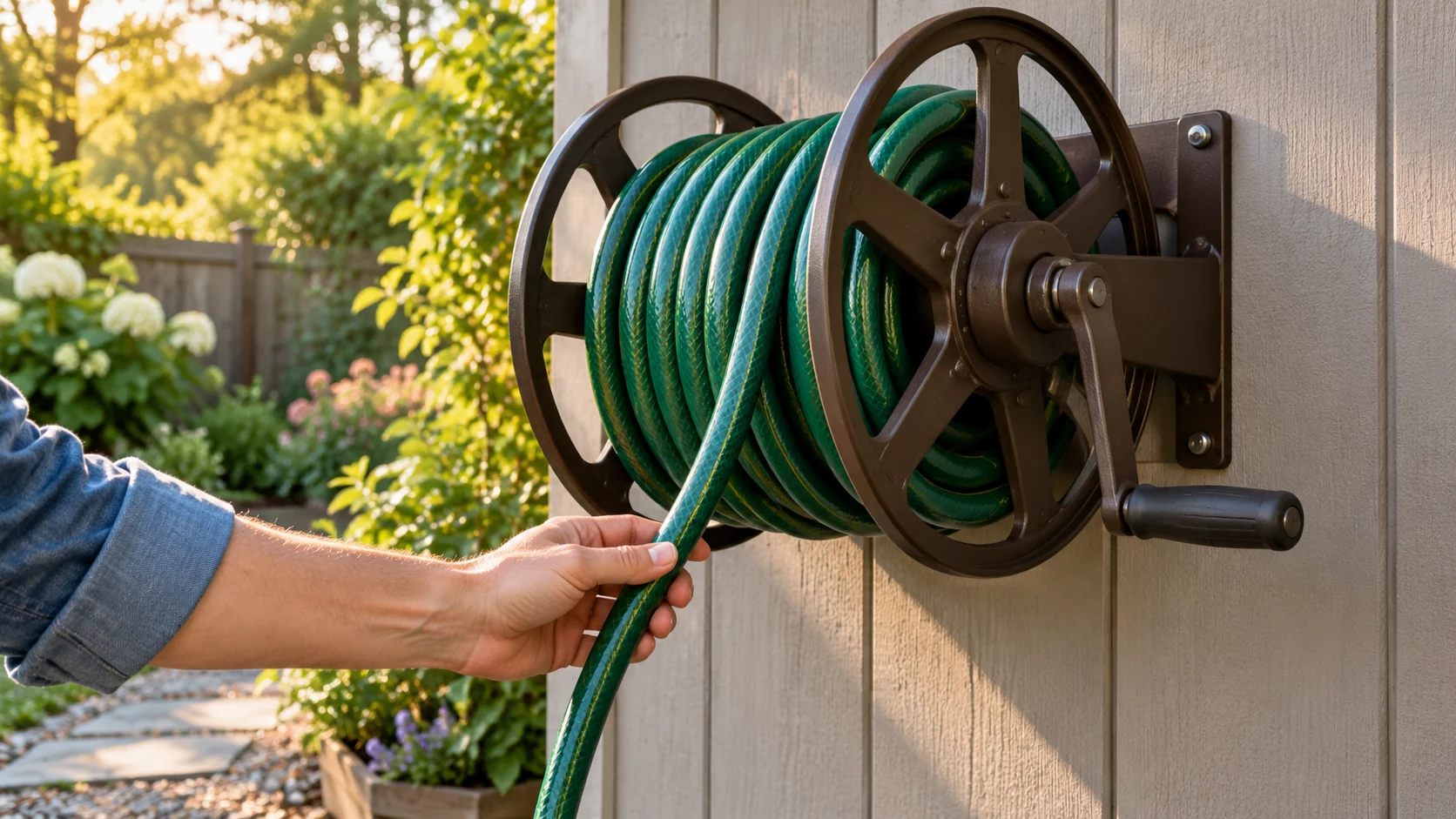
A manual hose reel hard to crank deserves a pause before another pull on the handle. Resistance can come from the hose outside the reel, the way it is entering the drum, movement at the reel's support, or a problem inside the unit. The handle alone cannot identify which. Stop winding, shut off the water, and look at what changed since the last easy use. If the reel is loose, a connection is leaking, or a part is cracked, leave it out of service and ask the maker or seller about that exact model.
Two current listings show the kinds of details worth checking. The Suncast hand-crank hose cart describes a manual slide-track guide, a metal crank with swivel grip, wheels, and foot pads. The Liberty Basics wall-mounted hose reel describes a rubber-grip handle, a wall mount with keyhole design, a shelf, and assembly required. One rolls on the ground; the other depends on its wall mounting. Neither listing provides a diagnosis for a crank that has become stiff. Use them to identify exposed parts and support differences, then consult the instructions for the reel actually in front of you.
Record when the resistance starts
Write down whether the crank feels stiff from the first turn, begins to resist as the hose builds up on the drum, or catches at one repeated point in each rotation. Those observations are more useful than deciding too early that the crank itself has failed. Note whether the hose is mostly paid out, half stored, or nearly full. Also note whether someone recently moved the cart, remounted the wall unit, changed hoses, or left a heavy twist in the line. A single new condition can guide the next safe inspection.
Do this with the water off and the hose lying where nobody will trip over it. Do not test a suspected jam by pulling harder, rocking the reel, or yanking a hose under pressure. You can observe a visible snag without forcing anything to turn. If the resistance arrived with grinding, a sharp crack, a visibly displaced crank, or water at a joint that should be dry, stop the test. The product page cannot tell you how that internal part is built or whether it is safe to continue.
Follow the exposed hose path first
Walk from the free end toward the reel and look for a kink, tight bend, twist, or section caught behind a planter, wheel, gate, or cart frame. A hose under tension can make winding feel harder even when the drum is sound. Move only loose objects and straighten an accessible section gently. Avoid pulling the hose across sharp edges. If the line is damaged, leaking, or flattened, treat that as a hose issue to resolve before another winding test.
At the reel, see where the hose enters. On the Suncast cart, the native description identifies a manual slide-track guide; its position matters to how the line approaches the drum, but the listing does not say to adjust it in any particular way when resistance occurs. On the Liberty wall unit, the gallery shows the hose arriving at an open drum. Follow the exact model's setup instructions before moving a guide or changing the route. Keep fingers clear of the drum and handle while another person could turn it.
A hose can also twist along its length after use. If it is safe to lay it out, observe whether loops want to turn over or pull against the direction of winding. Give the hose space to relax without dragging its fittings. Do not disconnect a pressurized line or assume the reel's swivel connection can be loosened to cure a twist. Connection work belongs to the model instructions and the actual condition you see.
Look at the drum as the hose accumulates
When the first turns are easy but later turns become heavy, look at the visible hose lay before touching the crank again. Is the hose piling on one side, crossing over itself, or pressing against a frame edge? A full-looking drum can simply be carrying a bulky or uneven wrap. That observation does not establish the reel's rated capacity or prove that a different hose diameter will fit. The Liberty listing states a capacity for 225 feet of 5/8-inch garden hose, while also saying hose is not included. The actual hose on a particular reel may differ.
If the reel and hose are intact, use the maker's instructions to guide the hose evenly during a cautious winding check. Keep hands away from pinch points and stop as soon as resistance returns. Do not pack more hose into a crowded drum merely because its advertised capacity sounds larger; capacity statements depend on the specified hose size and model. If the hose cannot lie within the reel without rubbing the frame, the next step is to confirm the exact reel and hose combination, not to force the last turns.
Compare the symptom at two positions, if a safe check remains possible. Note how the crank feels with most of the hose out, and then after only a small amount has been stored. If resistance appears only as the drum fills, hose lay or capacity deserves closer attention. If it is present before the drum carries much hose, the observation points back to the support, exposed path, or the reel mechanism. This is a way to describe the problem to support; it is not a diagnosis of bearings or gears.
Check the cart or wall support without loading it
Watch the reel body while someone applies only the light motion allowed by the model instructions. A cart that shifts on the ground can change the angle at which the hose enters. The Suncast listing describes wheels and bottom foot pads intended to keep the cart level and stationary during transit. Check that it is resting on a firm, level surface, and that an obvious obstruction is not pushing against a wheel or pad. Do not use a foot to brace a moving cart while forcing the crank.
For a wall reel, a moving backplate or shelf is a reason to stop. The Liberty Basics listing specifies a wall mount and assembly, but it does not state the condition of your fasteners or wall. Check the maker's instructions and the actual wall material before any mounting work. A reel that rocks as the handle turns may need qualified mounting help. Do not tighten unknown hardware or keep winding on a loose mount merely to finish putting the hose away.
These support checks differ from deciding where to install a new reel. The garden hose reel fit and reach guide helps plan a retractable model's wall position, lead route, and watering coverage before purchase. Here the question is what changed on a manual reel already in use. If the support is sound and resistance persists, stop at the observation rather than converting a placement guide into a repair instruction.
Keep an observation log for exact-model support
A short record makes support more useful: exact brand and model or product URL, hose length and diameter if known, where resistance begins, whether the hose is mostly out or wound, and whether the reel body moves. Photograph the visible hose lay and any exterior damage from a safe distance. Keep a note of leaks or unusual sounds. Do not remove a housing to get a better picture. The seller or maker can match those observations to instructions for the actual unit.
Do not infer package contents from a lifestyle photo or a length rating. The Suncast cart page says it comes partially assembled; the Liberty wall page says assembly is required and hose is not included. Those details matter when matching a manual or asking for a missing part, but they do not establish a repair method. The hose reel bundle cost guide addresses the separate purchase question of included hose versus a reel-only setup. Price arithmetic cannot decide whether the current reel is safe to turn.
Use the symptom pattern to choose the next question
A simple table in your notes can prevent several different symptoms from being called the same problem. In the first column, record the position of the hose: mostly out, partway in, or near the last wraps. In the second, record what moved: the hose at the entry point, the drum, the entire cart, or the wall mounting. In the third, record whether the resistance was steady or appeared once per turn. Leave a fourth column for what you could actually see, such as a crossed wrap or a hose caught on a nearby object. Write “unknown” when a part is hidden.
For example, a cart that begins to roll while the hose catches on a garden bed has two visible changes. First clear the safe external route and place the cart on a firm surface according to its instructions. Then observe whether the symptom remains during ordinary use. That sequence does not prove an internal defect or promise that the cart will be easy to turn afterward. A wall reel that stays fixed while each crank revolution catches at the same point gives a different report to the manufacturer. Avoid taking off its reel or backplate to confirm a guess about the axle.
If there are two users, only one should handle the reel during an observation. The other can watch from clear of the moving hose and drum. Stop the test immediately if someone cannot keep clear of the path. Take a still photo with everything at rest instead of reaching into a moving reel. A useful photograph shows the hose entry, the amount wound, and the support in one frame; a close view of visible exterior damage can supplement it. Keep the model label or purchase record with those notes so support does not have to infer the unit from its shape.
Do not compare the force at the handle with somebody else's reel as a universal standard. Hose length, hose material, how much is wound, and the reel's construction differ. Your own observation that the same reel changed suddenly is more relevant than a claimed normal amount of effort for an unrelated model. If a new hose was installed before the symptom began, record its stated diameter and length and compare them with the exact reel instructions. Do not assume a capacity printed for 5/8-inch hose applies to every other size or to a swollen, damaged hose.
When to stop
Stop if the crank repeatedly catches, the reel or mount moves, the hose has visible damage, a connection leaks, or the drum rubs the frame. Stop as well if a gentle, instruction-consistent check does not change the resistance. Continuing under force can make the symptom harder to understand and may worsen damage. Keep the hose where it will not block a path and contact the manufacturer or seller with your model and observation log.
If the exposed route was caught and the reel now winds smoothly under its normal instructions, watch for the same snag on the next use. If the symptom returns, keep that repeat in the log. The useful outcome is a clear account of when the handle becomes hard to turn and what can be seen outside the unit, followed by an exact-model decision about further use.