Crypto Commerce
LTS Future 8MP camera versus Turing motorized-lens bullet
The LTS Future 8MP camera has a stated infrared illumination reach of up to 197 feet, but that figure does not establish whether its fixed view suits your installation better than Turing Video's adjustable lens. The useful distinction is whether a fixed 2.8mm lens covers the area you need or whether you need the framing adjustment offered by Turing's 2.8~12mm motorized lens. Make that decision alongside a review of nighttime image requirements. Neither description establishes the detail you will see at your intended distance.
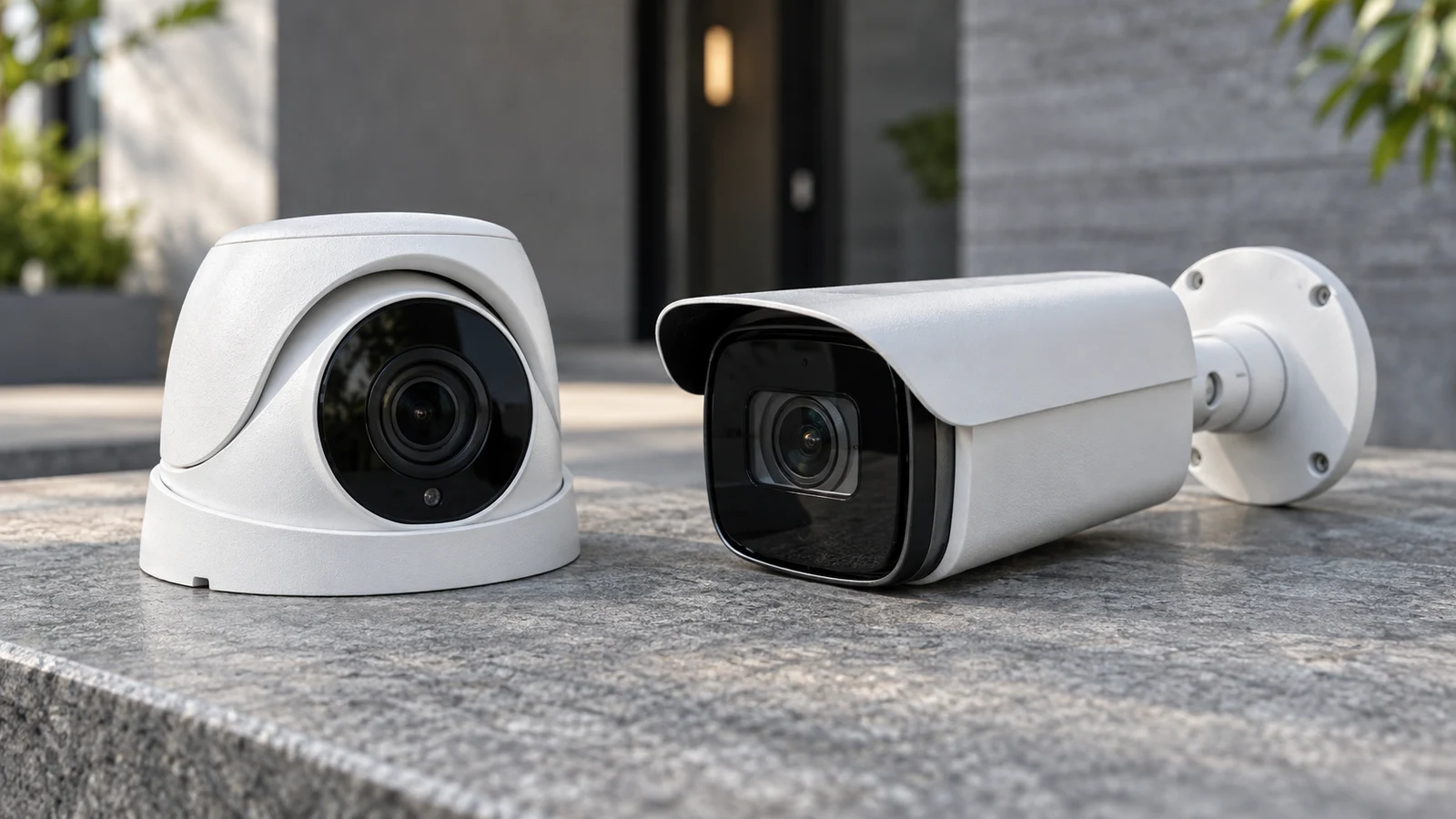
The LTS Future 8MP camera has a stated infrared illumination reach of up to 197 feet, but that figure does not establish whether its fixed view suits your installation better than Turing Video's adjustable lens. The useful distinction is whether a fixed 2.8mm lens covers the area you need or whether you need the framing adjustment offered by Turing's 2.8~12mm motorized lens. Make that decision alongside a review of nighttime image requirements. Neither description establishes the detail you will see at your intended distance.
This comparison concerns the LTS Future CMIP9382W-28MD and Turing Video Smart TP-MMB8AV2. Both descriptions specify 8MP resolution. LTS lists Smart AI detection, Wide Dynamic Range and infrared illumination. Turing specifies 4K video at 20fps, TwilightVision and Smart IR, along with additional storage and system features. These are catalog claims, not results from a side-by-side test. A useful purchase decision needs to connect those stated features to one proposed camera position and one clearly defined monitoring task.
Turing Video Camera Alternative: Fixed View Or Adjustable Framing?
Begin by writing down what must remain visible from the intended mounting point. For example, a hypothetical installation might need to include the full width of an equipment storage area while retaining useful detail at its far boundary. Draw the required edges on a simple site sketch and note the distance to that boundary. This gives a seller or installer a concrete question to answer about the two models without assuming either lens will produce the view you want.
The LTS Future 8MP camera description specifies a fixed 2.8mm lens. It does not provide a horizontal or vertical field-of-view angle. Ask for those model-specific figures and a coverage assessment at your proposed mounting location. A fixed lens can be a reasonable candidate when its confirmed view matches an established installation, but the supplied focal length alone does not settle whether the near edges and far boundary will all meet your needs.
The Turing Video camera alternative has a listed 2.8~12mm motorized lens. That provides a stated adjustment capability absent from the LTS description. Ask how the lens is controlled and which equipment or interface is needed to set it. Do not assume that motorized framing includes automatic tracking, pan-and-tilt movement or a particular remote-control method. None of those capabilities is established by the supplied Turing description.
Adjustability deserves weight if the final framing cannot be settled before installation. Suppose the initial plan includes a storage bay and an adjacent access aisle, but the eventual requirement may concentrate on the bay alone. Ask whether the Turing lens can accommodate both proposed views from the same position. For LTS, ask whether its fixed view meets the settled requirement without moving the camera. These are installation questions to resolve before treating either model as the better fit.
Keep the comparison tied to the same required scene. A demonstration of one camera showing a broad area and another showing a small section would leave the purchase question unresolved. Request examples with the required boundaries identified and the subject distance stated. If the seller cannot supply a comparable demonstration, record the remaining uncertainty. You can still compare the documented lens arrangements without claiming that either produces better usable detail.
Turing Video Camera Alternative: What The Nighttime Figures Establish
LTS lists infrared illumination reaching up to 197ft. Turing lists Smart IR with an effective range up to 50m (164ft). Those descriptions support a comparison of advertised illumination distances; they do not establish a recognition distance or guarantee a readable image at the far end of either range. Avoid choosing LTS solely because its quoted distance is longer. Ask what conditions support each claim and how those conditions compare with your proposed scene.
Define the nighttime result you need in ordinary language. You may only need to see whether an area is occupied, or you may require enough detail to distinguish an object involved in an event. Give that requirement to the seller alongside the distance and planned framing. Request a relevant nighttime sample, with its camera settings explained. A picture that looks bright can still leave your particular question unanswered, so judge the sample against the task you wrote down.
Both descriptions mention Wide Dynamic Range, also called WDR. The LTS description connects it with mixed lighting, while Turing describes it for high-contrast scenes. Turing also lists TwilightVision for improved low-light image clarity. These statements do not provide a measured ranking between the cameras. If your proposed view includes a bright light source and a darker working area, ask to see how each exact model handles that combination with the important area still visible.
A useful demonstration should also show the kind of activity you expect to review. If moving people or equipment matter to the task, request a sample containing comparable movement, rather than relying entirely on a still image of an empty area. Turing's description specifies 8MP (3840x2160) 4K video at 20fps. The LTS description does not state a frame rate. Confirm its supported resolution-and-frame-rate combinations before treating the two models as equivalent recording choices.
Turing Video Camera Alternative: Installation And Review Requirements
Once the proposed view looks suitable, check whether the supporting installation can deliver it. Turing explicitly lists PoE for power and data over a single cable. The LTS description identifies an IP camera but does not specify its power method. Ask for the LTS power requirements and the exact Turing PoE requirements before selecting supporting equipment. Do not transfer a feature from one description to the other because both products are network cameras.
For an existing system, provide the seller or installer with the recorder model and relevant system details. Ask whether the selected camera can supply the required image mode and whether the functions you intend to use remain available through that recorder. The supplied descriptions do not establish universal compatibility. An answer about receiving video should be kept separate from an answer about controlling the lens, accessing detection functions or searching saved recordings.
Turing's People and Vehicle Search has an explicit qualification: its description ties the feature to deployment with a SMART series NVR and Turing Vision Cloud Max. Do not budget for the camera alone and assume that purchase establishes access to the described search function. Confirm the required recorder, cloud arrangement and any associated terms for your proposed setup. The description does not establish included subscriptions, service pricing or how long access would last.
LTS lists Smart AI detection without identifying the detection categories or explaining how alerts and recordings are handled. Ask which events the exact model can detect, where configuration takes place and what the connected system must support. Detection, recording and later retrieval are separate questions. The supplied LTS description does not establish continuous recording, motion-triggered recording, a particular notification method or integration with another platform.
Turing supports a 256 G microSD card for on-board storage, according to its description. That does not establish an included card or a particular retention period. If on-board storage matters, confirm suitable media, supported recording modes and how saved footage is retrieved. For LTS, the supplied description does not establish on-board storage at all. Ask directly about the storage arrangement instead of assuming it matches Turing's.
Use Camera Battery Planning For Time Away From Charging: A Separate Power Question
Neither supplied description establishes rechargeable battery operation for these models. If your search began with a camera that would work away from a charging point, keep that requirement separate from this fixed-versus-motorized-lens comparison. The guide Use camera battery planning for time away from charging addresses that different planning need. Its relevance does not make either camera here a battery-powered option. Resolve the intended power arrangement before spending time comparing their imaging features.
For the installation itself, ask what the package includes and what must be supplied separately. The descriptions do not establish included mounting hardware, a power supply or all required connection accessories. Request a complete equipment proposal for your chosen position, including any work needed to make connections accessible for maintenance. This keeps an apparently suitable camera from being compared against another on the basis of incomplete installation costs.
Turing lists IP67 and IK10 protection ratings. Those are documented specifications, not an independent assessment of your intended installation. Ask whether the proposed mounting and connection arrangement suits the exposure at that position and what care the manufacturer requires. The supplied LTS description gives no comparable protection rating. That gap should remain an open suitability question; it does not establish either that LTS has equivalent protection or that it is unsuitable for every exposed location.
Turing Video Camera Alternative: Resolve Identity Before Choosing
Before drawing a purchase conclusion, resolve the LTS naming variation. Its description uses CMIP9382W-28MD and also lists LTCMIP9382W-28MD. It supplies SKU sku-2035589601 and UPC 794094529065. Ask the seller to confirm which model identification appears on the unit and which documentation applies to it. Preserve both strings in your enquiry. Treating one as an obvious typo would leave uncertainty about whether the specifications and offered unit match.
For Turing, keep TP-MMB8AV2 in the comparison and in any installation proposal. A response about another camera in the same product family would not answer questions about this specific motorized lens or its stated search dependencies. When requesting confirmation, name the feature that matters and the proposed supporting equipment. A general assurance that the product is suitable gives you less to evaluate than an answer tied to your actual view and system.
The LTS Future 8MP camera remains a candidate when its confirmed fixed view meets the scene requirement and its nighttime results are adequate for the task. Turing warrants closer consideration when you need the stated motorized lens adjustment or have a defined use for its documented storage or search features. Neither conclusion follows from resolution alone. If the fixed view misses a required boundary, or the adjustable model needs supporting services you do not want, that issue should carry more weight than an appealing specification elsewhere.
Request a current quote only after those questions are clear enough to describe the configuration you need. Confirm the selected variant, availability and current price, then identify any supporting equipment or service costs separately. Ask who handles setup questions and what support applies to the purchased unit. Review the applicable return and checkout terms before committing; this comparison does not establish eligibility, deadlines or other merchant-policy promises.
Take your scene sketch and nighttime requirement to the seller with one final request: confirm the exact camera identity, the proposed framing and the equipment needed to obtain and review that view. Choose the configuration whose answers fit your installation. If the decisive point remains uncertain, such as usable detail at the far boundary after dark, ask for a relevant demonstration before making that feature the reason for your purchase.