Lighting
Living room table lamp ideas: a black dome or a tall glass base
Compare two complete table lamps for a living-room accent surface by silhouette, control and stated bulb requirements without inventing light-output claims.
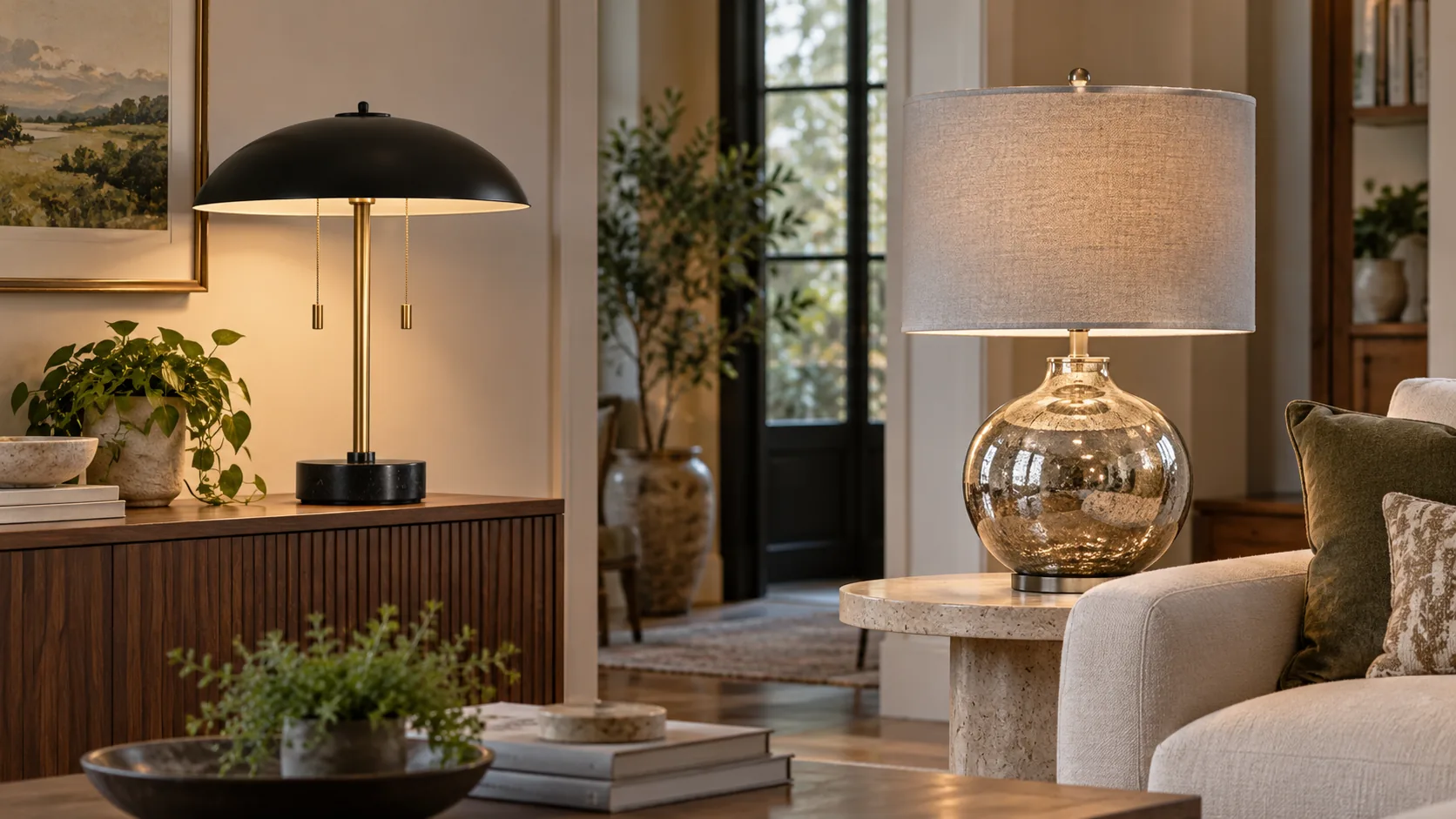
Living room table lamp ideas often start with a photograph of a beautiful fixture. A better starting point is the surface where the lamp will live. The same object can look modest on a long console, crowded on a narrow end table, or hidden behind a sofa arm. Two current offers make the difference clear: one uses a low black dome and individual pull chains, while the other uses a tall reflective base and a fabric drum shade. Neither listing supplies a measured answer for how either lamp will illuminate your room.
Choose the role before choosing the silhouette. Do you want an object that anchors an otherwise open stretch of console, or one that sits beside a chair without taking over the reachable surface? Will the control be accessible from where someone actually sits? Is there enough room around the shade for ordinary movement? Those are questions you can answer in your own room. The product pages can then supply dimensions and stated components, rather than making the room decision for you.
Start with the surface and the view from the seat
Measure the useful top of the side table or console, not only its advertised overall width. A vase, charging tray, books, and the space needed to put down a cup may already have claims on it. Mark a rectangle for the lamp's base and leave a little working space around it. The table should support the lamp as its maker directs, with the cord routed so it is not pinched or pulled across a walking path. If the surface is too narrow, changing lamp style will not create more room.
Stand where the lamp will first be seen, then sit where people spend time. A tall base may serve as a visible room accent from a doorway but place a broad shade near eye level from a sofa. A low shade may keep the overall profile quieter while requiring more room sideways. These are placement effects, not proof that one fixture is brighter. Use a cardboard outline or temporary object to test the height and width in your own room before treating a product photograph as scale.
Think about adjacent walls and furniture. A console under a framed picture has a different vertical boundary from an open side table. A lamp beside a sofa may be partly screened by the sofa arm. A nearby shelf or cabinet door may make a wide shade awkward even if the base fits. Sketch the space the shade would occupy, then check whether someone could reach its switch without leaning over furniture. A visually appealing lamp that cannot be operated comfortably is a poor match for that position.
There is also a difference between a lamp as a decorative object and a lamp for a specific task. If the main need is seeing a notebook page at an evening writing spot, the published desk lamp evening writing spot guide tests direction and controls at the actual page. This comparison owns a living-room accent surface instead. Keep that distinction when looking at images: a fixture that looks warm in a staged room has not been tested at your seat or on your reading material.
Read the black dome lamp as an offer, not a lighting test
The Adesso Cap Table Lamp listing describes a black metal dome with a gold-painted interior, an antique-brass finish, two standard 40-watt bulb sockets, and one pull chain for each socket. Its single native gallery image shows a complete standing lamp with the two chains visible. The listing calls it a table lamp and suggests several room surfaces. Those details identify what is being offered; they do not report measured light output in your room.
The dome has a strong horizontal shape. On a long, relatively empty console, that broad curve can become the focal object while the narrow stem leaves visual space beneath it. On a small side table, the width of the shade may matter more than the base looks in a thumbnail. Check the current product dimensions before ordering and compare them with your marked surface. Do not infer measurements from the photograph, which has no ruler or familiar object at the same depth.
Two pull chains are a concrete control detail. If the lamp will be beside a chair, imagine reaching for each chain from the seated position. A chain hidden behind the shade or pressed close to a wall would be less convenient even though the page says it exists. Decide whether you want the option to operate the two sockets separately, then verify the bulb requirements and the controls on the exact current offer. The number of sockets alone does not establish a particular brightness or color of light.
The page's warm-looking photograph is useful for understanding the finish combination and overall silhouette. It is not a promise that every bulb will produce the pictured appearance. Bulb choice, surrounding surfaces, daytime light, and camera exposure all affect the impression. Record the stated socket and wattage limits, then check the fixture instructions when choosing bulbs. Avoid turning the seller's broad claim about ambiance into a numerical claim about room coverage.
A gold-painted interior and a black outer dome give this offer two different surfaces to consider. The exterior is prominent from across the room; the interior is most visible from below or from nearby. If your console is high and the lamp is mostly seen from a seated position, look at the sightline rather than relying on a top-down product image. You can like the shape while still deciding that its switch position or shade width does not work for the specific spot.
Read the tall glass-base lamp on its own terms
The Forty West Candace Table Lamp listing describes a single plug-in lamp with a metal and mercury-glass base, a fabric drum shade, an 18-inch overall width and depth, and a 35-inch overall height. It specifies an E26 or standard bulb base with a 150-watt maximum, and says the bulb is not included. The native image shows a complete lamp with a rounded reflective base and broad shade. These are offer facts, not a test of how it will look beside your furniture.
Its height makes vertical clearance an immediate question. If the surface is under a picture, shelf, or sloping ceiling, mark the stated overall height from the actual tabletop. Leave room above the shade and check how the lamp will be moved or cleaned. The same height can feel balanced on a low side table and crowded on a high console. Your room and the surface elevation settle that visual question; the catalog dimensions alone do not.
The wide drum shade gives a simple outline, but its stated overall width is more useful for placement than a vague label such as “large.” Compare that width with the clear top of the table and nearby furniture. If a shade overlaps a sofa arm in your sightline, the base may be visible while the upper lamp feels cramped. If it sits on a long console, the shade can take a deliberate share of the wall space. Test that proportion with a paper outline at the real location.
The reflective base is part of the visual character of this offer. It can pick up nearby colors and bright shapes, so a photograph against a plain background may understate how busy it looks beside patterned upholstery or a bright window. This is an observation about reflective surfaces, not a guarantee about the exact finish delivered. Check the selected variation and current listing photos before ordering. If a particular metallic tone matters to the room, ask for a current product image tied to the item being sold.
The listing provides a bulb-base type and maximum rating, but a maximum rating is not a recommendation to use the highest-wattage bulb. Follow the lamp maker's instructions and the bulb's own specifications. The page does not give a measured lumen output for the room, and a staged image cannot fill that gap. If a precise light level is essential, plan to evaluate a suitable bulb and the actual installed lamp in the room rather than promising a result from a catalog image.
The included shade and its attachment hardware matter if you are comparing a complete lamp with a replacement part. The published replacement lampshade compatibility checklist owns fitter and dimensional matching for a separate shade purchase. Here, the question is where a complete lamp belongs and what its own listing states. Do not treat this comparison as a compatibility approval for swapping shades between these or other fixtures.
Compare controls, scale and the things the pages leave open
Put the two offers into a small decision card. Write the intended surface, the available clear width and height, the seated reach to the control, and the exact current product variation. Add only the facts each listing actually states. If a dimension or control position is missing, write “unconfirmed” instead of guessing from the picture. This makes it easier to tell whether the remaining question can be answered by a product specification or requires a seller response.
For the black dome option, the main visual question is whether its horizontal shade has enough room and whether the two chains will be easy to reach. For the tall glass-base option, the immediate questions are vertical clearance and whether a broad drum shade suits that stretch of wall. These are different design decisions even if both products are called table lamps. A search label groups them; your surface and viewpoint separate them.
Do not confuse a lamp's stated wattage limit with brightness. A socket rating sets a limit on what the fixture accepts under its instructions. Perceived room light depends on the bulb and the environment, and neither captured offer gives a measured result for your living room. Similarly, a warm photograph is an aesthetic reference, not a certified color-temperature measurement. Keep the two kinds of evidence in different columns of your note.
Look for a reachable control from the place where the lamp will actually be used. A pull chain is visible and described for the first offer; the second listing excerpt does not describe its switch location. That does not mean the second lamp lacks a switch. It means the captured offer leaves a practical placement detail to verify. Ask the seller for a current image or specification showing the control on the exact model, especially if the lamp will sit behind a sofa arm.
Confirm what the package includes before planning a setup around a pictured bulb or accessory. The tall lamp's listing explicitly says its bulb is not included. For the other offer, the two sockets are described, but the captured wording is not enough to assert which bulbs arrive in the box. Keep that difference visible. An image of an illuminated lamp can show intended use without proving a bulb ships with it.
Check the current selected variant at checkout. A product page can combine a parent description, a gallery image, and options that change what is ordered. The selected offer should match the material and finish you intend to place in the room. If the image and variation label do not line up, pause and ask. A conceptual editorial cover or staged room scene is even less specific: it illustrates the buying decision and cannot confirm a delivered color, component or electrical rating.
Give nearby objects a part in the test. Place a tray, books, or plant where they normally belong, then see whether the proposed lamp outline still has its own space. A wide shade may conflict with a tall vase; a reflective base may compete with several metallic accents. You need not buy matching objects. The goal is to avoid choosing from an empty-room image when the lamp must work amid ordinary items you already use.
Take one photograph of the real surface from the usual seat and one from the room entrance. Compare the outlines on those photographs with the verified dimensions and gallery views. If possible, use a simple cardboard silhouette rather than digitally pasting a scaled product cutout that may be inaccurate. The exercise reveals blocked controls, crowded clearance, or an awkward proportion before you rely on a seller's mood image.
Make a placement decision you can explain
If your surface is long, low and visually open, the black dome may supply a clear horizontal accent. That is a conditional design judgment, not a promise about light output. If the room has generous height around a side table and you want a taller focal object, the glass-base drum-shade option may be worth measuring. Neither preference overrides the practical checks: stable surface, safe clearance, correct bulb choice and an accessible control.
Before ordering, write the exact offer name and the measurements you have checked. For the first lamp, note the dome's available space and whether both pull chains can be used from the seat. For the second, note the 35-inch listed height, 18-inch listed overall width and depth, and the height and width actually available in your room. Keep dimensions from the listing distinct from dimensions you measured yourself.
If the unanswered point is important, make the seller question specific. Ask for the current full dimensions or switch location for the exact product, not whether it is “good for a living room.” Ask whether the selected finish and included components match the checkout variation. Save the answer with the offer identity. A useful answer lets you return to the same evidence later if the listing changes.
After delivery, follow the maker's setup and bulb instructions, then evaluate the lamp in the actual place. Look from the seat and the entrance, try the normal control, and check that the surface and surrounding objects still work. This is the first point at which you can judge the real lamp in your room. Keep the catalog's styling ideas as ideas, and let the installed object settle any questions the page could not answer.
The result should be a clear reason for the choice: a lower dome with visible individual controls that suits one surface, or a taller reflective base and broad fabric shade that suits another. The two offers provide different facts and shapes, while your room supplies the missing scale. A living room table lamp idea becomes useful when it names both the appeal and the remaining check before purchase.