Sewing & Crafts
Left-handed scissors not cutting: check the changed grip
A carried-over compensating twist can become a different problem on reversed blades. Keep the grip habit, blade layout and unresolved tool condition separate.
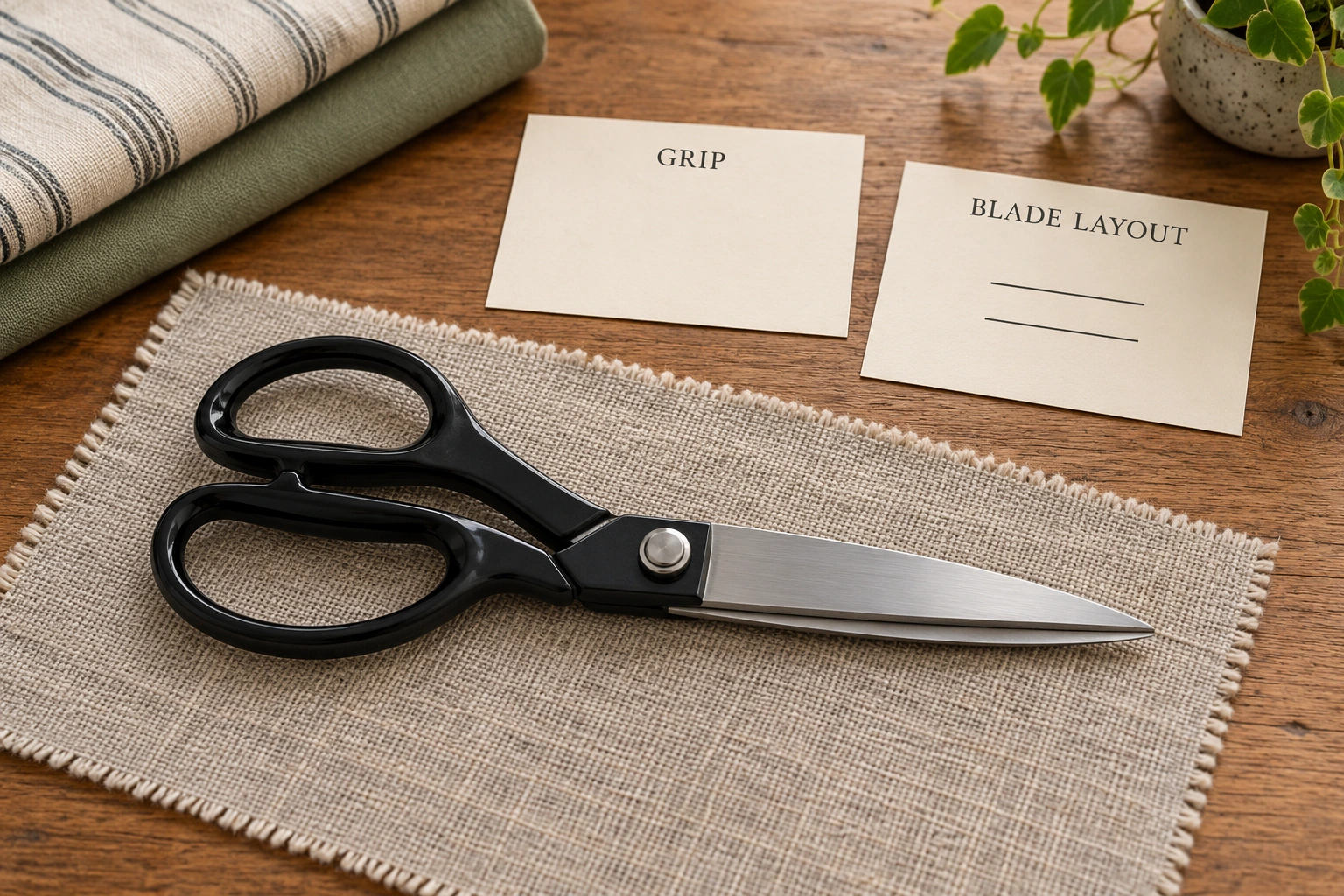
Left-handed scissors not cutting after a change of shears do not, by that report alone, establish blunt blades. A left-handed user may have changed the blade arrangement while carrying over a compensating twisting habit from an earlier pair. Keep that possibility separate from a confirmed fault. First establish the actual layout and what changed in the user's experience. This guide explains a bounded support account, not a diagnosis of your tool or a promise that a different grip will resolve every cutting problem.
Describe the change, not just the disappointing result
Begin with the two actual instruments involved, if there were two. Identify the pair used before and the pair used now. Record whether the complaint began after the change, existed beforehand or has an uncertain history. A short description such as “these new scissors do not work” leaves several of those questions unanswered. You can ask for clarification without deciding in advance that the person, the material or the tool must be at fault.
Keep the report in the user's own terms where possible. They may describe material folding between the blades, a difficult movement or an unsatisfactory edge. Those are different observations, and a photograph of the finished edge does not supply the missing history. This article has not made a cut with either selected offer, measured a blade gap or inspected a returned pair. A clearly bounded report gives the responsible support person a useful question instead of a confident cause invented from a symptom.
A grip label does not settle the blade arrangement
Kai's official 7250L account describes both a left-handed grip and blades reversed from a right-handed scissor. It separately identifies its 5220L as an example with a left-handed grip but without reversed blades. Keep that model distinction intact. The description explains why the phrase left-handed can leave a blade-layout question to answer; it does not certify the condition or cutting result of an individual retail unit.
Fiskars' current left-handed-scissors section describes its own designs as having reversed blades and handles made for left-handed users. That is the manufacturer's account of its range. It is not evidence that every product carrying a left-hand label has the same arrangement, and it does not identify the configuration of an unrelated pair from a handle photograph.
Use the complete designation when checking this information. Someone may remember a familiar maker or a handle that felt comfortable, yet be uncertain about the model. Preserve that uncertainty. A reply about another model can be useful background without answering the original equipment question. Ask which actual instrument the response names before carrying its blade-layout statement into the report. No blade reversal, handle conversion or adjustment is proposed here.
Read the two actual offers at their own scope
The Kai 7250L offer identifies true left-handed adult fabric shears, with SKU16310912636 and UPC761679717773. Its sole complete gallery image shows one black-handled pair with KAI marking. The native material, balance and fatigue language supplies no independent test here. The model account remains separate from the condition of a future delivery.
The BambooMN green fabric-scissors offer identifies three pairs and explicitly describes them as right-handed. Its sole complete gallery image shows three green-handled straight-blade pairs. The description also names a storage box and a tension screw. Those disclosures provide no adjustment setting, verified cutting result or permission to apply a left-handed method to this different arrangement. The one-scissor wording in the URL is not the current inventory statement.
Neither offer is a recommendation to order both. The right-handed reference helps keep the earlier arrangement in a possible support history identifiable, while the Kai account supplies a named true-left example. The article does not establish what a particular reader previously owned. If your earlier pair was different, retain its own identification rather than substituting the green model merely because it appears in this comparison.
Consider a carried-over compensating twist
Anything Left-Handed's authored support post describes a user accustomed to twisting right-handed scissors in the left hand to bring the blades together. On true-left blades, the same compensation can instead push them apart, with material twisting between them. Its response is to relax the hand and hold the scissors vertically rather than keep forcing the old movement. Treat this as a described mechanism, not proof of your individual cause.
The support post also warns against chasing that problem by repeatedly tightening the screw to force the blades together. This guide supplies no tension setting or screw procedure. A grip question and a mechanical service question should remain distinguishable when asking for help.
The post dates from 2013. Its broad language and old parenthetical remark about another maker are not a current classification of every brand or model. The current Kai and Fiskars accounts above provide their own blade-layout statements. The useful support point here is the particular change in a compensating habit after switching arrangements. Customer testimonials in that post are not a trial of either selected offer or a guaranteed outcome for this reader.
A hypothetical report can retain the missing cause
Imagine Rowan, an explicitly fictional left-handed user, reporting that a newly acquired pair feels unfamiliar and folds the material instead of producing the expected cut. Rowan remembers using an older pair but cannot yet identify it. The first useful note records that uncertainty alongside the new pair's exact reference. It does not announce that the new blades are defective or that Rowan has already demonstrated the habit described in the support article.
Suppose the new pair is then established as having reversed blades, and the earlier arrangement is identified through its own information. Rowan can ask the responsible support person whether the described compensating twist is relevant. The question is specific: could an old movement be separating the new blade pair? It is not a request for a universal screw setting. Applicable instructions and the response for the actual equipment still govern what Rowan should do next.
This invented exchange has reached a better question, not a completed repair. Nobody in the example has measured sharpness, certified a fabric or observed a successful later cut. Leave those results unwritten. If the support person needs more information, retain the requested detail and the model to which it applies. A clear question is a legitimate stopping point while the actual cause remains unresolved.
In a further invented exchange, Rowan receives a reply asking which earlier pair was used. Rowan can provide its actual reference or say that it remains unknown. The reply has not itself supplied a diagnosis, and an unanswered identification request should stay visible when the discussion is handed to somebody else. Keep the original observation in the same note so that the next person understands why the model question was asked. This preserves the enquiry without manufacturing a later test or a completed result.
An unknown layout is a different starting point
For a second hypothetical report, imagine that the only identification available is “left-handed scissors.” The user does not know whether that describes a grip alone or a reversed blade arrangement. Do not fill the missing field with the Kai7250L example. Establish the actual product through appropriate information before applying an explanation that depends on its layout. Similar handles or a familiar color do not supply the exact manufacturer's answer.
The report can say what is known and what needs confirmation. Keep the observed cutting difficulty beside that open identification question, rather than deleting it while researching the model. If the later answer identifies a different arrangement, reconsider the proposed explanation in that light. A condition attached to an earlier possibility should not disappear merely because another useful fact has been found. This is an enquiry about the actual pair, not a contest to select the quickest explanation.
Leave persistent difficulty with its own evidence
Now consider a report where the relevant layout and applicable grip guidance are established but the difficulty remains. The support mechanism described here does not authorize declaring the tool satisfactory anyway. Preserve the remaining observation and ask for the model-specific next step. Do not label a question resolved simply because it resembles an example with a possible explanation. The actual response may require information this article does not have.
Keep any completed action separate from the result. Reading applicable guidance is not the same event as observing the problem disappear. Receiving a product reply is not a condition inspection. Likewise, an order for another pair would not establish what happened to the first one. This modest distinction prevents a support history from acquiring a successful repair that nobody has actually reported. It also lets the next person see which question is still open.
Keep other blade and orientation guides separate
The Edlund No.1 can-opener wear guide follows that model's cleaning, inspection and knife-replacement limits. Its reversible knife and explicit no-resharpening instruction concern another mechanism. Neither is a procedure for changing a scissor blade arrangement, adjusting its pivot or deciding whether a hand movement caused this report.
The mirrored paper-template guide distinguishes reflection from rotation using declared coordinates and a named baseline. That is a paper agreement with an explicit calculation. It supplies no physical test for scissor handedness, blade pressure or an individual's cutting result.
Keep an optional order outside the diagnosis
If a resolved product question later leads you to consider an order on republeq.com and you prefer cryptocurrency, keep that preference with the actual purchase enquiry. An interest in USDT does not establish that either selected checkout offers it, which network might apply or whether payment has occurred. Retain the exact shear reference and any unanswered layout or contents question before deciding whether to proceed. A payment answer cannot identify an old pair, demonstrate a grip habit or certify the condition of a new tool. Read the information actually presented for the chosen transaction rather than importing details from a previous order or a familiar asset name. If a necessary instruction remains unclear, seek clarification through the assistance provided for that order before authorizing payment. This discussion supplies no receiving address, transfer procedure, wallet setup, fee calculation or financial advantage claim. Review delivery and return terms for the same goods and transaction. A preferred method does not promise an arrival date, a particular refund outcome or a cutting improvement. If somebody else is helping select the item, give them the actual reference and explain what remains open; a note saying left-handed alone does not describe every relevant product detail. Keep any eventual confirmation with the item actually selected so that later questions concern the same purchase. Should the proposed offer change, reconsider its own model, contents and transaction information rather than transferring the earlier answer automatically. You may leave the order undecided while pursuing the equipment question. Neither a token preference nor a completed transaction establishes that the underlying cutting complaint has been repaired.
Close the report at the result actually reached
Left-handed scissors not cutting can remain a report with an identified layout and a specific grip-habit question still open. Record the actual model, the relevant change and any observed later result. Keep an unsupported fault verdict, repeated screw chasing and an invented success out of the account. The described mechanism gives a focused question to investigate; the actual tool and applicable support still need to establish what happened.