Home & Living
LED bulb lumens vs watts guide for useful light and fixture fit
Use lumen output, actual wattage, beam shape and fixture restrictions as separate bulb-selection checks.
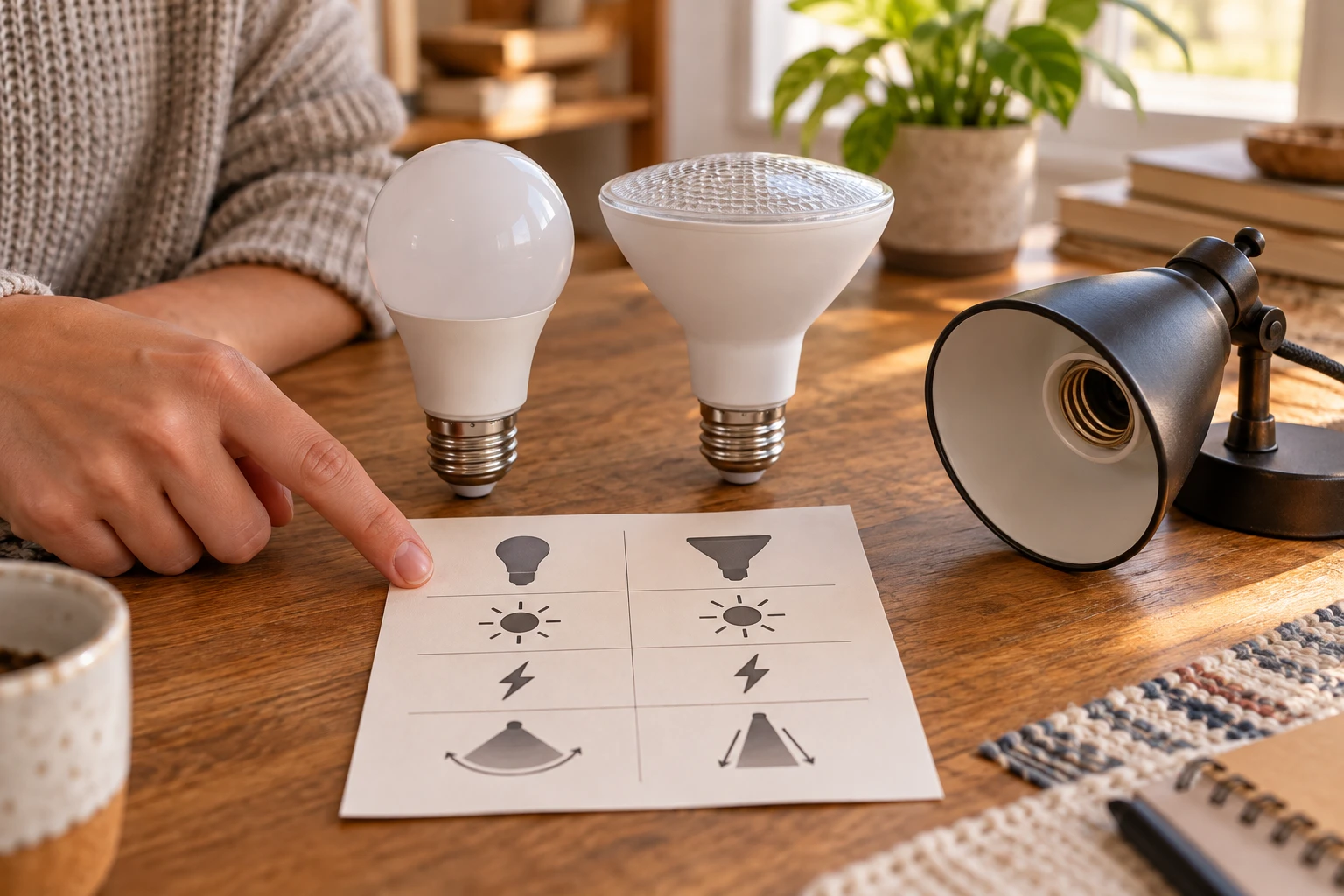
Two LED bulbs can screw into the same socket and still light a room differently. The practical comparison starts with the amount and direction of light, the electricity the bulb uses, and whether its shape works in the fixture. This LED bulb lumens vs watts guide explains those labels without treating a familiar incandescent-equivalent phrase as a complete specification. Read the actual bulb and fixture markings before purchase; a matching base alone does not establish physical fit, dimmer behavior or suitability for a damp location.
The tripod plate fit guide separates a camera-side screw from the head-side clamp; sharing one interface is not proof of the whole assembly. The windowsill herb corner guide starts from a real room and the plants' own care directions, rather than a decorative photo. This article applies that same discipline to light bulbs: identify the intended fixture and light pattern, then use the label values that answer those questions.
Lumens describe output; watts describe input
A lumen rating expresses the bulb's stated visible light output. It helps you compare how much light the source produces, but it does not say that all of it reaches the same part of a room. A watt rating expresses electrical power used while the bulb operates under its rated conditions. It is not a brightness measurement. Two bulbs can have similar lumen numbers and different wattages because their designs and light distribution differ. They may also be different shapes, which changes where the light goes.
The Luxrite A19 listing names an 800-lumen LED bulb with an 8-watt actual power rating, an E26 base and a 3000 K color temperature in its title. It calls the bulb 60-watt equivalent. That equivalent phrase is a shopping comparison to a familiar older bulb category; the LED does not consume 60 watts by virtue of that wording. The listing also calls it dimmable, but the intended dimmer and fixture still need their own compatibility check.
The HYTHU PAR30 listing names 850 lumens and 10 watts in its title, with an E26 base and a short-neck directional shape. Its native description calls out a 40-degree beam and selectable color temperatures from 2700 K to 5000 K. The title says 75-watt equivalent while a structured field in the native description says 65-watt equivalent. Those inconsistent comparison labels should not be silently resolved. Use the current verified lumen and watt specifications, then confirm the exact variant with the seller.
The difference between 800 and 850 stated lumens is much smaller than the difference between a broad A19 bulb and a focused PAR30 beam can feel at a particular surface. The numbers do not make the PAR30 universally brighter in every direction. A beam can place more light on one area and less elsewhere. Consider whether you want general room light, a recessed flood or a defined task area. The fixture's shade or reflector can change the useful pattern again.
Shape and beam explain where the light goes
A19 and PAR30 name bulb shape families, not interchangeable jobs. An A19 shape is commonly used for general household lamps, while a PAR30 shape is built around directional light. Check the actual dimensions, neck length and fixture clearance rather than trusting the family name alone. A short-neck PAR30 may fit one recessed housing and protrude or sit too far back in another. An A19 may be blocked by a narrow trim or shade even though its screw base matches.
The PAR30 listing's 40-degree beam claim tells you the seller intends a comparatively focused spread. Ask how that beam behaves in the exact fixture if you need an even wall wash or broad ambient lighting. A lamp with an opaque shade may hide much of a focused source; an open recessed fixture may make the beam obvious. The lumen number is for the source, not a guarantee of illumination at your desk, counter or floor. Placement and distance matter.
Sketch where you need light. For a reading chair, note the page position and whether the lamp can direct light without glare. For a hallway, note the width of the walking path and whether shadows are acceptable. For a kitchen work surface, note cabinets that could block a ceiling beam. These are layout observations, not promises that one named bulb meets every lighting need. A fixture maker's permitted bulb type and enclosure rating take precedence over a retail description's broad room list.
If an existing bulb produced a pattern you liked, record its shape, stated lumens, beam specification if any, and position in the fixture. Compare those fields with a candidate. Do not choose solely from the old bulb's incandescent-equivalent phrase; two modern LED designs can put similar total light into different parts of a room. The goal is to reproduce or intentionally change the useful light where you stand or work.
Color temperature changes appearance, not the lumen definition
Kelvin on a household bulb label is a color-appearance scale. Lower listed values are generally described as warmer; higher values look cooler or more daylight-like. It does not measure the bulb's heat at a touchable surface and it is not a substitute for a lumen rating. A 3000 K bulb and a selectable 3000 K mode can have a similar stated color category while differing in beam, output, rendering and fixture behavior. Use the values as one part of the room decision.
The A19 listing names 3000 K in its title. The PAR30 listing describes five selectable settings: 2700 K, 3000 K, 3500 K, 4000 K and 5000 K. Confirm how the current variant selects those settings and whether the choice is made before installation or through a control after installation. Do not assume a dimmer changes color temperature unless the product instructions say so. Dimmer level and color selection are different features.
Look at the room's other lights before choosing a setting. A very different color appearance beside existing bulbs can be distracting even when each bulb is usable on its own. If you are replacing one bulb in a multi-bulb fixture, compare the intended color and beam to the remaining bulbs. Do not mix designs where the fixture maker warns against it. A small test in the actual room, with the fixture used normally, can be more useful than a product photo.
Check the fixture before the feature list
Turn off the fixture and let the old bulb cool before reading its markings or removing it, following the fixture maker's instructions. Record the base, allowed bulb shape, maximum power, voltage, physical clearance and whether the bulb will be enclosed or exposed to moisture. Use the fixture's actual label, not a guess from the screw size. An E26 base is only one fit dimension. Do not force a bulb into a tight shade or modify a socket to accommodate it.
Both listings mention E26 bases, but their shapes and environmental claims differ. The PAR30 listing says the bulb is damp rated; that does not automatically authorize any outdoor or wet installation. A covered location, open exposure and a wet fixture can require different ratings. Check the fixture's location and the bulb maker's current instructions for the exact variant. The A19 listing's title does not establish a damp rating from the information used here.
A dimmable claim means the bulb is designed for some dimming arrangements, not every wall dimmer. Check the bulb maker's compatible-dimmer list and the installed control's specifications. Flicker, buzzing, an inability to dim smoothly or failure to switch off can indicate a mismatch. Do not open the electrical box or alter wiring as part of a bulb selection guide. If a fixture or dimmer needs electrical work, use a qualified person as appropriate to the job.
Look for enclosure restrictions too. Heat builds differently in a sealed fixture than in an open lamp, and an LED package may limit where it can be used. Do not infer enclosure suitability from the actual watt figure alone. A lower-wattage LED can still have electronics that require the airflow or temperature range stated by its maker. Check those instructions, especially for recessed housings and small globes.
Read equivalent wattage as a clue, not a verdict
The phrase 60-watt equivalent on the A19 title is meant to help a shopper recognize an approximate familiar category. The actual power figure in that same title is 8 watts. The PAR30 title and structured description disagree over 75 versus 65 watts equivalent, while the stated current bulb is 10 watts and 850 lumens. That conflict illustrates why an equivalent label should not carry the whole decision. It also may compare different older bulb types or variants; ask the seller rather than inventing a reconciliation.
If you are interested in electricity use, compare actual watts under your intended operating pattern. For a rough calculation, multiply the bulb's watt rating by hours used, divide by one thousand for kilowatt-hours, and use your own utility rate for an estimate. This is a calculation method, not a claim about what either listing will save in your home. Dimmer settings, controls and actual operating time can change the result. Keep the brightness and beam requirement in the decision so a lower watt number does not lead to insufficient useful light.
When comparing packages, note the number of bulbs and the current exact variant. The A19 listing says six bulbs; the PAR30 listing says four. A pack count can change a purchase quantity without changing the light from each installed bulb. Do not infer a per-bulb result from a box price or a marketing superlative. Record the unit you are actually replacing and verify that all the bulbs in a multi-bulb fixture meet its specifications.
Make a three-column choice
On a note, write three headings: useful light, power input and fixture fit. Under useful light, list stated lumens, beam direction and color appearance. Under power input, list actual watts. Under fixture fit, list shape, base, dimensions, dimmer, enclosure and moisture requirements. Mark a field unknown if the native listing does not provide it. A bulb with an attractive lumen number remains a pending choice when its physical or electrical suitability is unconfirmed.
For the two examples here, the A19 and PAR30 claims show why those columns matter: 800 versus 850 lumens, 8 versus 10 actual watts, broad-shape versus directional use, and different color options. The PAR30 equivalent-wattage labels conflict, and neither listing alone proves fit in your fixture. Check current maker information and the fixture label before installation. This LED bulb lumens vs watts guide helps you choose the light you need while keeping energy use and mechanical fit in their own places.