Educational & Explainer Articles
Laser distance meter reference points: where a length begins
Understand laser distance meter reference points with paper geometry: front and rear segments, moved starts, mixed references and double counting.
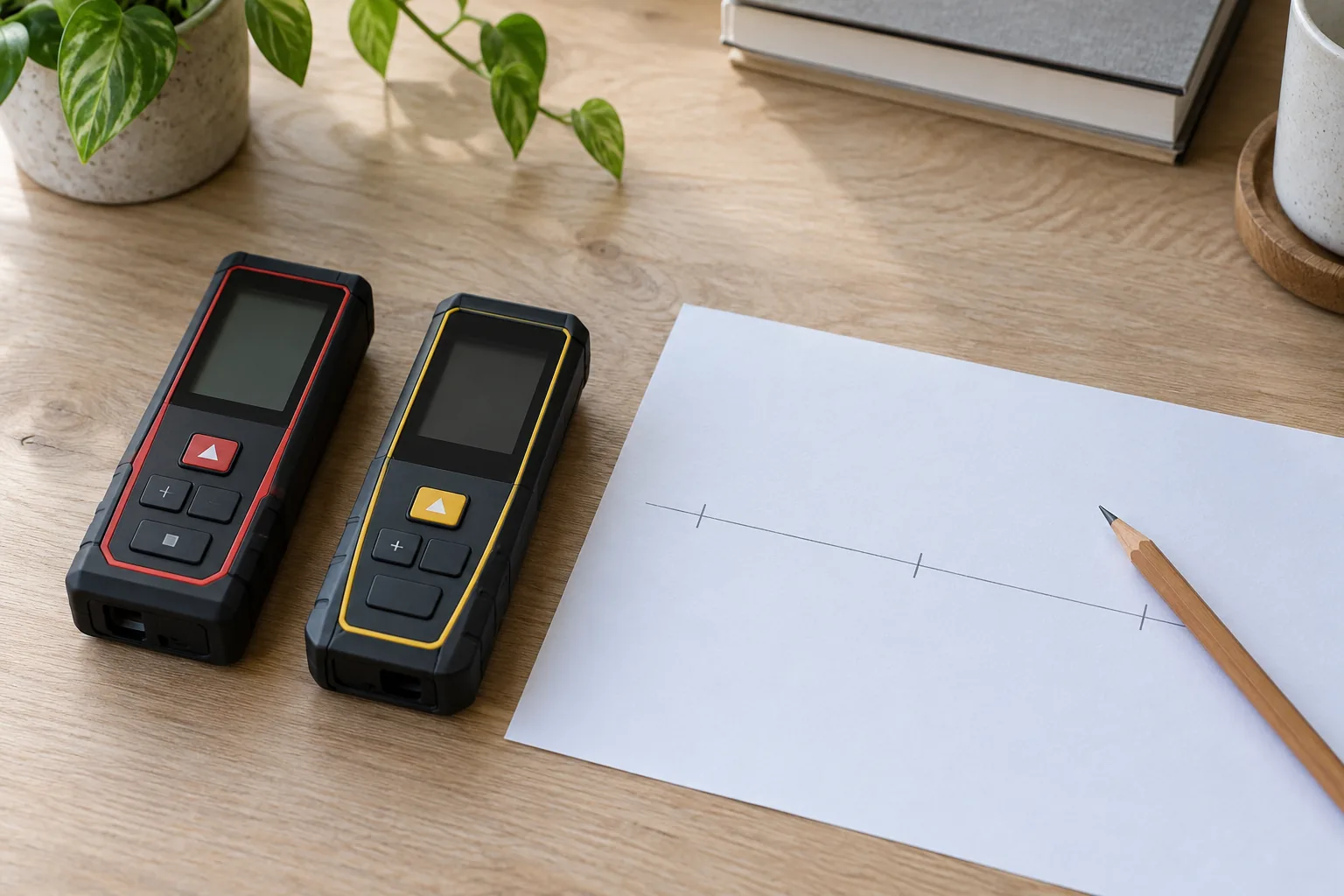
Laser distance meter reference points define where a reported length begins. A target can stay in exactly the same place while a length changes because its starting point moved. A paper drawing makes that distinction visible: mark the back and front of an imagined instrument, then draw a separate segment from each mark to one target. The two segments share an endpoint and have different beginnings.
The REED Instruments R8010 offer identifies the model used for the manufacturer example here. Its manual lists front or rear reference selection, shows separate reference icons, and says the selected reference is not automatically saved when the instrument turns off. The STABILA LD 220 offer is a separate laser-distancer listing. The REED settings described here belong to the R8010; they supply no setting claim for the STABILA.
Front and rear measurement reference on a paper line
For this explanation, front and rear measurement reference means choosing one of two defined starting positions. All points in the following examples lie on one straight line. Coordinates increase toward a target on the right. Every body length and coordinate is invented for arithmetic. The drawing supplies every length; no actual meter readings or accuracy tests are involved.
Put an imagined body's rear at coordinate zero metres and its front at 0.12 metres. Put the target at coordinate 4.00 metres. The body occupies the interval from zero to 0.12. The clear segment ahead of its front extends from 0.12 to 4.00. Naming these positions first prevents the word distance from concealing which endpoints a calculation uses.
The rear-to-target length is 4.00 minus zero, giving 4.00 metres. The front-to-target length is 4.00 minus 0.12, giving 3.88 metres. Subtracting the latter from the former gives 0.12 metres, exactly the fictional body's length. That difference follows from the starting positions supplied in the drawing. It establishes nothing about the length of either actual product.
Both answers are correct for their stated segments. Someone needing the span from coordinate zero to the target needs 4.00 metres. Someone asking about the span ahead of the front needs 3.88 metres. Agreement about the target alone cannot settle which answer describes the requested space. The starting position is part of the quantity being requested.
Move the body and keep the target fixed
Slide the entire fictional body half a metre to the right. Its rear is now at 0.50 metres and its front at 0.62 metres. The target remains at 4.00. The rear-to-target segment becomes 3.50 metres, and the front-to-target segment becomes 3.38 metres. Each segment shortened by half a metre because its beginning moved half a metre toward the unchanged endpoint.
The difference between those two segments remains 0.12 metres. Moving the body changed its position without changing the distance between its ends. This separates two effects that can otherwise become muddled: translation changes both target distances by the same amount; switching between the body's ends changes which of those distances is being named.
The full span from coordinate zero to 4.00 still exists in the drawing. It now consists of a 0.50-metre gap before the rear, the 0.12-metre body interval, and the 3.38-metre interval ahead of the front. Adding them gives 4.00 metres. The rear-to-target figure of 3.50 omits the initial gap because that gap lies behind its defined starting point.
This partition also explains why the body's rear cannot automatically mean the beginning of a room or drawing. In the first example those positions coincided by assumption. In the second they differ by half a metre. A label such as rear-to-target describes a relationship to the body; a separate statement is needed to locate that body relative to another boundary.
Compare two hypothetical body lengths
Return the rear to zero and the target to 4.00 metres. Replace the fictional body with a shorter one, 0.08 metres long. Its front is at 0.08, so its front-to-target segment is 3.92 metres. Its rear-to-target segment remains 4.00. The change in body length affected only the starting position associated with the front.
The first body's front segment was 3.88 metres; the second body's is 3.92. Their difference is 0.04 metres. Each result follows correctly from its own drawing. Calling that difference an instrument error would assume that both numbers were meant to describe identical endpoints. Here, one starting point is four centimetres farther along the line than the other.
For a direct comparison between the fictional bodies, use segments with matching endpoints. Their rear-to-target spans match because both rears occupy zero. Their front-to-target spans differ because the fronts occupy different positions. This remains a paper comparison: the invented 0.12 and 0.08 metres are not dimensions of the REED or STABILA, and the arithmetic supplies no performance ranking.
Laser distance meter length calculation with two targets
A laser distance meter length calculation can also involve the difference between distances to two targets. Keep the first fictional body's rear at zero and front at 0.12 metres. Put one target at 4.00 and another at 5.00. The target-to-target interval is one metre, regardless of which body endpoint is used to describe both target distances.
Using the rear consistently gives 5.00 minus 4.00, or 1.00 metre. Using the front consistently gives 4.88 minus 3.88, also 1.00 metre. The common starting coordinate cancels in the subtraction. In words, both distances include the same extra portion at their beginning, so subtracting one from the other removes that shared portion.
Mixing the definitions changes the result. Subtract the nearer target's rear-based 4.00 from the farther target's front-based 4.88 and the answer is 0.88 metres. Reverse the mixture, using 5.00 minus 3.88, and the answer is 1.12 metres. Each subtraction is arithmetically valid, but neither is the one-metre target interval defined in this drawing.
The two mixed results differ from the desired interval by the fictional body's 0.12-metre length, with opposite signs. The mismatch comes from combining segments whose starting positions differ. A repeated pair of numbers could therefore reproduce the same mismatch perfectly. Repetition of arithmetic cannot repair an inconsistent definition of the inputs.
There is a further condition in the cancellation: the common starting point must actually be common. Suppose the rear is at zero for the target at 4.00, then at 0.50 for the target at 5.00. The rear-based distances are 4.00 and 4.50. Their difference is 0.50 metres. Although both use the rear label, moving that rear changed its coordinate between the two drawings.
In algebra, let T be a target coordinate and S the starting coordinate. A forward segment's length here is T minus S. Comparing two such lengths gives the difference between target coordinates only when S is unchanged. If the starts differ, the subtraction also includes their change. This compact statement covers both the mixed-reference and moved-body examples without requiring any claim about an instrument's internal calculation.
Recover a target coordinate from a defined segment
The same relationship can be read backward. In the moved-body drawing, the front is at 0.62 metres and its segment to the target is 3.38 metres. Adding the starting coordinate and segment length gives 4.00 metres, the target coordinate. The start supplies information that the segment length alone lacks. A length of 3.38 could end at many coordinates if its beginning were unspecified.
For example, place a new imaginary start at 1.00 metre while retaining that 3.38-metre forward segment. Its endpoint would be at 4.38 metres. The segment has the same length as before, but occupies a different part of the line. This is why a distance along a line and a coordinate on that line cannot be substituted for each other, even when they use the same unit.
The coordinate zero itself is also a choice in this exercise. Relabel the first drawing by adding ten metres to every coordinate: the rear becomes 10.00, the front 10.12 and the target 14.00. Subtracting endpoints still gives a four-metre rear segment and a 3.88-metre front segment. Relabelling the entire line moved no point relative to another point.
That differs from sliding only the body in the earlier example. There, the target kept its coordinate while the body's coordinates changed, so the segments shortened. Here every coordinate changed together and all segment lengths stayed the same. The comparison distinguishes a change in the coordinate labels from a change in the relative positions represented by those labels.
Change units while preserving the endpoints
The first front-to-target segment, 3.88 metres, can be written as 388 centimetres. The fictional 0.12-metre body interval can be written as 12 centimetres or 120 millimetres. These expressions change numerical scale while preserving the same segments. A hundred centimetres make one metre, so multiplying a metre value by a hundred expresses it in centimetres.
Unit conversion cannot remove the endpoint difference. Written in centimetres, the first rear segment is 400 and the front segment is 388; the difference is still the body's 12 centimetres. Subtracting the unconverted figures 4.00 and 388 would combine different units. Putting both quantities into one unit allows the intended subtraction, while identifying their endpoints explains what its result means.
The guide to tape measure numbers, units and accuracy separates an instrument's stated length from other numbers attached to it. That distinction applies here when reading a catalogue range beside a worked segment. A range specification and a segment from a chosen start to a particular target answer different questions; neither label can stand in for the other.
Keep a body interval from being counted twice
Return to the first drawing, where the rear-to-target segment is already 4.00 metres. Adding the fictional body's 0.12 metres again produces 4.12. The drawing has no rear-to-target span of that length. The body interval was already included between zero and 4.00. Adding it a second time extends the calculation beyond the quantity that was defined.
By comparison, adding the body interval to the front segment gives 3.88 plus 0.12, or 4.00 metres. This works in the drawing because those two adjacent segments exactly partition the rear-to-target span. Each addition begins with a different defined quantity. Their arithmetic explains the double-counting risk; it does not instruct anyone to add a housing dimension to an actual meter display.
The anemometer airflow units explainer uses another defined-quantity problem: air speed and volume flow describe different things. Here the difference is between two lengths with different beginnings. In each case, a calculation becomes interpretable once the inputs say which physical quantity they represent. Similar digits alone do not establish interchangeable inputs.
For the fictional line, a useful answer names its starting coordinate, target coordinate and unit. “3.88 metres from the front at 0.12 to the target at 4.00” identifies the segment completely. The shorter note “3.88 metres” loses its beginning. Keeping the endpoint definition beside the value preserves the reason it differs from the equally valid four-metre rear-to-target span.