Kitchen & Appliances
Reading knife blade features on the face and edge
Read knife blade features by locating face hollows and edge scallops in offer photographs before drafting a product question.
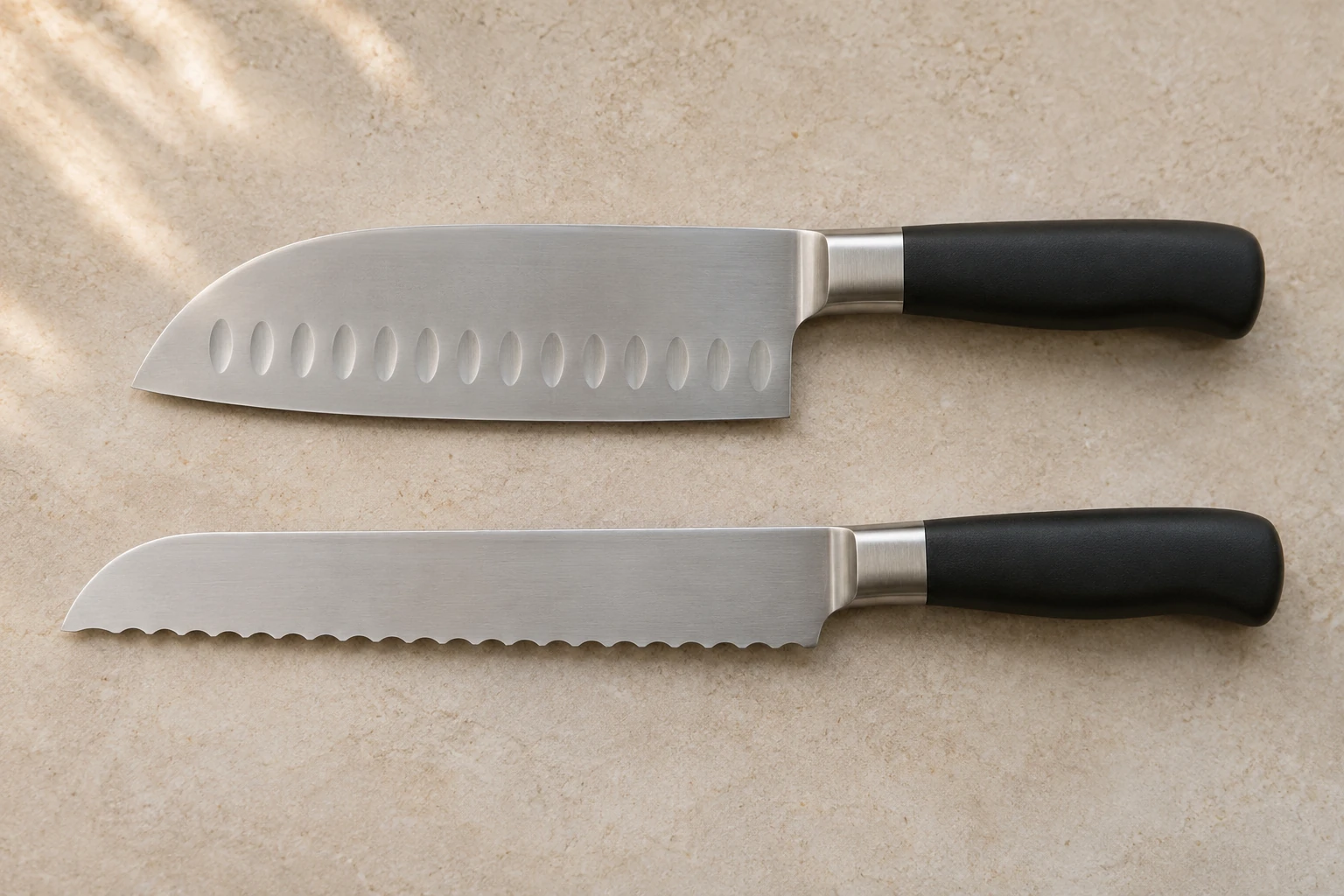
Read knife blade features by asking where a mark appears before deciding what its name means. A word in a product title can leave the particular area you are looking at unclear. This explanation separates blade face hollows from serrated cutting edges as a question about the shown location. It uses two actual offer views, without providing a cutting method, sharpening procedure or performance comparison.
Begin with a photograph that belongs to the exact offer you are reading. Keep the title beside that view while you identify the feature under discussion. If a description leaves the location unclear, make that the question you carry forward. You can finish understanding a photograph while still needing an answer about the delivered item or its applicable instructions.
Conceptual illustration of face marks and an edge outline on generic knives. It does not identify either retail model or demonstrate cutting.
Place the term before interpreting it
Here, the face means the broad visible area of the blade. The edge outline means the boundary being examined in the photograph. Oval marks inside that area and repeated scallops along that boundary occupy different locations. These descriptive terms do not specify a steel, grind angle or cutting result.
Ask two questions separately when reading an unfamiliar description. Which area does the word refer to? What does the seller actually say about that area? The first question locates the subject of the sentence. The second identifies the statement being made about it. An answer to one can leave the other open. Keep the unanswered part in your enquiry instead of completing it from an attractive picture.
Read the face in the selected santoku view
The ZWILLING Professional S hollow-edge santoku offer names a seven-inch knife. Its single gallery image shows oval hollows on the broad face and a continuous-looking cutting outline. Native metadata identifies model 31120-183, while the pictured blade marking reads 31120-180. Keep those references distinct when identifying the supplied variant. Its own description makes steel, hardness and edge-angle claims, which are not authenticated here. The image provides the visible feature-location example, without proving a cutting benefit or the identity of a delivered unit.
The pictured row of ovals stays within the broad face. A reader can point to that row when asking what the title means by hollow edge. The purpose of pointing is to identify the subject of the question. It does not settle a performance claim. If the response instead discusses a different model or another photograph, ask whether it addresses the same view before treating the question as answered.
Read the cutting boundary in the bread-knife view
The second blonde bread-knife offer titled Shun Premier TDM0705W retains Unbranded in its native brand field. Its description repeats the title. Two gallery images show a complete knife and a close-up of a scalloped cutting outline, with hammered-looking texture higher on the face. Two other gallery assets are blank white despite unrelated filenames. Those filenames establish no supplied radio. The photographs do not authenticate the maker, steel or delivered condition. The visible cutting outline supplies this example; the written title supplies a separate identity to confirm.
Here the lower outline has repeated scallops. That observation concerns the boundary shown in the close-up. Keep a question about the upper texture separate from a question about that outline. Someone answering one may have no reason to mention the other. A reply becomes easier to assess when the original enquiry names the area it meant, rather than using one vague word for everything visible on the blade.
Keep the descriptive word attached to its subject
Words such as patterned, textured or hollow can appear in a short conversation without identifying a location. Before substituting a more technical term, decide what the speaker was trying to point out. You might discover that two people were discussing different areas of the same image. Resolve that difference first. Giving the conversation a more specialised vocabulary would leave the original ambiguity in place if each person still meant a different feature.
A useful description can be brief. Identify the photograph, name the area and state the question. Leave out a claimed advantage unless that advantage is itself the information you are asking the responsible source to establish. This keeps the enquiry manageable for the person receiving it. It also gives you a way to recognise whether a later response addresses the question, even when the response uses different wording.
Avoid replacing the original wording of a title in your own notes. You can quote the term you are trying to understand and then describe the place you mean in ordinary language. That preserves the question without claiming you have resolved the terminology. If the responsible source explains a different use of the word, retain that explanation with the exact offer and view to which it applies.
Work through an explicitly fictional enquiry
Imagine that Amira is preparing a question for a retailer about a photograph. This is an invented communication example, with no actual order or seller reply. Her first draft says, “Are those marks what the title means?” The recipient would have to guess which photograph she was viewing and which marks she meant. Amira can improve the question before asking anyone to interpret an unfamiliar label.
In the example, Amira revises her question to identify the selected offer and the specific image. She then writes, “I mean the oval marks within the broad face in the first view.” That sentence identifies the intended location. She follows it with a separate question about how the title describes that area. The enquiry now makes its subject visible without claiming that a certain cutting result follows from the answer.
For the other view, an equivalent question can identify “the repeated scallops along the lower outline in the close-up.” Amira would send that wording only with the view she actually meant. A statement about the other image would not answer it. The two enquiries can remain separate, even if she originally opened both offers while trying to understand the same unfamiliar phrase. Each asks for clarification of its own pictured subject.
Suppose the fictional recipient replies by asking which image Amira means. That is a request for clarification, rather than an answer to her original feature question. She can provide the requested reference and leave the feature question open. In this example, nobody has confirmed an order, inspected a delivered knife or demonstrated a cutting result. The exchange illustrates how to repair an unclear question while keeping those other matters outside it.
Read the answer at the level it actually addresses
A response can identify an area without explaining a claimed benefit. It can explain a term without confirming the selected retail variant. Read the response against the question that prompted it. If you asked about the location of a pictured detail, an answer about location is useful on that basis. A different unresolved question can be asked separately instead of being treated as settled by the same sentence.
When a response includes a diagram or another image, check which offer and view it identifies. A helpful illustration may answer the descriptive question while leaving the pictured model reference uncertain. Keep that uncertainty explicit. You do not need to decide that either reference is wrong merely because the explanation uses a different example. You need to know which question the example answers and what still needs confirmation for the selected item.
The same discipline applies if another person helps with the enquiry. Give them the exact question and view, rather than an isolated phrase from a title. Ask them to distinguish the response they received from their own interpretation of it. That makes it easier to continue the discussion if a later question arises. It also avoids turning a second person’s summary into a claim that the responsible source never made.
Keep other blade questions with their own guides
The scissors blade-feature guide discusses named working ends and their documented applications. Its serrated, curved-tip and patterned-cut examples address tool and material tasks. Those applications do not become facts about either knife here. This explanation concerns where a pictured feature is located, without choosing a cutting tool for a particular project.
The stiff versus flexible putty-knife guide distinguishes an intended blade designation from a suspected fault and considers the relevant preparation material. That diagnosis belongs to its own equipment and job. A visual distinction between a face and an outline supplies no stiffness test, repair method or permission to alter either kitchen knife.
Before sending an enquiry, read the draft once without looking at the photograph. Ask whether the recipient could connect your words to the intended view if several attachments arrived together. Give the attachment an ordinary identifying name and use that same name in the question. This is a communication choice for your message, without creating a new model designation. Keep the offer reference separate so the recipient can distinguish the item being discussed from the attachment you chose to illustrate the question.
Finish with the question you can now identify
Return to the photograph and your original point of confusion. You should be able to name the view, identify the area you meant and say which part of the description remains unclear. That is a concrete result even if you postpone a purchase. Keep any later suitability, care or ordering question attached to the exact item. A descriptive answer can resolve a descriptive question without supplying those separate instructions.
If you consider purchasing through republeq.com, decide which exact offer and variant you intend to order before reviewing payment choices. This explanation establishes no current payment availability. If cryptocurrency or USDT appears in the actual checkout, read the instructions for that particular order and confirm the required asset, network, amount and receiving destination with the responsible service before authorising a transfer. A photograph of a product supplies none of those transaction details. Keep the confirmed basket, delivery destination and applicable terms available while you review the payment information. Ask how cancellation, returns and any refund would be handled for the proposed payment method. Do not infer those conditions from a previous purchase. If another person is placing the order, confirm which item and quantity they are submitting, and distinguish an alternative you discussed from an additional item you approved. Retain the order confirmation and actual payment result together. If the result is uncertain, reconcile it through the responsible service before considering another transfer. An unanswered product question does not show that a transaction failed, and a payment acknowledgement does not answer a question about the supplied item. Keep private wallet credentials and recovery information outside shared purchase notes. If support requests further information, identify the order and the specific unresolved point without supplying unrelated private material. Read any response against the actual transaction record before deciding what to do next. Preserve the response with the question it answers so a later enquiry can begin from the same confirmed facts. If instructions arrive across several messages, ask the responsible service which version applies to the order before replacing previously confirmed details with a later message.