Kitchen & Appliances
Kitchen composter running costs: estimate use before buying
Track eligible kitchen scraps and cycle frequency, then compare documented electricity and filter upkeep for two countertop units.
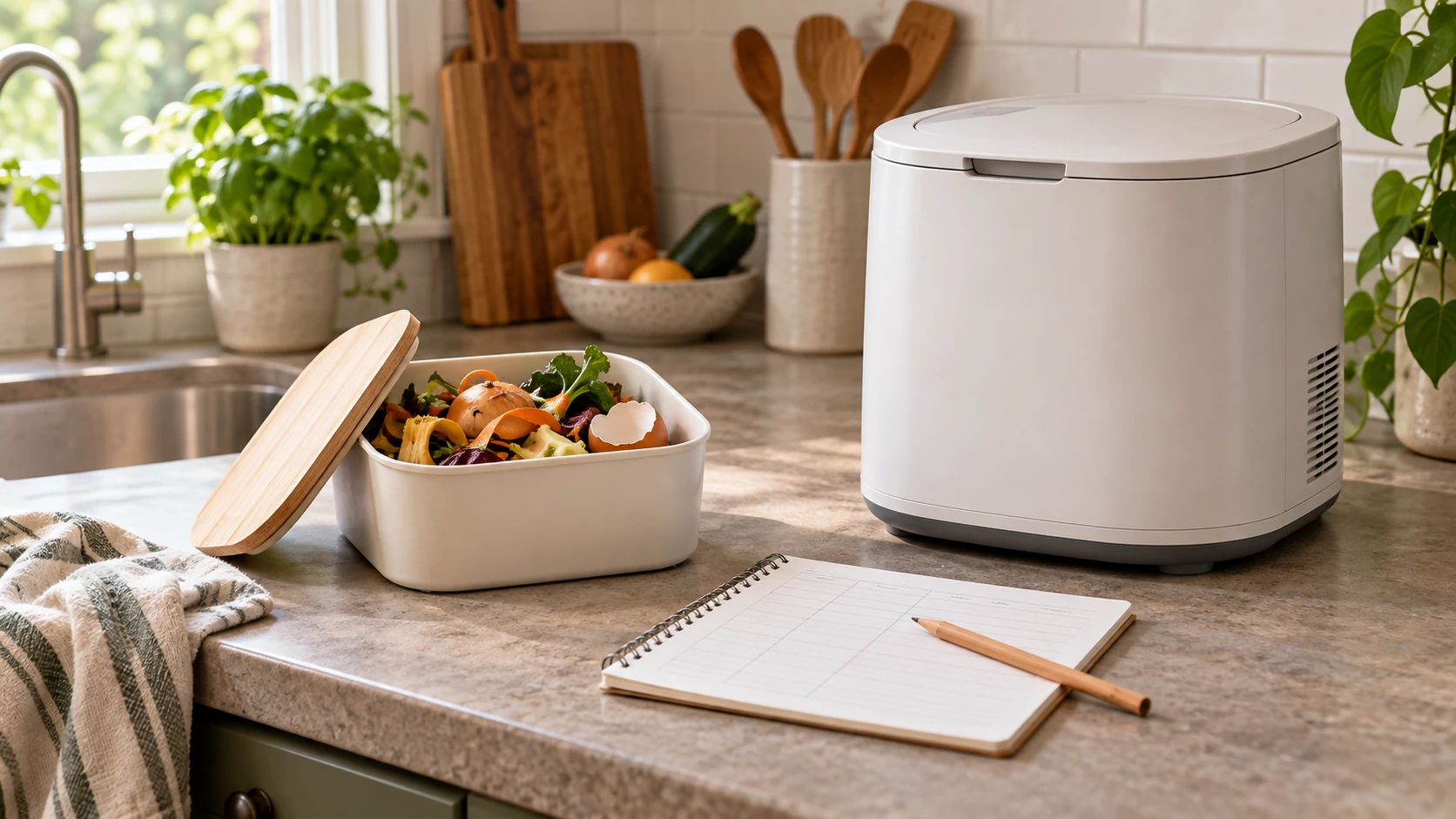
Kitchen composter running costs begin with how often you would actually use a countertop food-waste unit. A capacity label alone cannot tell you the monthly electricity use, filter spending, or work involved in emptying and cleaning it. Record a normal week of kitchen scraps before comparing machines. Note when the collection container fills, what goes into it under the maker's directions, and whether you would run a cycle immediately or wait for a larger batch. That small log gives you a realistic number of cycles to investigate instead of assuming daily use because a product page describes a daily routine.
Two current listings provide a concrete comparison. The KissAir CY03B 4L white countertop unit describes a removable bucket, grinding blades, and activated-carbon odor boxes. The Culinary Chef 3.8L stainless unit describes a smaller stated volume and dual activated-carbon filters. These are product-page claims for exact offers. Neither page, by itself, supplies a verified cost for your household. Use the named components and capacities to build a list of questions for the current seller or manual.
Measure the input before sizing the machine
Keep scraps in the ordinary container you already use and observe it for one week. Count how many times it fills, not merely how many meals you cook. A household that prepares vegetables in one large session may produce a different pattern from one that generates small amounts after each meal. Record days with no scraps too. Those quiet days matter when you estimate whether a powered unit would sit idle, run partly filled, or require another collection method between cycles.
Do not assume everything in a kitchen collection container belongs in either unit. Check the exact maker instructions for accepted and excluded inputs. The listings use broad terms such as food scraps, but they do not settle every material question for a particular household. For a useful trial, sort the material you can confirm is allowed from what must go elsewhere. The allowed portion is the input to compare against a 4L or 3.8L chamber; the rest still needs its own disposal or composting plan.
Use a container with a marked volume if you want a rough capacity comparison. Fill it as you normally would rather than packing material unnaturally. Record how much accumulates between times you are willing to run a machine. This does not prove the precise usable fill line of either product. A stated capacity may describe the bucket, while operating instructions can set a lower practical limit for a load. Verify the actual fill guidance on the current model before turning the observation into a purchase decision.
The difference between 4L and 3.8L is modest on the page, so it should not carry the whole decision. Counter space, access to the bucket, the hours when a cycle would run, and the work of cleaning may matter more to you. Sketch the place where the unit would sit and check the clearance needed to open the lid and remove its container. Product images show the broad form; exact dimensions and ventilation instructions belong to the model documentation. Do not size a kitchen shelf by scaling a marketing image.
Turn cycle frequency into an electricity question
Write a low, typical, and busy-week estimate for how many cycles you would run. Keep these as scenarios, not promises. The KissAir listing describes a three-to-five-hour process, while the Culinary Chef page describes a four-to-six-hour process that can adjust with load. Those are seller descriptions, not independently measured energy use. Time alone does not reveal electricity consumption: a unit's power draw can vary during a cycle, and actual loads can differ from the examples behind a listing.
To estimate electricity spending, obtain a model-specific energy figure in kilowatt-hours per cycle or measure one safely with an appropriate meter after purchase. Multiply that figure by the number of cycles you expect, then by your utility rate per kilowatt-hour. Keep the inputs separate in your notes. If the maker does not provide a usable energy figure, mark the estimate unknown rather than converting hours into energy with an invented constant. This keeps a cost worksheet honest even when one offer has more marketing detail than the other.
Ask how cycle settings affect that figure. A drying, grinding, or cleaning mode may use electricity differently. You may also run a unit less often than expected once you learn how long preparation and cleaning take. Try two scenarios in the worksheet: the frequency you hope to use and a lower frequency based on your actual schedule. The second scenario can reveal whether buying a powered unit makes sense for your habits at all. It does not label either machine inefficient; it tests the routine you would bring to it.
Do not compare these two units by the claimed processing time alone. A shorter listed cycle is not proof of lower electricity use, and an automatically adjusted cycle is not proof of savings for every load. Look for maker-supplied consumption data under a comparable test or measure each exact unit under similar conditions if you already own them. Until then, treat cycle duration as a scheduling detail. It tells you when the bucket may be available again, while the energy figure answers a different question.
Account for filters and cleaning parts
The KissAir page identifies two activated-carbon boxes for odor control. The Culinary Chef page describes dual activated-carbon filters. This tells you that filters are part of the described setup, but it does not establish how often your household will replace them or what replacements will cost. Ask whether the exact current offer includes initial filters, whether compatible replacements are available, and what the maker specifies for replacement or cleaning. Keep the replacement interval and replacement-part expense as separate entries in your worksheet.
Check the removable parts as carefully as the filter plan. The KissAir listing says its bucket and blades are dishwasher-safe. The Culinary Chef listing depicts a bucket and filters, but confirm its cleaning directions for the exact model before assuming the same dishwasher treatment. A feature that saves effort for one household may matter less to another with limited dishwasher space or a preferred hand-washing routine. Time spent cleaning is part of the ownership decision even when you choose not to convert that time into a monetary number.
Keep seller claims at their proper scale. The KissAir page says it can reduce waste volume substantially, and both pages describe fast processing. Those statements do not prove the resulting material is mature garden compost or that a household will cut waste-service charges. If the intended output matters to your garden, read the exact maker instructions and local gardening guidance. A countertop processor may serve a different role from the outdoor storage and placement decision in the published fall garden cleanup compost-bin guide.
Separate purchase questions from use questions
Make two columns. In the first, record what must be true before purchase: acceptable inputs, dimensions, electrical requirements, included filters, replacement-part availability, cleaning instructions, and the exact warranty. In the second, record what you can only learn from your own routine: weekly eligible scraps, expected cycles, convenient operating hours, and willingness to empty and wash the bucket. This split prevents a long product-feature list from hiding an unanswered household question.
A brand name or volume figure is not a substitute for an exact model check. The KissAir listing names CY03B and a 4L white unit. The Culinary Chef listing names a 3.8L stainless unit. Save the current model identifier and selected variant if you compare manuals or replacement filters later. Different variants can change what comes in the box, so do not transfer a filter count, dimension, or operating claim from a similar-looking offer without checking the exact listing.
Consider whether another kitchen task is being mixed into the decision. A food-waste processor is for a different purpose from a preparation appliance. The published food-processor disc and bowl storage guide concerns meal-preparation accessories and storage. It can help when allocating cabinet space for kitchen equipment, but it does not establish how a food-waste unit handles scraps. Give the intended processor its own footprint and maintenance line in the plan rather than counting every appliance with a bowl as interchangeable.
Before using a cost comparison, decide what outcome you want. Some households may value having less material in a kitchen collection bin; others may be looking for a garden input or a particular disposal routine. Those goals call for different evidence. This article cannot promise a reduction in a trash bill, a measured environmental benefit, or a particular compost quality from the captured listings. Write your goal at the top of the worksheet and reject any claimed saving that does not actually follow from your household's waste service or garden use.
Build a cautious running-cost worksheet
For each exact model, list expected cycles per month, measured or documented energy per cycle, your utility rate, maker-specified filter replacement interval, replacement-part expense, and any cleaning supplies the instructions require. Leave unknown fields blank. If a figure is available only for one model, do not fill the other with it. You can still compare what is known, identify the largest missing input, and decide whether to ask a seller or wait for better documentation.
Run the worksheet again for a busier and a quieter month. If the result changes sharply with cycle frequency, the week-long scrap log deserves more attention than a small difference in stated chamber volume. If filter availability dominates uncertainty, confirm parts before focusing on electricity. A worksheet is useful when it points you toward the next fact to verify. It should not manufacture a precise total from guessed replacement intervals, imagined power draw, or a marketing statement about cycle length.
Keep the final comparison short enough to use: exact model, eligible scraps per week, likely cycles, physical fit, cleaning burden, documented electricity input, and filter plan. Revisit the current product pages and manuals before buying because availability and included parts can change. Put a date beside each fact you verified so an old screenshot does not silently become a current parts promise. If more than one person will use the machine, ask them whether the emptying and cleaning schedule is realistic. The right conclusion may be one of the two units, a different size, or no powered unit for the present routine. That decision follows the kitchen work you observed and the costs you can substantiate, rather than a promised saving from an unmeasured machine.