Headphones & Earbuds
kids speaker headband: how it differs from over-ear headphones
See where each listening device holds its speakers and how a soft fabric band differs from over-ear cups. Use the exact listing to check what is included.
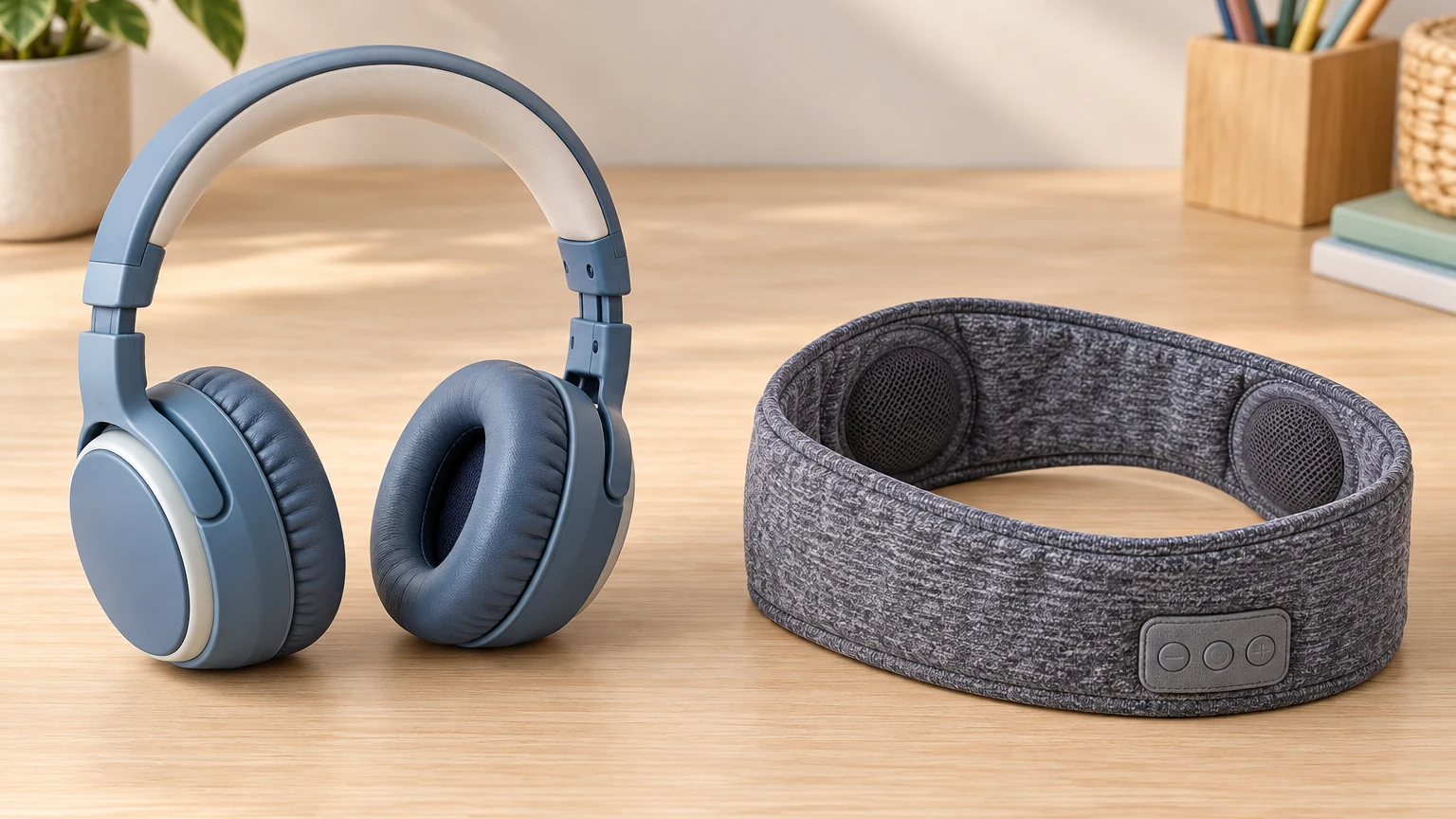
A kids speaker headband and a set of over-ear headphones can both deliver audio, but the part holding the speakers is different. In one design, a soft band crosses the head and places its speakers inside the fabric near the ears. In the other, a rigid frame holds padded cups against or around the ears. Those structures matter before you compare Bluetooth versions, battery claims, or colors: a caregiver needs to understand what the child would actually wear.
The current Minecraft kids over-ear headphones listing describes a foldable headset with padded ear cushions, an adjustable band, Bluetooth playback, a microphone, and an included 3.5 mm cable. Its product photograph shows two substantial cups joined by a firm top band. The listing also makes volume and runtime claims; neither the photograph nor the listing supplies an independent measurement of those claims.
The soft kids speaker headband listing describes Bluetooth and 3.5 mm playback in a flexible fabric band. The native photograph shows a broad orange band with a small control patch and no rigid earcups. Its product name calls it headphones, but the visible construction is closer to a wearable strip holding speakers near the ears. The photograph does not establish where the speaker modules can be repositioned, whether the fabric can be washed, or how it will feel on a particular child's head.
First locate the part that makes sound
Look at a headphone photograph without reading the feature bullets for a moment. In a conventional headset, the speakers sit inside distinct cups. The cups and their padding create a visible boundary around the child's ears. A top band and hinges hold those cups in place. If the cups fold inward, that changes how the object packs away, but it does not turn it into a fabric headband.
In a speaker headband, the band itself carries the audio components. You may see a control panel or a seam rather than an exposed cup. A photo of the whole band is useful for identifying its shape; it is a poor substitute for a diagram of the internal speaker modules. If the listing does not show the modules separately, do not assume that they slide freely, detach, or can be removed before cleaning.
Images can establish more when they show the same item from several angles. A front view shows the width of the fabric across the forehead. A side view can show whether a separate cup protrudes around the ear. A close view of the band might reveal a pocket or seam that holds a speaker. If the seller supplies only one angle, mark the unseen construction as an open question. The name of a feature does not reveal how it is built into the product.
On a rigid headset, inspect how the cup joins the frame and whether the padding is part of the cup or a separate removable piece. On a fabric band, look for the location of the control patch and any opening identified by the maker. Do not pull at a seam or remove electronics on the strength of a photograph. These observations help you ask a precise product question without inventing a maintenance procedure.
This is a construction distinction, not a sound-quality verdict. The two forms may both connect to the same playback device, but the product photographs do not reveal measured volume, frequency response, or how much surrounding sound reaches the wearer. A soft band is not automatically a hearing-protection product, and visible earcups do not prove a particular degree of isolation.
Notice what each structure covers
The rigid headset presents its two sound-bearing cups on the outside of the frame. The soft band covers a wider strip across the head, and its speakers are less obvious from the outside. A caregiver inspecting the object can see cup position immediately; with a fabric band, the product instructions or a diagram may be needed to find the speaker locations. Those visual differences describe construction. The listing offers no independent evidence about comfort, stability, or acoustic isolation.
Notice the edges as well as the center. An earcup has a visible perimeter and padding; a headband has fabric edges and hidden components. A hood, glasses, or seat back may meet those surfaces differently, so the structure raises different questions for the actual setting. The seller photos answer where the visible pieces are. They cannot tell whether either device will be comfortable for a particular child.
The photo of a person wearing a band while resting does not prove that it is safe for sleep. It also does not show whether a speaker could press against the ear in a different position. Treat any proposed resting use as a separate question requiring the maker's instructions and appropriate care, rather than inferring it from a lifestyle image.
Read feature bullets through the physical design
Both current listings mention wireless and wired listening. That shared feature does not make the physical designs equivalent. The rigid headset locates its controls on the frame near a cup; the fabric band shows a control patch sewn into its surface. Read each product page for its own cable, charging method, and included parts. A cable or microphone named for one item is not evidence that the other package contains it.
An adult headphone listening-fit comparison examines connection and wearing questions for two different products. Its details cannot establish the performance of these child-oriented offers. Here the useful first step is to identify which piece holds the speaker, a question the product photographs can answer without a connection test.
The adult on-ear and over-ear comparison considers two conventional cup designs. The speaker headband presents a different structure: fabric can conceal its sound-bearing pieces, while a rigid headset makes its cups visible. A cup-focused comparison therefore leaves open the basic question of where a fabric band places its speakers.
Read care and storage instructions for the exact construction
Fabric invites questions about cleaning; electronics inside the fabric make the answer model-specific. Check the maker's care directions before wiping, washing, soaking, or removing any component. If the listing is silent, that silence is a reason to ask for instructions, not permission to machine-wash the band. For the rigid headset, check its own directions before cleaning padding or folding the hinges. Neither listing's photograph supplies a cleaning procedure.
For storage, identify the part that should not be crushed. A headset has cups, hinges, and a top band. A speaker band has fabric, its embedded components, and a control area. Place each where the child can find it without leaving it under heavy items or stretching a cable. Those are simple handling checks, not claims about durability or the length of a warranty.
Untangle the word “headband” in a product listing
Ordinary over-ear headphones have a headband, too. In that design, the headband is the bridge between the cups. A speaker headband uses the band as the main wearable body, with audio pieces housed in or against the fabric. When a listing says “adjustable headband,” look for the cups before deciding which design it describes. A single shared word is not enough to identify the item.
Check the product title against the whole photograph. A title might emphasize Bluetooth, a character design, or a claimed listening benefit, while the image shows the actual structure more clearly. If the picture shows a large frame and two separate cups, describe it as a cup headset. If it shows a continuous soft strip with a control patch and no cups, describe that physical form as a speaker band. Save the seller's exact product name when ordering, because those plain descriptions are only tools for understanding it.
Then look at what the package information actually lists. A wired mode can mean a detachable cable, a permanently attached lead, or an input on the product; the name alone does not say which. The same caution applies to charging accessories and microphones. A photograph of the device establishes its visible pieces, while an included-items list establishes what the seller says comes in the box. If either source is unclear, keep the question open until the listing or maker answers it.
Use the photographs as evidence with limits
A product image is strong evidence for visible shape and weak evidence for performance. You can see whether a cup exists, whether the band looks continuous, and where a control patch sits. You cannot hear audio through the image, measure its peak level, or know how a hidden speaker presses against a particular ear. Treat the seller's performance bullets as claims to check, especially when the decision depends on a number or a health outcome.
Lifestyle photographs add context, but they can also hide details. Hair, a hood, or the camera angle may cover the edge of a speaker band. A close product shot may omit the cable, charger, or underside. Compare views of the same named item rather than combining features across nearby listings or suggested products. If one photo contradicts another, record the discrepancy and ask which version is being sold. A purchase should be tied to the exact model shown in the cart.
These limits also keep the comparison fair. The rigid headset makes cup position easy to see; the soft band may call for a closer view or maker diagram. Neither has earned a comfort or safety ranking from appearance alone. The useful result is a more precise question for each seller: how are the speakers held, which parts contact the head, and what care steps apply to the construction delivered?
Use a construction-first decision
Before comparing feature labels, answer three questions from the exact item in front of you: Where are its speakers held? What part rests on or around the ears? Which instructions explain use and care? If the seller's page or packaging cannot answer one of them, keep that point open. A product name containing “headphones” cannot settle it by itself.
Write down the answer beside each exact listing. “Two visible cups on a rigid frame” and “speakers held inside a fabric band” are observations a product photograph can support. “Safer,” “more comfortable,” and “better sound” require evidence the photographs do not supply. If the physical form is clear but the maintenance instructions are missing, the remaining task is to obtain those instructions. If the form itself is unclear, request another view before treating a feature list as a substitute.
The rigid headset and soft speaker band are both plausible ways to carry audio for a child, yet they ask for different observations. Recognize the structure first, check the manufacturer's stated contents and instructions next, and make any fit or performance judgment from the actual child and product. That order keeps an attractive photo from doing the work of evidence it cannot provide.