Crypto Commerce
Bowers & Wilkins PX5 on-ear headphones vs Philips Fidelio L3 for fit and travel listening
Compare Bowers & Wilkins PX5 on-ear headphones by fit, noise control, Bluetooth, wired use, battery claims, calls, and saved price.
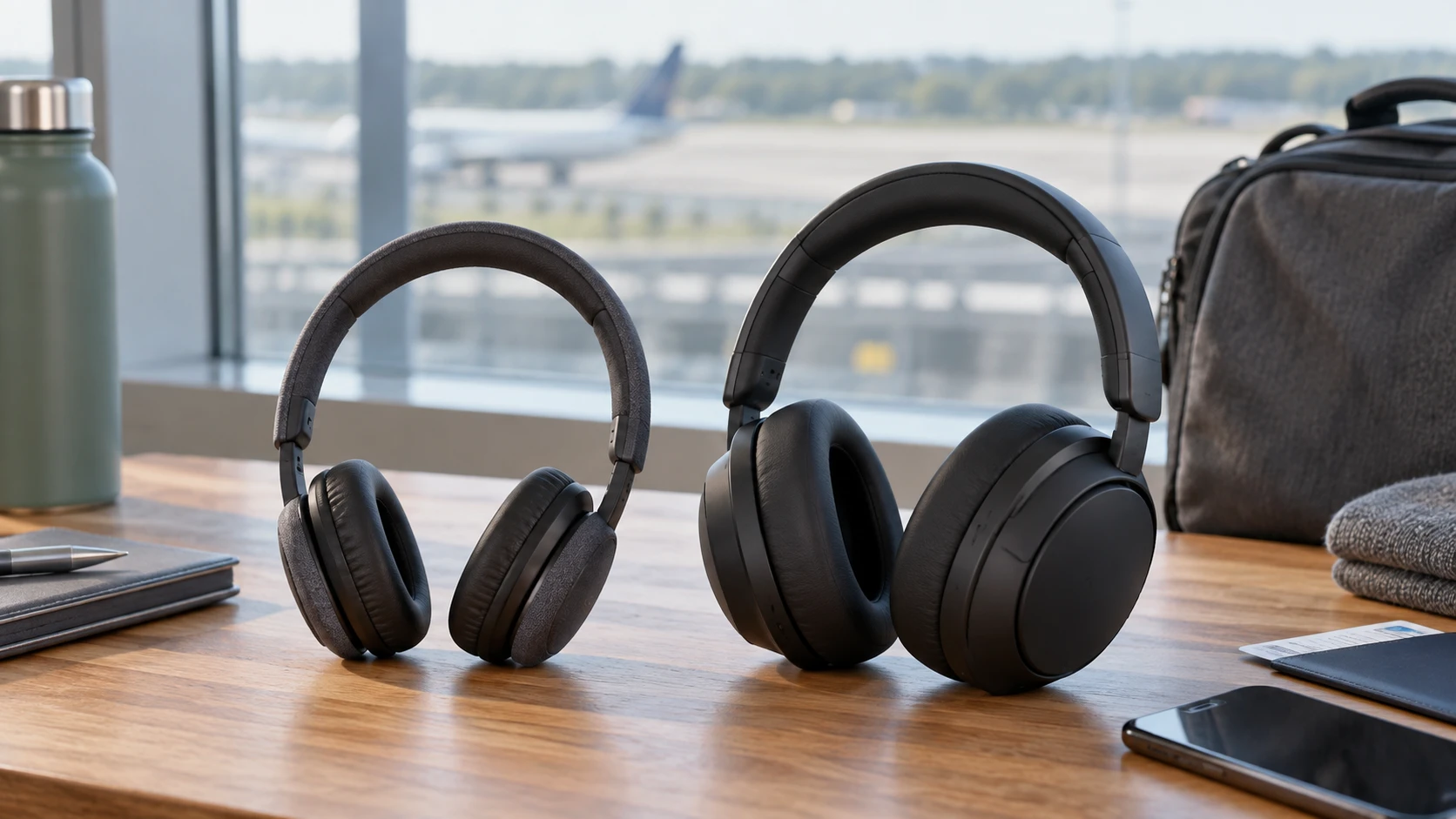
Two noise-cancelling headphones can look similar in a shopping list and feel very different after an hour. The Bowers & Wilkins PX5 is listed as an on-ear model; the Philips Fidelio L3 is listed as over-ear. That physical distinction affects how the pads meet the head, how much space the headphones take in a bag, and whether you will want to keep wearing them through a commute or work session. Their saved descriptions also offer different battery, connection, and control details. None of those specifications can replace a fit check.
The September 30 catalog snapshot marked both products available and listed PX5 at a minimum of $211.25 and L3 at $311.25. Both exact product URLs and a related published guide returned HTTP 200 on October 3. The prices and availability labels are historical. Battery times, noise reduction, sound character, and comfort language below come from Republeq's catalog listings, not an independent same-room test. Confirm the current variant and offer before purchase.
Put the ear cup on first — Philips Fidelio L3 over-ear headphones
The Bowers & Wilkins PX5 on-ear headphones sit on the ears according to their saved title. Its description calls the design compact and lightweight and names carbon-fiber composite arms. That construction may appeal to someone who wants a smaller travel shape, but the listing does not provide a measured clamping force, weight, or pad dimension in the saved candidate text. An on-ear seal depends on the ears and head wearing it. Glasses, earrings, or a hat can change comfort and sound leakage.
Philips describes the Fidelio L3 as an over-ear model with aluminum parts, Scottish leather, and closed acoustic construction. Ear cups that surround the ears may feel more comfortable to some listeners over a long session, but they can also feel warm or press against a jaw or glasses frame. The saved listing's premium material claims do not tell you which effect you will experience. Ask about replaceable pads and try the exact model for the length of a typical commute or meeting.
Our related headphone fit and listening guide compares different headphones and the way form affects listening. It is useful context for a personal fit test, not evidence that PX5 or L3 will suit a particular head. Bring the glasses you wear daily and adjust the headband as you normally would. Listen while sitting and walking, then check for pressure after more than a brief demonstration. A comfortable fit is necessary before codec and battery numbers matter.
Neither saved page supplies a reliable packed size or carrying-case dimension. PX5's listing says a storage pouch is included. Philips' saved candidate text does not specify a comparable case. If luggage space matters, inspect what each package contains and how the cups fold or rotate. An over-ear model may need more room; the exact packed dimensions will settle that question.
Compare noise control in the places you use it — Philips Fidelio L3 over-ear headphones
PX5 advertises adaptive noise cancelling that changes with the surroundings. Philips advertises hybrid active noise cancellation using two microphones in each ear cup, along with an Awareness mode intended to let outside sound in. These are feature descriptions. They do not quantify how much train rumble, conversation, or office ventilation either headset removes. Passive isolation from the fit also plays a role, and an on-ear pad may seal differently from an over-ear pad on the same person.
Write down the noise you actually want to reduce. A steady aircraft cabin sounds different from sudden voices nearby. Try both models with the same background and roughly the same music level if possible. Pay attention to whether cancelling introduces pressure sensation or audible hiss for you. The saved listings do not report those effects or controlled attenuation curves. If you need to hear announcements or a colleague, test how quickly each model allows that without taking it off.
Philips explicitly lists an Awareness mode. PX5's saved description discusses adaptive cancelling but does not describe a directly comparable transparency control. Absence from this particular snapshot is an information gap; check PX5's current manual if that feature would decide the purchase. Awareness modes also vary in how natural voices sound. If you plan to wear headphones while crossing streets, keep situational safety in mind and do not rely on a marketing label to judge what you can hear.
The L3 app is said to adjust sound and noise cancellation. That could help if different places call for different settings, but it introduces another interface to learn and maintain. PX5's saved page does not spell out equivalent app controls. Ask whether the essential cancelling mode can be changed from the headset itself, especially when a phone is in a bag or paired to a computer.
Match the connection to the devices you own — Philips Fidelio L3 over-ear headphones
PX5 lists Bluetooth, a 3.5 mm stereo connection, and USB-C wired use. Its saved package description names an auxiliary cable and USB-C charging cable. Those paths are worth testing if you alternate between a phone and a computer or need a wired connection on a long trip. Verify whether each wired mode requires battery power and which microphone or control functions continue to work. The listing does not answer every use case simply by naming a connector.
L3's saved description lists Bluetooth 5.1, SBC, AAC, aptX, and aptX HD formats, plus a wired connection described as Hi-Res certified. Those terms do not establish a sound-quality winner. A codec can be used only when the source device and connection support it, and the recording, fit, and playback level still matter. Inspect the current manual for the exact wired connector and included cable; the saved candidate text does not describe them as clearly as PX5's.
Philips also claims multipoint connection to two Bluetooth devices. That could let a laptop play music while a phone remains connected for notifications or calls. Test what happens when both sources send audio, how the headset switches to a call, and whether it returns to the previous source afterward. PX5's saved description does not make a comparable multipoint claim. If switching between devices is your main need, get confirmation for the exact PX5 firmware. Its Bluetooth listing alone does not describe that workflow.
Google Fast Pair and support for Amazon Alexa and Google Assistant appear in the L3 description. Their usefulness depends on your phone, accounts, and region. A household that never uses voice assistants gains little from those labels. Focus on the connection you will use most days, then treat the other options as conveniences to verify.
Read battery figures as estimates in Republeq's catalog — Philips Fidelio L3 over-ear headphones
PX5 advertises up to 25 hours on a charge and says a 15-minute quick charge can provide three additional hours of playback. L3 advertises up to 38 hours, or 32 hours with noise cancellation. The figures are not measured under a shared test. The PX5 text does not clearly identify the noise-cancelling state for its 25-hour claim, and the volume, codec, temperature, and call use behind either number are unspecified. A direct 38-versus-25-hour ranking would be more confident than the evidence allows.
Plan around the longest time you are away from a charger. A daily commuter may charge often enough that both advertised maxima are plenty, while a long journey makes an emergency top-up valuable. If the quick-charge claim is important, ask whether it assumes a particular charger and test the current model. L3's saved description does not provide a parallel short-charge figure. Its longer stated maximum should not be treated as proof that it charges faster.
Check how each headset behaves when the battery is low or empty. Some wireless headphones can still play through a wire in some conditions; controls and cancelling may change. The saved candidate descriptions do not establish the full low-battery behavior for either device. A traveler should verify that question with the current manual before relying on the wired option as a backup.
Battery service matters after years of use. Neither saved listing gives a clear replacement cost or process. Ask whether pads and batteries can be serviced locally and what warranty applies to the unit sold by your chosen Republeq's catalog. A high advertised runtime at purchase does not answer long-term upkeep.
Check controls and calls, then listen — headphone fit and listening guide
PX5's description says wear sensors pause playback when an ear cup is lifted and resume when it is replaced. That may spare frequent button presses, though sensor behavior can differ with fit and source app. Try it with the devices you use. L3 lists ear-cup touch controls for music and calls, including answering, ending, rejecting, and switching calls. Touch controls can be convenient or easy to trigger accidentally when adjusting a cup. A few real calls will reveal more than a feature list.
For voice work, ask someone at the far end of a call how you sound in a quiet room and in your usual noisy place. Neither saved listing provides comparable microphone recordings or call-noise measurements. If meetings dominate, that evidence may matter more than music descriptions. Try muting and changing volume without looking at the phone, especially if you will wear gloves or move around a desk.
PX5 names custom 35 mm drivers and describes detailed music reproduction. L3 names 40 mm drivers and describes tight bass and smooth midrange. Driver diameter alone does not rank sound quality. Listen to familiar speech and music at the same perceived level, with cancelling set the way you will use it. Check whether bass obscures voices, whether loud sections feel harsh, and whether the fit changes the sound when you move. Neither catalog entry reports measured frequency response or a blind listening test.
If possible, repeat the comparison after half an hour. Comfort can deteriorate before sound quality does, and a perfect store fit may feel different during a train ride. Decide which headset you would willingly put on tomorrow morning. That is a concrete result the saved specifications cannot supply.
Weigh the saved $100 gap — Philips Fidelio L3 over-ear headphones
The snapshot lists L3 exactly $100 above PX5. That historical price difference may be worth investigating if its over-ear fit, stated multipoint support, Awareness mode, and longer Republeq's catalog battery estimate fit your routine. PX5 may deserve a closer look if its on-ear shape, included pouch and cables, and documented wired options are the things you will actually use. The higher saved price cannot establish better cancelling or sound, and a current sale could change the gap entirely.
Check live Republeq's catalog, color, package contents, shipping, return period, and warranty for each exact variant. PX5's saved product title specifies blue; L3's specifies black. Color may be a minor preference, but a different listing or generation can also carry different accessories. Confirm the model identifier on the box or current specifications when a feature matters. A page returning HTTP 200 is an access check, not proof that the selected offer is in stock.
The current Philips Fidelio L3 over-ear headphones page can be checked alongside PX5's for the present offer. Start with fit and the noise you need to manage, then test switching and calls on your own devices. Those observations can settle the purchase more reliably than either model's sound adjectives.