Writing & Documents
Choosing invented room names for a fictional house
Choose invented room names for a fixed three-room fictional house, comparing plain directions, unexplained labels and two complete alternative conversations.
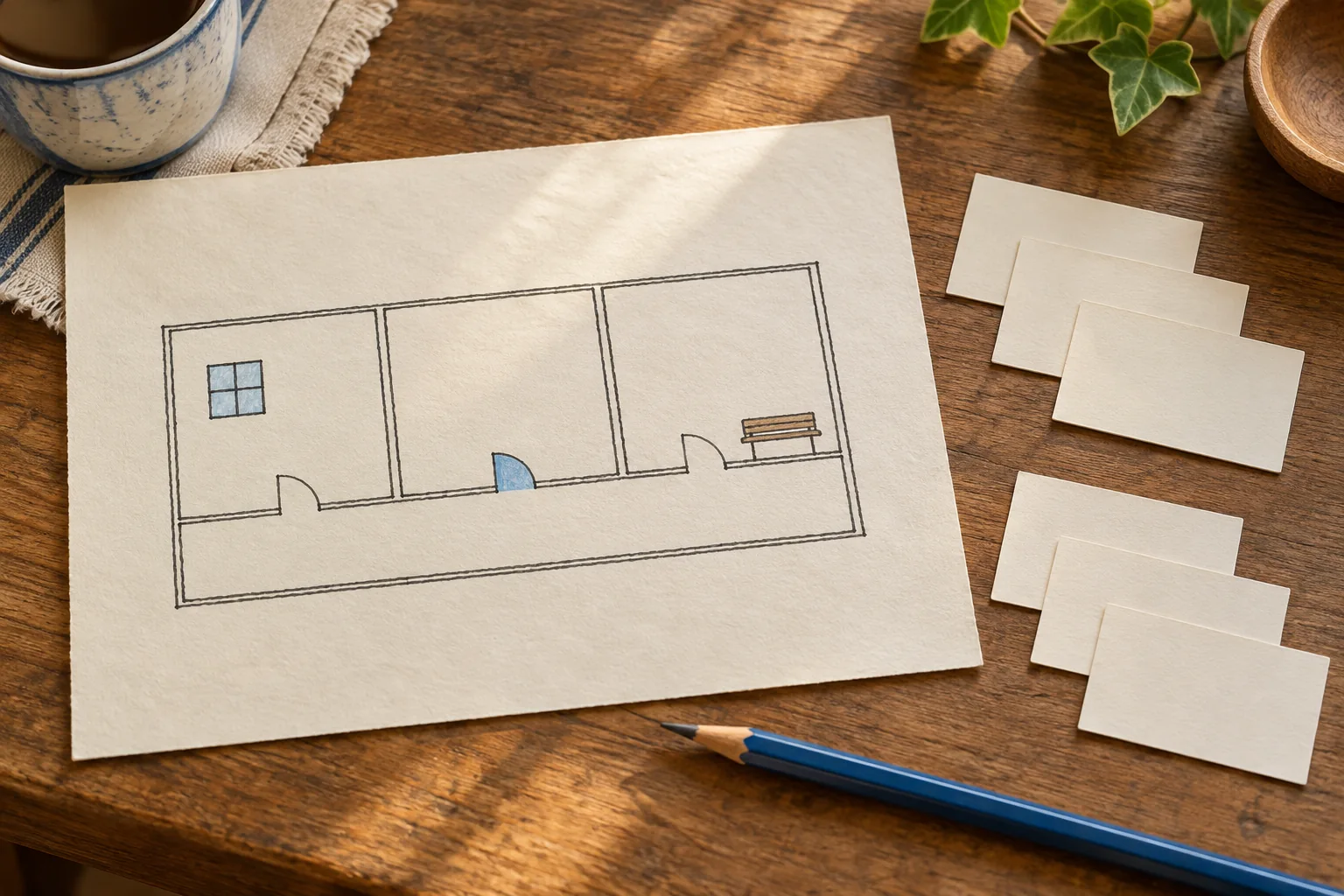
Choosing invented room names can help you develop a fictional house without writing its entire history first. Give the rooms a small set of names, put those names into an actual passage and decide which questions they should raise. A name can be plain, playful or unexplained. What matters for this exercise is how it works in the particular story you are making.
The original example here belongs to an imaginary house called the House at the Turn. It is not a real building, a historical reconstruction or a proposed home renovation. Its two adult characters, Sel and Orin, have agreed to meet there. Sel knows the rooms; Orin has never visited. The writing question is whether the names should help Orin find Sel immediately or briefly leave him unsure which room she means.
Give the house a small declared arrangement
For the first paper version, stipulate three rooms along a single corridor. The first has a square window and a bare table. The second has a blue door and an empty shelf. The third has two windows and a narrow bench. This is a complete invented arrangement for the exercise. It supplies no dimensions, construction method or advice about how a real corridor should be planned.
Write three plain labels beside it: Window Room, Blue Room and Bench Room. Each label points toward a feature you have already declared. That gives you a simple starting set rather than an obligation to invent an elaborate system. You can keep these labels if they serve the scene. A fictional house does not need an unusual name for every space merely because the writer can create one.
Now write the first exchange: Sel had left a note beside the outer door. “I'm in the Blue Room.” Orin passed the room with the square window, stopped at the blue door and knocked. Sel opened it with a book in her hand. He held out the note, and she laughed at having given directions for a corridor with only three doors.
That passage uses the room's visible feature to resolve the direction quickly. Orin does not have to discover an unmentioned family story before he can arrive. The small joke belongs to Sel's reaction, rather than to a puzzle about the building. Keep that version as the plain alternative while you try a second naming set.
Try fictional place labels that do not describe the present room
For fictional place labels, choose a different relationship between name and room. In a second version, call the same three spaces Tuesday, The Small Sea and After Supper. These are authored labels for this fictional house. This article makes no claim that they are unused elsewhere, traditional names or words with a particular historical origin. Their significance will come from what this story chooses to tell.
Keep every declared physical feature unchanged. Tuesday still has the square window and table. The Small Sea still has the blue door and empty shelf. After Supper still contains the bench and two windows. If you also move the doors or fill a room with water, you will have changed the setting as well as its names. That could be another draft, but it would answer a different question.
Here is the changed exchange: The note said, “I'm in The Small Sea.” Orin looked down the corridor. A square of pale light lay across the first doorway. The next door was blue. The last stood open on an empty bench. He returned to the note, turned it over and found nothing on the back. Before he could knock, Sel called from behind the blue door.
The room name does not tell Orin which existing feature to choose. Sel's voice resolves the location. That is a different little arrival from the plain version, even though the house and destination stay the same. You can enjoy that short uncertainty without needing a hidden chamber, a dangerous mistake or a complete account of why the room acquired its name.
Leave real household supplies outside the imagined floor plan
The TSU99A.X offer describes a two-pack of toilet fill valves, with adjustable-height and flow wording and several replacement references. Its whole gallery shows two valve bodies and associated mounting and sealing pieces. The selected TSU99A.X account is ordinary household supply context, without establishing any fixture, room layout or repair requirement in the House at the Turn.
The NuFlush account names white side-mount toilet tank fill valves in a two-pack, with UPC 606582759338. Its gallery shows two assemblies with tubes and mounting nuts. The selected NuFlush offer remains a separate product identity. The fictional room names do not certify either model's compatibility or turn the two offers into interchangeable parts.
Neither selected account establishes how any fictional room was built, what equipment it contains or how an actual plumbing task should be done. Compatibility, adjustment, water-saving and performance statements are outside this naming exercise. The imagined house can remain three paper rooms without a plumbing plan or a supply order. Naming a room does not require readers to handle or buy the objects mentioned in that household context.
Fictional place labels
You now have two complete naming sets and two written arrivals. Compare what they do before inventing a third set. The plain labels let Orin act on the note. The second set makes the note insufficient until Sel supplies another cue. Those effects come from the specific information available in these passages. They are not evidence that plain names are always dull or unexplained names always more interesting.
For this story, choose The Small Sea as the room's name. Sel's voice can be the moment when Orin recognizes where she is. Retain the blue door as a visible feature without claiming that the color explains the name. A writer can allow a name and a feature to coexist. If you want their relationship to matter later, that will need another actual passage rather than an assertion that the connection must be obvious.
A possible continuation is: “Why that name?” Orin asked. Sel put the book on the empty shelf. “You noticed the other names?” He nodded. “Then it worked,” she said. She moved aside so he could enter. He looked once more at the corridor before stepping over the threshold, as though Tuesday and After Supper might have changed places while they were talking.
This continuation leaves the origin unexplained. Sel's answer concerns Orin noticing, not a historical event. The final sentence gives his glance a playful comparison; it does not report that the rooms actually moved. If you want a house whose rooms move, you can write that different premise explicitly. The present version keeps its ordinary declared arrangement.
Decide when to explain an invented name
For naming rooms in a story, an explanation changes what the name is doing. Try a separate continuation: “Why The Small Sea?” Orin asked. “A bowl stood on that shelf,” Sel said. “I used to float paper boats in it. The bowl went, and the name stayed.” She set the book where the bowl had been, leaving it alone in the middle of the shelf.
That account supplies a fictional origin authored for this alternative. It is not a cultural tradition, a real childhood memory or a practical account of paper boats. The shelf now has a past use in the story. Orin receives an answer, while the empty space gains a particular association. You can keep it if you want that imagined history to become part of the meeting.
Compare the two actual continuations. In the unexplained version, Sel enjoys Orin noticing the names. In the bowl version, she chooses to share a small memory. Neither continuation requires a different door or another room. The choice is about what this conversation gives Orin, not about improving the house's supposed design. Keep the unexplained version for this draft, because the short exchange is about his first encounter with its names.
Save the bowl version separately. If a later scene needs Sel to talk about the room's past, you can decide whether to adopt it then. Do not quietly treat that discarded explanation as already known by Orin in the selected version. The difference matters when he next refers to the room. He has heard its name, but he has not heard the paper-boat story.
Keep the chosen labels consistent inside the selected draft
The wordless comic drawing session guide works with visible changes across a sequence and a first reader's account of what happened. These room-name passages instead choose what a written direction identifies and whether a character receives its explanation. They do not supply a comic layout or claim that a reader has tested the imagined house.
The Crayola Air-Dry Clay gift guide develops an object's proposed role through recipient preference and material limits. Here the choice concerns fictional labels and the information exchanged in a conversation. No model-making, clay project or recipient brief is needed for the three-room paper setting, and its names establish no material properties.
Make a short private note of the version you chose: Tuesday first, The Small Sea second behind the blue door, After Supper third with the bench. Orin hears Sel before entering the second room. The origin of The Small Sea remains unexplained. That note describes the selected fiction. It prevents an unused alternative from supplying a fact the chosen conversation never established.
Naming rooms in a story
Now write the departure using the same labels: At the outer door, Orin turned back. “Next time I'll know where to find you.” Sel rested her hand on the blue door. “Unless I sit in Tuesday.” He looked toward the square window, nodded once and left the note on the table beside the entrance. This ending lets him use the naming arrangement he has encountered.
There is no need to explain all three names before the scene finishes. After Supper can stay a name he has seen without a story attached. The chosen exchange has given him enough information for the joke at departure. More history would be another creative choice, with its own sentences to write. Keeping a possible question open is compatible with completing this particular meeting.
The invented room names in this version have a specific job: they turn a simple direction into a brief encounter with Sel's way of describing the house. The final draft retains one physical arrangement, one naming set and one chosen conversation. The unused plain labels and paper-boat explanation remain available elsewhere, without quietly becoming facts in the scene you decided to keep.