Product Compatibility & Accessories
Interchangeable needle cables: identify the join before combining kits
A maker example and four fictional equipment choices separate an existing system, a complete kit and a replacement purchase.
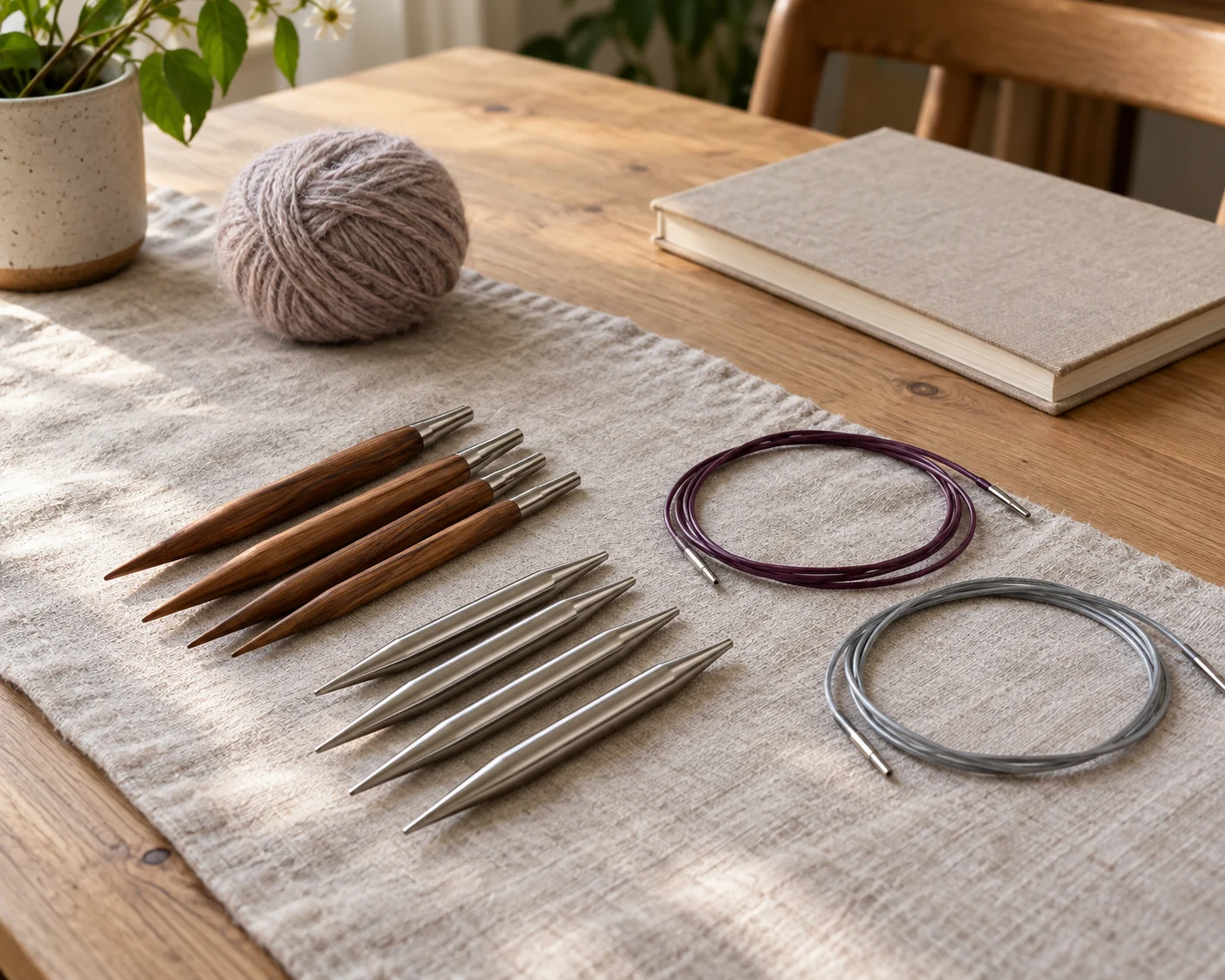
Before combining interchangeable needle cables, identify the connection between each tip and its cord. A knitting-needle diameter alone does not specify that connection. The manufacturer example below makes the distinction concrete, followed by two retail sets whose descriptions do not establish cross-brand fitting. Depending on the equipment you already own, the sensible outcome may be to retain an identified system or select a complete separate kit. Neither choice requires treating an unidentified cable as a compatible replacement.
Needle tip and cable joins have a separate identity
ChiaoGoo's FAQ gives a useful example of needle tip and cable joins. Its standard four- and five-inch Small sets include US 3, 3.25 mm tips. Its two- and three-inch Shorties Mini range also reaches US 3, 3.25 mm. Those styles use different join families despite sharing that needle size. The FAQ also describes directional adapters: Small tips to Mini cables, and Large tips to Small cables. This is information about named ChiaoGoo parts, not permission to join either retail set below to that system.
Consider a fictional knitter, Lena, who owns the two ChiaoGoo tip styles in that example. She has put several components together on a table and initially sorted them by needle diameter. She now changes the sorting decision: the identified Small parts stay together, and the identified Mini parts stay in their separate group. She chooses the matching Small system for the project she intends to continue. For the project she has already started, Lena chooses the equipment she can identify. The shared needle size has simply ceased to be her reason for mixing the two groups.
The same FAQ says ChiaoGoo's five-inch tips are too long to make a comfortable sixteen-inch circular; it identifies shorter tips and an appropriate cable as an alternative in its own range.
Lena had also hoped to make her existing arrangement shorter. In this fictional situation, she postpones that change rather than treating any connection that can be identified as the whole solution to a different project. Her current project remains with the equipment she selected for it. The shorter arrangement becomes a separate choice to make before another project begins. The example ends with that separation of work: one identified arrangement for the present piece, and no substituted part justified by an assumption about another arrangement.
Keep the two retail sets with their actual descriptions
The MOMOJIA wood interchangeable circular needle set describes wood tips and interchangeable connectors. Its photograph presents an open case, assorted tips, cables, thin T-shaped metal pieces, a red heart-shaped piece, cylindrical connectors and red caps. The short description does not give a complete diameter inventory or an external connector specification. The pictured assortment should not be turned into a promise about an unlisted package count. Nor does the wood's appearance establish that another brand's cord will attach. This offer identifies a kit to investigate as its own system, without documenting a mixed-brand assembly.
The Aluhayos steel interchangeable circular needle set describes nine pairs from 2.5 to 5.0 mm and four cables listed at 40, 60, 80 and 100 cm. It also names two cable connectors, two metal tightening keys, one posting tool and a zippered case. Its selected photograph shows a closed pink case, so it does not reveal the shapes of those supplied tools. The words tightening key do not establish an Allen size or a hexagonal interface. Retain those accessories in the package account while leaving their exact shape unresolved. The listed cable lengths also need their own measurement meaning; the description does not establish compatibility with MOMOJIA or ChiaoGoo parts.
For a separate fictional shopping decision, imagine Arun wants another complete kit, rather than a spare cord for equipment he already owns. He chooses to keep the Aluhayos offer under consideration as a complete purchase, with its own stated components. He does not select it as a source of replacement cables for Lena. This is a useful change in the intended purchase: one buyer is considering a whole set, while another person is retaining an existing system. The two decisions can coexist without turning a shared activity into evidence that their components fit one another.
Finished circular needle length is a combined measurement
KnitPro's cable guide states that its interchangeable cable labels describe the full tip-to-tip measurement after its needle tips are attached. Its example uses a cable measuring about 35 cm on its own for a finished 60 cm needle. That makes finished circular needle length different from the bare cord length in this named system. The guide also distinguishes fixed circular needles, whose tips and cable are one piece, from interchangeables. Both selected retail sets here describe interchangeables. KnitPro's stated convention does not verify what Aluhayos means by its four cable labels or provide measurements for the unnumbered MOMOJIA assortment. Keep that convention attached to the source that actually states it.
The guide also discusses swivelling connectors as an option in KnitPro's own cables, intended to counter twisting during use. That feature does not replace the join identity. Neither selected retail description authenticates a KnitPro swivel assembly. Keep the optional feature separate from whether the ends belong to the same stated system.
Imagine another fictional reader, Mae, replacing a component in equipment whose manufacturer's length convention she has already identified. She chooses the replacement using that convention, rather than equating a bare-cord measurement with a finished-length label. She leaves the two other-brand kits out of that replacement decision. Her task is now specific enough to complete without buying a whole unrelated set: retain the identified system and select within its applicable account. Its outcome is the choice of a consistent basis for the purchase, with no claim that equal-looking numbers describe equal physical lengths.
Keep maker promises inside the range they name
KnitPro's FAQ states that its own cables work across its interchangeable range. The same FAQ describes using the included key to secure its tip-to-cable connection and using end caps when removing tips from work left on a cable. These statements belong to KnitPro's equipment. They do not identify the two other brands' tightening pieces, supply their assembly procedure, or authenticate an adapter for them. A connection instruction also is not a care instruction: this guide transfers none of the FAQ's cleaning, treatment or warranty wording to the retail offers. Their instructions would need to concern their actual supplied parts.
The FAQ includes KnitPro's interchangeable Tunisian crochet hooks in its stated cable compatibility. It separately explains that the advertised cable length is not achieved with that hook: the length account uses two interchangeable needle tips, while the hook has a different length and working arrangement. Compatibility within the named range therefore does not make every configuration the same length. This is a useful limit on the manufacturer's statement, without providing a Tunisian crochet lesson or permission to fit the two retail brands to those hooks.
The distinction lets Arun keep a complete-set choice separate from an upgrade to an existing collection. In the fictional shopping situation, he has no need to describe the selected offer as an extension of someone else's equipment. He can consider the set on the information actually given for it. If his purpose changes to replacing one component, the decision must be reconsidered for that purpose. A complete kit and an individually compatible spare answer different needs.
Use the project's own gauge and working method
The actual crochet gauge guide separates horizontal stitch gauge from vertical row gauge and distinguishes a tool's millimetre label from a fabric measurement. Its worked figures describe crochet, not the result of either needle kit here. That scope matters after a hardware choice: identifying a connection does not demonstrate project gauge. This article supplies no knitting swatch result and no instruction to adjust a pattern from a cable label.
For a first lesson with a hook, the crochet practice-strip tutorial identifies the starting chain and then the single-crochet rows built above it. It treats the loop on the hook separately from completed stitches. That gives a learner a way to recognize the stage being practised. The lesson stays with crochet equipment and its stated materials; it provides no circular-knitting sequence, cable assembly method or permission to substitute either needle kit.
In a final fictional case, Jo has selected that crochet exercise for a short practice session. Jo decides to use the hook specified by the exercise and leaves the circular-needle shopping for another project. Jo already has the hook selected for the exercise and decides to practise with it. The two needle kits stay outside that short session, since Jo's chosen task calls for crochet equipment. The choice follows the activity actually selected. It also leaves the other readers' decisions intact: Lena retained an identified connection system, Arun considered a complete separate set and Mae used the applicable length convention for a replacement.
Read checkout for the purchase you actually select
If one of these equipment decisions leads to an order on republeq.com, assess its payment choices at the checkout for that order. A preference for cryptocurrency does not establish which methods will appear there. When USDT is actually displayed, read the instructions for that specific option before deciding whether it suits the transaction. This article provides no accepted network, wallet procedure, payment address or transfer sequence. The selected purchase still needs its own clear identity: a complete needle kit and a replacement cable are different orders, even when both relate to the same project. Keep the relevant offer with the order information so later correspondence can concern the item you actually chose. Review the delivery and return terms shown for the transaction rather than assuming that a tool will arrive before a planned session. No cryptocurrency discount, fee level or refund result is promised here. If a payment instruction is unclear, leave the order undecided until the applicable information resolves it. An apparent similarity between asset names supplies no authority to substitute one for another. Another person's successful checkout would not confirm the methods or terms for your order. If you decide to proceed, retain its actual confirmation without treating it as proof of connector compatibility. Payment cannot determine whether a cord's stated length includes needle tips or establish how an unidentified tightening accessory is used. Those equipment decisions belong to their own applicable product information. You may also decide to keep using equipment already identified for the project, in which case no new order follows from this guide. Choose a displayed method only for a purchase whose item and current transaction instructions you understand.