Problem-Solving Articles
Crochet gauge matches width but not height: read both counts
When crochet gauge matches width but not height, compare the stitch and row counts over their stated intervals before choosing a project-specific change.
When your crochet gauge matches width but not height, keep the two results separate. Matching the horizontal stitch count does not establish that the vertical row count also matches. A piece can reach the intended width while a fixed number of rows produces a different height. Write down both comparisons before deciding what the sample establishes.
Identify the direction that differs, the measurement supporting that finding and the project instruction affected by it. This guide uses an explicitly fictional gauge example to explain the arithmetic. It does not prescribe a universal hook change, add rows to an actual garment or promise that either selected hook offer will produce a particular gauge.
Read stitch gauge and row gauge separately
For stitch gauge and row gauge, keep the count, direction and measured interval together. A horizontal count describes stitches across the stated width. A vertical count describes rows over the stated height. The number alone is incomplete: twenty stitches over four inches answers a different question from twenty rows over four inches.
Read the gauge statement in the actual pattern you intend to follow. Retain the stitch pattern, yarn and hook information attached to it, along with any stated preparation before measuring. A count copied from another project would leave the intended pattern’s requirement unanswered. If a needed measurement interval is absent, resolve that missing information rather than silently inserting one.
Also distinguish a hook label from a gauge result. A hook marked 5.5 mm identifies a stated tool size. It does not state how many stitches or rows you personally made over a particular interval. You can correctly identify the hook while still needing to measure the resulting fabric.
Measuring a crochet gauge swatch in both directions
For measuring a crochet gauge swatch, the Craft Yarn Council’s Certified Crochet Instructors Program shows horizontal stitch gauge and vertical row gauge in Diagram 87. Its guidance describes measuring a central four-inch area in a larger sample to avoid relying on edges that may be loose or curled.
The council describes placing the sample right side down on a smooth, hard surface and measuring across its centre. Follow the actual pattern’s stated gauge interval and preparation as well. Read both directions over their specified intervals; do not use one width measurement as the result for the other direction.
Identify which marks form the boundaries of the interval you counted. Keep the same start and end points while checking the count. If you change the interval, record the new interval with its count rather than retaining the earlier number. A count and a measurement describe one observation together.
If the fabric edge curls or a stitch boundary is unclear, retain that uncertainty. A convenient whole-number count would not become more reliable simply because it is easier to compare. Return to a sample and measurement arrangement that lets you identify the actual interval instead of filling in a guessed row.
Write the target beside the observed result
Use two separate comparison lines. On the horizontal line, put the pattern’s stitch count and width beside your observed stitch count over the same width. On the vertical line, put the pattern’s row count and height beside the rows you observed over the same height. This is a record of the measurement, not an instruction to change the pattern.
Check the units before interpreting a difference. If one statement uses inches and another uses centimetres, do not compare their counts as though both intervals were the same length. The fictional examples below use inches throughout. They do not convert the actual pattern’s wording or supply a missing interval for a retail yarn description.
Keep a confirmed horizontal match alongside the different vertical result. Keep it in the record so the next inquiry knows which part already agrees. Equally, a vertical mismatch should remain visible instead of being dismissed because the width looks right at first glance.
Record which stitch pattern you actually used for the sample. A square made in one stitch pattern is not automatically the sample another pattern’s gauge statement describes. If you followed a learning exercise instead of the specified project sample, keep that identity in the comparison. It may explain why the two sets of counts are not answering the same question.
Likewise, retain any preparation the actual pattern specifies before measurement. If you have not established whether that preparation was completed, leave the condition open. This guide supplies no washing, blocking, stretching or finishing treatment to apply as a universal fix. The first task is to compare the sample you actually made with the sample the project actually requires.
Work through a fictional width match and row mismatch
Suppose an invented pattern target is twenty stitches and twenty-four rows over a four-inch square. Suppose the sample actually measures twenty stitches across four inches, but twenty-eight rows over four inches vertically. These are invented figures for the explanation, not a tested result for Vollux, Loops & Threads, a particular yarn or an actual garment.
The horizontal target and observation both equal five stitches per inch. In that direction, the stated example matches. Vertically, the target equals six rows per inch, while the observation equals seven. The row counts differ even though both observations were made over four inches.
Under that observed seven-rows-per-inch assumption, twenty-four rows would occupy twenty-four divided by seven inches, about 3.43 inches. They would not occupy the target four inches. More rows within the same measured height means a smaller average height per row in this mathematical example.
This explains why matching the stitch count cannot settle a fixed-row height question. It does not establish how to correct an actual piece. A real pattern can have shaping, stitch-pattern changes or other construction instructions. The calculation supplies no permission to rewrite those instructions or a guarantee that adding four rows would produce the intended finished item.
Check the other direction of a row-count difference
For another invented observation, keep twenty stitches across four inches but count only twenty rows over four inches vertically. That is five rows per inch. Under that assumption, twenty-four rows would occupy 4.8 inches. The same horizontal match can therefore accompany a height result in either direction.
Use the observed counts to describe which case you actually have. Saying “the gauge is off” leaves the direction unclear. A more useful description identifies that the stitch count matches over the stated width while the row count is higher or lower over the stated height.
Do not infer the cause solely from the difference. These numbers do not identify a defective hook, a particular hand movement or a material problem. They describe a result needing the applicable pattern guidance. Keep the actual yarn, hook and stitch pattern with the inquiry rather than selecting an explanation from the size of the mismatch alone.
Find the project instruction affected by the mismatch
The council’s gauge guidance distinguishes a pattern specifying a row count from one specifying project length. That is a useful place to read your actual instruction carefully. A direction to work a fixed number of rows raises a different immediate question from a direction to work to a stated measurement.
Neither instruction type gives this article enough information to redesign a project. Read the complete applicable pattern, including shaping and any stated adjustment advice. If the next action remains unclear, ask the pattern’s support source about the actual stitch and row results you recorded.
Keep the question narrow: the stated horizontal interval matches, the vertical interval differs by the observed amount, and this is the instruction whose result concerns you. That gives the inquiry a specific measurement and construction context. A general request for a hook that fixes gauge would omit the information needed to interpret the problem.
Keep the two hook offers in their actual roles
The Vollux twelve-piece crochet-hook offer describes stainless-steel tips from 0.9 to 4.0 mm and ergonomic resin handles. It names engraved size markings and claims intended comfort and snag prevention. Those statements identify offered features rather than a measured gauge result for your sample.
The Vollux description also names a large-eye sewing needle, a bowed knitting needle and a portable storage case. Those accessories do not define the stitch pattern or gauge interval for a project. Its secure-stitching-lock wording supplies no complete control or adjustment method here, and this guide does not interpret that phrase as an instruction.
The Loops & Threads 332621800IMM offer identifies size I, 5.5 mm, with a 24-pack account and a six-inch length for each hook. It describes anodized aluminum and says the hooks are available in multiple sizes. The selected account does not say the twenty-four hooks are twenty-four different sizes.
Keep the 5.5 mm tool-size label separate from the six-inch tool length and the twenty-four-hook order quantity. None is a count of crochet rows. Neither offer establishes that switching to it will preserve the current stitch gauge while changing only the row gauge. Resolve that proposed change through the actual project guidance rather than assigning a selective effect to a retail size label.
Do not substitute a learning strip for the pattern’s gauge sample
The crochet practice-strip guide follows a starting-chain and single-crochet row sequence so a learner can locate the stitches and turning point. Its actual setup names the Craft Yarn Council’s worsted-weight yarn and size G hook. It gives no gauge result for either new hook offer here.
A practice piece can help you recognize a row without becoming the required sample for another stitch pattern or yarn. Keep the purpose of each piece explicit. The current problem needs a comparison with the actual project’s gauge statement, while a learning strip can remain a separate record of a movement you were practising.
Keep the gauge result with the purchase question
The yarn unit-cost and whole-pack guide uses Sensy Candy and SENSY CAKE quantities to distinguish price per length from project outlay. Their actual crochet gauge accounts name different counts and hook sizes while leaving the sample dimensions unstated in those descriptions. Package arithmetic does not establish project suitability.
That distinction matters before treating another pack or tool as the answer to the mismatch. The amount of yarn in an order cannot identify why the row measurement differs. Keep the actual pattern requirement, sample result and purchasing question together, without promising that a larger supply or a different hook will repair the piece.
Recheck both directions after a documented change
If you later make a change under the applicable pattern instructions, record what changed and measure both directions again over the specified intervals. Retain the earlier observation beside the new result. A changed row count should not silently replace the earlier horizontal match without checking what happened to that direction too.
The new sample can resolve the particular gauge question only to the extent its measurements support it. It does not establish every fit or construction result for a completed garment. Keep a remaining difference visible and return to the instruction it affects rather than labelling the whole project fixed.
When crochet gauge matches width but not height, the useful result is a clear two-direction comparison. Identify the stitch count that matches, the row count that does not and the actual project instruction affected. Use the arithmetic to describe the mismatch, then choose the next change through the pattern’s applicable guidance.
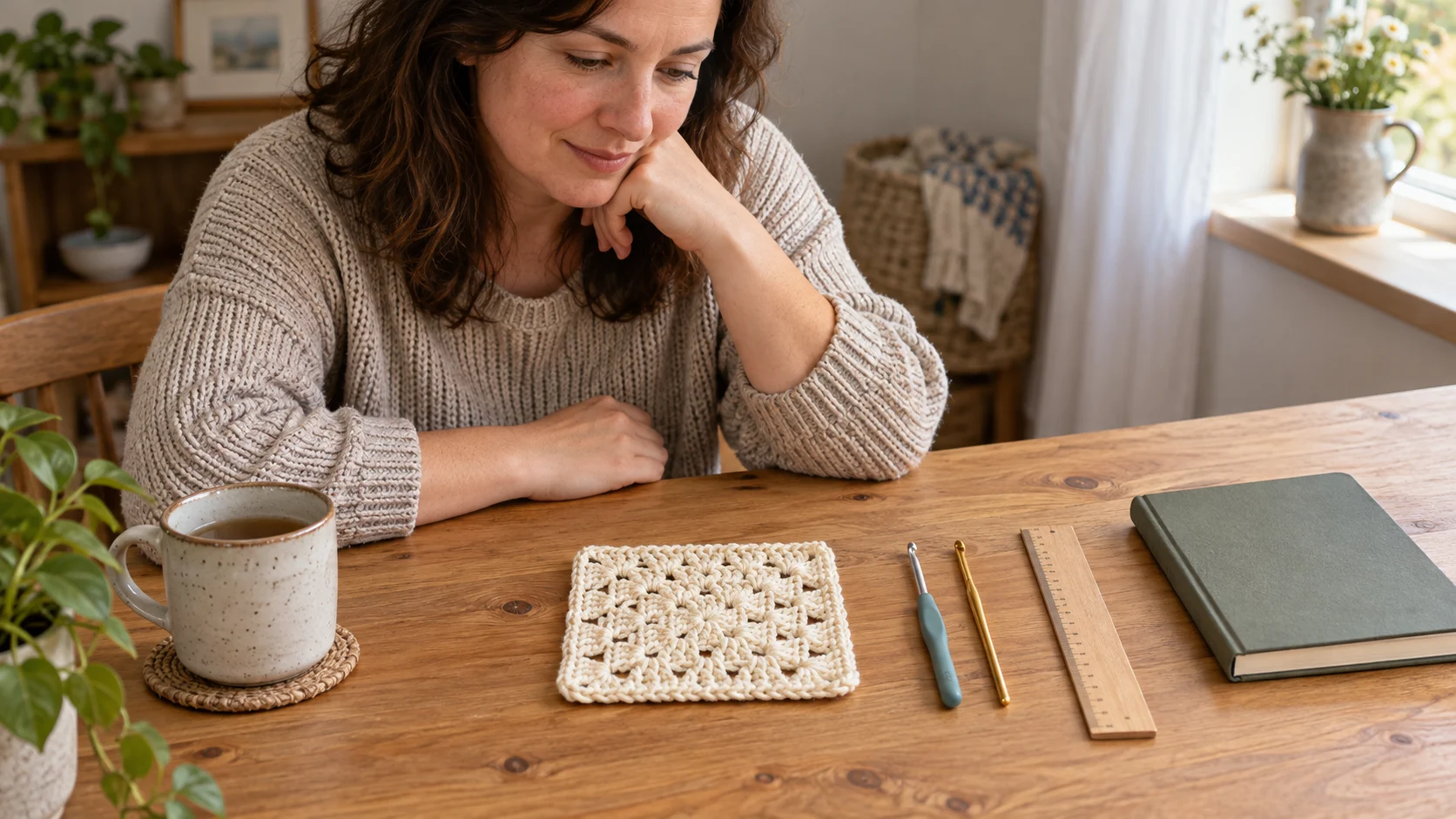
Conceptual crochet gauge matches width but not height scene with a whole generic fabric sample, two hooks and a ruler; no exact pattern, gauge, measurement or fit result is demonstrated.